4 Tips for Digital Mindfulness at Work

In this post, I outline some steps we can all take to be more mindful regarding the use of work laptops, phones, and messaging programs when we’re supposed to be enjoying some “downtime”.


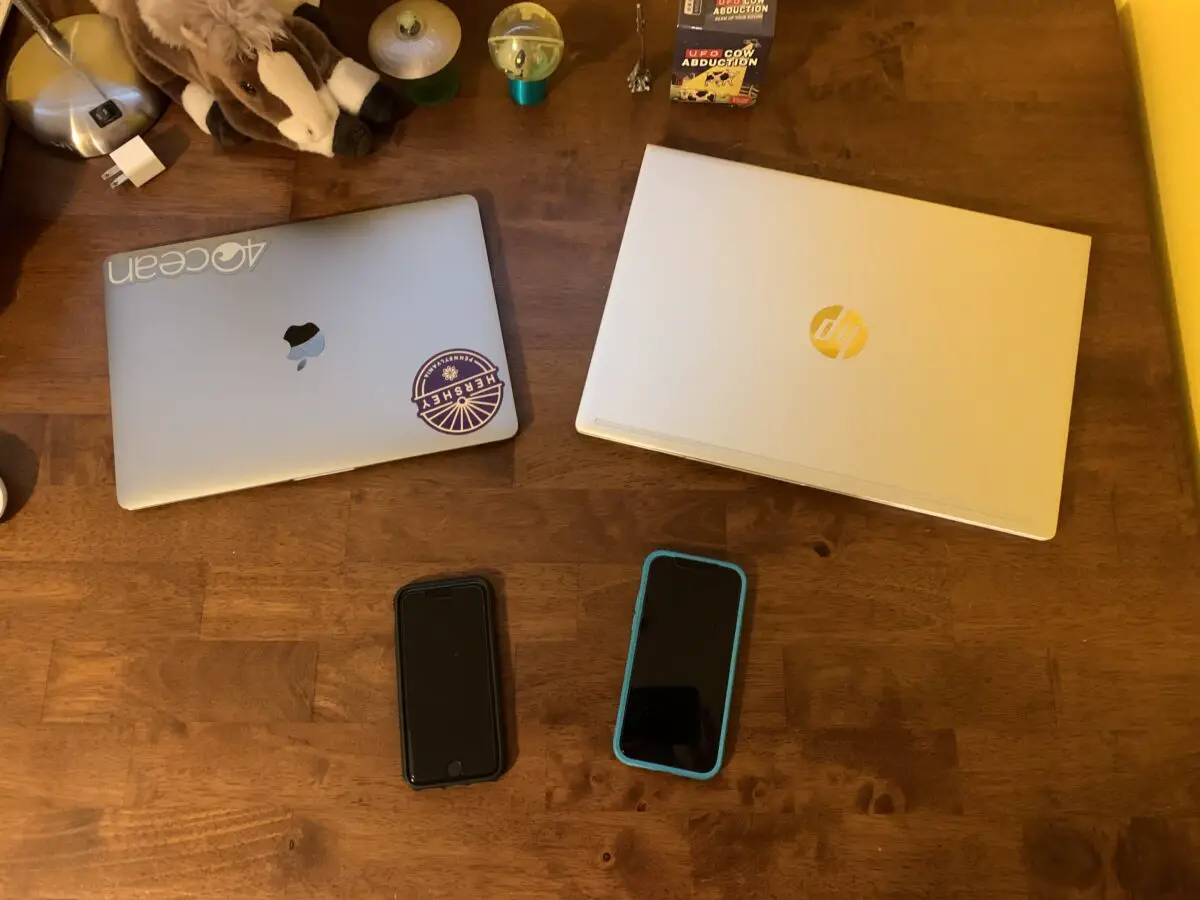
I started a new (more normal) job a few years ago after COVID pretty much killed my freelance career. 😝  I still work from home a lot but I also visit with clients out in the community.  Because of this, I now have two laptops and two phones (one each for work and personal use).  As you may imagine, this does not lend itself to tranquility, peace, or a dearth of technology in my life. 

I’ve felt like the old grandma at work, trying to figure out her grandkids new-fangled technology. 😝  I actually did this same job 10 years ago but back then all I had was a Word document, a flip phone, and a laptop. (It took real effort to locate a WiFi signal anywhere away from the office back then, and there were no hotspots on my flip phones!)  Today, almost everything is web-based.  While this makes things far more convenient (and saves trees, a definite plus!) it also means there are countless more assessments and paperwork items that are screaming for my attention at all times.

All of this runs completely counter to the mindfulness principles so many of us work so hard to maintain in our lives.  We want to be Present in the current moment…we strive to focus our mental energy on one task at a time…and then we’re slammed by multiple devices pinging and dinging with alerts like “you’ve got mail!”, “someone’s calling!”, or “your next meeting starts in 15 minutes!”  It’s EXHAUSTING!

So, how do we use these devices as tools to help make our work-life run efficiently, so we can focus our mental and physical energy on what is most important, thereby leaving LOTS of time to live life?  Read on for the Tranquil Trekker’s tips for digital mindfulness at work! 

Author’s Note:  My intent with this post is NOT to complain about my new job.  Having a work phone and laptop actually makes a lot of sense with the work I do.  My home IS my office.  Also, since my job is fairly mobile, it only makes sense that my work is mobile too.  I also VERY MUCH appreciate that my company has provided me with work devices as I DON’T want to have to use my own. 😝  

And bottom line, SO MANY people are in this same boat.  Having multiple devices is really just becoming the new normal (especially with the popularity of flexible work options and the rise in work-from-home due to COVID.)  My goal with this post is to encourage people to view these devices as necessary evils and to help them figure out how to use them as beneficial tools without allowing them to take over our lives.

Compartmentalize your Work Devices

Compartmentalize with your work laptop, phone, and any messaging apps if at all possible.  You can accomplish this by only having these work-related programs on your work devices.  Also, be sure to turn these off at the end of every day and on your days off if possible (I realize this isn’t always an option if you are on-call).

If you feel this isn’t an option in your case, my question would be, are you actually on-call?  If not, is there truly an expectation that you respond to calls, emails, or messages during off-hours?  To put it bluntly, are you actually jeopardizing your job (or future promotional opportunities) if you don’t respond promptly?  Or, is this a self-imposed prison?  Is it not actually necessary for you to be available at all times but do you feel like you should be?

Many people have their work email come to their personal phone (even though oftentimes this is voluntary, and is NOT required by their job).  I think they’re nuts, personally 😉, but I also can’t help but feel a bit sad for them.  They need (and deserve) a break and I just don’t see how this practice achieves that for them.

So my advice is to talk to your boss.  Get a clear understanding of what the expectations really are.  If the presumption is that you be readily available during off-hours, then you’ll have to decide for yourself if that’s the work environment you want.  Just know that studies show you’ll be a better employee if you have true downtime. (Don’t take my word for it, you can read about some of them below! 😉)  And if you’re the boss, check out the links and please, don’t be an a-hole! 😇)

Harvard Business Review–The Upside of Downtime  
Forbes–Downtime is Important!

Multitasking Makes you Less Productive

In addition to compartmentalizing your work devices, the studies linked below also show that contrary to popular office belief, multitasking DOES NOT work, and it actually DAMAGES your productivity! 😮

Forbes: Multitasking is Bad for You!
Cleveland Clinic:  Multitasking Doesn’t Work
Forbes:  Multitasking Hurts Productivity

Multitasking is almost NEVER a mindful practice, as mindfulness requires you to put your full mental energy and focus into ONE task at a time.  As an example, think about taking a work call while driving (we’re going to assume you’re using hand’s-free devices.)  If you’re paying attention to driving (which you should be) you CAN’T be putting all your mental energy and concentration toward the phone call you’re having.  And if you’re aren’t focusing on the phone call whatever/whomever you’re trying to serve with that call won’t be getting your best effort.  Also, you can’t take notes while driving, or look things up on your computer or phone as you may need to. (I would also ask, how do you pay close attention to driving if you’re distracted by a call?)  So all this multitasking scenario succeeds in is making you less of a safe driver while also providing lousier service to your job task at hand.  It’s a lose-lose situation!

Prioritize Downtime

Now that I’m back to working more like a normal person, there is nothing better than 5:00 on a Friday, when I log out of my work email, turn my work phone off, close my work laptop, and put all of them (screen down) in the office, not to be looked at for the next several days.  I think it’s important that we have that break whenever/wherever we can take it.

That break is important for our mental health and it makes us better workers.  It gives us a chance to recharge mentally and physically so we have more mental energy to face the challenges of the job when the next work week comes.  I worry this appreciation for the benefits of downtime is something that’s gotten lost in recent years, in our always-on society.

Find Unique Places to Work

This one may be difficult for some people.  Depending on the type of work you do you may need to be in front of a video monitor often.  Or you may do highly technical work that requires you to be tied down to some sort of office environment.  But for many of us, one of the joys of flexible work situations is that you can pick where you want to actually work.  So don’t limit yourself to being locked in your home office, the basement, the second bedroom, or wherever you usually work from.  If it’s a nice day and you have the internet access you need, work from the front porch or the back deck.  Go sit at a local park, beach, or other green/blue spaces.  If the Great Outdoors isn’t really your thing, go to a local coffee shop.

Obviously, make certain you are still ensuring all necessary confidentiality your job may require.  Use screen protectors so others can’t read your screen, talk quietly if you’re on the phone or seek out private places to talk, or use headphones if you’re in a meeting or a training session (anyone sitting within earshot will appreciate this anyway!)

To Conclude:

This is somewhat of a complex subject as our jobs all vary so greatly in terms of the circumstances that surround them, what our supervisors may require, the security necessary to protect the information we work with, and the practicality of how our jobs function.  I just want us all to “think outside the box” when it comes to flexible work options. 

One of the best things about these work options is they allow us to get out of the office and better fit our work into the lives we live.  So take advantage of this!  Set boundaries for when and how you use your work devices.  Recognize that while multitasking may make you FEEL more productive, in all likelihood it’s probably, actually hurting your productivity.  This isn’t good for your company or the clients you serve.

Also, remember to prioritize your self-care.  If you aren’t in a good place it will be almost impossible for you to put your best foot forward in terms of the work you do.  Part of this self-care means making your work environment the most pleasurable it can be (while staying within the confines of what is required for your job, of course). 

So, the next time you go to grab your work laptop or phone on your “off” hours ask yourself, “Is this really what’s best for me, my client, or my company?” If the answer is likely “no” go do something enjoyable instead!

Do you have any tips for keeping a healthy balance between work and home when your digital, work devices follow you home?  Tell me about them in the comments!


Did you enjoy this post?  Pin it!
Two laptops and two cell phones, all sitting on a desk. Pin reads, "Tips for Digital Mindfulness at Work"


Like what you read here today?  Please feel free to leave a comment, like or share this post!  Add your email at the bottom of the page, or the sidebar to the right, to be notified when a new post is published.  By signing up for the email list, you will also receive a free copy of the Tranquil Trekker’s Top 10 Tips of Trekking Do’s and Don’ts!

You can also follow the blog on social media by clicking the links below!

Facebook

Twitter

Instagram

Pinterest

Mindful Thoughts on COVID

In this post, I look back COVID, from my perspective.


In the spring of 2020, the world ended (metaphorically speaking)…it still feels surreal…COVID…I feel like it became a punchline…of the worst joke EVER! 😝  So many people lost income and jobs to the Pandemic (I did), and so many lost their livelihoods.  So many people had their lives abruptly changed and for some things may never fully return to normal…

We were lucky out here in South Dakota.  We never had any real, state-wide mandates (masks or otherwise).  Most people were good about wearing masks during the height of the Pandemic.  (You still see people wearing them occasionally.  I still wear them frequently for work but that’s because I work with people who are very high risk who also live and spend time in community settings.)

I am still awed at how a minuscule event in one corner of the world could shut the entire globe down…

The majority of the US population now has COVID antibodies (whether through vaccines, natural immunity, or both)

They say that as much as 95% of Americans now have COVID antibodies, whether that be from the vaccines, natural immunity, or both.  If I NEVER hear the words “herd immunity” again, it will be too soon! 😤 *sigh*

Mr. Trekker and I have both 😝

Mr. Trekker and I stayed healthy for a long time!  We both received our 3rd round of COVID shots in late 2021…and then we both got COVID (probably Omicron) in early January 2022.

I got it from him, we have no idea how he got it. 😝 

We didn’t have it too bad, it mostly felt like a bad sinus infection/cold. Interestingly enough, between the two of us, we were more worried about me getting it because I have mild asthma.  As it turned out, I hardly had a cough at all, while Mr. Trekker ended up with a mild cough for several weeks afterward…this virus is weird!

I also ended up with mild pinkeye as a side effect of my first round with COVID (apparently that isn’t too unusual with viruses.)  Since then, my eyes have become INCREDIBLY sensitive.  They’ve always been that way but now, if they get dry from dust or wind, or if I am near any food that could be considered even the teeniest bit spicey, my eyes will begin to burn and water horribly (like to the point where I can’t see out of them. 😝)  This is especially true in my right eye which is also the one that had the worse pink eye symptoms.

Then in June 2022, we both got it again…

This time, I’m pretty sure I got it from a client (even though we were sitting outside and she wasn’t symptomatic at the time.)

I then proceeded to pass it on to Mr. Trekker and MommaTrekker. 😔

We were really worried about her as she’s over 70 and has several pre-existing conditions. She had just had a booster a few weeks before though and honestly faired better than either of us! 

This time it didn’t last as long and the symptoms weren’t as severe. Unfortunately, we both ended up with a cough that lasted WEEKS and more lasting Long COVID symptoms from this round–mostly brain fog and memory issues.

Again…*sigh*

I HATE this virus! 😡

Mindfulness in the Midst of a Worldwide Pandemic

I try and keep a somewhat positive outlook on the whole experience by being mindful of how the pandemic ACTUALLY played out vs. how the experts feared it might end up.

There were more than one million deaths in the US from COVID-19, and millions more worldwide, and to be clear, EVERY. SINGLE. ONE. of these was awful!  However, when the whole mess started the experts were projecting more than two million deaths in the US alone, before the end of 2020, and that was with social distancing protocols being implemented.

I don’t mean to make light of the tragic losses that did occur, but this FAR lower statistic is a pretty amazing feat!  It is a testament to the scientists, researchers, medical professionals, and technology we have available to us at this point in history!  If this awful virus had come around 100 years ago or more, billions could have died! (Think the Spanish Flu.)

Valid Emotions During Crisis Situations:

We all experience and respond to crises differently but I think it’s important to acknowledge that whatever feelings you had regarding COVID were valid.  We should be mindful of how we express them but don’t run from these emotions (be they positive or negative).  Accept them and acknowledge they exist (because they will whether you fight them or not).  We must allow ourselves to feel whatever it is we need to.  Below are some emotions I experienced throughout COVID:

Anger About the Pandemic:

Hoarding: Many people seemed to think only of themselves and didn’t save enough products for others (some who were seniors or the immune-compromised who really shouldn’t have been going out).  If you aren’t the Duggars, or you aren’t buying toilet paper for multiple families, you don’t need to hoard! 😡 

On the other hand, we were told not to hoard, but then the CDC and other emergency preparedness groups came out and said to have up to a month’s supply of food on hand…what were we supposed to do with those two bits of contradictory information? 🤷

Leave people alone!: I never understood many peoples’ desires to comment on the choices of others.  I’ve said before on several occasions that I lean Libertarian so I’m pretty big on people being left alone to make their own choices.  However, I do understand in crisis situations when at least local governments may need to implement certain restrictions in the interest of Public Health.

More so than that though, I don’t understand peoples’ need to criticize others for wearing a mask or being careful when the general public is no longer being forced to.  You have no idea what a person’s situation is. Just because they wear a mask doesn’t necessarily mean they’re “living in fear” (and if they are, so what, how does that affect you?)  They may be immunocompromised (or be caring/living with someone who is.)

There was a point, several years into the pandemic, where I was preparing for–and recovering from–MAJOR abdominal surgery that required a multi-day hospital stay.  I wore masks for WEEKS in public around that time.  It wasn’t that I was “scared” per se, but I did NOT want to get sick with ANYTHING!  It could have led to my surgery being delayed, my getting horrifically ill, or serious complications after surgery due to violent coughing/sneezing/vomiting. 

So, why not just leave people alone to do what they feel is best for them? (And you can do the same for yourself?)

The Media:  I often felt a sense of rage at the news media.  I’ve distrusted them in the past but after COVID I’ve become completely jaded–regarding the virus and most other news-worthy issues.  They seemed to mislead at every turn if it could cause controversy. (I probably shouldn’t be surprised anymore but I still am at points.)

I’d read a clickbait headline that makes one claim and then goes on to almost disprove itself if you read the actual text of the article, or watch the entirety of the video clip they referenced in the article.  They weren’t openly lying, because there was a semblance of truth in what they said, but their claim was so far from the truth that it may as well have been a lie with the message they were proclaiming to the masses (and for the record, I don’t care which news source is your favorite, I’ve seen ALL of them do this.)

They seemed to take pleasure in reporting bad news and stirring people up.  They didn’t take the time to fully research information, that would apparently have taken too long. 🙄  It seemed to be more important that they were “the first” to break a story.  The really shameful thing was, that I don’t believe they cared.  They just went happily along reporting bad news every chance they got because it may have helped a reporter’s career or a certain company’s reputation.

Depression and Anxiety over COVID:

Anyone who reads this blog regularly knows I already struggle with anxiety (which obviously, COVID caused for many of us.)  One symptom of anxiety is catastrophizing.  This means your mind automatically jumps to worrying about the worst-case scenario and that was SO EASY to do during COVID.

I believe I’m technically an optimist at heart.  I try to focus on the positive (although I worry about the worst-case scenario, of course, especially with my anxiety).  But it just felt like, during the Pandemic, that so many only wanted to focus on the worst thing that could happen and they wanted to scream that to the world.  Why?  Why do we seem to focus on things that make ourselves and others miserable?

We need to rely on Logic, not Emotion during these difficult situations!  I believe we have to be calm and logical when dealing with times like these.  I don’t mean to sound snarky, but why can’t people stay rational when things get difficult without immediately jumping to APOCOLYPSE?!  It feels like they’re pouring salt into an already raw, gaping wound…

COVID may be with us for a while…

The COVID pandemic isn’t over yet, unfortunately.  I’m starting to think it will NEVER be “fully” over, at least not for the next few decades.  I hold out hope that we’ll be able to remain living relatively normal lives, but now I fear that regular vaccines (and perhaps even regular–hopefully mild–infections) are going to remain a part of “normal” life. 😕  

At one time I was hopeful that we were on our way out of this mess.  Now that I’ve done everything right (at least regarding getting my vaccines) and we STILL got COVID (TWICE!)–AND we’ve got Long-COVID symptoms I’m more skeptical…

I believe in science. I believe it’s very possible the reason neither of the Trekkers got all that sick from this potentially deadly disease was due to our vaccines.  I also believe the reason none of our parents have gotten very ill from COVID is due to vaccines.  And I am VERY thankful for these! 

But when we got sick 1 MONTH after getting our boosters I just felt…DONE.  I think, at that moment, I just gave up.  It’s here, it isn’t going away, and we have to learn to live with it….THE END. 😪

I understand the vaccines probably worked as intended and those in our families who have had COVID while vaccinated came through relatively unscathed.  But we still got it, and I’m assuming if another variant (maybe one not related to Omicron) develops, we will likely be at risk of at least mild disease from that.  So, this is our “new normal”. 

We will probably have at least annual vaccines with the threat of at least occasional, mild illness always looming…possibly for the rest of our lives…it sucks but I just feel like that’s what we have to adjust to and accept for the foreseeable future. *sigh*–again!

Searching for Hope and Encouragement in Crisis Situations

I have to end this post on a good note, right?

I can’t help it.  Even with my learned helplessness after years of being beaten down by COVID, I still feel a glimmer of hope.

COVID was a unique time in our lives.  Many of us have never experienced something like this before.  As a (very OLD) Millenial, the only country-wide crisis I’ve really had to deal with was the September 11th terrorist attacks.

I grew up hearing stories about my grandparents’ generation dealing with World War II, the rationing of meat, the transitioning of factories to make equipment for the military, and the various drives people engaged in at home for the “war effort”.  I always wondered what it would be like to be able to do something like that to help your country.  Now I know…

Through all this, I’ve been reminded that there is a lot of good in the world, and times like these are when it really shows.

A lot of good things DID happen!  Vaccines were produced in an unheard-of, record time.  So many people bound together to help each other get through this crisis, from wearing masks and social distancing in public to those who volunteered their time to make masks for local schools and hospitals.  Others ran errands for people who felt they couldn’t go out.  Some small businesses transitioned to help their local communities (like distilleries that stopped producing alcohol and started producing hand sanitizer instead.)

I think a lot of the world’s goodness was shown throughout COVID.  I know I’ve learned a lot, both about myself and also about the reality of country-wide/worldwide crises:  how they proceed, how people react to them, the good and the bad.

So there are things to be hopeful about regarding COVID!

What did the COVID crisis feel like to you?  What POSITIVE things did you see during this time of crisis?  Share your experiences in the comments!


Like what you read here today?  Please feel free to leave a comment, like or share this post!  Add your email at the bottom of the page, or the sidebar to the right, to be notified when a new post is published.  By signing up for the email list, you will also receive a free copy of the Tranquil Trekker’s Top 10 Tips of Trekking Do’s and Don’ts!

You can also follow the blog on social media by clicking the links below!

Facebook

Twitter

Instagram

Pinterest


Spring Forward: Daylight Saving Time

In this post, I discuss how my SAD symptoms decrease with the time change.


It’s that time of year again!  We push our clocks forward one hour this weekend (in the US at least)!  I know people hate the time change and I know many people have good reasons for feeling that way. (It has even been proven to mess up your sleep.)  I actually love time change day (in the spring)!  It is the day my SAD (Seasonal Affective Disorder) dies ya’ll!  

For those of us in the Northern Plains, the time change really does make the best use of our daylight hours that fluctuate wildly throughout the year.  If we stayed on Standard Time all year, it would start getting light at 3:30 am in the summer (no joke).  Whereas if we stayed on Daylight Time all year, it wouldn’t get light till after 8 am in the winter.  I’m not ok with either of these options.😝  So, I will firmly remain #teamtimechange.

Winter passed quickly

I am always amazed at how quickly the dark winter actually flies by.  It always goes more quickly than I think (worry) it will.  I’ve been VERY fortunate that my SAD has been super mild for the past few years.  I’ve hardly been noticing it at all!  It may be a fortunate side effect of my taking high doses of Vitamin D3 for the last several years. It helps that we’ve had fairly mild winters in recent years, too.

Other Vitamin D3 options:  Nature’s Bounty, Nature Made 2000 IU tablets, NOW softgels

SAD symptoms end with the time change

I am always amazed at how much better I feel once my SAD symptoms start to ebb.  It really gives you an appreciation for how strongly they affect your life.  You don’t always notice it while you’re experiencing them.  You know that everyone seems to be keen to IRRITATE THE HELL OUT OF YOU! (must they swallow so loudly?! 😂)  And you can’t help the tears that come when EVERYTHING YOU TRY TO DO FAILS MISERABLY!!! (Why am I the only one whose life is so difficult?! 🙄😉)

I hope it’s obvious that I’m being sarcastic with these statements.  In all seriousness though, I find it amazing how my SAD symptoms cast a shadow on every other aspect of my life.  Even though I personally experience it, it’s hard to believe it can cloud your judgment so much on whatever thing you’re dealing with at any given moment.   Every problem seems 10x worse when SAD is already weighing you down.  Any other stressor you feel is amplified. 

As someone who struggles with anxiety throughout the year, the SAD worsens those symptoms, as well.  I am a master champion at catastrophizing future events that I’m worried about on a good day.  When I’m dealing with SAD, as well, that ability becomes a superpower. 🙄😝

Every fall I swear, I’m not going to let SAD affect me as much this year.  I know what’s coming, I know how to deal with it, I know it WILL END, I just have to get through it…and then every spring I’m back to, “Wow!  Was all that extra angst I was feeling JUST from my SAD?”  Maybe someday I will learn. 😐

Related posts: Summer Solstice: The Longest Day; Therapy Lamp and Calm App Reviews; I HATE Seasonal Depression!Enjoying the Winter Solstice; Increasing Daylight as Winter Wains

Take back your power from SAD

Our brains are powerful tools, and they can allow our imaginations to run away with themselves if we permit them.  While its important to always be patient and understanding with ourselves, it’s also important to try to reign in the negative thoughts, especially when we can speak the name of the demon they come from (“SAD”).  By doing so we can help to lessen its control over us.  Fortunately, we CAN control that demon, and it’s time to take our power back!

Do you find the time change affects your mood?  Tell me about it in the comments!

Did you enjoy this post?  Pin it!

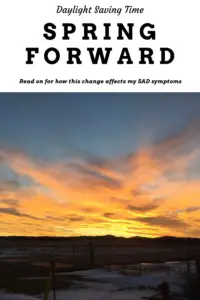
Orange sunrise over a meadow with a silouette of mountains in the background. Pin reads, "Daylight Saving Time Spring Forward Read on for how this change affects my SAD symptoms"


Like what you read here today?  Please feel free to leave a comment, like or share this post!  Add your email at the bottom of the page, or the sidebar to the right, to be notified when a new post is published.  By signing up for the email list, you will also receive a free copy of the Tranquil Trekker’s Top 10 Tips of Trekking Do’s and Don’ts!

You can also follow the blog on social media by clicking the links below!
Facebook

Twitter

Instagram

Pinterest

Stay Mindful by Using a Smartphone Purposefully

In this post, I discuss ways to lead a more mindful lifestyle by using technology as a tool rather than as entertainment.


Mr. Trekker and I are pretty good about not being glued to our phones.  We have a standing rule at our house that there are no phones at the dinner table (with the exception of emergencies/family situations or, sometimes, when making travel plans on the run).

We’ve actually had strangers comment to us (in a good way) how unusual it is to see two people sitting together at a restaurant just talking to each other, with neither of us being on our phones.  They always seem so impressed.  I hope, by this small act, I can inspire other people to use their smartphones purposefully, as well.

My Week Without a Smartphone

A while back, I lost the use of my phone for almost a week. 😮   I was reminded of what life was like before we all had computers at our fingertips at all times. 🙄

It was due to this weird situation where Verizon pushed an update through and that basically “broke” my cellular ability.  So I could use apps when I was connected to a WiFi network, but that was it.  I couldn’t make any phone calls AT ALL (which is ironic since wasn’t that the whole point of having phones to begin with?!)  After troubleshooting several things I decided that my phone was shot.

Fortunately, I have a warranty so I was able to get a free replacement from Apple.  It was the same, old model I already had, and it had a crappy camera that took pictures with pink backgrounds 🙄  but at least it worked.  I didn’t want to spend the money on a whole new phone at the time (we had literally just bought one for Mr. Trekker a few weeks before) so this was a good enough replacement.

On a personal note, my local Verizon store was FAR more helpful in dealing with this issue than Apple was over the phone. (The nearest Apple store is almost 400 miles away, in Denver).  I’ve had good luck with Apple customer service in the past, but the Verizon store won this round!  Apple seemed somewhat confused as to what exactly was wrong with the phone.  Even though they told me not to bother with the local store because “the carriers don’t deal with this issue” Verizon was able to understand my problem and diagnose it almost immediately.  This potentially saved me $100’s in replacement costs!

Remember the days before Smartphones?

It was weird to be thrown back to a life without a smartphone.  I appreciated the break from the constant temptation to check social media or email while doing mundane things like standing in line at the store.

I did feel very isolated though, and cut off from the world.  I could contact people via Facebook Messenger if I had a WiFi signal, but I couldn’t text.  We haven’t had a landline phone in over a decade so, even at home, I realized I had no way to make a call to 911 if it was needed (fortunately it wasn’t).  It was humbling and frustrating.

Part of me would love to throw all this tech garbage away and just go back to an old-fashioned “dumb” phone.  I used to love my old flip phones, where I could send a quick text message or write a simple note to myself.  I could even take the occasional picture (if it was REALLY important because they were EXPENSIVE!)

I could *gasp!* call someone (or have them call me) if we needed to get in touch.  I really miss those simple days, they feel so 2006-ish! (Yeah, I didn’t get a cell phone of any kind until after I graduated college in 2005, told ya I was old-school! 😉)

How to Use a Smartphone Mindfully

Smartphones do have their benefits.  They’re pretty handy when I’m away from my computer and need to make an update to my blog or handle other work-related business.  A portion of my livelihood is made via the internet so having access to my blog, social media, and email (let alone old-school phone calls) from almost anywhere means I can be far more productive with my freelance work (and it gives me far more freedom to be away from home–the office).

I read the book Digital Minimalism, by Cal Newport, recently as research for another project I’m working on.  It was a very interesting read!  I’d recommend this for anyone who feels technology has too much control over their life.

In the book, he stresses using technology, such as phones and social media, as minimally as possible to pursue more fulfilling things in life.  I don’t feel like I struggle as much as many of the people he discusses in the book, so I didn’t feel the need to implement all of his strategies.  However, the book did help me to structure my free time better and prioritize things I really care about.

I pride myself on not being a technophile, but this book really brought home to me the importance of using technology as a tool rather than as a device for entertainment. (It made me think we should view it almost like a pen or a drill, that is needed solely to complete a task.)

As an example, rather than scrolling through my Twitter or Facebook feed, I strive to only check a few, individual people who I follow.  This helps me stay up-to-date with family and friends who live far away.  I also check a few, specific, news sites so that I remain in-the-know on current events.

There are also a few, individual groups that I am a part of that help me to achieve my blogging and writing goals (I rank these under Professional Development).  That’s it.  If I’m not using my phone or social media for those purposes, I try not to use it at all.

There are always other free-time options to pursue.  I’ve got a stack of books I’m working my way through, I’m also still enjoying the Star Wars, adult coloring book Mr. Trekker got me for Christmas several years ago, and I’ve got other projects to keep me busy.

Our lives are hectic enough!  I challenge you to look for ways to reduce your smartphone use.  Maybe instead you could interact with some flesh-and-blood humans 😉; take a walk, read a book, or go throw a baseball with your kiddo (or a tennis ball for your pup!)  Let’s try to be more mindful and purposeful when using our smartphones!

What do you think?  Have you seen any benefit from being more mindful with the use of your phone?  Let me know in the comments!


Did you enjoy this post?  Pin it!

Do you find yourself constantly reaching for your phone? Read on for ways to be more mindful and use your smartphone purposefully.


Like what you read here today?  Please feel free to leave a comment, like or share this post!  Add your email at the bottom of the page, or the sidebar to the right, to be notified when a new post is published.  By signing up for the email list, you will also receive a free copy of the Tranquil Trekker’s Top 10 Tips of Trekking Do’s and Don’ts!

You can also follow the blog on social media by clicking the links below!
Facebook

Twitter

Instagram

Pinterest

Just Groovin’: 5 tips for Using Mindfulness to Lower Anxiety

I find myself stressed, many days, over the simple tasks of daily life. Read on for how I’m striving to reduce this, and ways you can too!


I find myself feeling anxious over dealing with day-to-day items and stressors.  I know this isn’t healthy for me mentally or physically.  I want to be more Present and live in the current moment.  So, I’ve set the goal for myself to use mindfulness practices to help lessen my anxiety levels.

I Feel Anxious Every Day

I think the anxiety stems partially from the less-than-regular, work-from-home lifestyle that I mentioned in a previous post.  My days offer incredible flexibility, but the lack of routine can make life feel chaotic.  I think the stress is also due, in part, to the general anxiety I deal with on a daily basis.  I just have a tendency to worry about things in the future.

I think many people struggle with this.  We worry about situations from daily life; we worry about interactions or disagreements that occur in our family, friend or work groups; we worry about the health of people we care about.  Basically, we just worry a lot!  Often times there’s nothing particularly awful occurring, these are just the situations we encounter over the course of life for any given day, week or month.  These are normal things to concern ourselves with, but what can we do to ease the strain caused by that constant level of stress?

How I Lessen Anxiety with Mindfulness

I’m striving to implement a “Just Groovin'” mindset†.  Read on for tips on how to use this to reduce your levels of anxiety and to live in the moment…

†You may remember this from a previous post, where I discussed us visiting a great BBQ spot in Marble, Colorado.  It was called Slow Groovin’ BBQ, but their message was basically to just take time to enjoy the simple things in life.  The Trekkers have made this into a personal, family motto of sorts, though we edited the name to “Just Groovin’!” 

5 Tips to “Just Groove”:  Using Mindfulness to Live in the Moment and Reduce Stress:

1)  Stop Catastrophizing! 

This is a therapeutic term that basically means, don’t imagine what horrible things can go wrong in a situation when it hasn’t even happened yet, or you don’t even have all the details regarding it yet. 

This is something I struggle with regularly.  I am striving to not worry about *insert-situation-here* until it actually happens.  Usually, things play out better than I imagined they would anyway. 

Often, I build up all this angst around an impending event and then it ends up proceeding far more smoothly (and often more quickly) than I had anticipated.  Then I’m left with this surplus of negative energy that had been consuming me that, as it turns out, was completely unnecessary.  Now I have no way to release that pent-up strain, so it is just added to my ongoing stress load. 

Instead, I want to “just groove” through life, to just deal with things when and if they happen.  

2)  Don’t Stress Yourself Out Over Everyday Tasks:

I have this habit of rushing to get everything that’s on my To-Do list for that day, or week (or month) done as efficiently as possible.  While it’s good to not procrastinate when necessary tasks need to be completed, it’s also good to implement productive, time-management practices. 

We shouldn’t let ourselves get stressed out about these things.  That causes unnecessary mental and physical tension.  Again, I am usually able to complete all the to-do items that day (or at the very least that week or month) and it often takes less time than I thought it would.  So then I am stressed out, and for what?  Time and again, the list has been completed (usually more easily and more quickly than I anticipated), and all I’m left with is a further build-up of negative energy that I now struggle to relieve.

Are you seeing a pattern here? 😋  This compounding of stress just further contributes to the unnecessary tension we feel in our daily lives. 🤯  Ugh!  This is why anxiety is so mentally exhausting!

3)  Stop Stressing About the Future: 

We need to remove the word “might” from our vocabulary.  People with anxiety are always worried about what “might” happen in the future.  “My boss MIGHT yell at me when he calls me into the office; those routine tests at the doctor MIGHT show something bad…”  Let’s stop with the “might”! 

There’s only so much we can control in life.  Matthew 6:34 says, “Therefore do not worry about tomorrow, for tomorrow will worry about itself. Each day has enough trouble of its own.”  Not everyone is big on the Bible, but I think this is some advice that can benefit all people, whether they are religious or not.  We need to stop worrying about what “might” come tomorrow, next week, next month or next year.  Because these things are only MIGHTS, they aren’t actually occurring yet, and we can’t deal with them until they happen.  So, let’s be mindful, live in the present, and expend our precious, mental energy on what is actually occurring RIGHT NOW!

4)  Don’t Miss Out on Today’s Joys by Worrying About Tomorrow:

Not all stress comes from negative events.  We have a tendency to want to rush through life so that we can get to the good stuff, though that may mean we don’t fully experience or appreciate the simpler, everyday nuggets we encounter along the way. 

A famous philosopher once described this problem in his young apprentice, “all his life he has looked away to the future…to the horizon…never his mind on where he was…what he was doing…” (If you’re imagining a small, elderly, goblin-looking creature, talking about Luke Skywalker…you’d be correct.  Hey, Yoda was sort of like a philosopher!  I’m a Star Wars nerd and I’m not sorry. 😉)

It’s good to enjoy the fun and exciting parts of life.  But the humble joys of our daily existence are important too.  Things like watching your children play on the playground, having a talk on the swing with an aging parent or pulling off the side of the road just to watch a particularly, stunning sunset.  In the end, these nuggets are what we experience most often and they are what we’ll remember in the long run.  These are the little things that make life worth living.

5)  Just Groove! 

My ongoing life goal that I’m continuously striving toward is to learn to just “go with the flow”.  I will strive to not allow myself to be anxious about things unless I KNOW that there is something to be anxious about. 

You may be thinking, “ever thought of trying some meds?”  Anti-anxiety medication is always an option, of course (full disclosure, I do use it, occasionally, on days that feel particularly stressful).  But I don’t want to have to rely on it for the rest of my–hopefully lengthy–lifetime.  I don’t want to need it just to get me through the normal pressures of daily existence.  It seems to me, being that most of us live in a time and place where the quality of life is about the best it’s ever been, throughout the entire course of human history, that I don’t have any excuse to build up so much stress over just getting through the day. 

This is where the concept of “Just Groovin'” comes in.  Basically, it means, take life as it comes.  I am striving to embrace mindful minimalism, and only concern myself with problems as they present themselves (rather than wasting mental energy to worry about them ahead of time). 

Want to join me on this quest?  Tell me in the comments about your tips for using mindfulness to lessen daily stress, and to live in the present moment!


Did you enjoy this post?  Pin it!

Photo of a river running through a canyon with rock walls on both sides and green trees and grass in the foreground. Pin reads, "5 Tips for Using Mindfulness to Lower Anxiety".


Like what you read here today?  Please feel free to leave a comment, like or share this post!  Add your email at the bottom of the page, or the sidebar to the right, to be notified when a new post is published.  By signing up for the email list, you will also receive a free copy of the Tranquil Trekker’s Top 10 Tips of Trekking Do’s and Don’ts!

You can also follow the blog on social media by clicking the links below!
Facebook

Twitter

Instagram

Pinterest

IBS: an Invisible Illness

In this post, I discuss my ongoing struggle with a chronic condition called IBS.


It starts with a characteristic *grumble–grumble* in the tummy, like you might feel when you’re getting hungry…but not quite.  It progresses to sharp pains and paralyzing cramps that can spread from your abdomen to your feet…then there’s the nausea, the cold sweats, the chills, and sometimes what feels like hours doubled over with stomach pains…and then…as quickly as it comes on, the attack is relieved…you may even feel hungry…

You just had an IBS attack!

I’ve mentioned several times that I struggle with this chronic condition, otherwise known as Irritable Bowel Syndrome.  This is a unique problem.  It isn’t considered a disease, per se, but more of a disorder.  Basically, when people suffer with IBS, it means their bowels don’t work correctly, and it isn’t understood why.  Doctors usually give you this diagnosis when they can’t find anything else wrong after other tests are completed.

Some people don’t consider IBS to be a “real” ailment at all.  I’ve heard several claim it’s the “diagnosis of doctors who are too lazy to figure out what’s really wrong with you”.  Symptoms and severity differ for each person (and what each individual suffers can vary over the course of time).  IBS is complicated. 😛

What is Irritable Bowel Syndrome?

IBS comes in three categories:  “Predominantly C”, “Predominantly D”, or an unpredictable, varying mixture of the two.  I won’t get into the dirty details, but since this syndrome focuses on the bowels, I’m sure you can figure out what the C and D stand for. 😝  I also won’t TMI you with which one I deal with, as it isn’t really relevant, and people who suffer with the disorder can switch between the types throughout their life…I did.  

I think part of the reason I struggled so much with the restrictive, low-carb diet I tried several years ago is that my IBS already limits what I can eat, so the diet just exacerbated that even more.  In addition, some “Paleo/Keto-friendly” foods aren’t well tolerated by my testy tummy (like dark chocolate, or certain types of super-fibrous veggies).  To contrast, many “naughty” foods, such as bread, my body loves. 😝 (Fortunately, my stomach will tolerate whole-grain breads, so I can compromise with those). 😀

What IBS is NOT?

As I mentioned before, IBS isn’t considered to be a disease…exactly.  It isn’t as acute as Celiac, Crohn’s or Inflammatory Bowl Disease, though the symptoms can be severe (I consider myself blessed that mine rarely are).  They don’t actually know what, exactly it is.  It isn’t an auto-immune issue, it isn’t gluten intolerance (I’ve mentioned before that my body loves whole-grain carbs, for the most part).  It isn’t caused by an allergic reaction either.  Some people with IBS can be gluten or lactose-intolerant, but those are separate issues–I am not.  For the most part, these foods don’t bother me at all, though there are one or two options in these categories that I’ve learned to stay away from.

IBS Trigger Foods

This disorder makes food choices complicated.  Symptoms, severity and food sensitivity differs from person to person, though some foods are considered “trigger foods” as they, generally, “trigger” negative responses.  These include onions and celery, though I can eat these foods if they’re dried, or well-cooked (the process must change the makeup of the foods so they are easier to digest).  I recently learned that both almond milk and apples are frequently considered to be “trigger foods”.  Nobody tell that to my stomach, as I’ve been eating both for years with no problems! 😛  Did I mention symptoms vary?   

One of my “triggers” is spices.  Not spicy food, per se, but herbs.  Because of this, I tend to eat and cook my food pretty blandly.  A perk of this, I have noticed, is that it enables me to enjoy the actual flavor of the food I’m eating, rather than whatever spice/essence has been added to it.   

Another example of how complicated IBS can be, I can drink milk and eat cheese without stomach problems (though it affects my sinuses).  But if I eat or drink things with a lot of heavy cream in them, my stomach may protest. 😛  I also have to be careful with honey.  I can eat it, but only in small amounts. 

How to treat IBS

I have seen a reduction in my symptoms in recent years.  Some of this is due to learning what my trigger foods are, and avoiding them.  I believe a lot of it is also due to reducing stress.  An example of this stress reduction reducing one of my food sensitivities is that since decreasing my stress level I can now drink orange juice.  One glass used to do me in.  Now, I happily enjoy it every morning!  I have also started a daily regimen of probiotics, which has been shown to help reduce IBS symptoms.   

I find treatments such as stress reduction and healthy bacteria to be so interesting because, clearly, this is not JUST a physiological ailment.  If my symptoms were purely based on an allergic or immune response, I should react to the same foods all the time.  Because my response to them can vary based on the presence of other stimuli, other factors must be at play. 

More and more, effective medications are being found to treat this disorder.  For now, I’ve chosen to not use them.  I’ve stated before that I’ve become disillusioned with modern society’s over-reliance on “magic pills” to fix everything.  I don’t shun modern medicine, but this is one arena where mindfulness and behavior changes can bring positive improvement, sometimes without the use of drugs at all–though the need for medication varies by person as well. (To be clear, I don’t consider a probiotic to be a “magic pill”.  Namely, because it is righting the actual issue that experts believe is playing a part in causing Irritable Bowel Syndrome, to begin with, that of inaccurate bacteria growth within the gut.)  

Gut health and IBS

The gut is known to be a common place we all hold stress.  When I’m under pressure, I regularly notice stomach cramps as I unconsciously hold tension in my abdominal muscles.  This can trigger an IBS attack.  If my body is reacting to a food I’ve eaten, there isn’t much I can do.  However, if my symptoms are due to tension (and I have learned to feel the difference) I have literally stopped an IBS episode using nothing but relaxation and deep-breathing techniques.  How empowering is it when we can see real, positive changes in our health just by changing factors that we have control over?    

A connection between IBS and anxiety?

There is a known correlation between IBS and anxiety, though it isn’t fully understood. (I hear my Research Methods prof in the back of my head right now saying, “correlation is not causation!”)  While an exact link between IBS and anxiety has not been successfully proven, it is not unusual for people who suffer from IBS to also struggle with an anxiety disorder or vice versa. 

Anyone who reads this blog regularly knows that I wrestle with both.  Researchers don’t know why this occurs, but they have some ideas: 

      • It may be that the body is lacking nutrients as IBS can cause the gut to not absorb them from food well.  More and more, problems in the gut (and subsequent nutritional deficiencies) are being linked to numerous physical and mental health issues, even if they once appeared seemingly unrelated.
      • It could also be that the stress brought about by anxiety causes changes in the gut flora, mini-muscle contractions, or a more acidic gut environment, all of which can then lead to the IBS symptoms.

Invisible Illnesses are Real

IBS is different for every person who suffers from it.  It’s complicated and it’s hard to explain.  The bottom line, this condition is a very real part of the lives of millions of people around the world, and it can hinder life greatly.  I hope, one day, they find a cure for this life-altering and chronic condition, but until they do, I hope to continue employing the methods mentioned above to decrease the severity and frequency of my symptoms.

Do you struggle with an invisible illness like IBS?  Tell me about it in the comments!


Did you enjoy this post?  Pin it!

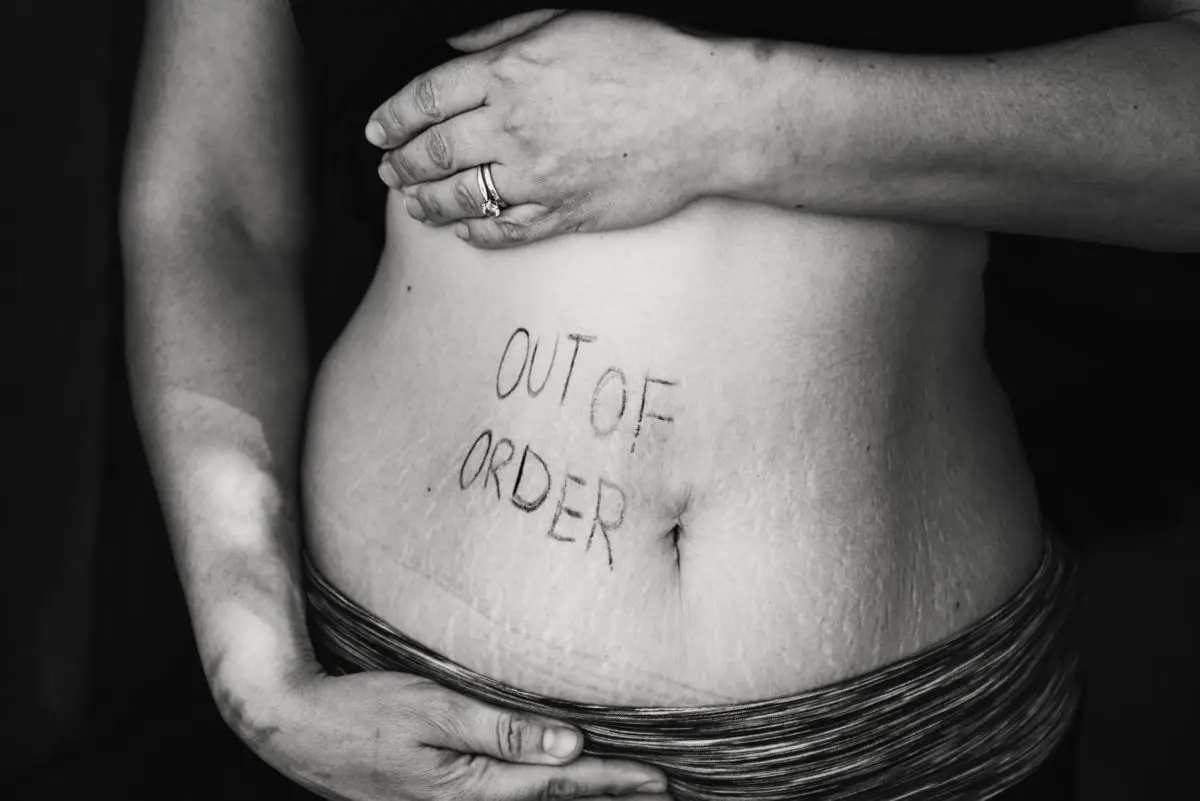
Black and white picture of a person framing their bare stomach with their hands. Words are written on the stomach that say "out of order". Pin reads, "IBS: an Invisible Illness


Like what you read here today?  Please feel free to leave a comment, like or share this post!  Add your email at the bottom of the page, or the sidebar to the right, to be notified when a new post is published.  By signing up for the email list, you will also receive a free copy of the Tranquil Trekker’s Top 10 Tips of Trekking Do’s and Don’ts!

You can also follow the blog on social media by clicking the links below!
Facebook

Twitter

Instagram

Pinterest


Summer Solstice: The Longest Day

I discuss my feelings on the longest day of the year


The Summer Solstice, also called “Midsummer”, is the longest day of the year.  Despite the name, most people don’t think of this date as the middle of summer (especially in parts of the country like the Black Hills where it isn’t unusual to see snowfall well into May! 😮)  The calendar says today is the first, official day of the warm season, though that doesn’t feel quite right either since many of us have been enjoying warm weather for a while now…

Reflecting on the Summer Solstice

Today is always a day of reflection for me…

I’ve written extensively about my struggle with SAD (Seasonal Affective Disorder) during the winter months.  I’ve also discussed how I look forward to the Winter Solstice because our waning daylight finally begins its triumphant return after the shortest day of the year.  Ironically the opposite extreme, the Summer Solstice, always makes me a little sad.

While I don’t struggle with SAD symptoms this time of the year, today is always a bit of a “downer” for me.  Don’t get me wrong, I FULLY appreciate the more than 15 hours of sunshine we enjoy in the Northern Plains this time of year. 😎  But I will miss the sun, that bright companion that makes even the most difficult of days just a bit more cheerful.

Now that our daylight will be slowly decreasing, I won’t miss getting woken up at 4:00 every morning. My body is VERY sensitive to daylight so, if it’s light out, I’m awake. 😛 (This is especially troublesome when you have a bedroom that faces east).  It got so troublesome I had to start wearing a sleeping mask to block out the daylight. 😝  It can also be a struggle to go to bed at a decent time when it stays light and warm out till almost 10 pm, and I need to get to sleep because my body is gonna wake me up again at 4! 😛 

On this, the day of the year with the longest amount of daylight, I enjoy sitting on the back deck in the early morning, watching the sunrise, before the sounds of children playing outside and neighbors mowing their lawns takes over.  The combination of the leafy and pine-needled greens that surround our backyard, combined with the cacophony of birds tweeting, complete with the dampness that starts the day, makes it almost feel like you’re in the middle of a rainforest.  It’s a great time for reflecting, meditating, and/or journaling.  We can’t hold on to daylight any more than we can hold the waves in place on the sand.  So, we have to be fully present in each moment we are blessed with and embrace the joy to be found there.

Origins of the Summer Solstice

People who practice the Pagan religion call this day “Litha”, special ceremonies are even held at Stonehenge to commemorate the many hours of sunlight.  In recent years I have developed my own little celebration.  I try to get up early so that I can enjoy both the sunrise and sunset on this day.  I try to spend as much time as possible experiencing every moment of today’s daylight.  I want to soak up as much Vitamin D as I can, to start storing it up for the shorter days to come. 🌞

To our friends in the Southern Hemisphere, you can enjoy your “season in the sun” for a while now.  Don’t get too comfortable with it though, we’re going to take it back in six months! 😎

Do you have any traditions to celebrate the longest day of the year?  Tell me about them in the comments!

Did you enjoy this post?  Pin it!

In this post, I explore what exactly the Summer Solstice is, as well as my feelings regarding this, the longest day of the year.


Like what you read here today?  Please feel free to leave a comment, like or share this post!  Add your email at the bottom of the page, or the sidebar to the right, to be notified when a new post is published.  By signing up for the email list, you will also receive a free copy of the Tranquil Trekker’s Top 10 Tips of Trekking Do’s and Don’ts!

You can also follow the blog on social media by clicking the links below!
Facebook

Twitter

Instagram

Pinterest

A Day in the Life of a Freelancer

In this post, I detail what I learned from my experience working as a freelancer.


Author’s Note: I wrote this article several years ago when I was working as a Freelancer, writing grants, online articles, and doing some consulting. Unfortunately, COVID brought that opportunity to a grinding halt (though I now have a more typical “9 to 5 job” I’m still blessed that it’s very flexible and it allows me to frequently work from home.) I thought people may still find my Freelance experience interesting though and I do hope to return to this type of work someday. 

I cannot express how thankful I was that I was able to seize this opportunity.  My thanks especially go out to my amazing hubby, as without him this wouldn’t have been possible (both emotionally and financially).  A word of warning, this type of work is not all roses and sunshine.  It’s hard work, there isn’t a lot of job security and it requires a large amount of personal discipline.  But the freedom it gave me to live my life as I chose made it all worth it!

Can you freelance in most professions?

Freelance work covers a wide range of industries.  It can be anything from online writing, web design, or consulting to an artist who is contracted for work or a person selling beauty products or supplements on the side.

A freelancer could be a stay-at-home parent who babysits other people’s children in addition to their own, jobs like Uber, or a dog walker.  Basically, it is any service contracted between you and another party, for any type of payment.

Payment may not even be financial in nature.  While I firmly believe no one should work for “free”, it isn’t unusual to do at least some freelance work for no financial compensation.  Instead, “payment” could include experience earned, connections made, or even just the hope of future dividends paid.  I got started as a volunteer and this eventually morphed into a paid opportunity.  

Freelancing can be a physical job based on a hand-shake with a real human, or a gig in the new, online workforce where you may never meet or even see your client face-to-face.  Literally ANYONE can do this!

Is freelancing a “real” job?

The answer is a resounding YES! (and it can be TOUGH!)  Freelancing often gets a bad rap.  It’s become more and more accepted and normal in the past few years (especially during COVID), and trends suggest this will only continue into the future.

But many people (and even some businesses and potential employers) treat it with condescension.  They think all we freelancers do is sit on the porch all day, sipping on lemonade while we type on our laptops.

To be fair, there is a little truth to this idea (says the woman who is currently typing on her laptop while sitting on the porch. 😇) 

But many don’t realize the effort that goes into freelancing…

A freelance job is stressful

I didn’t fully appreciate just how stressful freelancing would be when I first started.  There are things they don’t tell you about this “dream job”.  For one, you literally don’t get paid unless you’re actively working.  That may seem silly to say, but you don’t realize just how tiring a day of work can be until you don’t make a dime unless the project is delivered and completed, to the client’s liking.  Whether it takes you two hours or two days to complete the project, the payment is the same.  Even if you bill a client on an hourly basis, you have to justify every minute of that hour. 

At a typical hourly (or even salaried) job, you get paid for those breaks you take to run to the coffee machine, or the bathroom, or to stop by a coworker’s desk to discuss a project (and end up shooting the breeze for the next 20 minutes).  As a freelancer, you don’t, you literally have to work for every…single…cent you make.  It’s a wonderful, flexible, exhilarating, rewarding experience, but it’s also tiring.  I can honestly say I felt more tired at the end of the day, working part-time from home as a freelancer, than I almost ever have working a normal, 9 – 5, hourly job. 

There is a lack of job security with freelance work

There is also the financial strain of fluctuating, irregular income, and extreme job uncertainty with freelance work.  While no job is “guaranteed”, people with long-term employment are usually pretty comfortable that their job will still be there next week or next month.  With freelancing, there is virtually no job security.  There are some contracted positions, but those are usually only “guaranteed” until the current project is complete (and as we all learned with COVID you can be laid off at any time, with little to no warning.)  Most freelancers are continuously seeking out new work.

Freelancers work an irregular schedule

You can spend days or weeks with almost no work, and then a big project will crop up with little notice (which is wonderful, for the money and experience, but it can cause a lot of sudden stress and really throw off a family routine). 

Please understand I don’t intend any of these statements as complaints.  I LOVED working as a freelancer and hope to return to it someday.  I am VERY aware of just how fortunate I was to even be allowed this opportunity.  I just want people to understand that just like any job, working for yourself has its challenges, as well.

Freelancer pearls of wisdom

I learned a lot through my freelancer experience, and I know a lot of freelancers who are striving to make their “side-hustles” work, so I thought I’d pass on a few pearls of wisdom:

–Freelance work is INCREDIBLY rewarding.  This was one of the only jobs where  I actually felt like I EARNED every single dime I made (don’t tell any of my “real” bosses I said that! 😛)  That felt REALLY GOOD!

It was ironic, I made less working as a freelancer than I had in more than a decade, but I felt more proud of the work I did and the income I received.  It reminded me of when I first started working in high school.  Even though the checks weren’t large, I knew I busted my butt for every single dime I received (of course, then Uncle Sam comes in and takes his share…😤)

–I find online freelance work can be surreal.  It IS work, it takes time, planning, and mental energy.  But it doesn’t FEEL “real”.  Depending on the type of work you do, tt may not be unusual to only communicate with clients via email or online messaging.  You may never hear their actual voice, or even know what they look like!  Then there’s also the fact that your work is magically sent into the ether that is the World Wide Web, and then, a while later, if the client is pleased, money magically appears in your bank account. 😮

I’ve gotten several jobs through Upwork, a freelance matching service.  There are several platforms like this out there that allow freelancers to connect with potential clients around the world.  I’ve worked with companies as far away as Seattle.  Living in western South Dakota, just a few, short years ago it would have been hard to even connect with a place like this.

–I am still somewhat amazed that you can actually make a decent income, literally working from your backyard.  I have learned that there are actually legitimate companies out there that will pay you a decent wage to work from home.  It takes a little luck to get established and to find some of the connections, but once you get over that hurdle, depending on the time you have available, your internet connectivity, your skillset, and your determination, you can make a decent career for yourself as a freelancer.

–I liked being able to pick and choose what companies I wanted to work with and what projects I wanted to work on.  Obviously, if I was picky, that meant less money in my pocket.  But it enriches your work life when you don’t have a boss forcing you to work on a project you aren’t interested in or being forced to work with a company you don’t respect.

–I had to learn about things like quarterly tax payments to the state, and “estimated tax” to the Federal government.  Ugh, every time I had to deal with the bureaucracy involved with these my Libertarian heart grew a little larger (and I say that as a former State employee living in a business-tax-friendly state! 🤑)

–Then there’s the constant bane of my existence, the one act of blogging that makes me want to rip my hair out and throw the–not inexpensive–laptop across the room…the dreaded coding. 🤮  I HATE coding!  I’m learning to do it, though I’m still an extreme novice, but I HATE it.  I know, this is an unpopular opinion, and I probably just made a bunch of “Women-in-STEM” advocates cringe, 😉 but I can’t help it.  I HATE it! 😋

I find coding is a tedious process.  The more I understand, the more I can use it, but it just doesn’t spark my interest.  A lot of people really enjoy it, and I can kind of understand why.  It is like a puzzle that needs to be solved (kind of like math, which I also HATE! 😉) 

But for me, the time spent trying to figure out why that stupid heading INSISTS on remaining in the middle of the page just feels like a waste of time.  It’s probably mostly that the blog isn’t making much income at this time.  That’s ok, that’s how these things work and I understand that.  The hope is that it will pay dividends in the future.  But I think the stress of spending hours fighting the code would be much easier to handle if a hefty salary came along with it. 😛

Goals I was able to achieve in my attempt at freelancing:

      • I’ve was able to develop a decent portfolio of online travel writing that served me well in long-standing jobs
      • My grant writing career didn’t progress like I hoped it would. COVID, and the resulting economic decline saw to that. I did find  I could only focus on a few projects at once, so having one or two clients I could place all my focus on was much better than having to divide that focus out among numerous agencies.I originally started by providing volunteer services.  I learned A LOT during those years, and am happy to say that knowledge paid off as several grants I submitted were approved for funding.  It’s incredibly satisfying to be able to help local, non-profit agencies that I care about and can see literally helping people in my own community, to be able to continue to provide those necessary services.
      • For a short time, I was able to work as a consultant for a local agency and was able to pull from several previous jobs to succeed in that position.
      • Regarding the blog, I have learned SO MUCH regarding marketing, social media, and coding and I’ve even begun to master the much-dreaded SEO. 😮   Don’t let anybody kid you, maintaining a blog can be a full-time job in itself.  But I’m excited to say I’m finally starting to see some success and growth!

You won’t find a more flexible, family-friendly work environment than that of a freelancer.  But, there’s also the stress that comes from uncertain job security and the financial strain that’s caused when you move away from a steady, full-time income (and benefits).  This is made far easier for anyone who can lean on a partner or spouse for financial support or things like health insurance, but not everyone is in that position, which makes freelancing even more difficult.

To Conclude

Many people pursue freelancing on a part-time basis as the ever-popular “side hustle“.  This is a GREAT way to get started, it’s also far smarter and more secure financially.  But it poses problems of its own…

We’re all busy, trying to carve out time in our days around work, house chores, dealing with kids and/or elderly parents, or working around busy family schedules.  Finding time to fit in an additional job, especially one where you may not make much money for the first several years, can feel like an insurmountable obstacle.

I pursued this endeavor under the best of circumstances (I was financially able to lean on a partner for support and we don’t have kids), and I STILL felt the stress and eventually failed at my endeavor (at least for now. 😉)  I can’t imagine how people who deal with additional stressors manage.  So to all the other freelancers out there, trying to make it as a pioneer in this new, gig economy, my hats off to you!

Have you done freelance work?  What have you learned?  Are you interested in becoming a freelancer?  What additional questions do you have?  Let me know in the comments!

Did you enjoy reading this post?  Pin it!

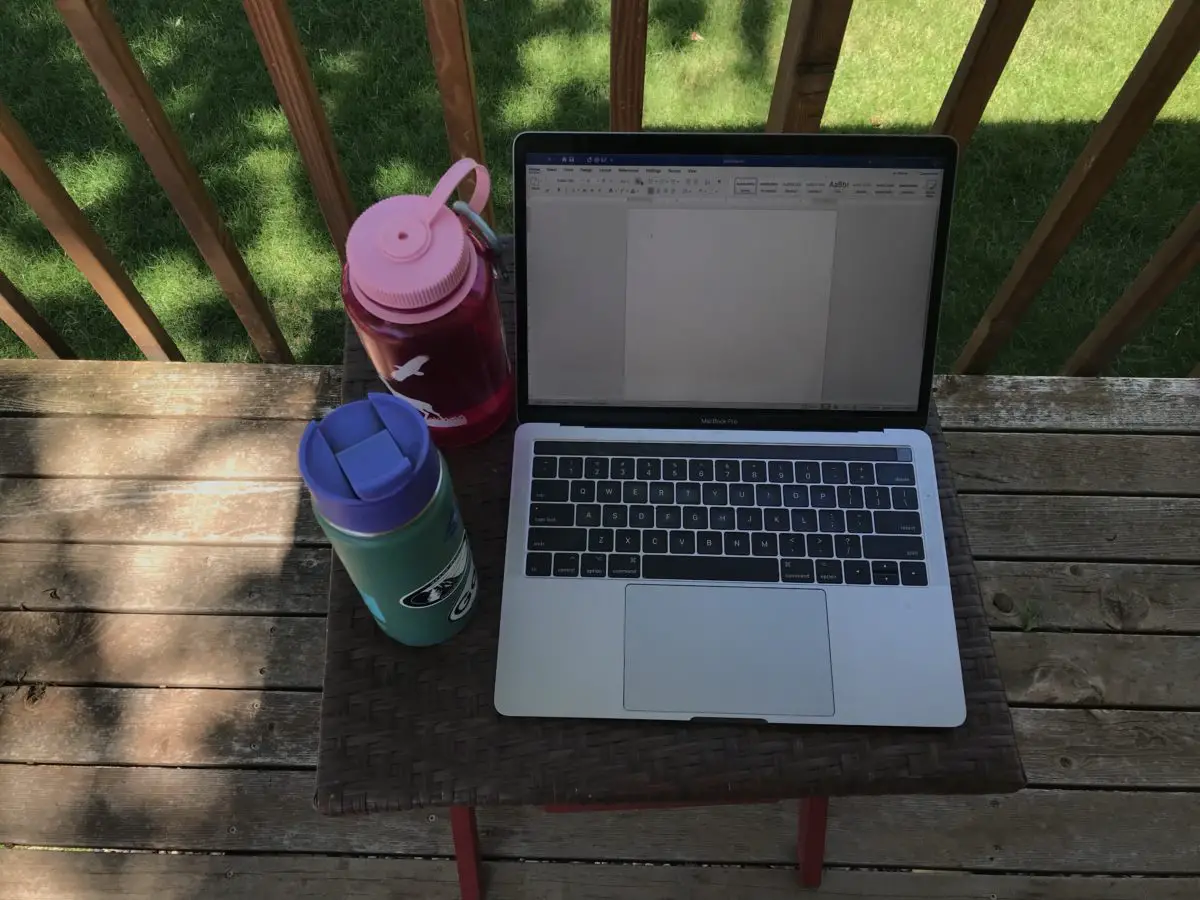
A laptop, water bottle and drink container sit on a table on the deck of a house. Pin reads, "A day in the life of a freelancer"


Like what you read here today?  Please feel free to leave a comment, like or share this post!  Add your email at the bottom of the page, or the sidebar to the right, to be notified when a new post is published.  By signing up for the email list, you will also receive a free copy of the Tranquil Trekker’s Top 10 Tips of Trekking Do’s and Don’ts!

You can also follow the blog on social media by clicking the links below!
Facebook

Twitter

Instagram

Pinterest

Ode to an Old Friend

In this post, I remember the life of a wonderful dog!


After 12 wonderful years, we finally had to say goodbye to our family dog.  We aren’t sure exactly how old she was.  We adopted her as a young adult in 2007 so…she was at least 13 and could have been closer to 15, just based on the information we were given at the time of adoption.  This sweet, spoiled canine led a good, long life!

Allow yourself to feel grief

Sometimes “adulting” is hard.  I’ve spoken before about how we don’t like to experience any pain in the modern world if we can avoid it (and frequently we can).  There’s usually a pill that will at least help to dull the ache.  Pain is never completely avoidable in life, though.  One of those unavoidable heartaches is the loss of close friends (be they human or animal).  Grief sucks…and it HURTS!

We must keep in mind though, that this feeling of loss we are forced to experience from time to time is actually a sign of a good life.  That pain means you had something to love, something that added joy to your life, to begin with.  We should consider ourselves blessed if we have things in our lives that hurt so much to lose.

The Trekkers have been preparing for this eventuality for quite a while.  For the last several years, we’ve watched our dear friend, slow, lose her hearing, and the ability to fully enjoy many activities she used to delight in.  The dog who once–with enthusiasm–drug our butts all the way up and down the 6,683-foot Mt. Mitchell, in North Carolina, became a greying friend who could barely make it around the block. 

Our furry friend led an enjoyable life.  Since 2007 she’s accompanied us on countless hiking and camping adventures, traveled with us to both Indiana and New England to spend holidays with our families, and relocated more than 1700 miles across the country with us when we moved from North Carolina to the Black Hills of South Dakota. (She glared at me from the back seat of my Civic through every mile of that trip 😂!  This is a dog who used to get carsick after less than 15 minutes in a car, which made things interesting those first few years. 😛)

We adopted her from the Wake County Humane Society in Raleigh, North Carolina.  For anyone living in the area, this is an amazing place.  They provide an incredibly comprehensive survey to help match you with your ideal pet, and they provide support services after adoption (such as behavior counseling) if needed.

Happier memories of times past:
Black and tan dog lays on the back cushions of a sofa
She LOVED to sleep on the back of that couch (it did not survive her)! 😂
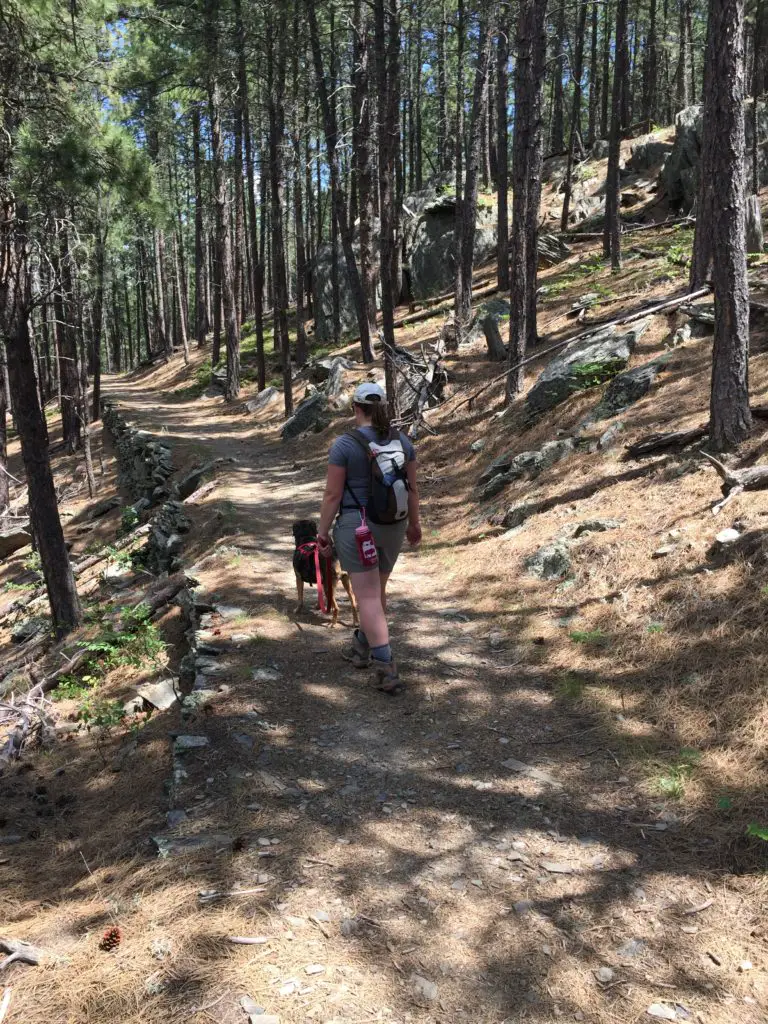
(View from the rear) Dog walks in front of a woman down a trail in the woods
Dragging Mommy down the trail…
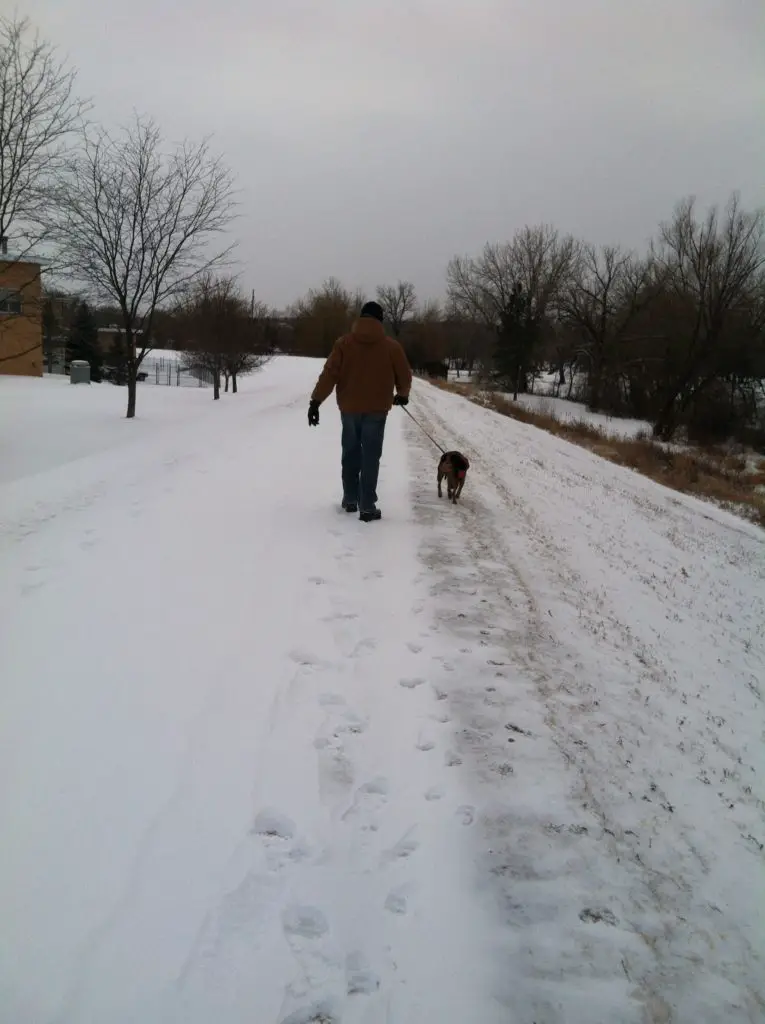
(View from the rear) Dog walks down a snowy trail in front of a man
Dragging Daddy through the snow…
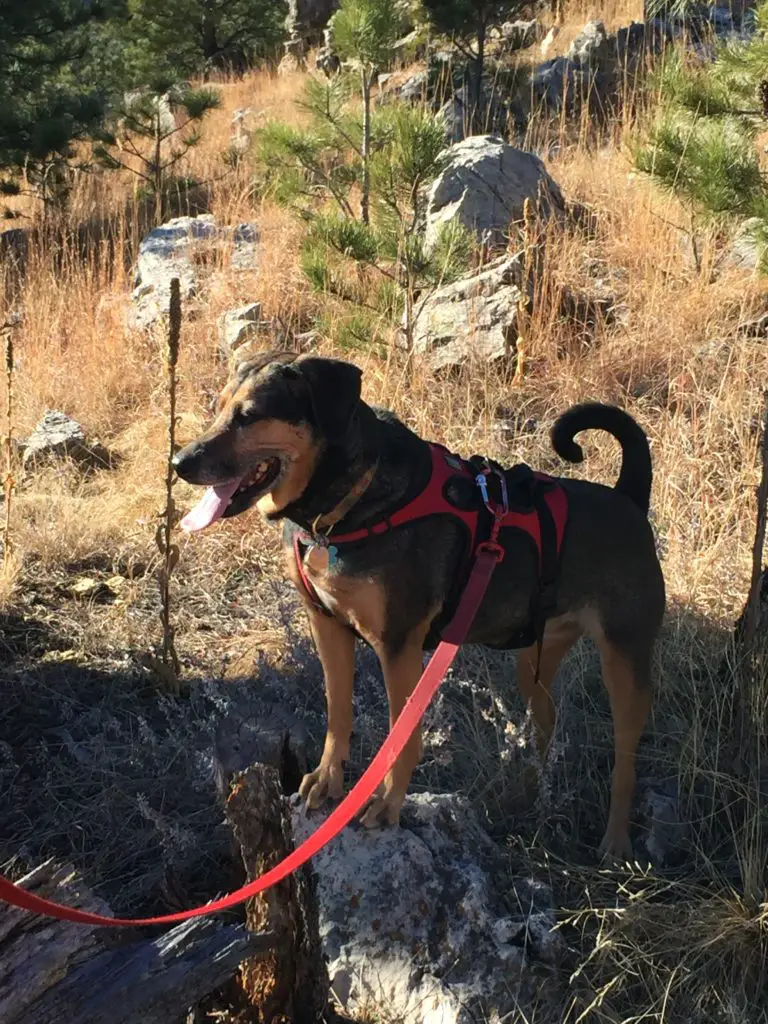
Black and tan hound dog stands on a rock in the forest
She loved getting outdoors!

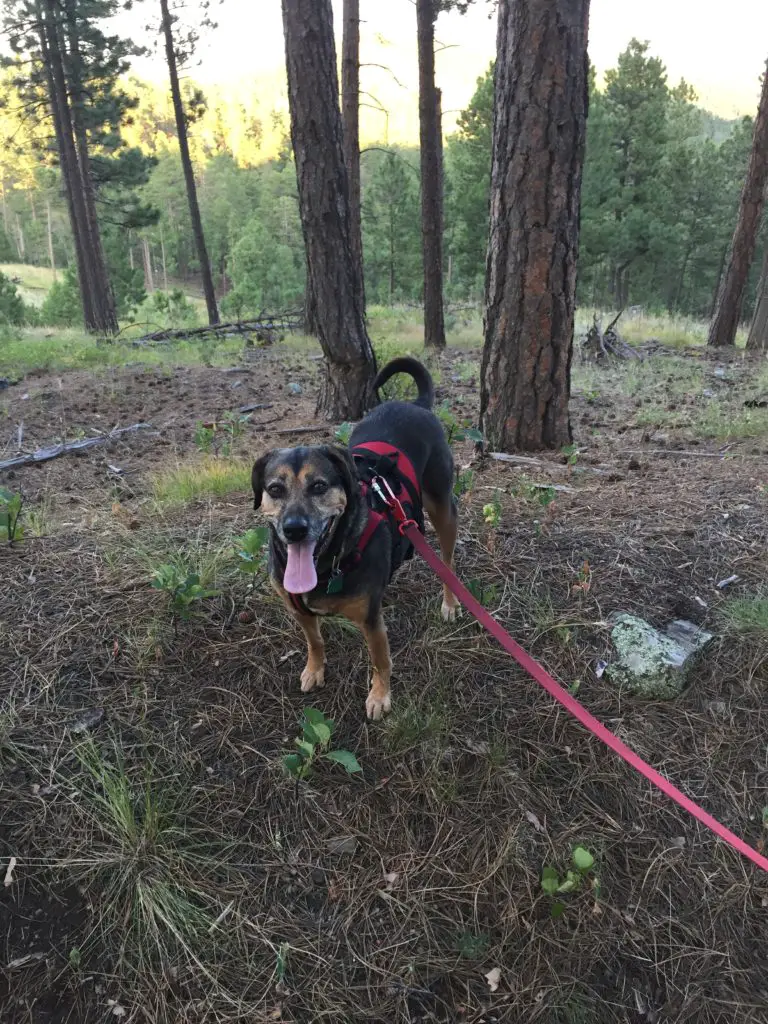
Black and tan dog panting while standing in the forest

In case it isn’t obvious from the pictures, this pup was spoiled rotten.  😉

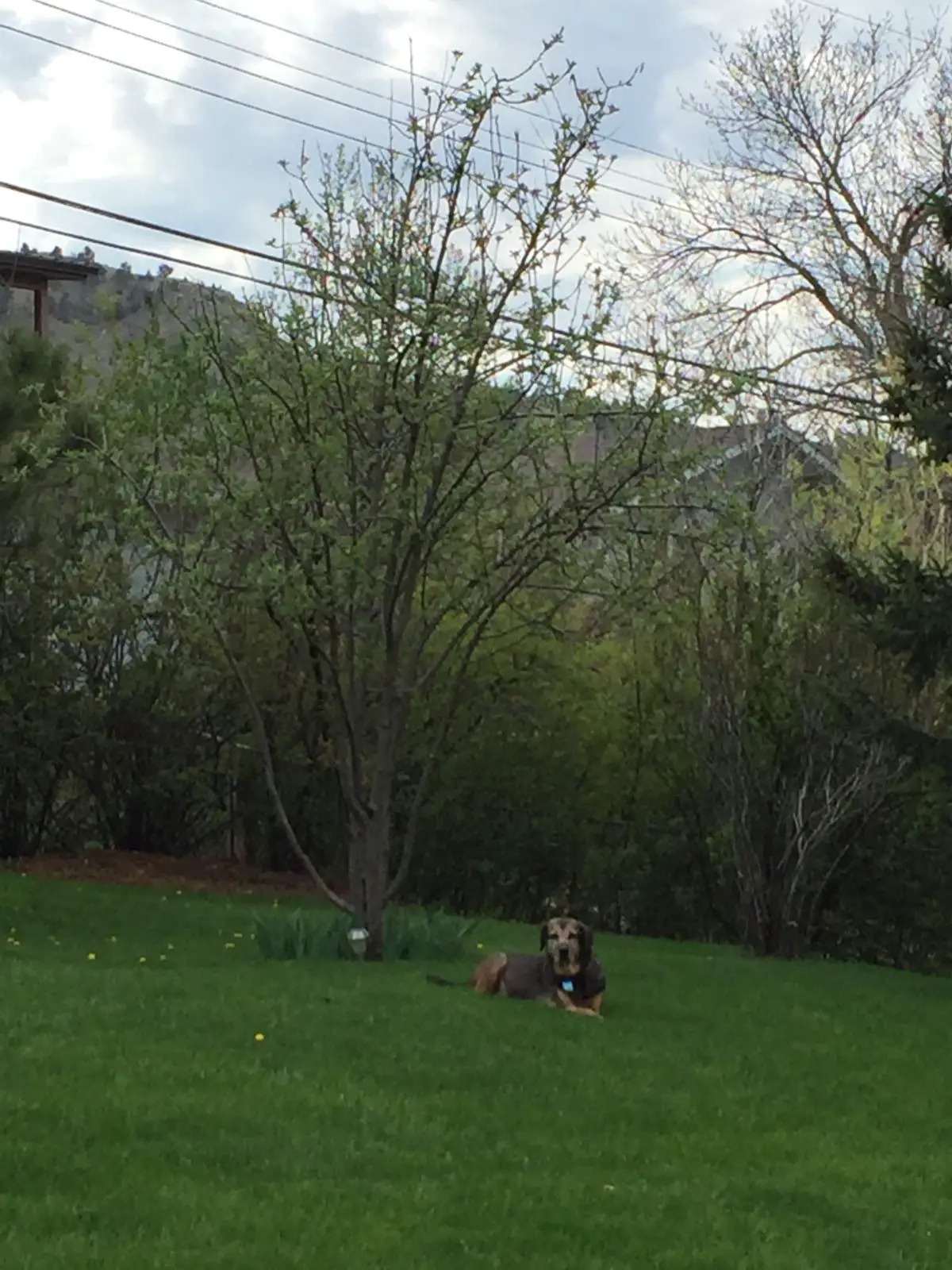
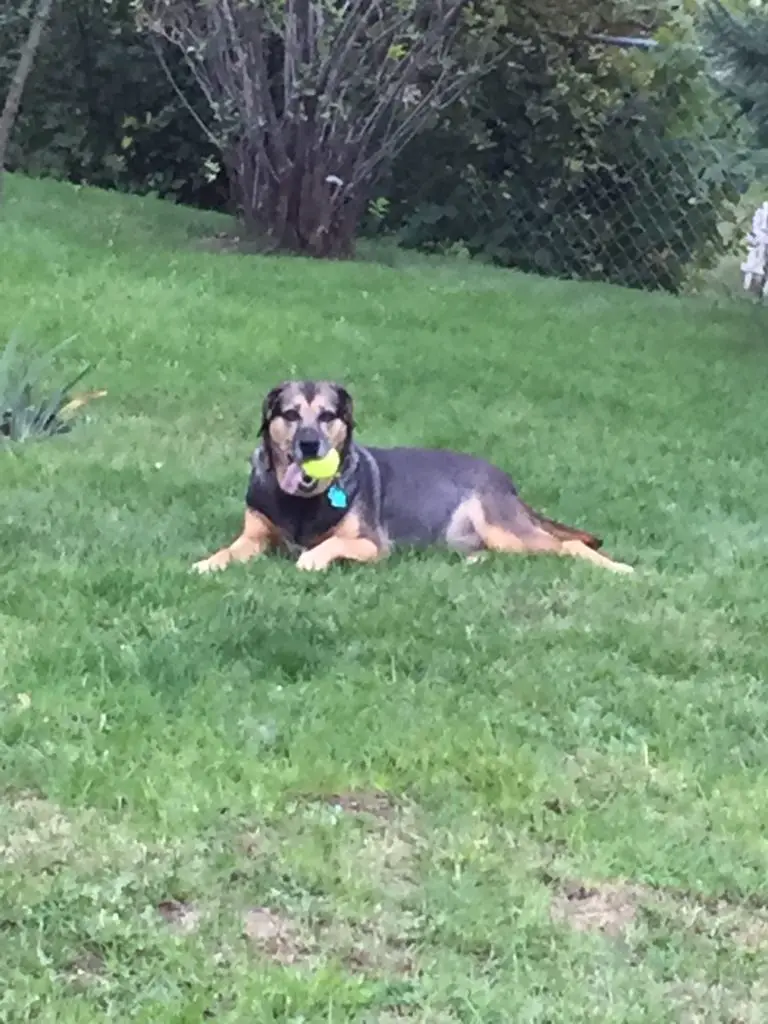
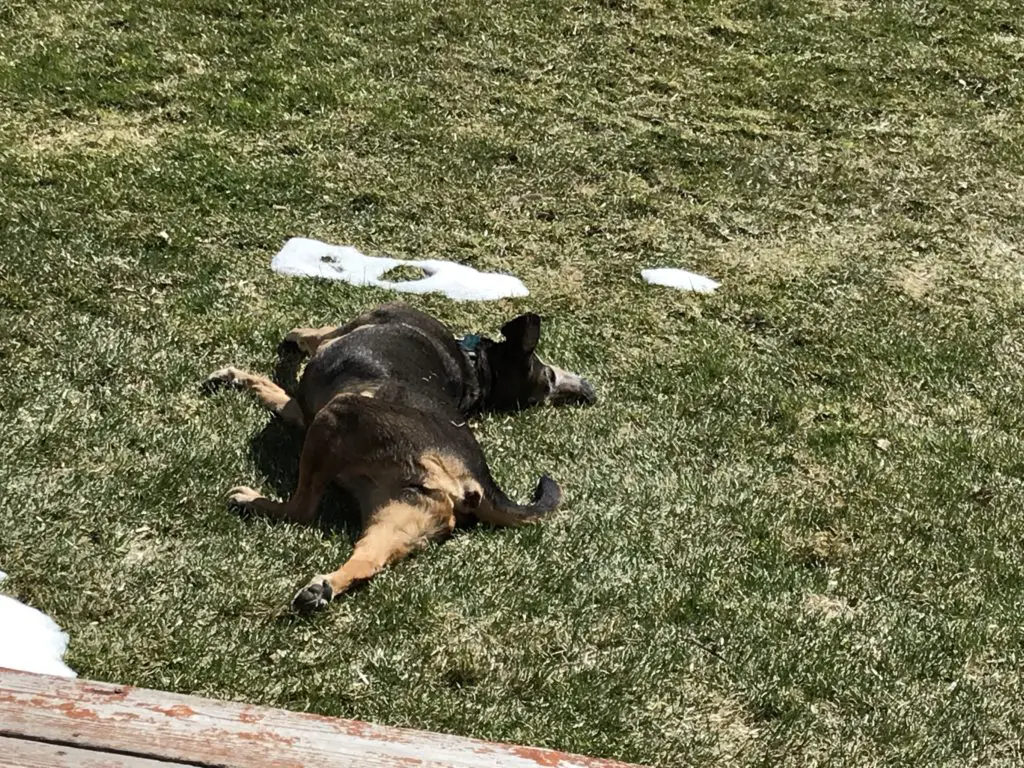
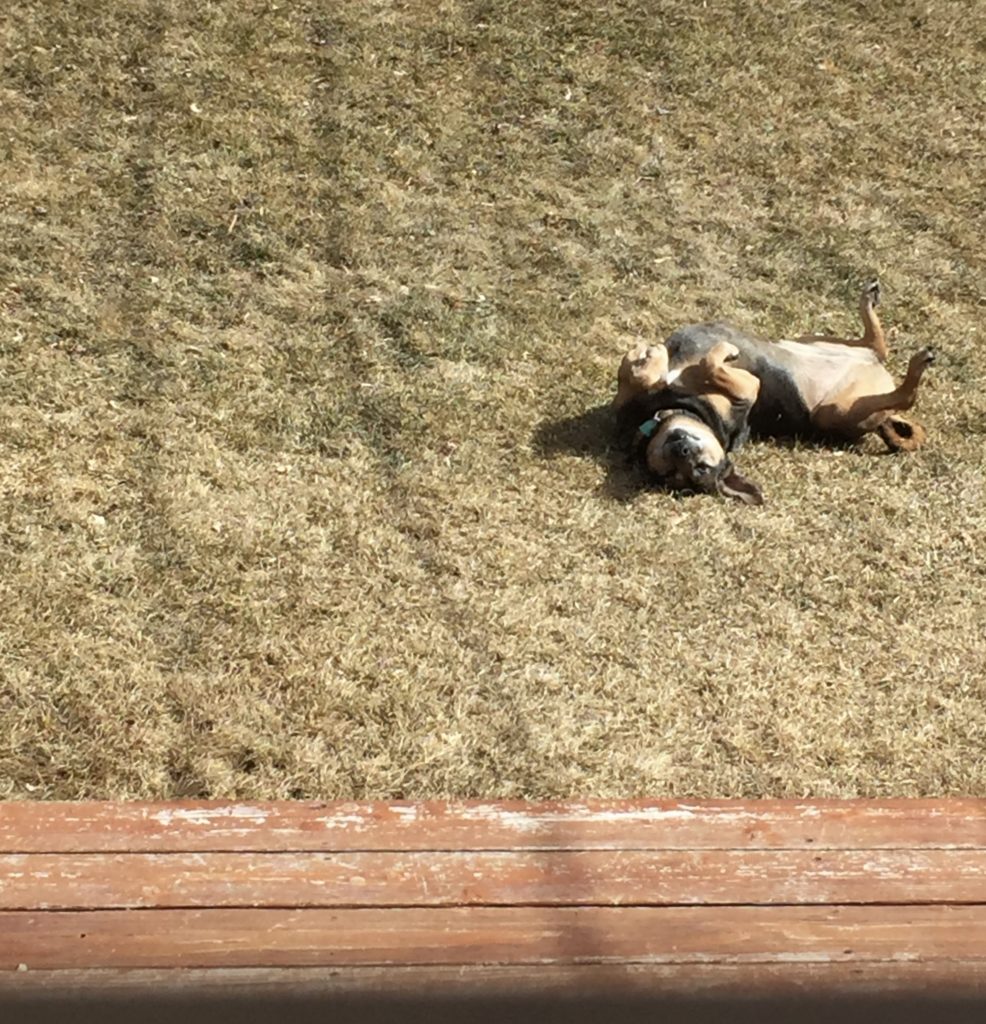
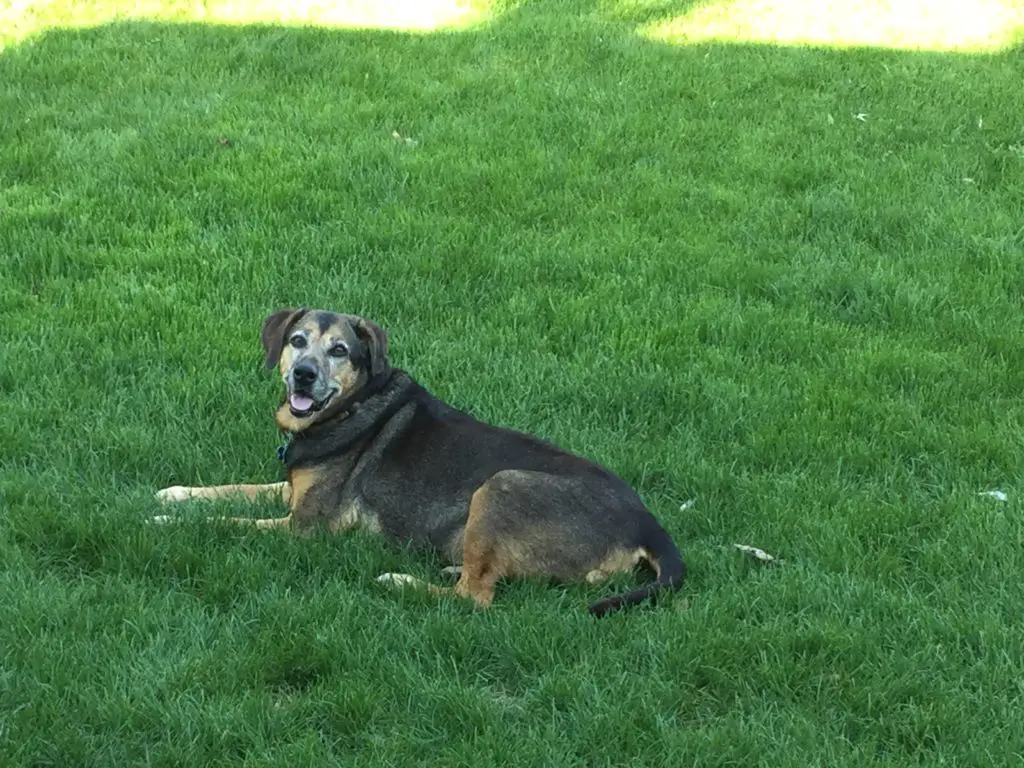
We received her terminal diagnosis several months before she died, so we were very blessed to get to spend so much extra time with her.  She ended up outliving the vet’s prognosis by several months!  We were so happy that she hung on long enough to be able to enjoy laying in the sun and rolling in the soft, green grass of spring again.

I have to say a huge, “thank you!” to the staff at Dakota Hills Veterinary Clinic as well.  They took such good care of our friend for the last eight years, she actually enjoyed going there.  On her last day on earth, she happily walked in the front doors, excited to see the friends she had made there.  The staff made a difficult and painful experience as easy as possible to bear. 

We were fortunate to have more than 12 long years with our friend, and I like to think she was pretty happy with her human pack members as well.   

We should all strive to live life like a hound dog!

Black and tan dog lays on green grass with a tennis ball in her mouth Black and tan dog rolls on her side in the grass and snow

Black and tan dog rolls on her side in the grass and snow

Black and tan dog rolls on her side in the grass and snow

Black and tan dog lays upside down in the grass

Goodbye old friend, you are missed but you will never be forgotten…

Black and tan dog lays in the bright, green grass


Like what you read here today?  Please feel free to leave a comment, like or share this post!  Add your email at the bottom of the page, or the sidebar to the right, to be notified when a new post is published.  By signing up for the email list, you will also receive a free copy of the Tranquil Trekker’s Top 10 Tips of Trekking Do’s and Don’ts!

You can also follow the blog on social media by clicking the links below!
Facebook

Twitter

Instagram

Pinterest

Reduce Stress by Embracing Mindful Minimalism

In this post, I provide a list of mindfulness and minimalism practices I use to keep my sanity when I’m stressed.


I hate that feeling when your mind seems to be racing out of control.  When you’re so hyped up, your whole body feels like it’s trembling.  It’s like you’ve ingested too much caffeine…you feel like life and your brain is careening out of control and you just can’t seem to relax.  The more you try to focus on something the more it seems to slip through your mental fingers.

Yet you notice, perplexedly, when you take a breath and are able to relax, that thoughts come easier.  You can remember and focus when, just a few hours ago, you couldn’t hang onto a thought for more than a few seconds…read on for tips on how to lessen stress using Mindful Minimalism.

Signs Your Body is Stressed

Tight stomach muscles…taught shoulders…you feel the dull ache of a tension headache at the back of your neck…then your eyelid or cheek starts to twitch…your lower back and shoulder blades are tense…there’s the occasional, weird twinge in your chest or abdomen…sometimes a lightheadedness kicks in, complete with difficulty focusing and a dazed sense of, what could almost be described as, disorientation…you may have trouble sleeping, or experience sleep disturbances or strange dreams…

These are all signs that our body is telling us, “YOU ARE STRESSED AND NEED A BREAK!”  You know the stress is building when you notice these signs.

My understanding is some of the stranger symptoms, such as the lightheadedness and disorientation, occur because we have a tendency to unconsciously hold our breath– or at least breathe shallowly–when we are tense and stressed.  This leads to lower oxygen levels and the disconnected, lightheaded feeling (it doesn’t help that I have chronic sinus and inner-ear problems that mess with my equilibrium 😋).

How to Use Mindfulness and Minimalism Practices to Reduce Stress

I’ve learned to take heed when these symptoms show themselves.  At the first sign of them, I immediately try to kick my mindfulness, simplicity and minimalism practices into high gear.  I focus on meditation, physical exercise and taking slow, deep breaths.  I also try to focus on only one task at a time while keeping the distractions as minimal as possible.

In the age of our always-on, always-connected lives, many people are starting to feel that our brains are being overwhelmed, present company included. Below are some of the procedures I employ when I notice these symptoms and realize I need to take a little “me time”:

Digital Minimalism:

This may seem odd for a blogger, and full disclosure, I do use multiple social media platforms for the blog.  However, I try to focus on them ONLY for the blog.

I do use them to stay up-to-date on certain subjects, mostly travel-related, and to keep in touch with long-distance family and friends.  I also peruse the occasional political site to keep up with the news, as well.  But I consider it a good sign when the platform is “nudging” me that I haven’t been posting much.

Prioritize Minimalism in All Areas of Your Life:
            • I try to minimize the distractions caused by music and television (unless I’m focusing on them as a means of relaxation).
            • I try to focus on other relaxation practices such as coloring or writing in a journal.
            • I’m big on simplicity.  I don’t wear much jewelry, and what I do wear tends to be small.  I find one of my biggest irritations in the morning is how much time I waste “getting ready” (and the fact that Mr. Trekker can do it in half the time it takes me 😋).  So, to counteract that, I keep that process as simple as possible.  I don’t mess with my hair much, most days I don’t even dry it.  I wear very little makeup, I don’t even own a bottle of hairspray anymore. 😋
            • I’ve never been a very showy person (says the woman with a nose ring and tattoo, but hey, they’re both small!   I suppose “showy” is in the eye of the beholder. 🙃)  My tattoo is simple, consisting of only one color and a little shading. Both can be hidden if I choose.I prefer these methods of beautification because they are simple and constant.  They’re there but are blessedly low maintenance.  Often times I completely forget about them.  They allow me to show off my own personal flair but in a subtle and simple way.

(To be clear, this isn’t intended as any sort of judgment on people who do prioritize beautification more.  These methods are just part of the way I keep life simple.  I was also always way too lazy to take the time to learn how to do much regarding my hair or makeup anyway. 😛)

Make Lists (LOTS of Lists!):

I’ve always been a fan of list-making, but I find during times of higher stress it’s even more helpful.  It relieves stress because, when you write things down that you need to keep track of, you don’t have to “stress” 😉 about remembering them anymore.

This also helps with maintaining focus as you have fewer thoughts bouncing around in your head.  I always carry a pen and a small notebook with me so, at a moment’s notice, I can write things down I don’t want to forget.  You can also use the “notes” or “reminder” function on your phone, but I’m partial to the “old school” method.

Stress Makes Everyday Life Harder

High levels of everyday, mental stress make it more difficult to handle real problems when they actually occur.  As an example, a “low-tire” light on a car, while not usually more than a nuisance, can feel like an insurmountable obstacle that you don’t feel like you can handle when your mental energy supply is already depleted.

One of my biggest struggles is feeling like IhavetorushandgetmytodolistdoneasfastasIpossiblycan!!!  (That’s difficult to read, right?  Yeah, that’s just a glimmer into the everyday workings of my foul little mind. 🙃)

Inevitably I find I allow myself to get stressed about all the things I need to do throughout the day or week.  Sometimes they are legitimately urgent (in which case they go to the top of the Mental Energy Priority Pile).  But more often than not, they’re just everyday tasks that need to be completed.  Things like errands, groceries, chores around the house and various work tasks. These issues are by no means life and death, they’re just part of normal living.  Inevitably I find I ALWAYS manage to complete them (quite often, faster and more easily than I thought I would).  And if they take a little extra time to finish, guess what, the world somehow still continues on.  The sun still rises each morning and sets each night, the birds still sing in the trees…

The trouble with all that stress I bring on myself is that when I complete the task and realize all is well…I still have all that negative energy built up…and then I start stressing about how to relieve THAT! 😛🙄

To Conclude:

Ultimately, it’s not healthy for us to maintain all the strain that we hold on a daily basis.  The rates of anxiety and stress-related illnesses keep increasing in modern society.  The saddest part of this is, that most of our lives aren’t even that difficult.  We are literally making ourselves sick with illnesses that harbor potentially lethal consequences…over “First World Problems”.  We all really need to CHILL OUT! 😉

More and more I’m finding that implementing mindful, minimalism practices helps with controlling my anxiety and stress-related symptoms.  I hope this list helps you (and I) work toward a more serene life.

How do you implement Mindfulness and Minimalism practices to help reduce everyday stress?  Let me know in the comments!


Did you enjoy this post?  Pin it!

Black and white picture of the woods in snow. Tree shadows trail across the white snow. Pin reads, "Reduce Stress by Embracing Mindul Minimalism; 'Into the forest I go, to lose my mind and find my soul.' --John Muir"


Like what you read here today?  Please feel free to leave a comment, like or share this post!  Add your email at the bottom of the page, or the sidebar to the right, to be notified when a new post is published.  By signing up for the email list, you will also receive a free copy of the Tranquil Trekker’s Top 10 Tips of Trekking Do’s and Don’ts!

You can also follow the blog on social media by clicking the links below!
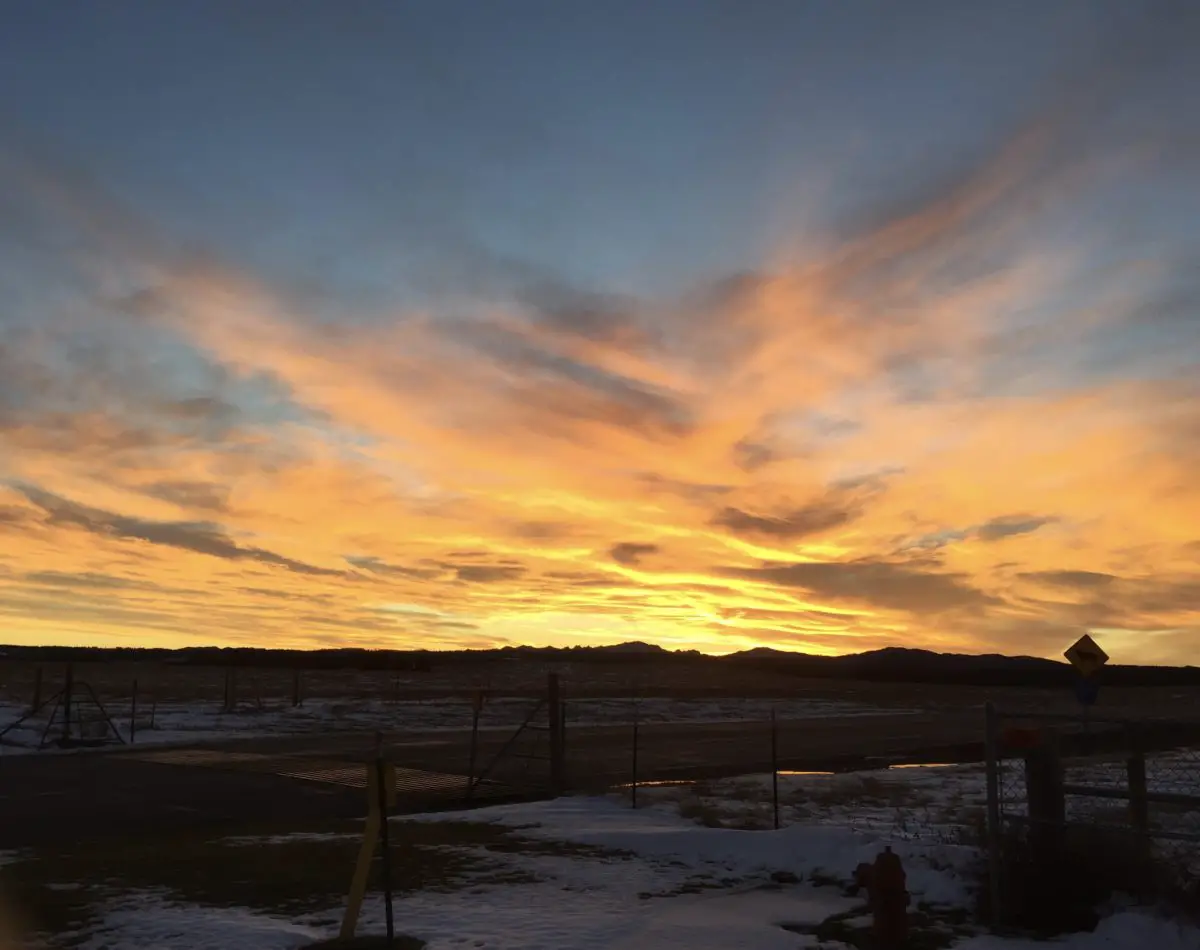
Facebook

Twitter

Instagram

Pinterest