My posts!

5 Fun Things to do in Southeastern Colorado

In this post I detail a trip to see the Royal Gorge, an extinct volcano and a tarantula migration near southeastern Colorado


A deep gorge, volcanoes and large spiders…oh my!

Southeastern Colorado is a bit of an undiscovered gem! It doesn’t provide the fancy, ski resorts that people think of for the state so it’s kind of overlooked. It does still have much to offer though with beautiful mountains, lovely weather, and the best part for many of us…fewer crowds! Also, some of the attractions are lower-cost as they aren’t as well known!

Cañon City Colorado and the Royal Gorge

Cañon City is located in south-central Colorado about 40 miles west of I-25 and the larger town of Pueblo. This small town features a fun, downtown area that reminded us of Grand Junction. It offers lots of outdoor opportunities including hiking and rafting (when weather permits). It is also home to Colorado’s iconic Skyline Drive as well as a cool, scenic railroad and the incredible Royal Gorge!

Skyline Drive

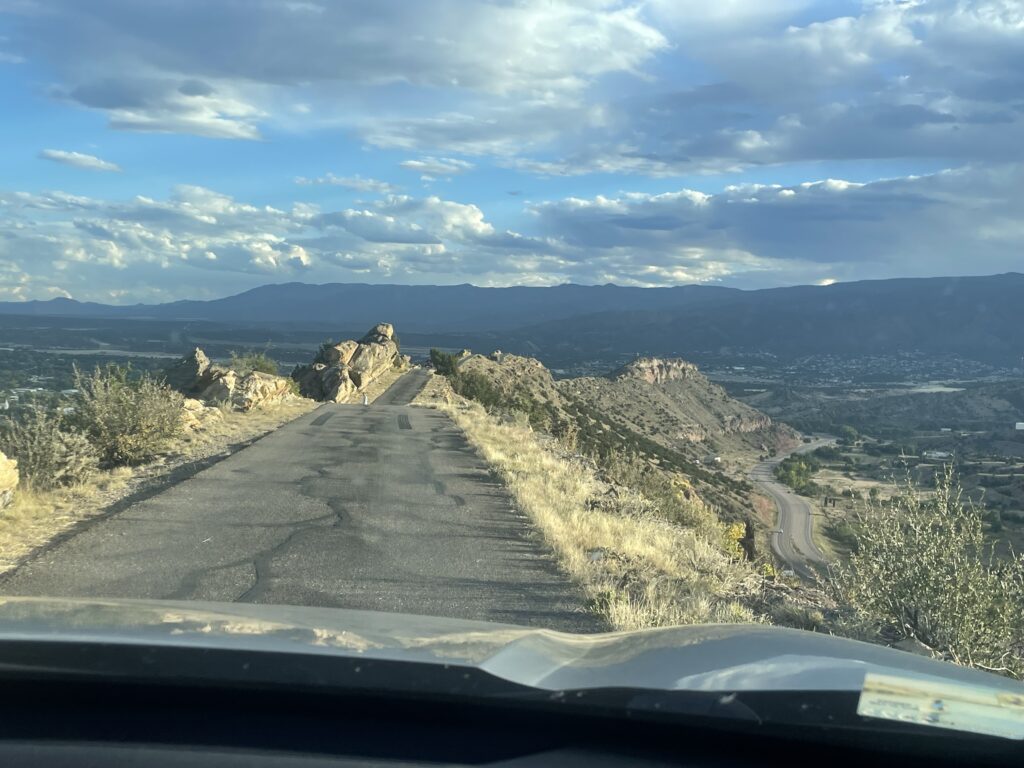
Skyline Drive is a one-way, single-lane route that runs for about three miles, parallel to US 50, on the western edge of Cañon City.  The drive traverses the spine of some nearby hills and towers about 800 feet above the nearby town. There are also some fossilized, dinosaur footprints found near the road!

View of a narrow, mountain road with dropoffs on both sides and rocky edges, overlooking a scenic valley and distant mountains under a partly cloudy sky.

Skyline Drive: Would you believe this is considered one of the scarier drives in Colorado?! Hehe, I could call with a few shelf roads we’ve grown familiar with over the years!

The next two pictures are views of Cañon City from Skyline Drive:

A scenic view of a winding road passing through a valley with hills, scattered vegetation, and mountains in the distance under a partly cloudy blue sky. Sunlight breaks through the clouds, casting light on the landscape.

A wide landscape view of a small town with scattered houses, open fields, and mountains in the distance under a clear blue sky with a few clouds. Sunlight casts shadows across the valley.

Royal Gorge

I have mentioned my immense fear of heights in the past. That was challenged on this trip! We visited the Royal Gorge which is also on the west side of Cañon City–this one has been on my bucket list for several years!

The Royal Gorge is a gorge–as the name implies–that is more than 1200 feet deep! Here the Arkansas River cuts a deep canyon through the local bedrock. The site is open all year (weather-permitting) and offers a number of attractions including: walking the bridge across the Gorge (which is ironically also about 1200 feet long); both a zip line and gondola ride across the Gorge; yummy–albeit expensive–food choices; playground-type areas for kids and some theaters that offer various informational shows on the history of the Gorge. There is also a via ferrata!–my fear if heights said ABSOLUTELY NOT to this option! Most of the activity options are included in the general, ticket price with the exception of the zipline and via ferrata (and the food, of course!) There is also a scenic train ride that starts in town and travels through the bottom of the gorge (for an additional cost of course)–some of the cars even have glass ceilings!

The Royal Gorge is a great attraction for adults and it is absolutely family-friendly, so bring the kids too!

The bridge that spans the Gorge:

A long suspension bridge spans a deep, rocky canyon with a river at the bottom, surrounded by rugged, reddish cliffs and distant mountains under a cloudy sky.

A deep rocky gorge with steep cliffs, spanned by a suspension bridge on the rim. A river flows at the bottom of the canyon, surrounded by rugged terrain and sparse vegetation. Mountains are visible in the distant background.
If you look closely at the bottom you can see the train traversing the bottom of the gorge

There are no vehicles allowed on the bridge (with the exception of employees of the site). The crossing was a little rough for me! The bridge moves in the wind (as it’s designed to do) and is especially nerve wracking when golf carts used by the employees are driving across it!

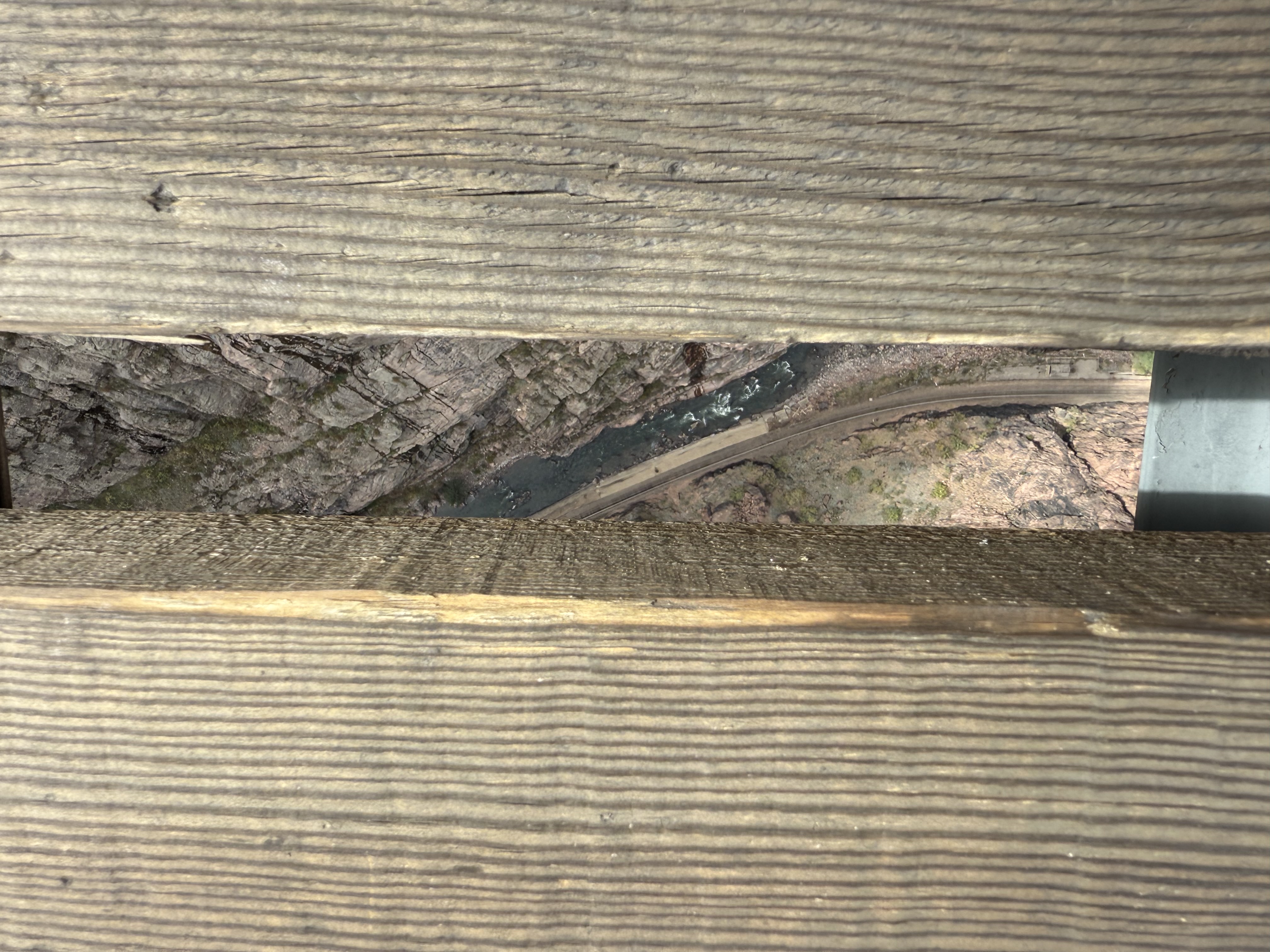
The pic below is through the wooden slats from the middle of the bridge, looking at the river 1200 feet below! 

View of a rocky canyon and river far below, seen through a narrow gap between two wide, weathered wooden planks.
“Long way down!”–I’m feeling my inner GooGoo Dolls with this pic!

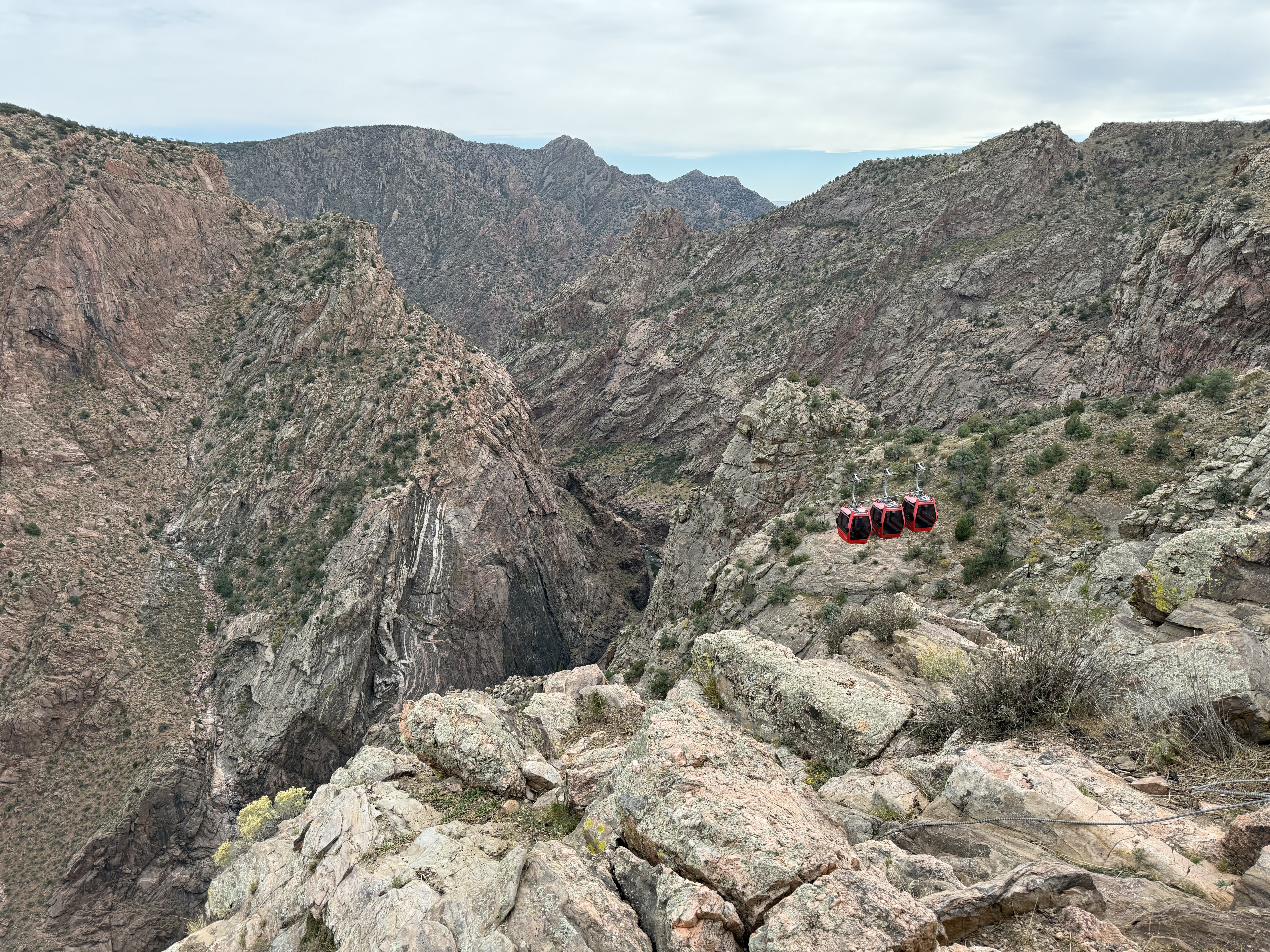
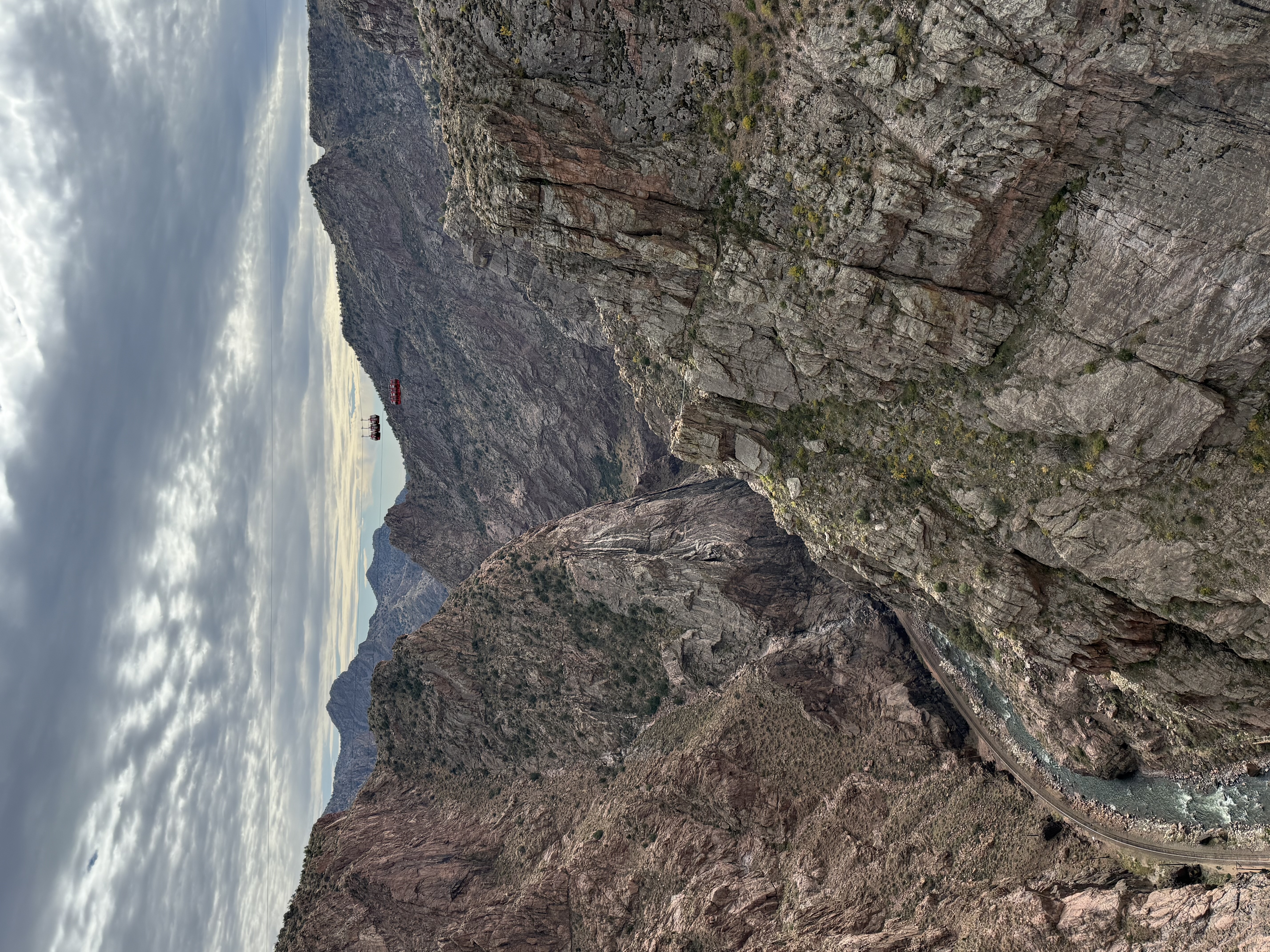
We also enjoyed the gondola (or tram) ride on our return trip across the gorge. It was also a bit frightening as the cars swing back and forth some in the wind (again, as they are designed to do) while you dangle above the yawning chasm of the gorge!  I’m really glad we both walked the bridge and took the gondola-tram as both options offered amazing views and opportunities to see the gorge differently!

The gondola-tram across the Gorge:

A deep rocky canyon with a river flowing at the bottom, surrounded by steep cliffs. A red tramway car travels across the canyon on cables under a cloudy sky.

There are also some hiking trails in the park that we enjoyed. Just realize these don’t offer much shade and this area can get pretty hot in the summer months (it was in the 80s when we were there in October!)

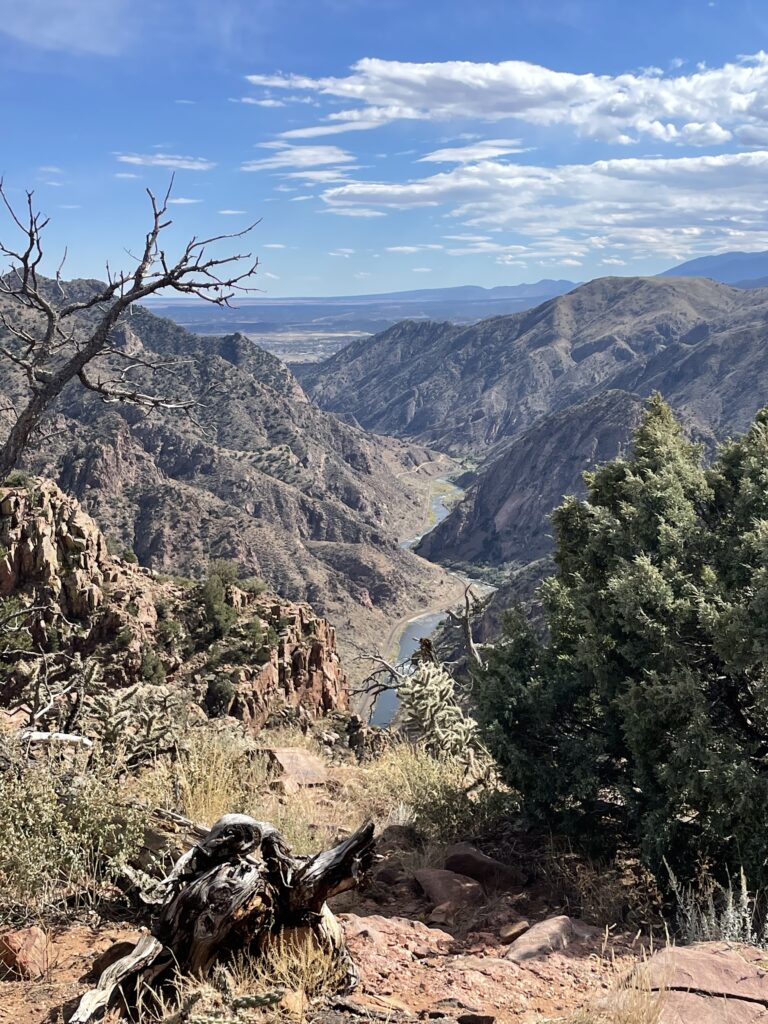
The Royal Gorge–facing east!

A scenic view of a rocky canyon with a river winding through it, surrounded by rugged mountains and dry vegetation, all under a partly cloudy blue sky. In the foreground, there are shrubs and a twisted, weathered tree.

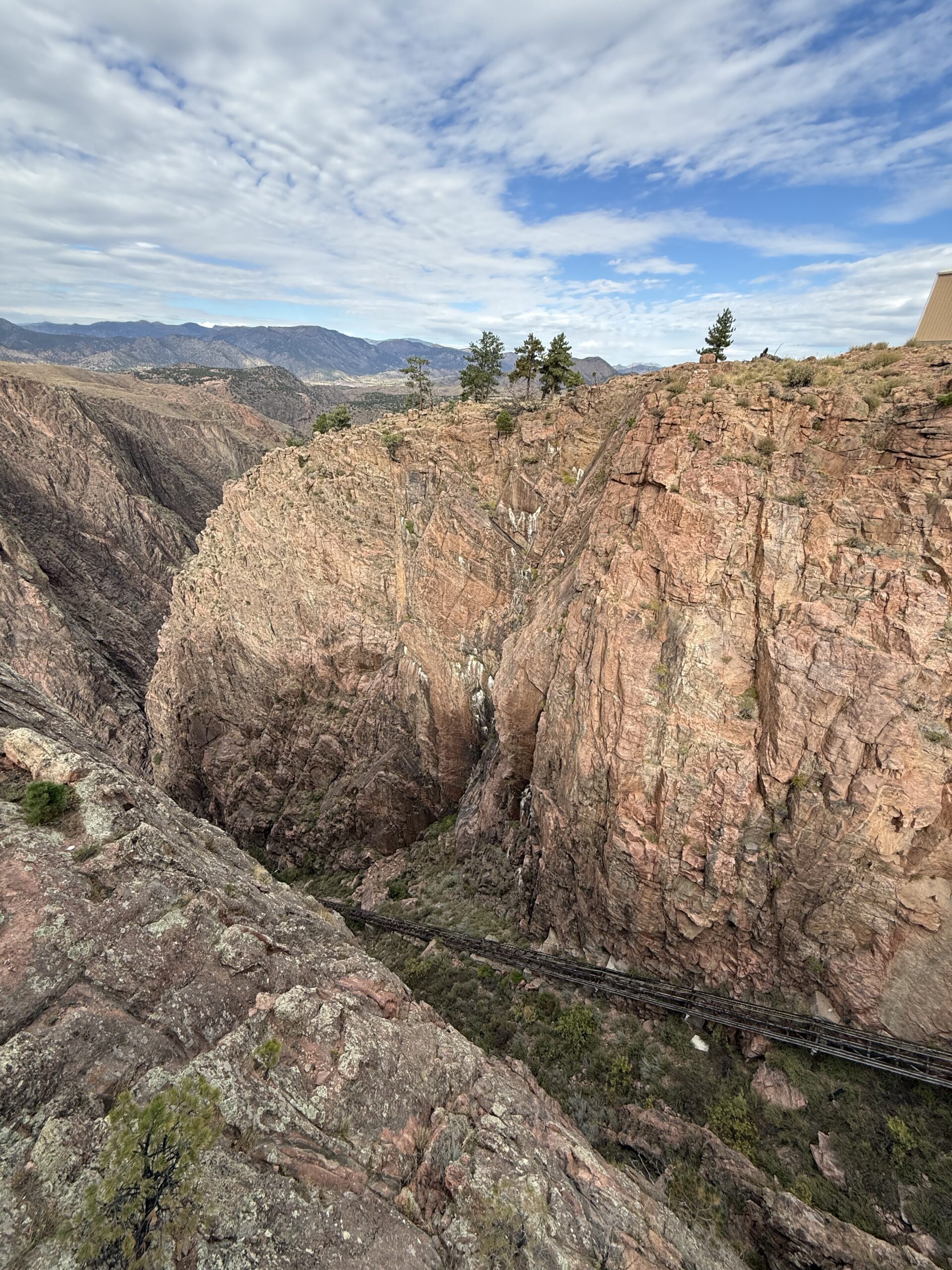
Below is a pic of the tracks for the incline tram that was the original way for tourists to access the gorge–this is no longer in use:

A steep, rocky canyon with reddish cliffs, sparse green trees on top, and a narrow railway track running down the side of the canyon, under a partly cloudy sky. Mountains can be seen in the background.


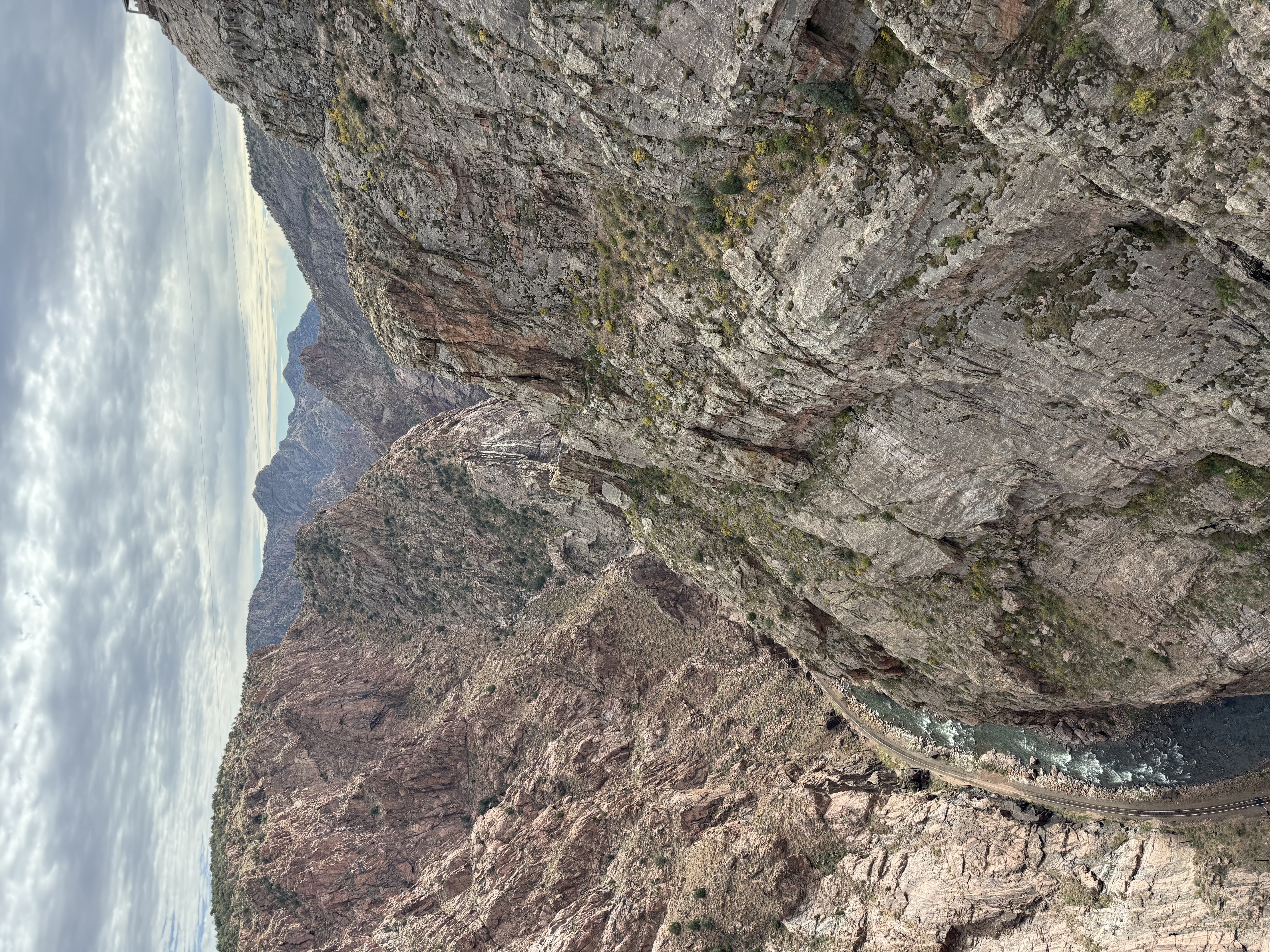
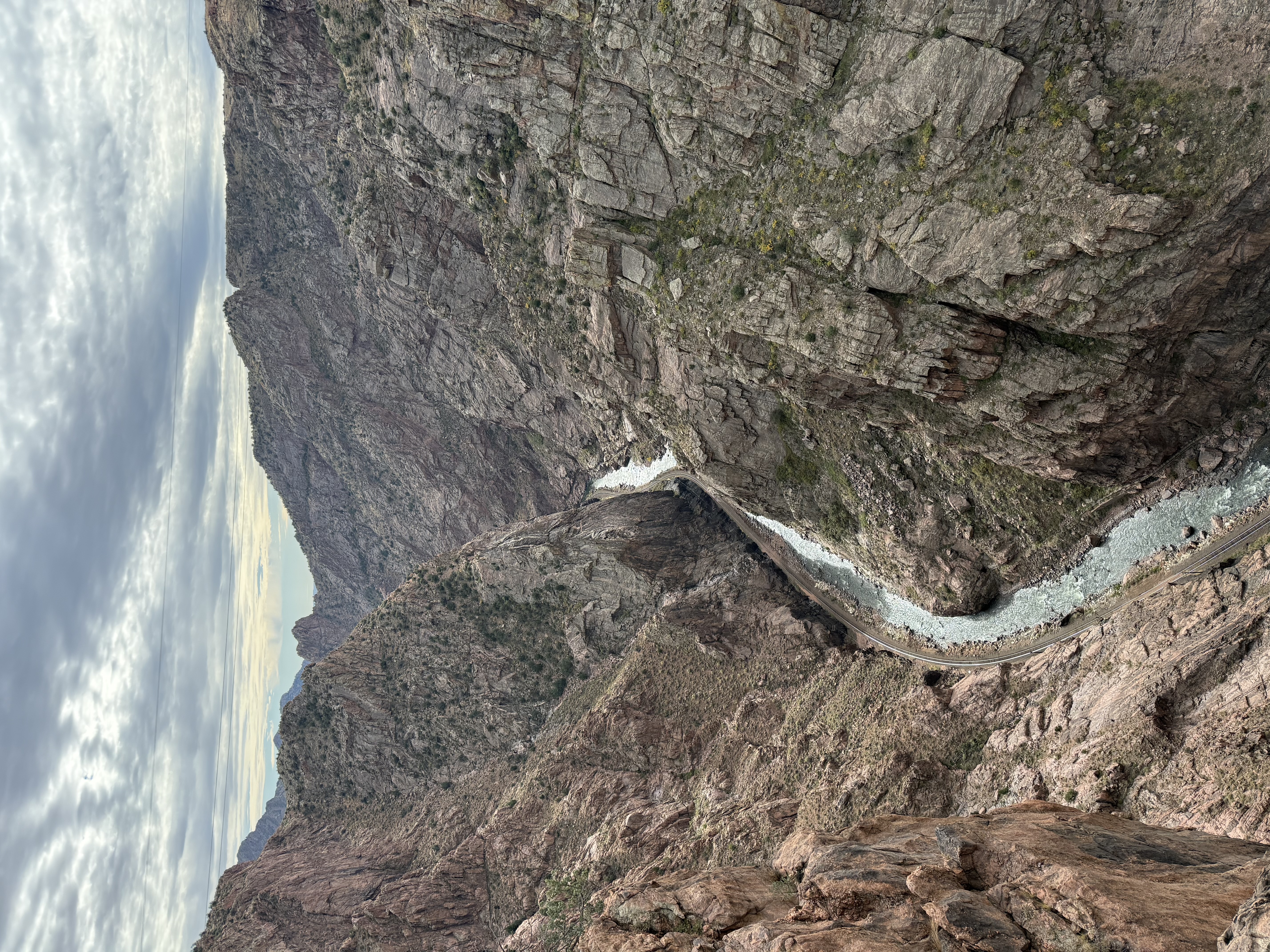
Royal Gorge facing west!

A deep rocky canyon with steep, rugged cliffs and a winding river at the bottom; train tracks run alongside the river. The sky above is cloudy, and distant mountains are visible on the horizon.

A winding river flows through a deep, rocky canyon with steep, rugged cliffs and sparse vegetation under a cloudy sky.

Capulin Volcano National Monument in New Mexico

**Author’s note: Just a word of warning, as this is a National Monument, no dogs are allowed on any trails (exceptions for Service Animals). They are only permitted in the campgrounds and parking lots.**

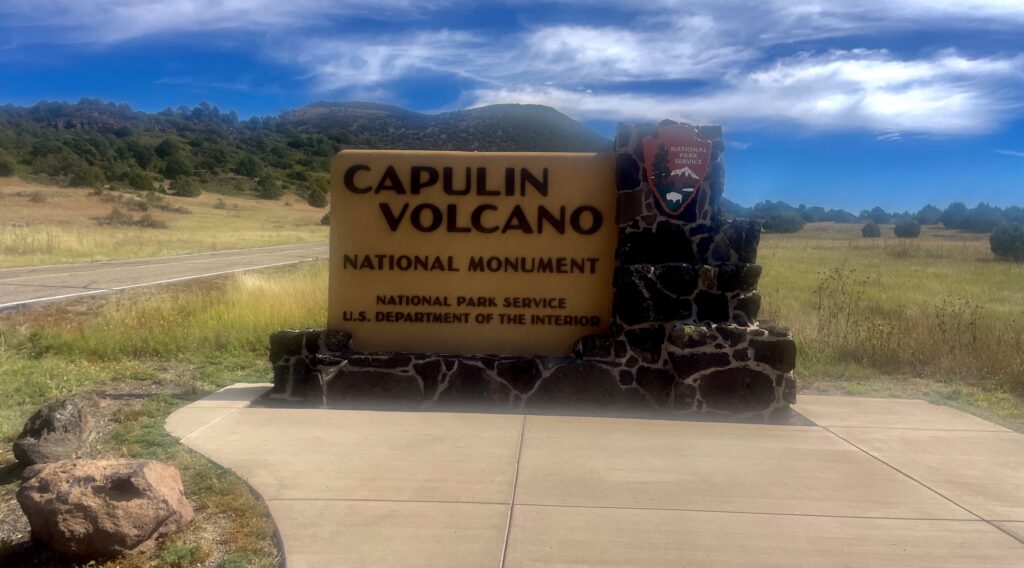
Ok, Capulin Volcano is actually in far, northern New Mexico but it’s REALLY close to Colorado and can easily be implemented into a southeast Colorado road trip! 😁  

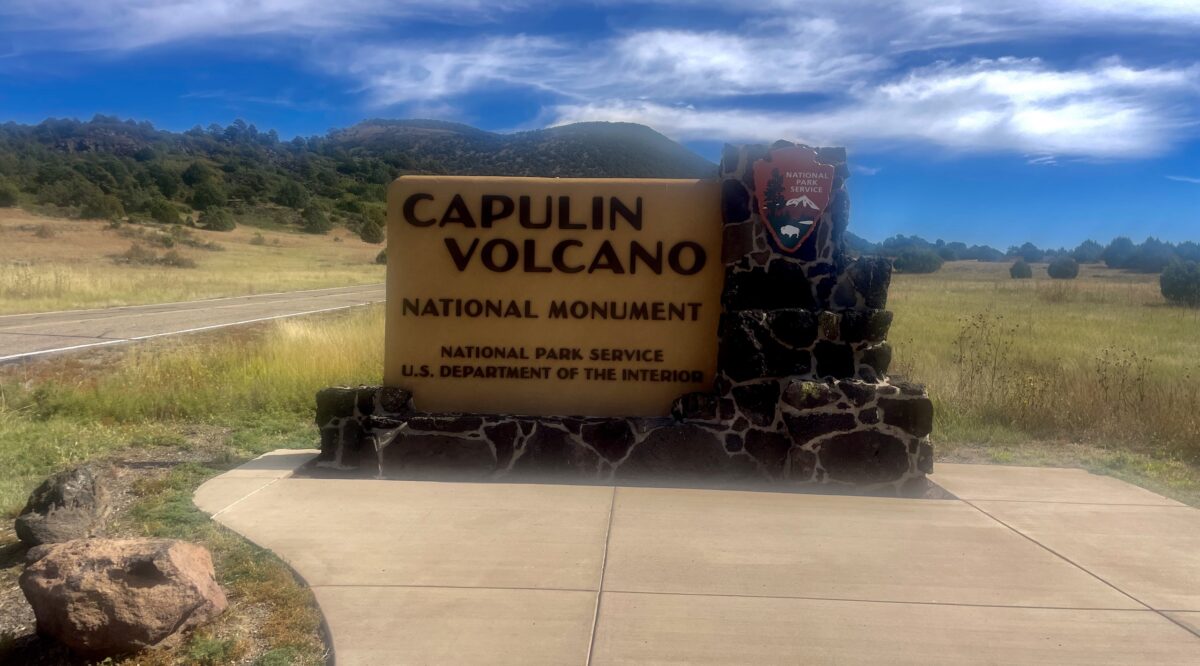
A large stone sign for Capulin Volcano National Monument stands beside a road, surrounded by grassy fields and hills, under a blue sky with scattered clouds.

Capulin Volcano is found in the far, northeastern corner of New Mexico about three miles north of the tiny town of Capulin. It’s also about 25 miles east of I-25 and Raton, New Mexico and about 60 miles southeast of Trinidad, Colorado.

The volcano is pretty cool!  It is technically extinct–though from my extremely limited understanding of volcanology, an “extinct” volcano simply means it hasn’t erupted in a REALLY long time…but that in no way ensures another eruption isn’t possible (case in point)!

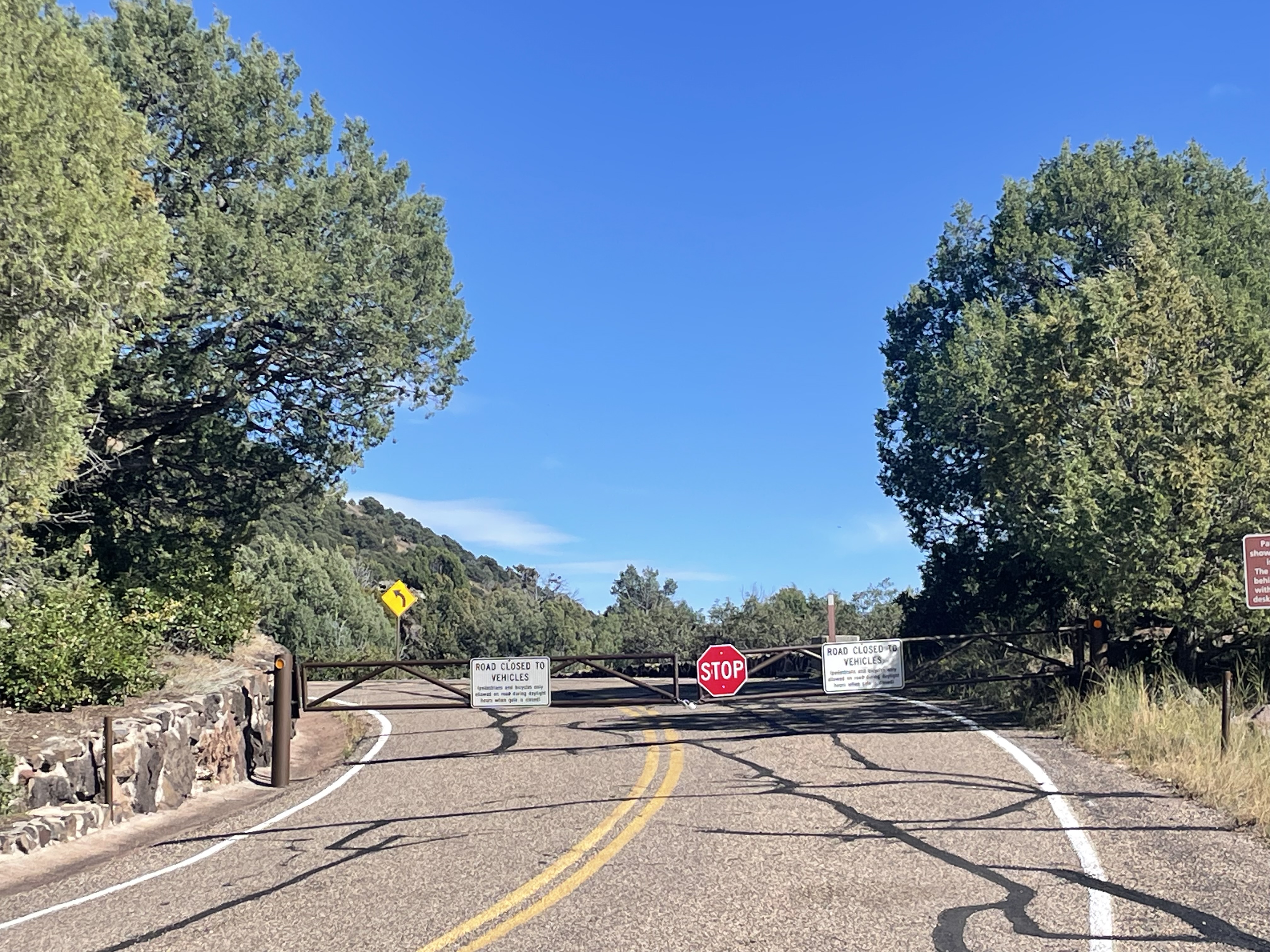
We have not had good luck with this attraction! In 2017 we tried to visit it on a road trip. By the time we arrived the gate to drive the road was already closed for the day. We could have walked up but I was still recovering from a NASTY stomach flu so there was no way that was going to happen.

When we visited in 2025 it was in the middle of a lengthy, Federal government shutdown so the gate was again closed. I was pretty frustrated as this had been on my list for SO LONG and it was a beautiful day! Fortunately there was a friendly ranger volunteering at the closed visitor center. (He was offering safe views from his telescope of solar flares that were occurring on the sun. That was pretty cool to see!) He also assured us we were still welcome to walk the four miles up and down the closed road to the top of the volcano.

A paved road ends at a closed gate with several warning signs and a stop sign. Trees and greenery line both sides of the road under a clear blue sky.
EVERY. TIME. we have tried visiting Capulin Volcano, we see this!

At the time I was about 8-months out, still recovering from my NASTY, broken ankle (though by then my PT was telling me, “use your ankle!”) So…we did! I was NOT missing this volcano again if I had anything to say about it and the experience was actually pretty cool. We literally had the entire mountain to ourselves! The hike up and down was on a paved road so it wasn’t too bad! (Though there is NO SHADE in northern New Mexico so it could be pretty hot depending on the weather. When we were there in mid-October it was a LOVELY 75-ish degree day with a breeze at 7000 feet elevation!)

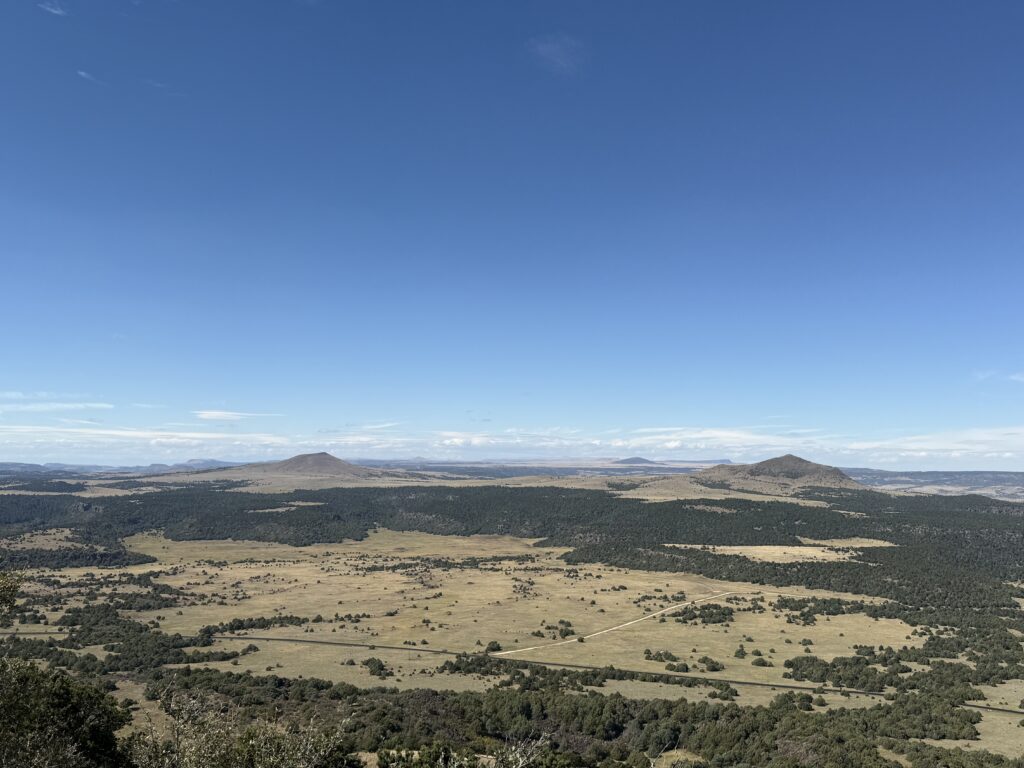
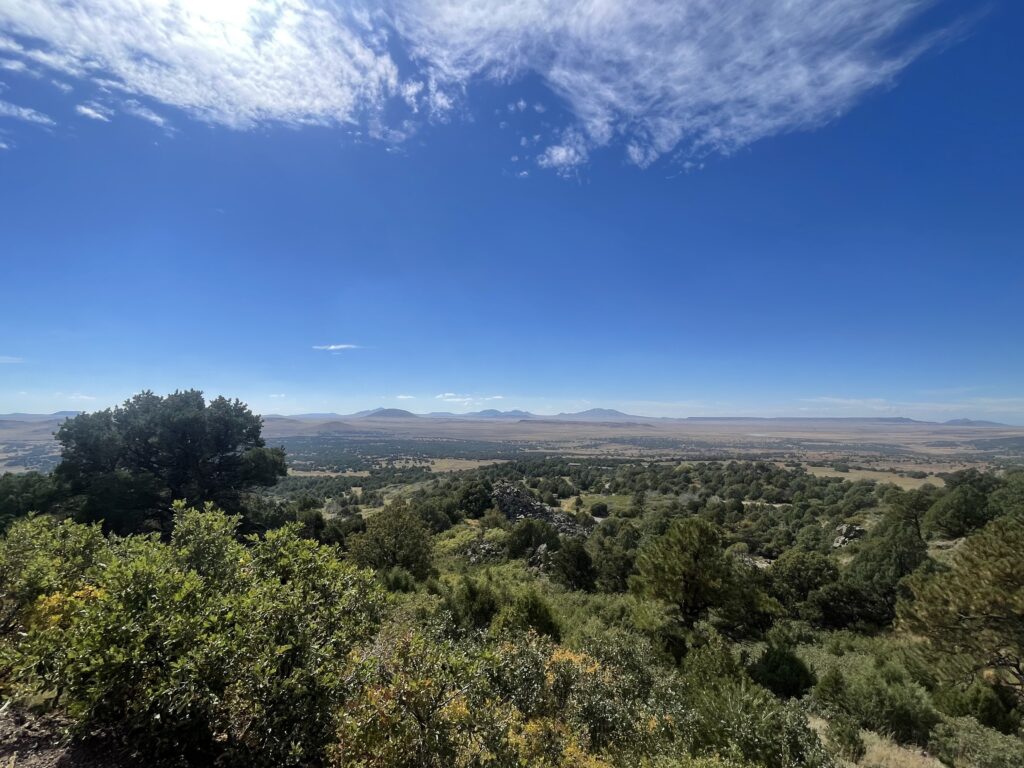
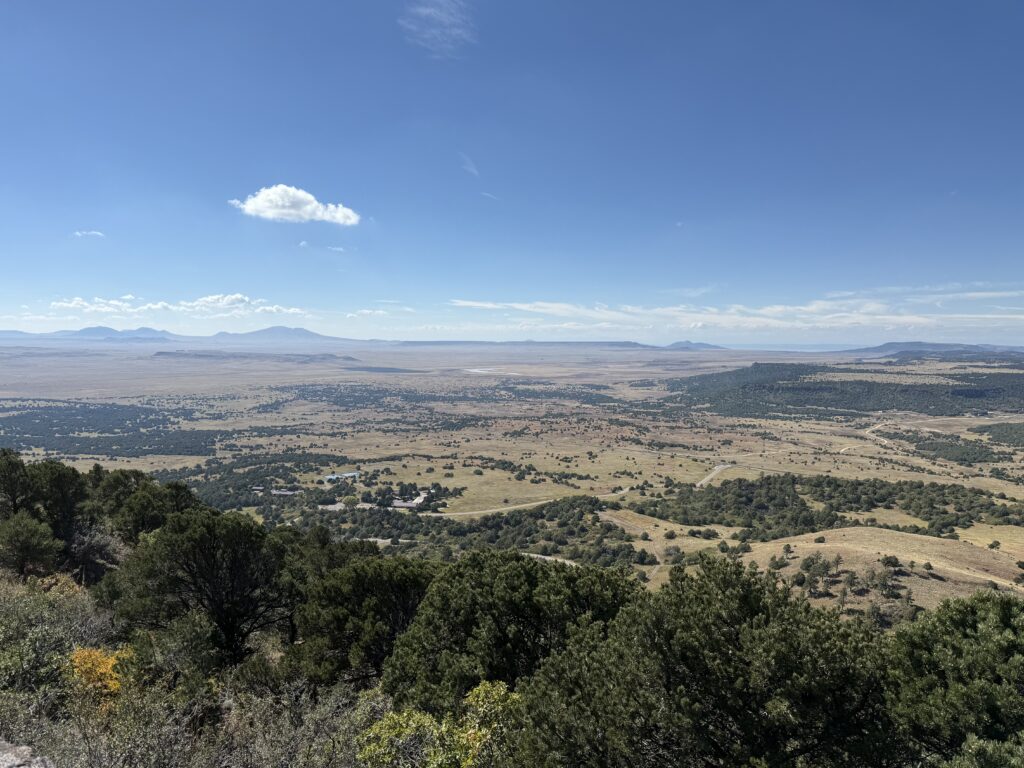
View from our hike up Capulin Volcano–I feel the need to remind my readers again of my utter fear of heights! 😂  

View from above, a wide vista from high above of grassy plains, scattered trees, and patches of forest under a clear blue sky with distant hills and mountains on the horizon.
You can see other volcano cones in the local area

View of a vast landscape with green trees and shrubs in the foreground, open plains in the middle, distant mountains on the horizon, and a blue sky with scattered clouds above. View from above, a vast landscape view of a grassy plain with scattered trees, rolling hills, and distant mountain ranges under a clear blue sky with a few clouds. The foreground features dense, green shrubs and trees.

When you reach the top of the volcano there is a small parking lot (apparently sometimes the road is actually open to cars!–Mr. Trekker actually visited here in college and they WERE able to drive the road.) There are also some hiking trails that traverse the rim of the volcano crater and one that takes you down into its center. Of course we did this one–it was a little unnerving!

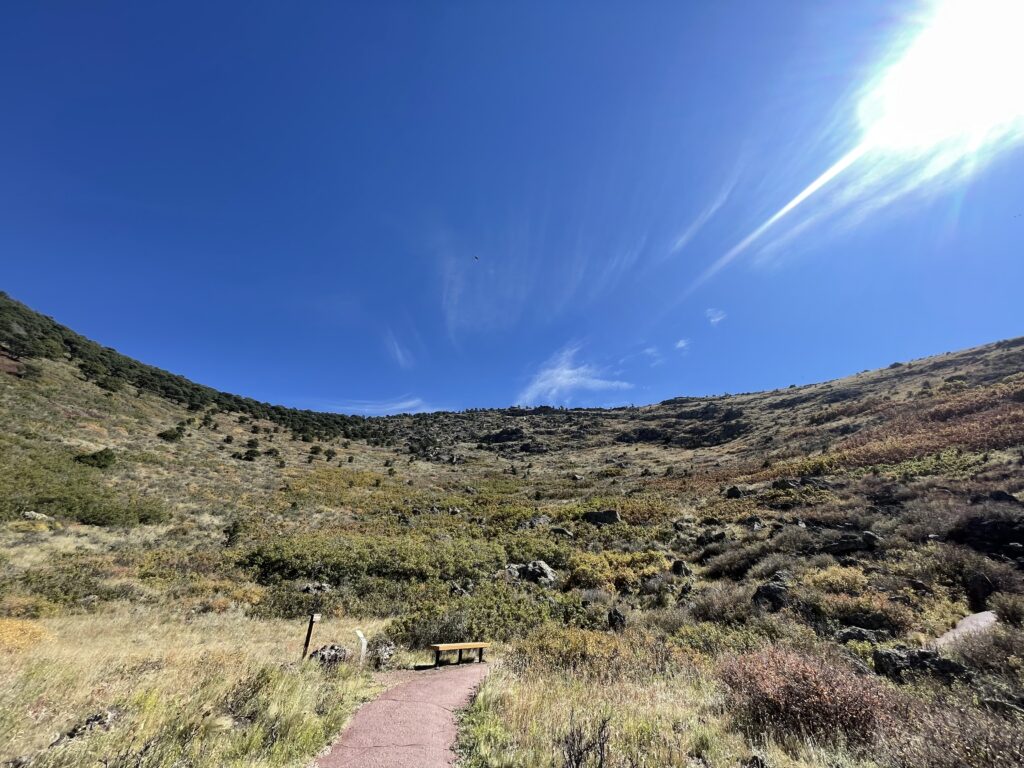
Views from inside the hardened crater inside the volcano:

View from the bottom of a crater...a dirt path leads to a wooden bench surrounded by dry grass and shrubs at the base of a sunlit, sloping hillside under a bright blue sky
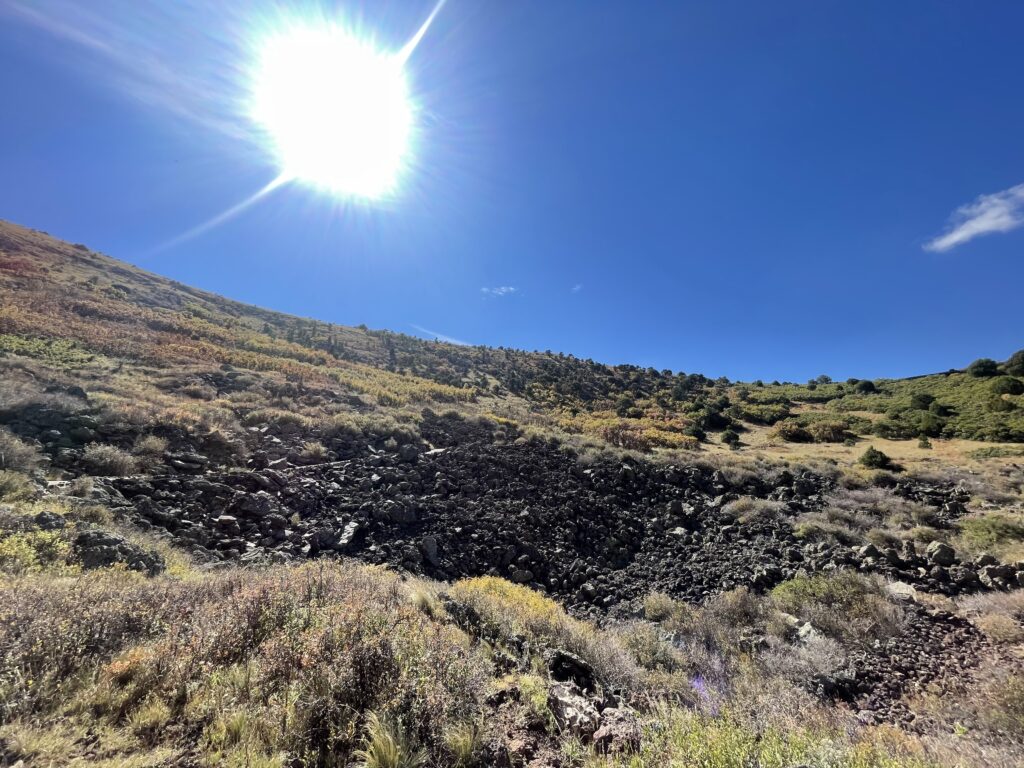
View from the bottom of the crater looking up the crater walls
View from the bottom of a crater, a bright sun shines over a sloping hillside with green bushes and brown, dry grass complete with black, lava rocks comprising much of the hillside; all under a clear, blue sky.
LAVA!

A paved road ends at a closed gate with several warning signs and a stop sign. Trees and greenery line both sides of the road under a clear blue sky.

Highway of Legends

The Trekkers love their scenic drives and we found another one on this trip! We drove the easier (read “paved”) portions of the Highway of Legends. If I had known about this and researched it more we could have done the whole highway as the rougher (read “dirt”) portion of it ran very near our Air B&B–but as I mentioned earlier this part of Colorado is often overlooked and I had never heard of the highway until we arrived to the region.

The Highway of Legends Scenic Byway is a dirt road that basically cuts through the middle of this wilderness area. It runs largely east and west and roughly connects the tiny villages of Aguilar and Cuchara and traverses Cordova Pass–this portion of the route is largely closed in the winter and should be approached with more caution if you drive a lower-clearance sedan or any time the weather is wet/snowy as conditions may be far worse than on other, more-traveled roads.

The Highway of Legends is largely a scenic loop that runs along Highway 12 and eventually connects with US 160 near La Veta. It meanders through the beautiful, Spanish Peaks mountains of southeast Colorado and many small and historical towns like Cokedale, Valdez, Stonewall Gap, Monument Park and Cuchara. It ultimately connects the towns of Trinidad and Walsenburg. (If you want to take the REALLY easy way between these two larger towns–read the “BORING!” way–you can just take I-25. 😝)

Sites along the highway included some artifacts of the old, coke ovens used in the processing of coal out by Cokedale. This was a lovely drive through the mountains and it gave us ideas of potential, quieter places to camp in the future!

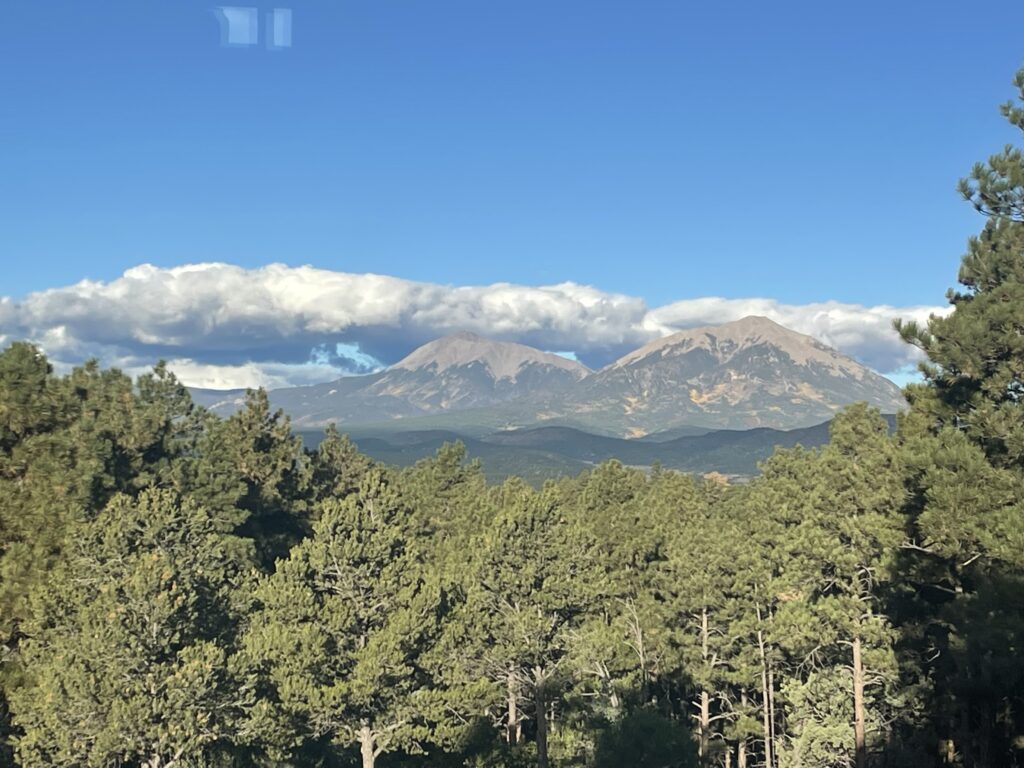
THE Spanish Peaks that the range was named after! 

Two mountains rise in the distance under a bright blue sky with fluffy white clouds, with a dense forest of green pine trees in the foreground.
We had this incredible view from our Air B&B!

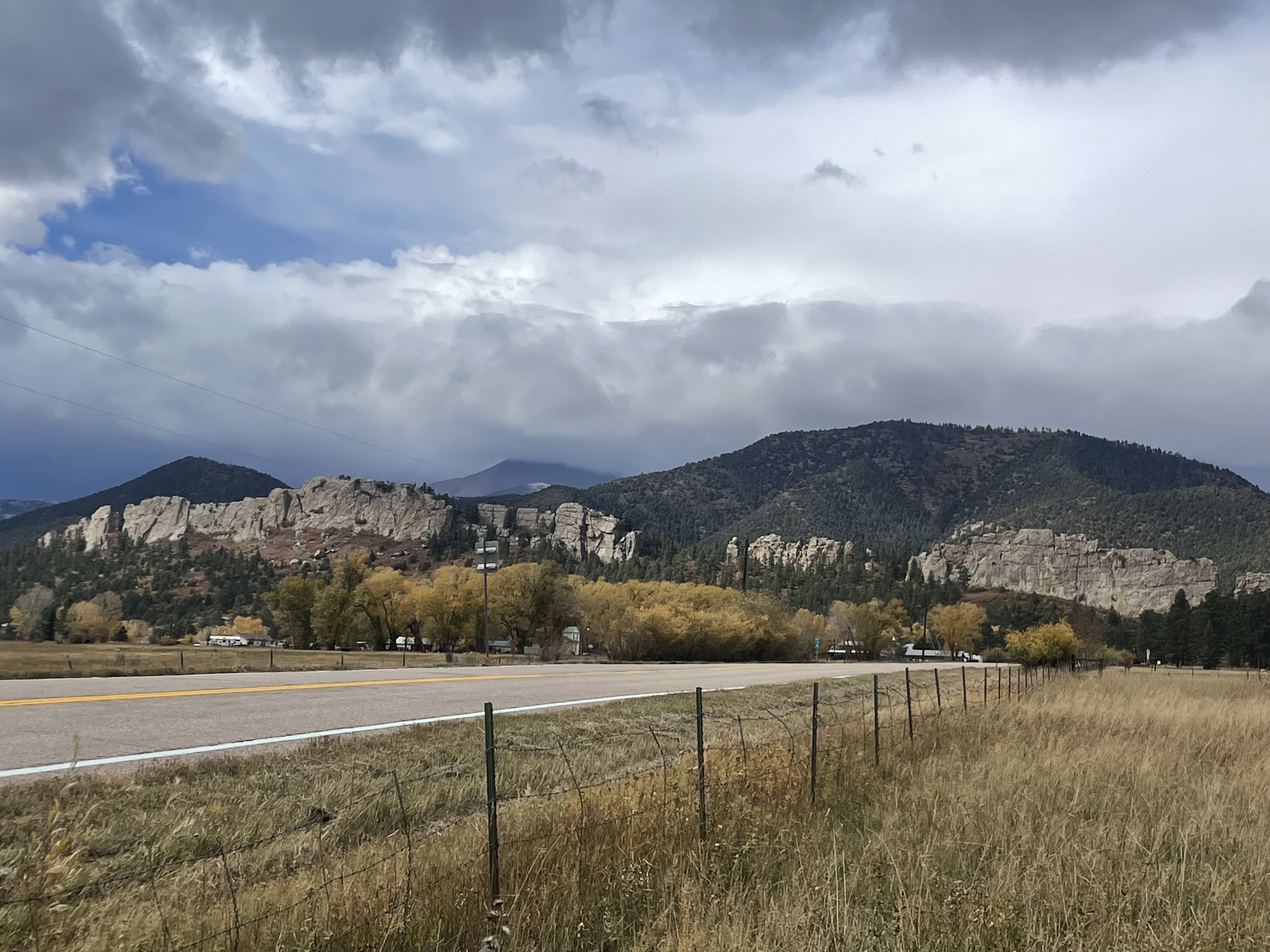
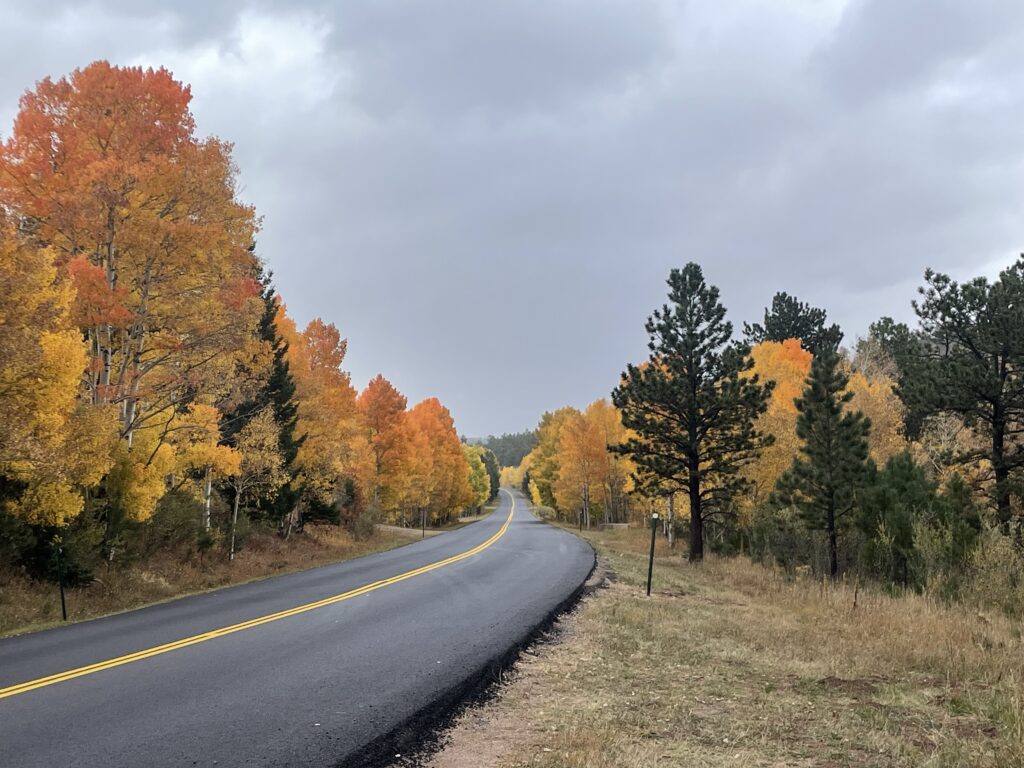
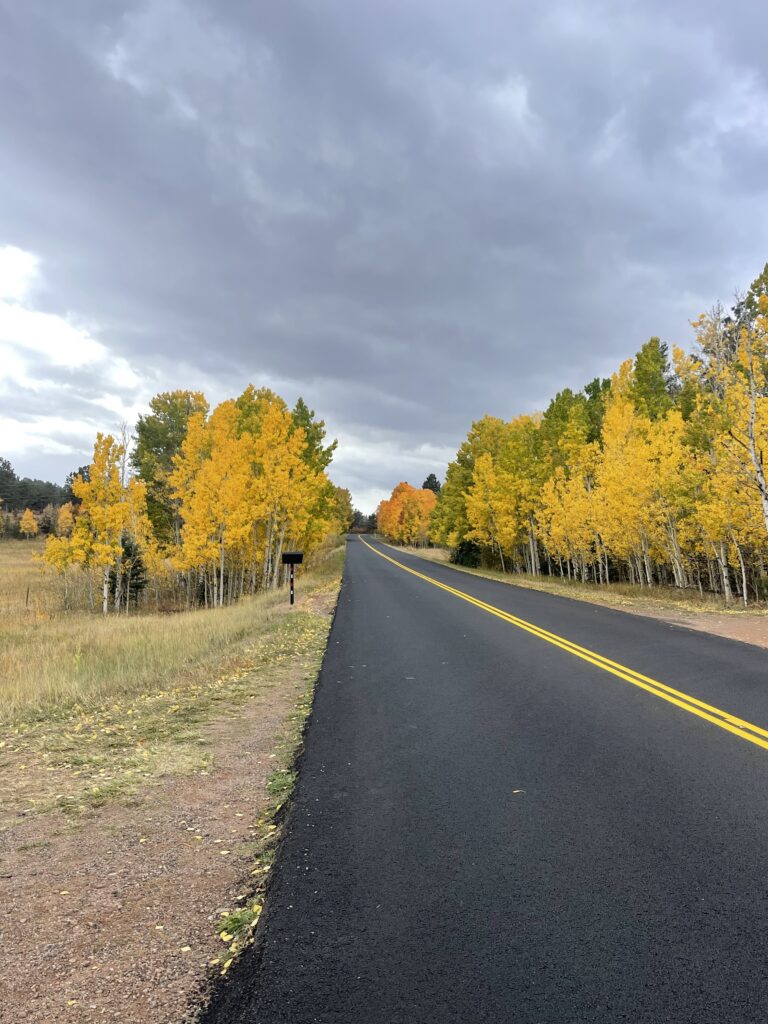
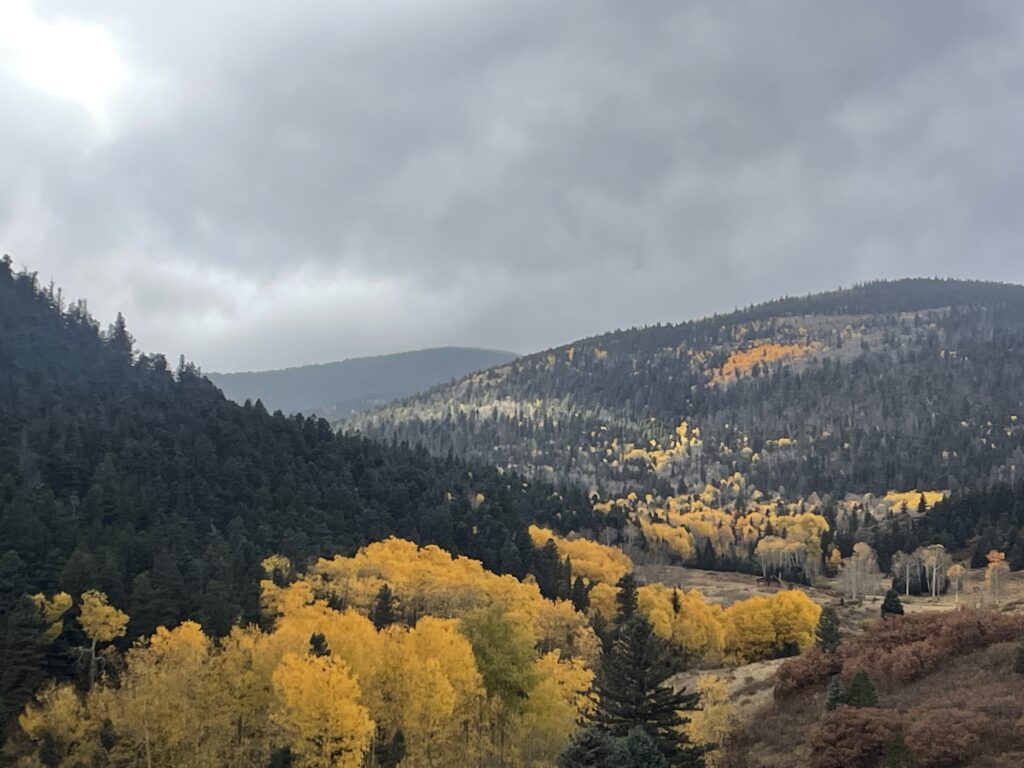
We happened to drive the Highway of Legends on a cloudy, rainy day in October…it was BEAU-tiful and perfect for Fall colors!

A two-lane road runs past a wire fence and grassy field, with rocky hills, scattered trees, and cloudy skies in the background. A road winds through a forest with vibrant autumn foliage. Trees with yellow, orange, and green leaves line both sides of the road, and the sky above is cloudy and gray. A road runs through a rural area lined with trees showcasing bright yellow and some orange autumn foliage under a cloudy, gray sky.

A landscape of rolling hills covered in trees, with vibrant, yellow autumn foliage mixed among dark green pines, under a cloudy, gray sky.
Colorado, being moody!

Tarantula Migration in the grassland of southeast Colorado!

Authors note: I feel the need to remind my dear readers of my utter fear of arachnids! 😂 

La Junta, Colorado is a small town located about 60 miles east of I-25 and Pueblo near the Comanche National Grassland area. A unique occurrence happens here every fall. From September through early November thousands of large spiders trek around the dry grassland in search of love! (As someone with a severe case of arachnophobia, even I say, “aww!”)

This is a website put out by the town of La Junta–they even tell you prime places to go to see the spiders!

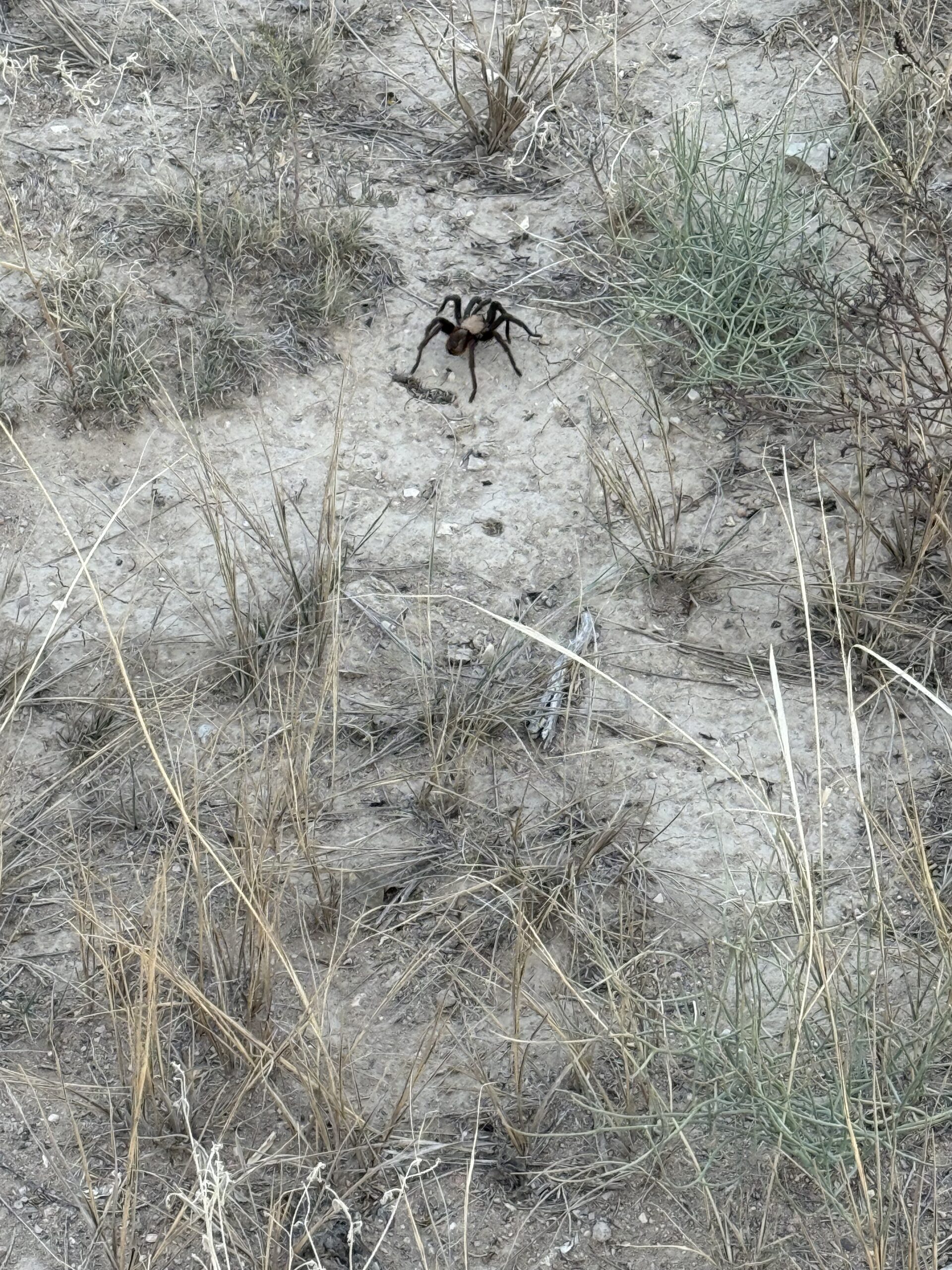
Basically, the male spiders hang out in their burrows mostly sleeping and eating for 5 – 10 years. Then, one fall, they get an urge and go searching for lucky lady spiders–who pretty much just hang out around their burrows for their MUCH longer lives (the females can live up to 25 – 30 years!)

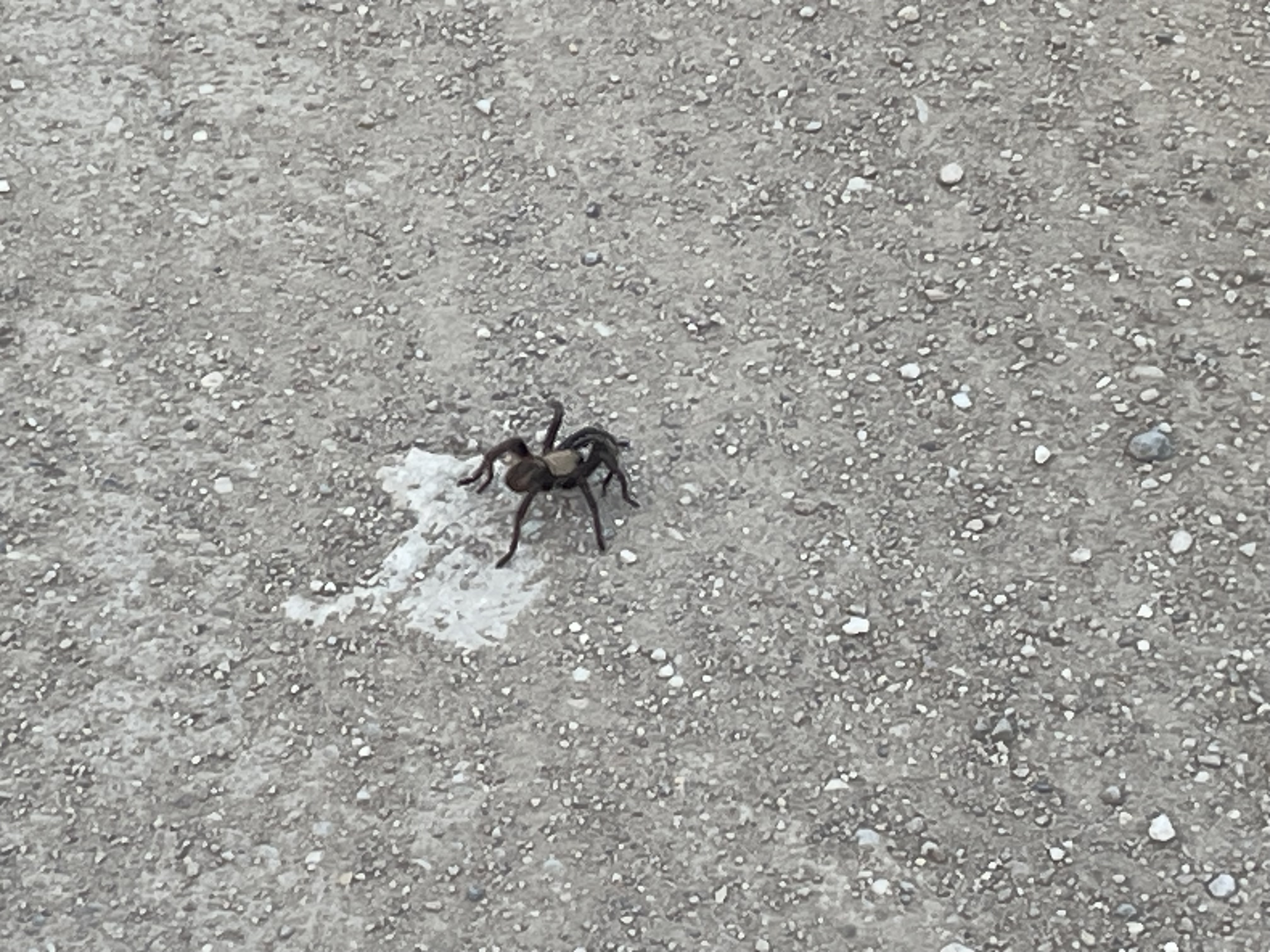
A large, black and tan tarantula crawls on dry, sandy ground scattered with sparse green and brown grass.
Just an old man looking for love

There are a bunch of places to view the spiders but honestly, just drive the dirt roads around the Vogel Canyon area around sunset. (This is located in the Comanche National Grassland off Route 109 south of La Junta, Colorado.) The spiders use those roads as a highway!

Drive slowly and cautiously so you don’t hit them…and you can’t miss them! They are about the size of a human hand–legs included. I HATE spiders but these guys are SO CUTE as they kind of dance across the dirt! (Click here for a quick spider video!)

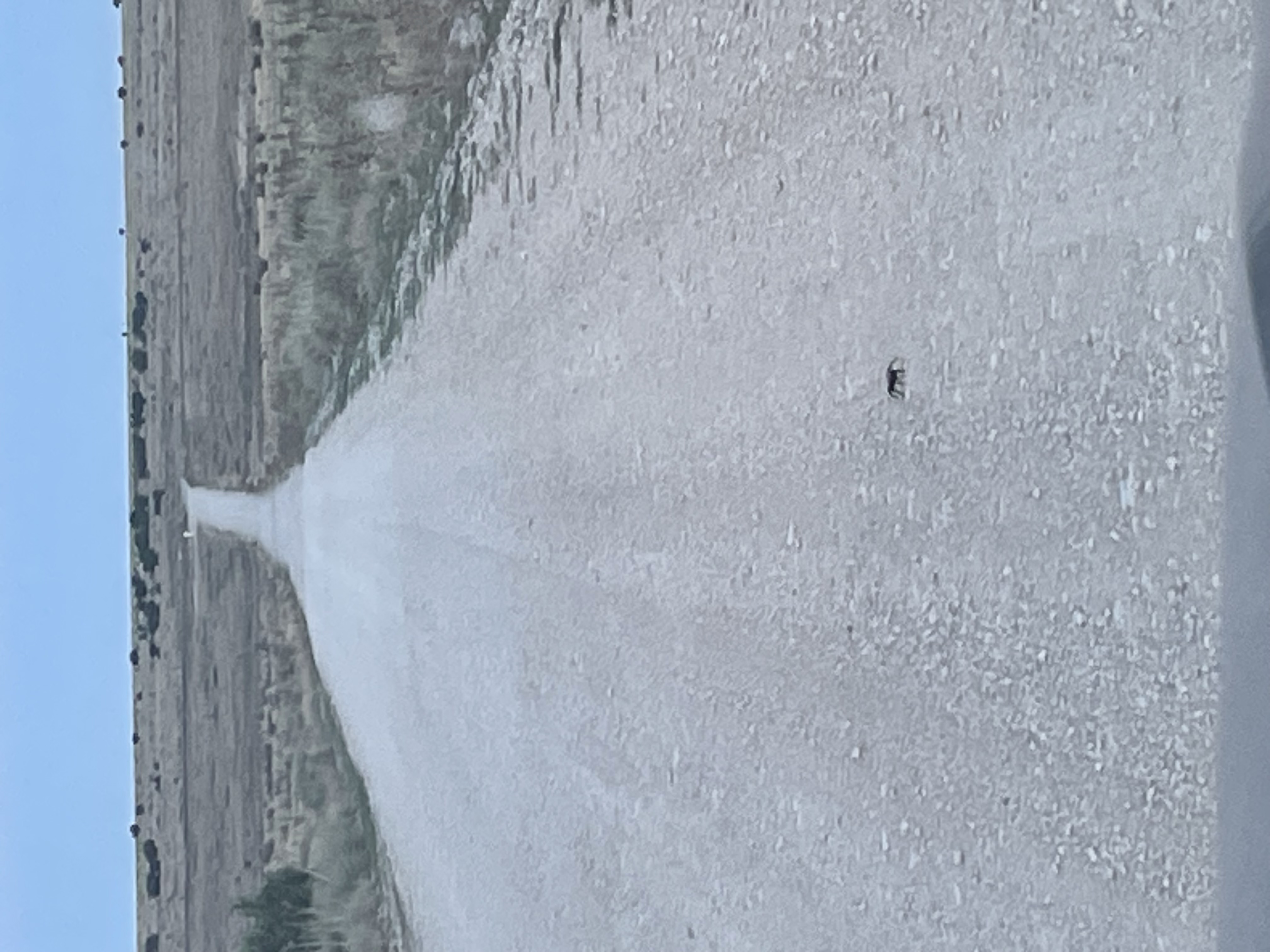
A long, straight, dirt road stretches into the distance across a dry, grassy plain. In the foreground, a dark tarantula, crosses the road. The sky is pale blue.
Spider on the highway!

Give these old guys their space though! The spiders aren’t venomous (though individual people could be allergic to their bite. Apparently they can also jump up to like two feet if they feel threatened…😮 and they can shoot the hairs off their back a ways which can imbed in your skin and get really itchy.)

Also, the spiders are pretty fragile so if you try to pick them up and accidentally drop them they can be injured–overall, just give these poor, old men a break. Most of them have completed their final molt and they’ve got one purpose left in life before they either become prey for a passing bird/snake, die of starvation or, as is common in spider world…they become dinner for their hungry mate!–there are worse ways to go out I suppose though, then enjoying a little romance. 😉

A close-up of a large, black ant walking on a gravel road, scattered with small pebbles and white spots.
The spiders were SO CUTE!
To Conclude

Southeastern Colorado isn’t nearly as well-known or popular as the majority of the rest of the state but that doesn’t mean it isn’t worth a visit. It is kind of a hidden gem that still offers some incredible beauty as well as a quieter, more secluded experience than much of the rest of the Rocky Mountain State.

So if you’re looking for a different, family (and wallet)-friendly travel option in Colorado, check it out!

Like what you read here today?  Please feel free to leave a comment, like, or share this post!  Add your email at the bottom of the page, or the sidebar to the right, to be notified when a new post is published.  

Enjoy Fort Robinson State Park and Toadstool Geologic Park

In this post, I discuss a summer adventure to this great, state park in western Nebraska


Nebraska isn’t all flat cornfields! Looking for some hidden gems for recreation? Check out Fort Robinson State Park and Toadstool Geologic Park, both located in the far, northwestern corner of the state!

Fort Robinson State Park

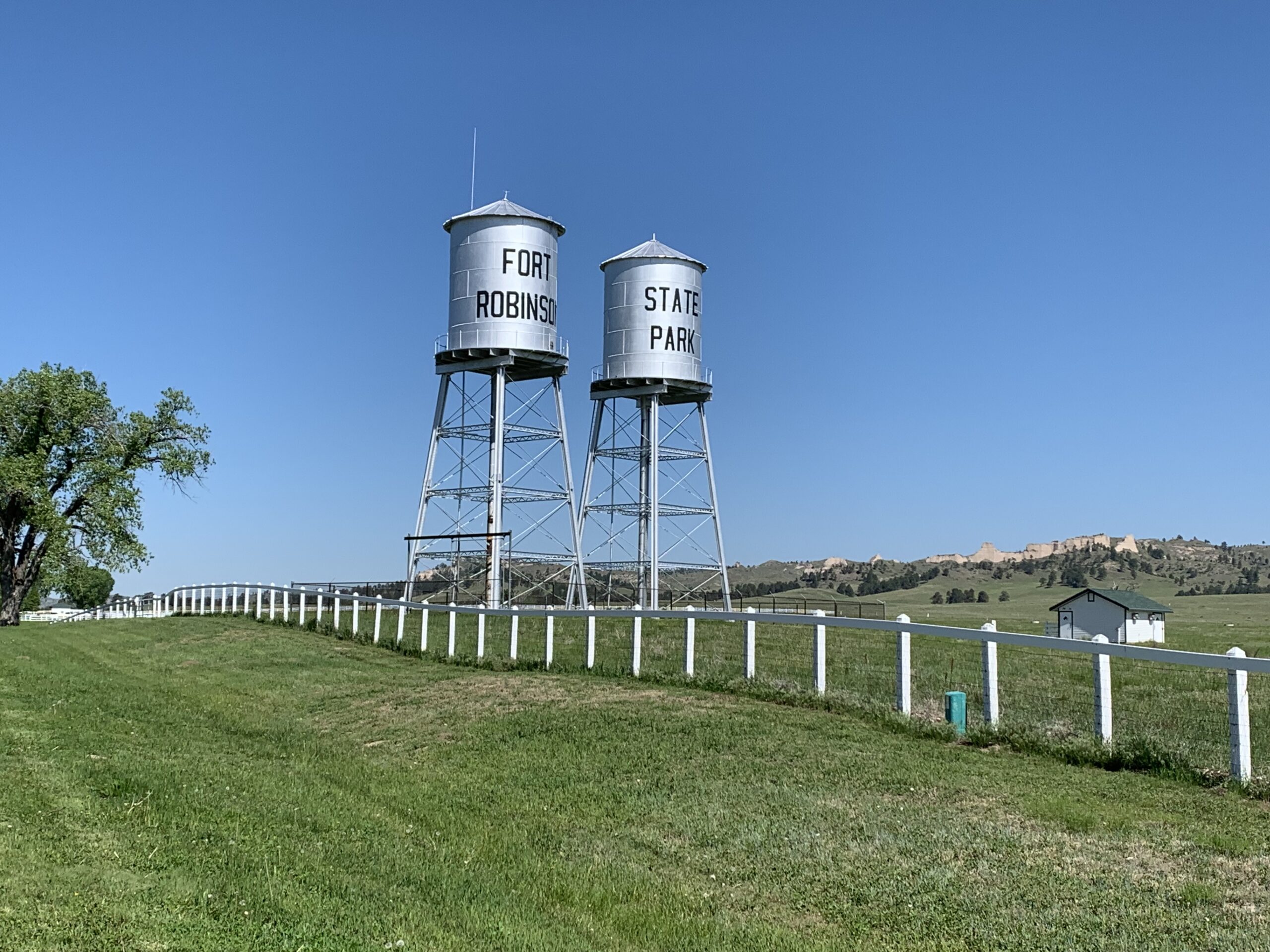
Fort Robinson State Park is a great place to visit! It is a former fort (hence the name 🙃) that has been transformed into a family-friendly rec area! It offers hiking paths, history, and many of the old soldiers’ Quarters were refurbished and are now available for vacation rentals. This is unique and allows Fort Robinson to actually be known as a great, family reunion destination.

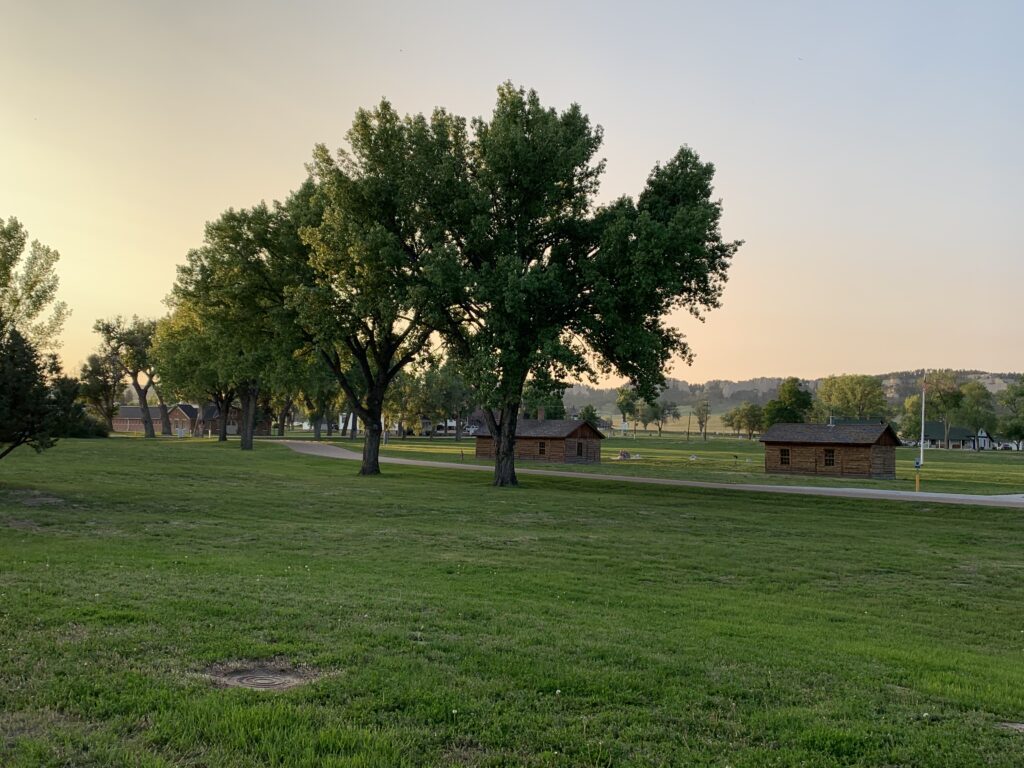
Sometimes called a “gem of Nebraska State Parks”, Fort Robinson was quite nice! (It’s a little-known fact that western Nebraska is actually very pretty! I recommend it over the rest of the state!) The park features LOTS of shade trees!

A grassy park at sunset with several tall trees and small wooden cabins spaced throughout the area, under a clear sky.

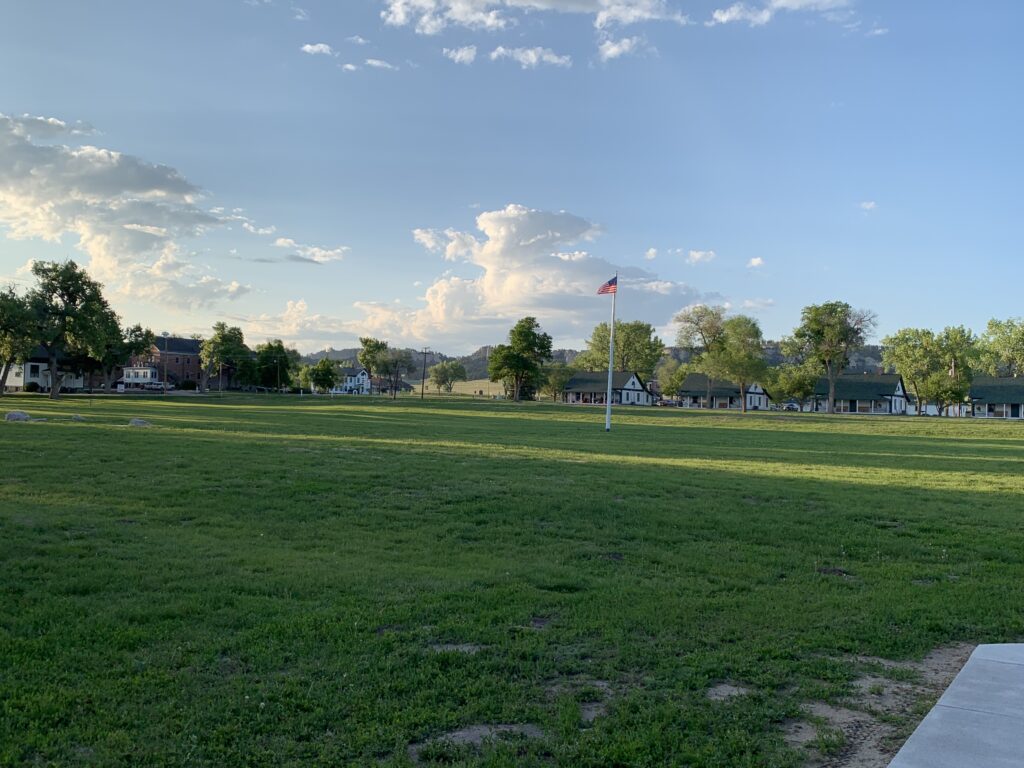
A wide grassy field with an American flag on a flagpole in the center, surrounded by small buildings and trees under a blue sky with scattered clouds.

We did struggle with some ticks and bugs though at least it was quite green when we were there in late May. The mosquitoes weren’t bad though I’m sure they could be at times (and the tent-camping section was all grass, under trees, near the creek. It seemed fairly dark and damp–it looked like a great place to snag a few-hundred mosquito bites! 😝)

To be fair, we’ve only been to two of them, but this has been our experience with Nebraska state parks. We’ve never been impressed with their tent-camping areas (we had another disappointing, tent-camping experience at another Nebraska state park, on a Great Plains road trip, several years ago–though it did result in some Northern Lights viewing!)

For this trip, we actually chose to stay in the RV camping area. Though the sites were pretty tightly packed we were quite happy with this option.

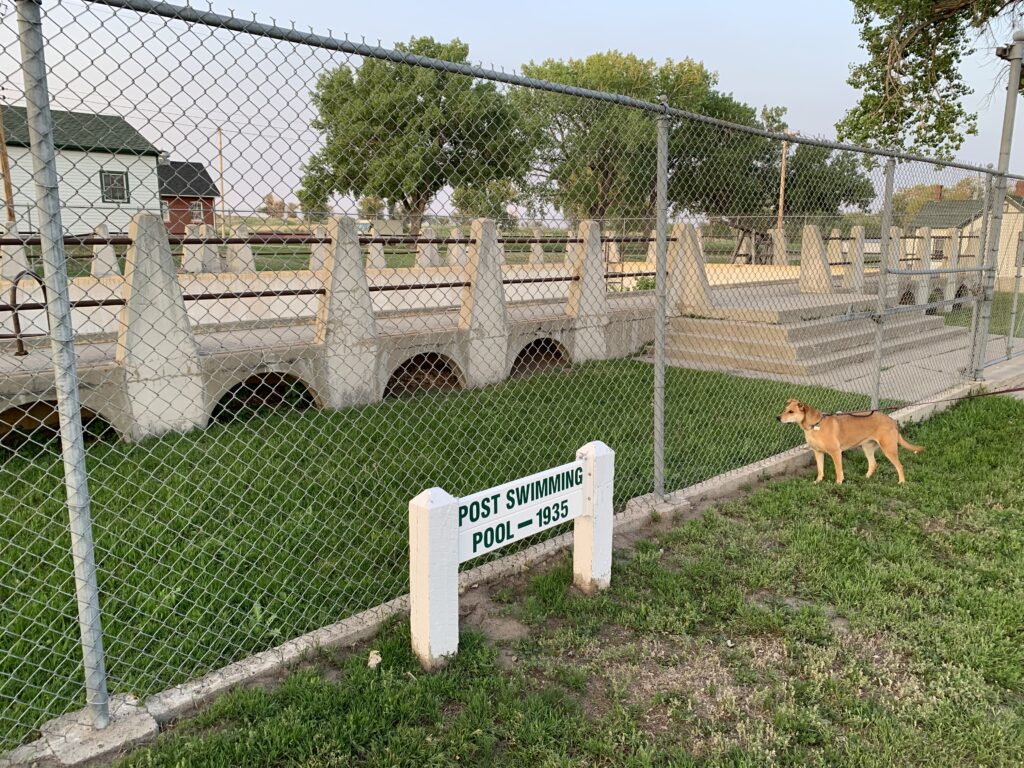
A fenced-off historic pool structure labeled Post Swimming Pool – 1935 stands behind a chain-link fence, with a dog looking through the fence. Trees and houses are visible in the background.
Puppers checking out the old, fort pool
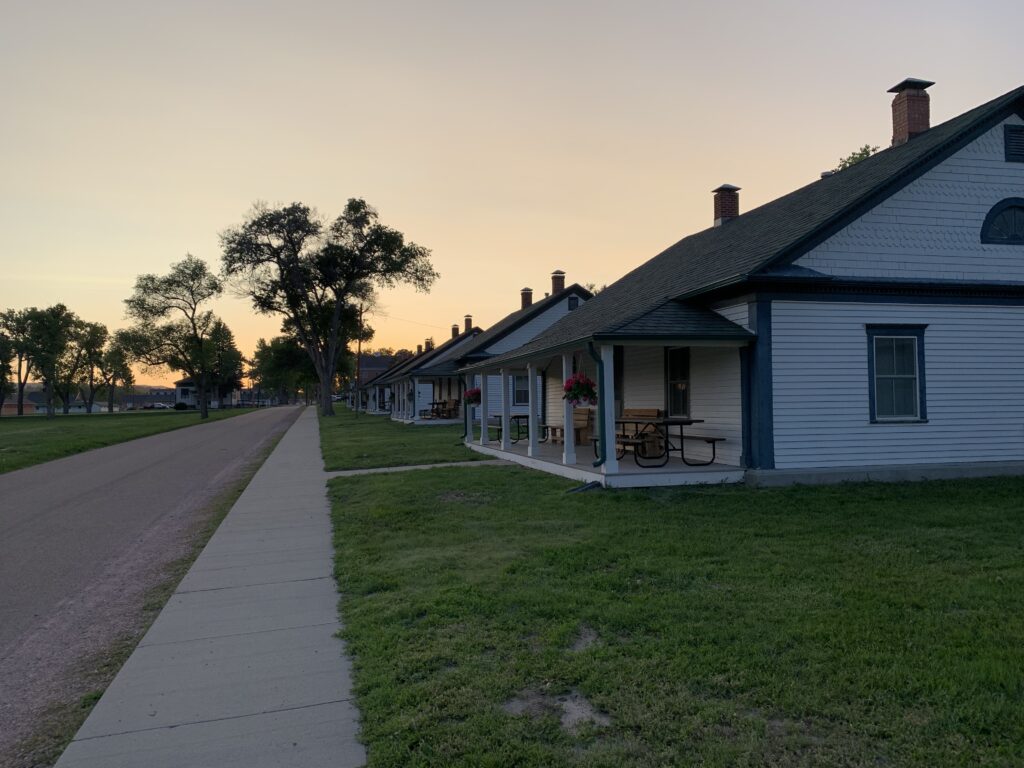
A row of white houses with porches lines a quiet street at sunset, with a sidewalk and grass in the foreground and trees in the background.
These were Officers’ Quarters that are now available for rent!
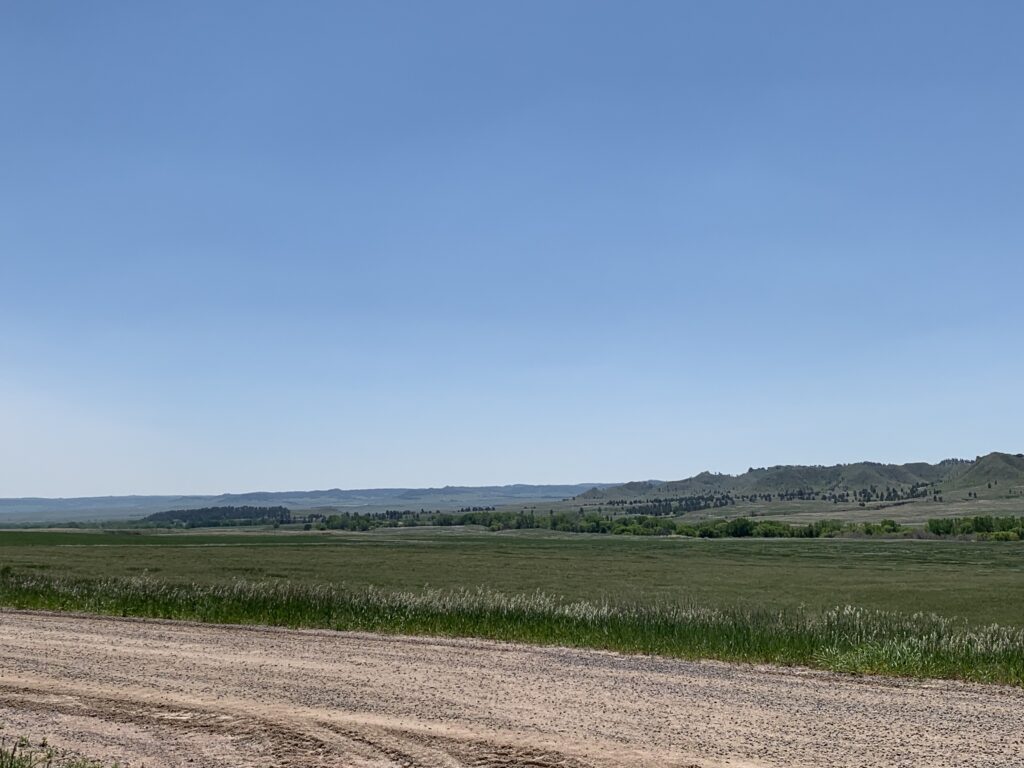
A dirt road runs alongside a wide, open grassy field under a clear blue sky, with distant hills and scattered trees on the horizon.
Western Nebraska is quite beautiful!
Where is Fort Robinson Located?

Fort Robinson sits right on US Hwy 20 in far, northwest Nebraska, less than five miles southwest of the small town of Crawford.

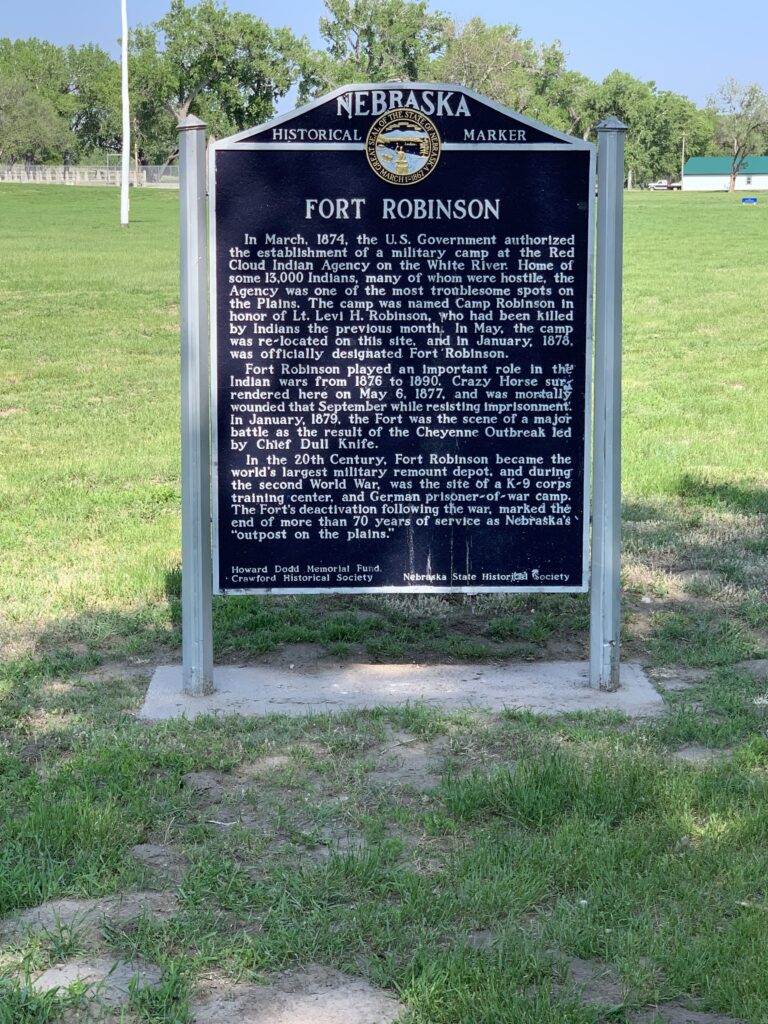
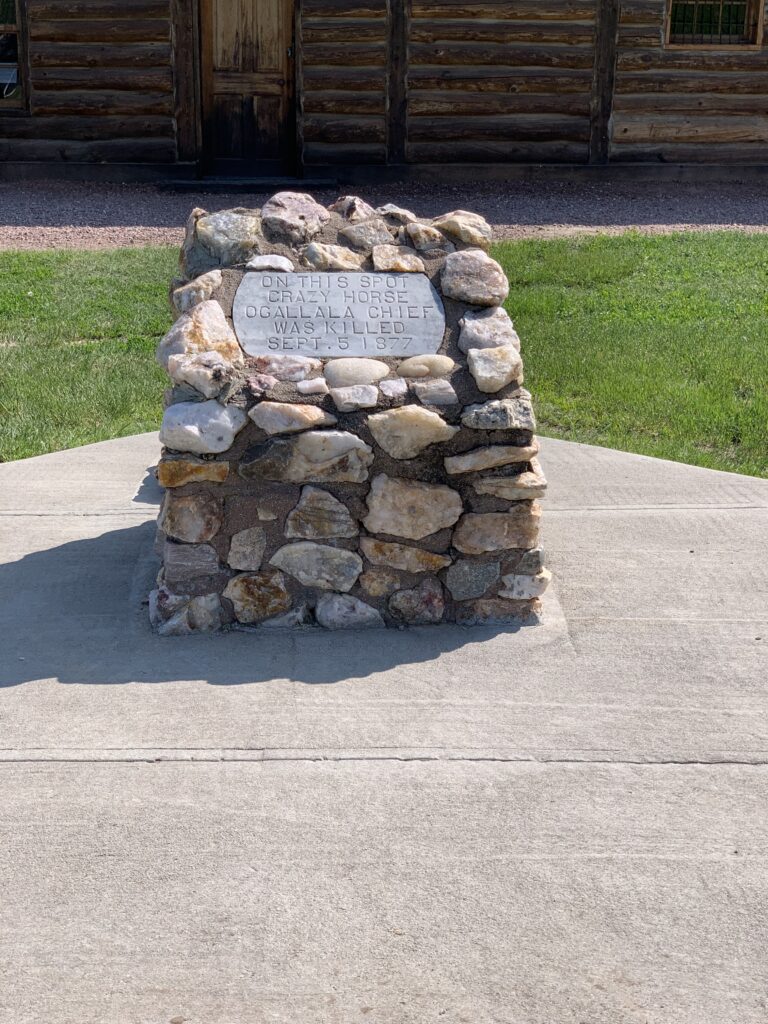
The park has quite a storied past. It started as a fort during the Indian Wars in the 1880s–this was actually the sad location of the death of Crazyhorse, the great Lakota warrior.

A historic sign reads, "Fort Robinson" and gives details about the fort

A stone marker reads "On this spot, Crazy Horse Ogallala Chief was killed, Sept 5, 1877". A wood cabin is in the background.
The actual site where Crazyhorse died

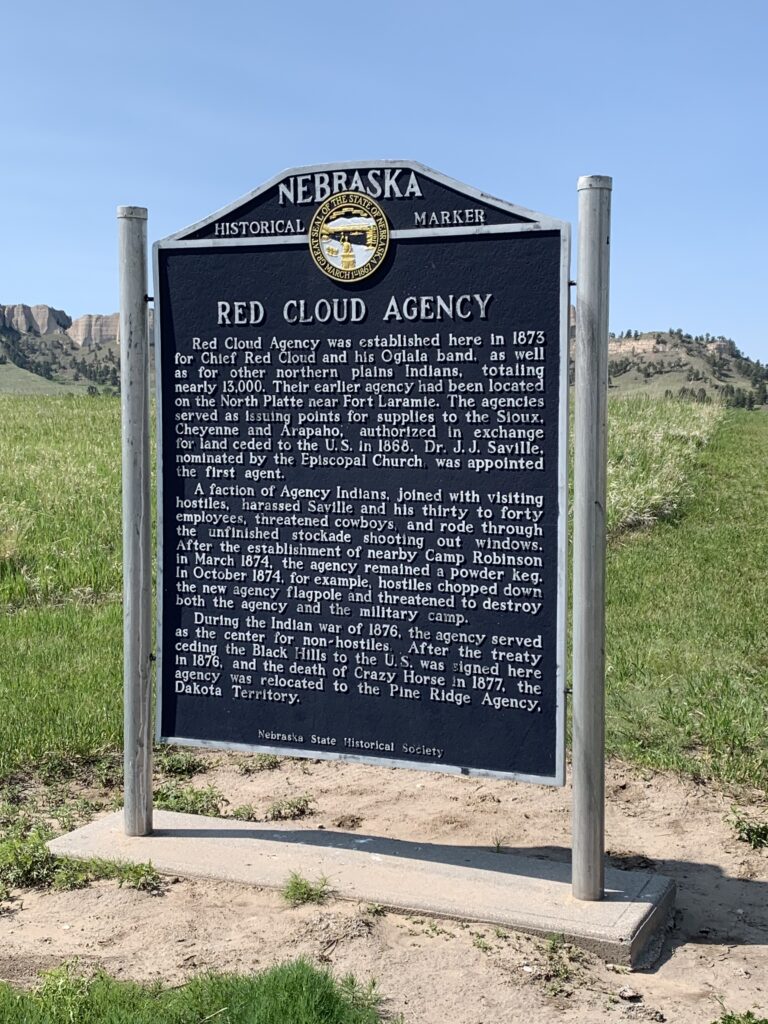
Fort Robinson also served as a large reservation for many American Indians including Red Cloud and his people.

A historical sign describes the Red Cloud Agency--a former American Indian reservation that was located at this spot.

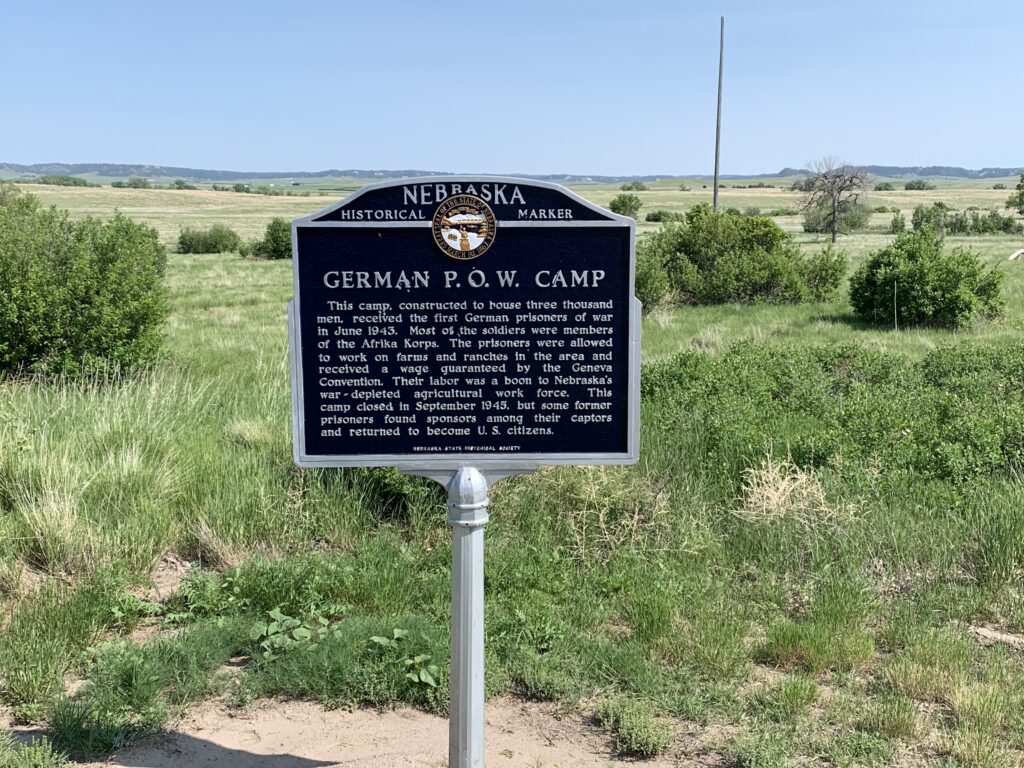
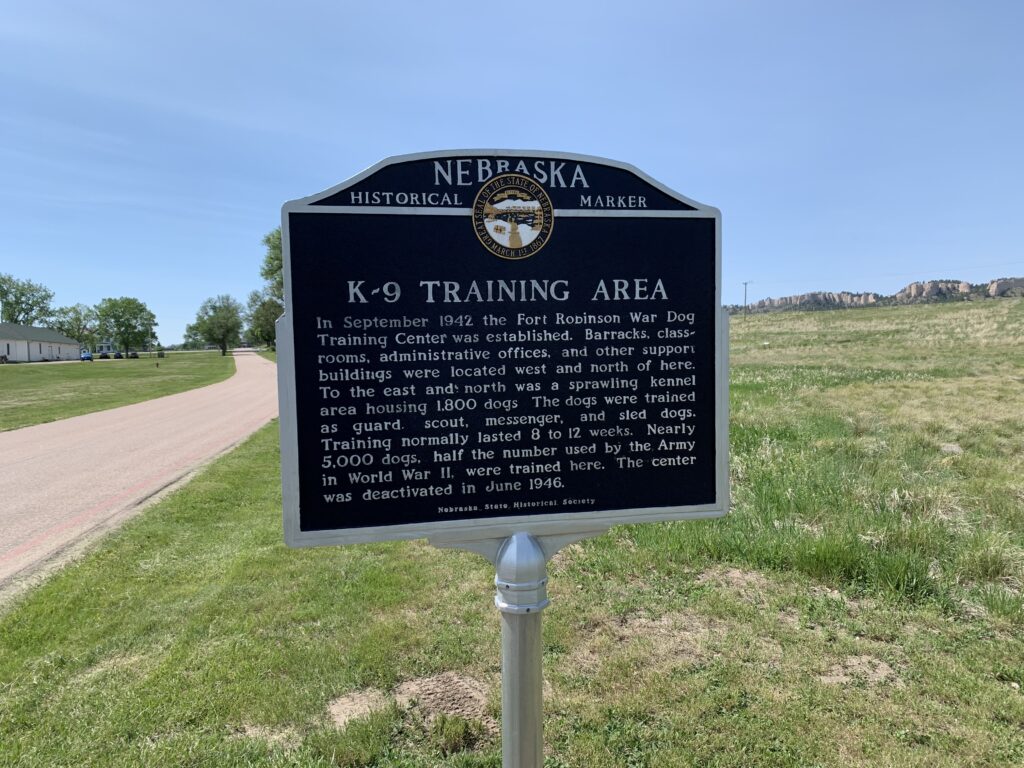
The fort was also a “remount” location for Calvary horses (meaning the battle horses and their wounds were treated here and new mounts were provided). Fort Robinson was also a war-dog training camp and a German, Prisoner of War camp during World War II.

A Nebraska Historical Marker stands in a grassy field. The sign reads “German P.O.W. Camp” and provides historical information about a World War II camp for German prisoners of war in Nebraska. Bushes and open plains are visible behind.

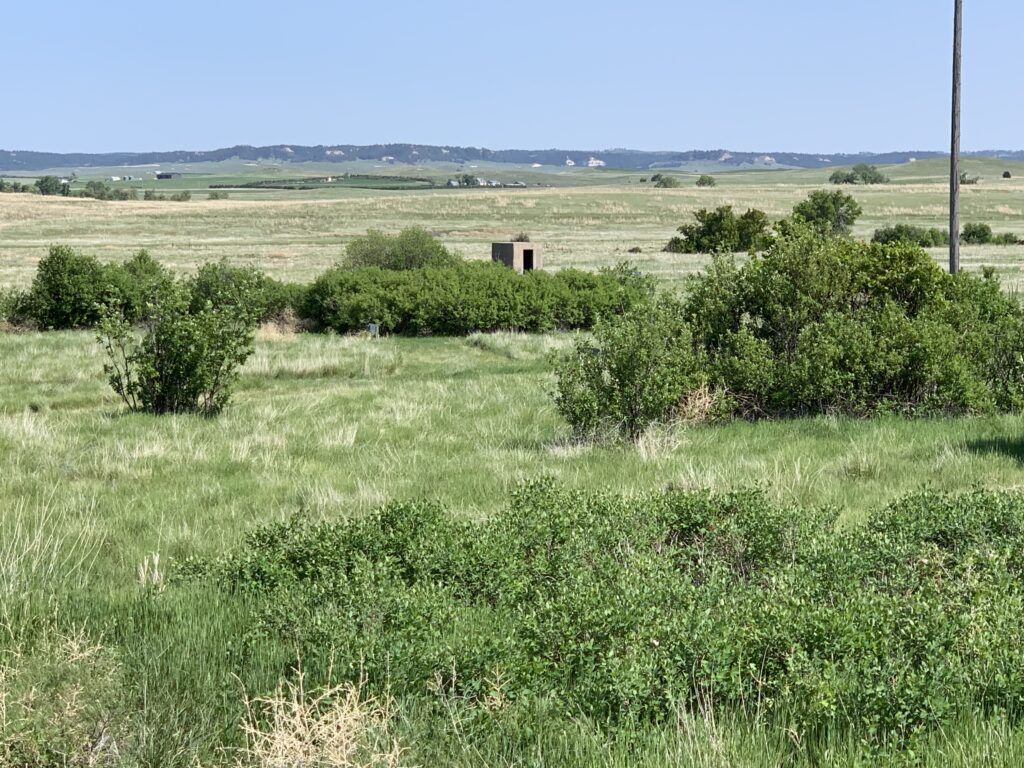
A grassy field with bushes. In the distance is a small, cement bunker-type building
This is about all that remains of the former, German, POW camp
A Nebraska historical marker titled K-9 Training Area stands by a road and grassy field, describing the World War II war dog training center established in 1942 and deactivated in 1946.
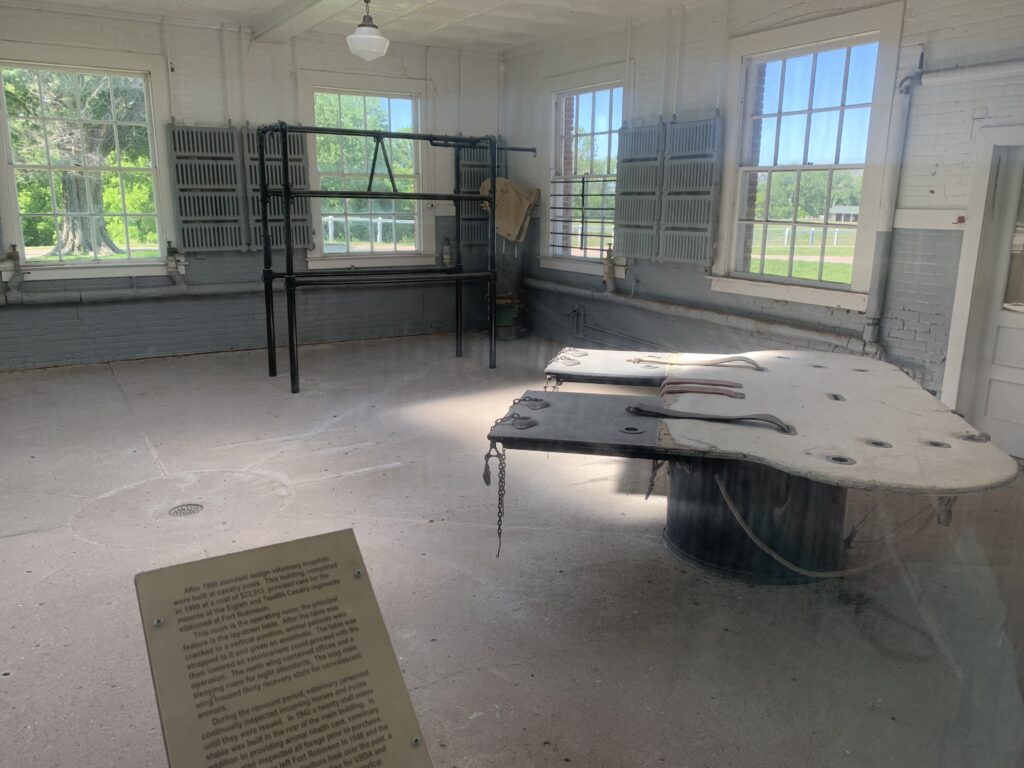
A sparsely furnished, sunlit room with large windows, an old examination table with restraints, and metal racks along the walls, viewed through glass. Trees are seen outside.
Horse vet center! That table moves to the vertical. They would strap a standing horse to it, sedate the animal and then move the table–with the horse strapped to it–back to the horizontal to perform procedures–not bad for 1940s technology!

Toadstool Geologic Park

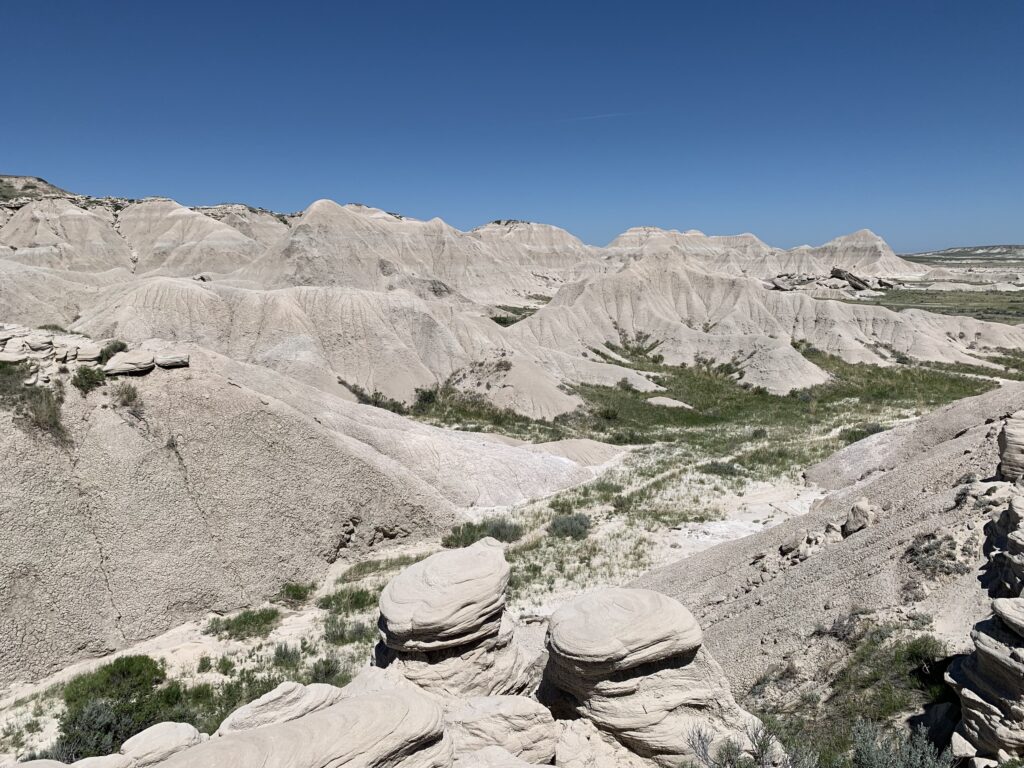
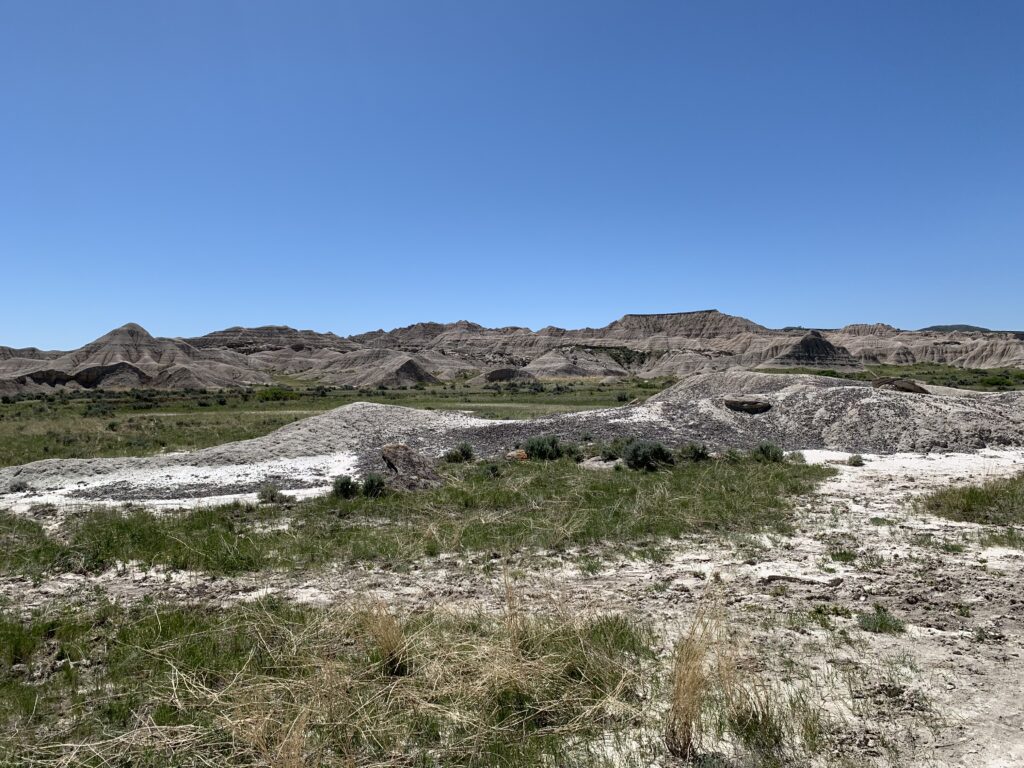
Toadstool Geologic Park is literally in the middle of nowhere! It is situated in the far, northwest corner of Nebraska, about 30 miles north of Fort Robinson, 20 miles northwest of the small town of Crawford and 40 miles west of Chadron, Nebraska.

The park looks a lot like Badlands National Park in South Dakota or the North Dakota Badlands at Teddy Roosevelt National Park–you can read more on that hidden gem here!

Light-colored rock formations and rolling hills under a clear blue sky with sparse green vegetation scattered throughout the landscape.

A dry landscape featuring rocky hills under a clear blue sky, with sparse green grass and patches of white, sandy soil in the foreground.

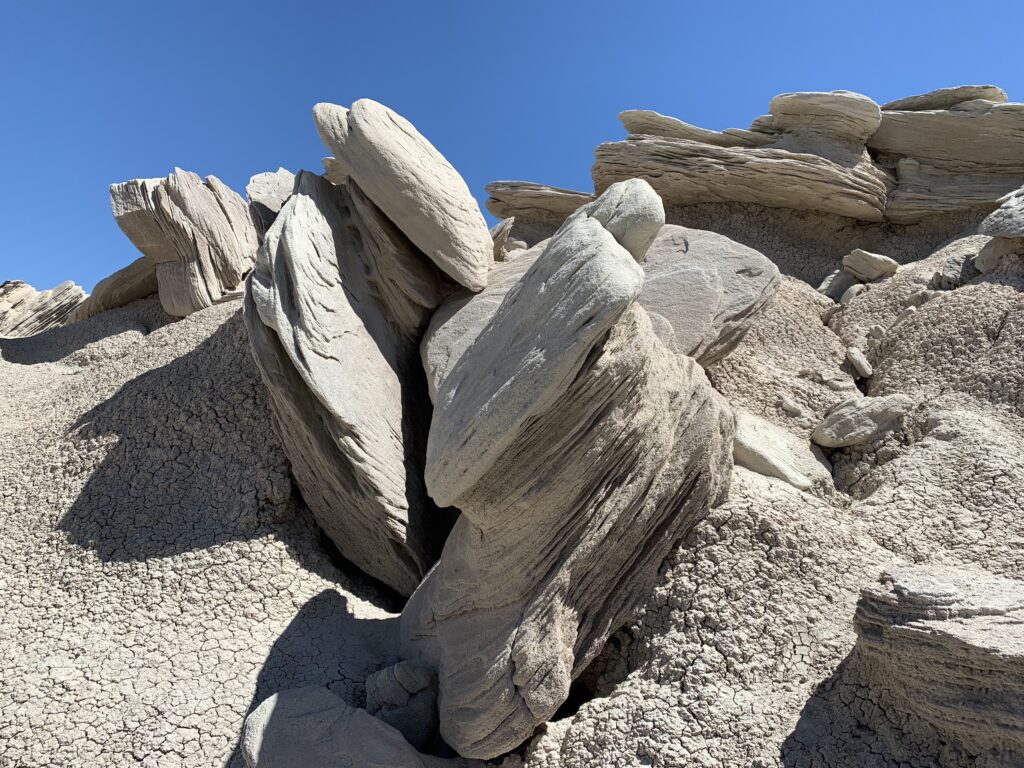
Toadstool Geological Park is mostly a place for hiking though it does offer some camping options…

This was my first big hike after severely breaking my ankle a few months prior. It was a little tougher than we were first expecting for a “nature trail” but I finished the route thanks to my awesome trekking poles and help from Mr. Trekker!

The trail said it was a one-mile “nature trail” which are usually fairly easy. This hike wasn’t “difficult” but there was plenty of uneven ground and some scrambling on loose gravel as well as a few steeper ups and downs…

We learned later that I “may” have gotten a little too aggressive with twisting my ankle around on the uneven ground on this hike. A few weeks later, at my next ankle-surgeon checkup, we found out I broke one of my titanium pins! 😅 The doctor was like, “How did you manage that?!”–she had planned to take it out anyway 😇 

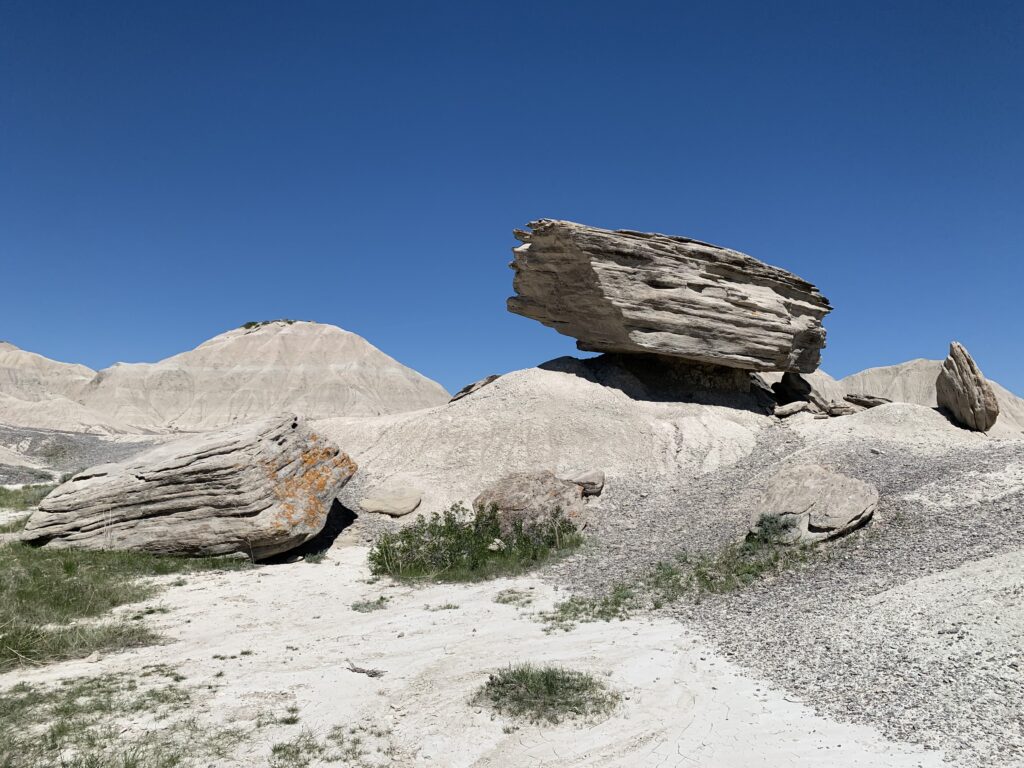
A short hill with large, flat rocks layered on each other that lay on their sides surrounded by light-colored gravel all under a clear, blue sky.

A large, flat boulder is precariously balanced on a mound of pale, rocky ground under a clear blue sky.

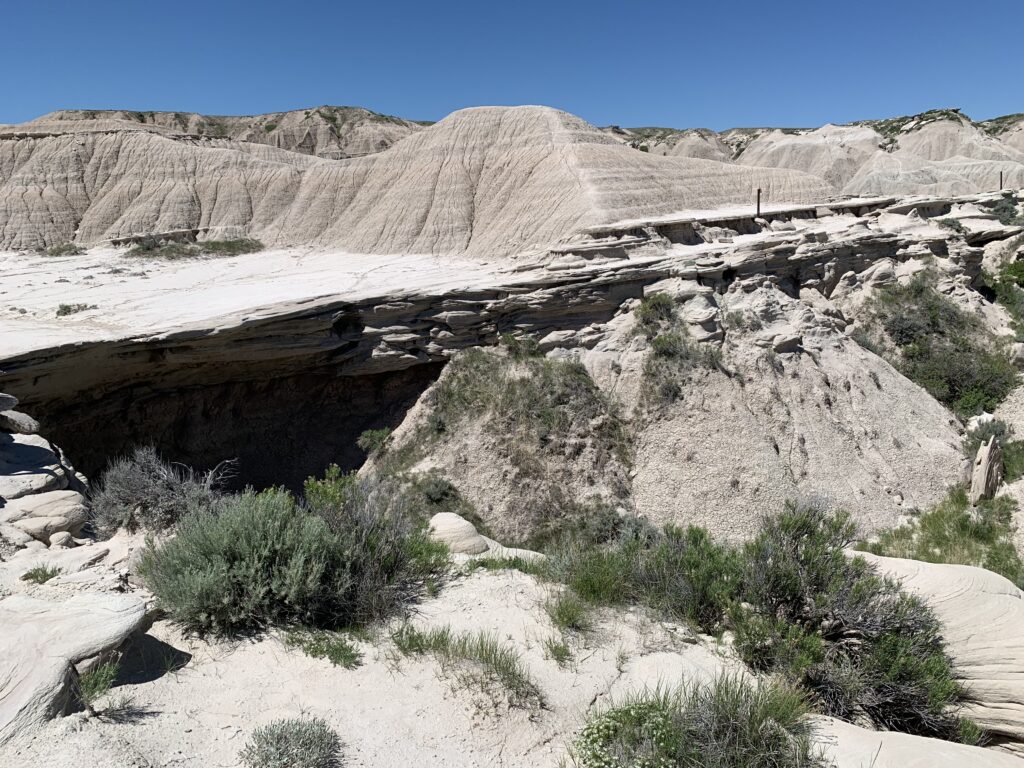
A natural stone bridge spans a deep ravine in a dry, rugged, badlands landscape under a clear blue sky, surrounded by sparse green shrubs and layered rock formations.

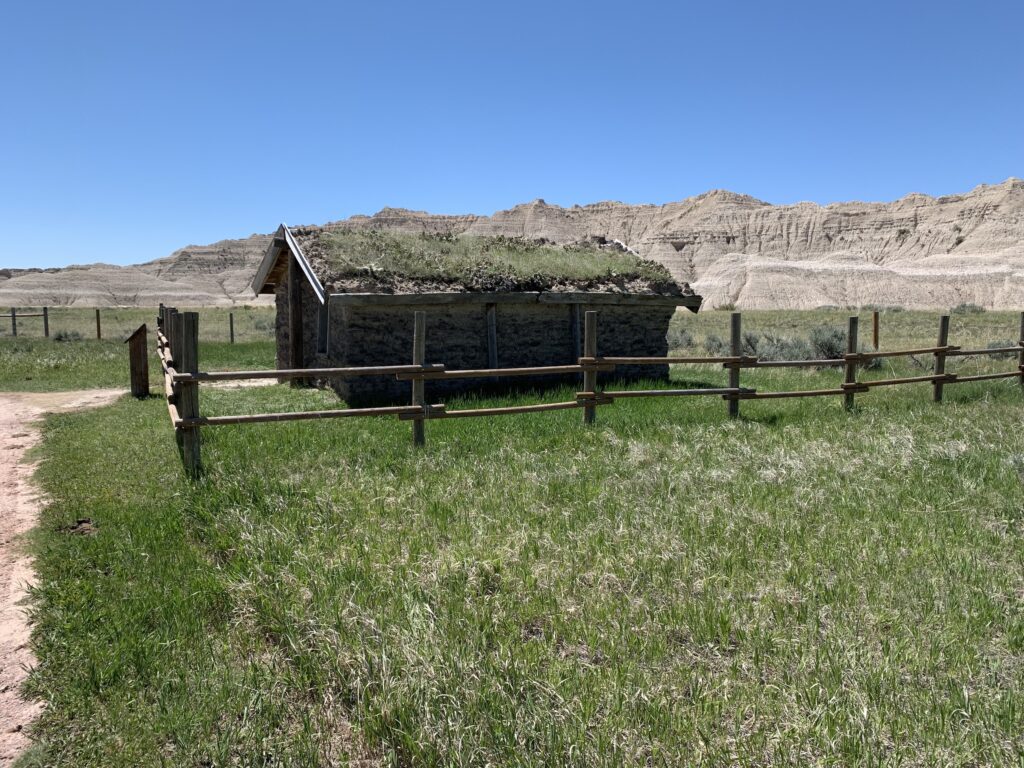
A small log cabin with a sod-covered roof stands behind a wooden fence in a grassy field, with rocky hills and a clear blue sky in the background.
This is a mockup of a sod house–these were common in this part of the country in the past

If you’re looking for some great, family-friendly outdoor and camping options in western Nebraska, check out Fort Robinson State Park and Toadstool Geologic Park!

Like what you read here today?  Please feel free to leave a comment, like, or share this post!  Add your email at the bottom of the page, or the sidebar to the right, to be notified when a new post is published.  

Teddy Roosevelt National Park

In this post, I discuss what you’re missing from this national park you may not know exists!

**Author’s note: Just a word of warning, as this is a National Park, no dogs are allowed on any trails (exceptions for Service Animals). They are only permitted in the campgrounds and parking lots.**

The Trekkers have had Theodore Roosevelt National Park, in southwestern North Dakota, on our bucket list for quiet a while. We wanted to go fairly early in the season, so it would still be green, and in mid-June it was BEAU-tiful!

This was one of the first trips we took once I could start hiking again after I had been laid up for MONTHS thanks to surgery for an ankle that was broken in two places (along with being dislocated and a torn tendon) after a NASTY fall on the ice. 😝 I was finally able to start getting back out there!

Teddy Roosevelt National Park is named after the 26th President of the United States as he lived in this area for a while (before becoming President). He credits his time there as inspiring him to the Presidency.

I’ve come to decide “Teddy” may be my favorite President. They did call him the “Conservation President” after all! He originally came west to help him escape the pain of several serious, personal losses (one of the “loves of his life”, his first wife, died from complications after childbirth THE SAME DAY his mother died of typhoid fever! 😪)

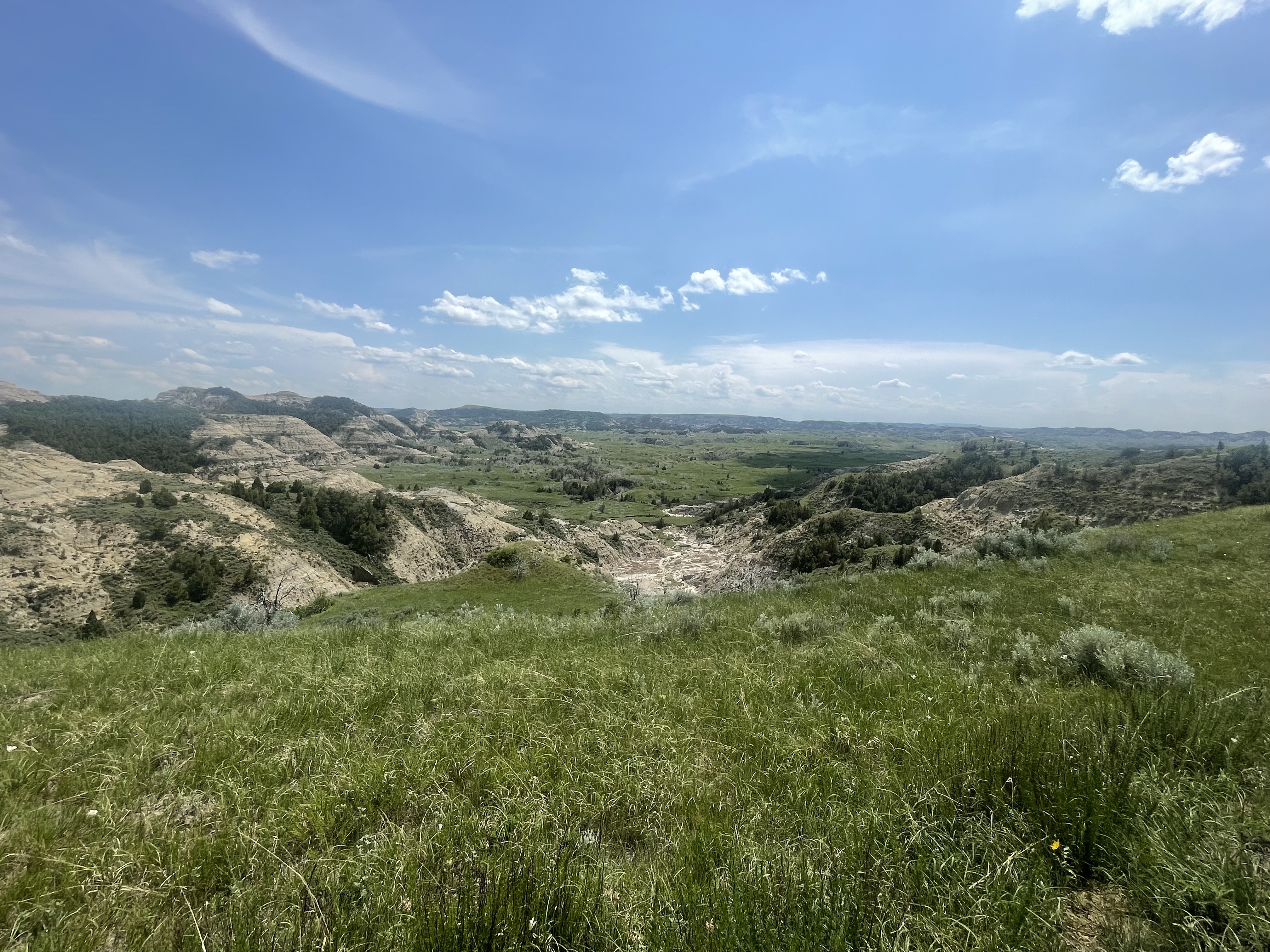
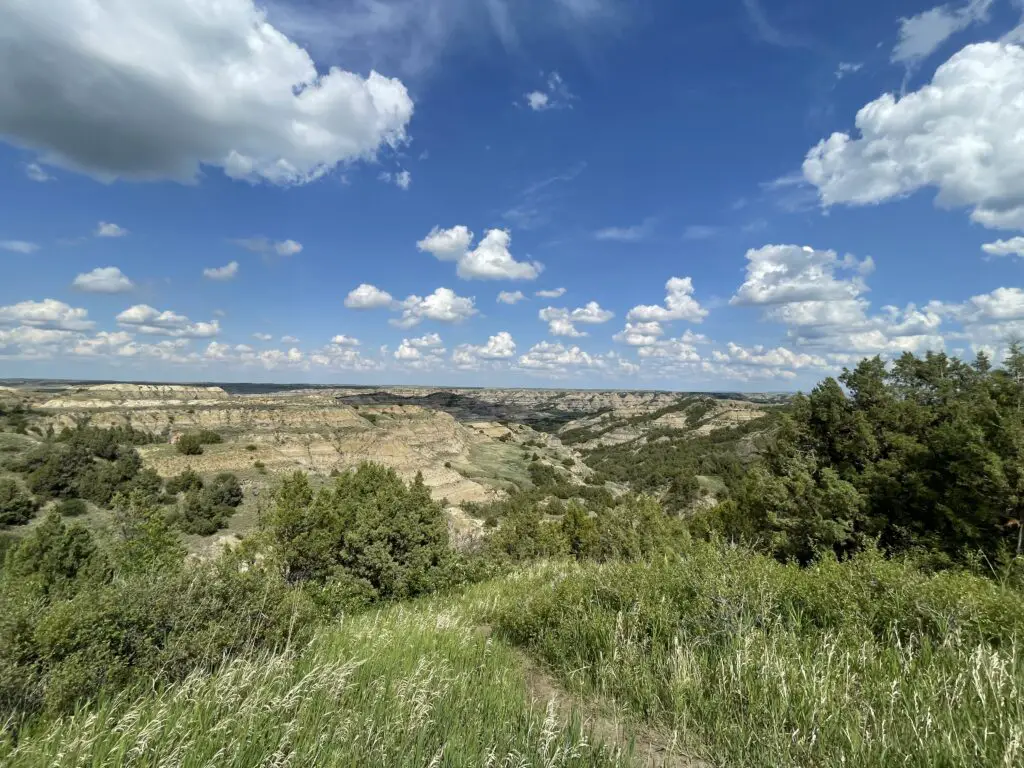
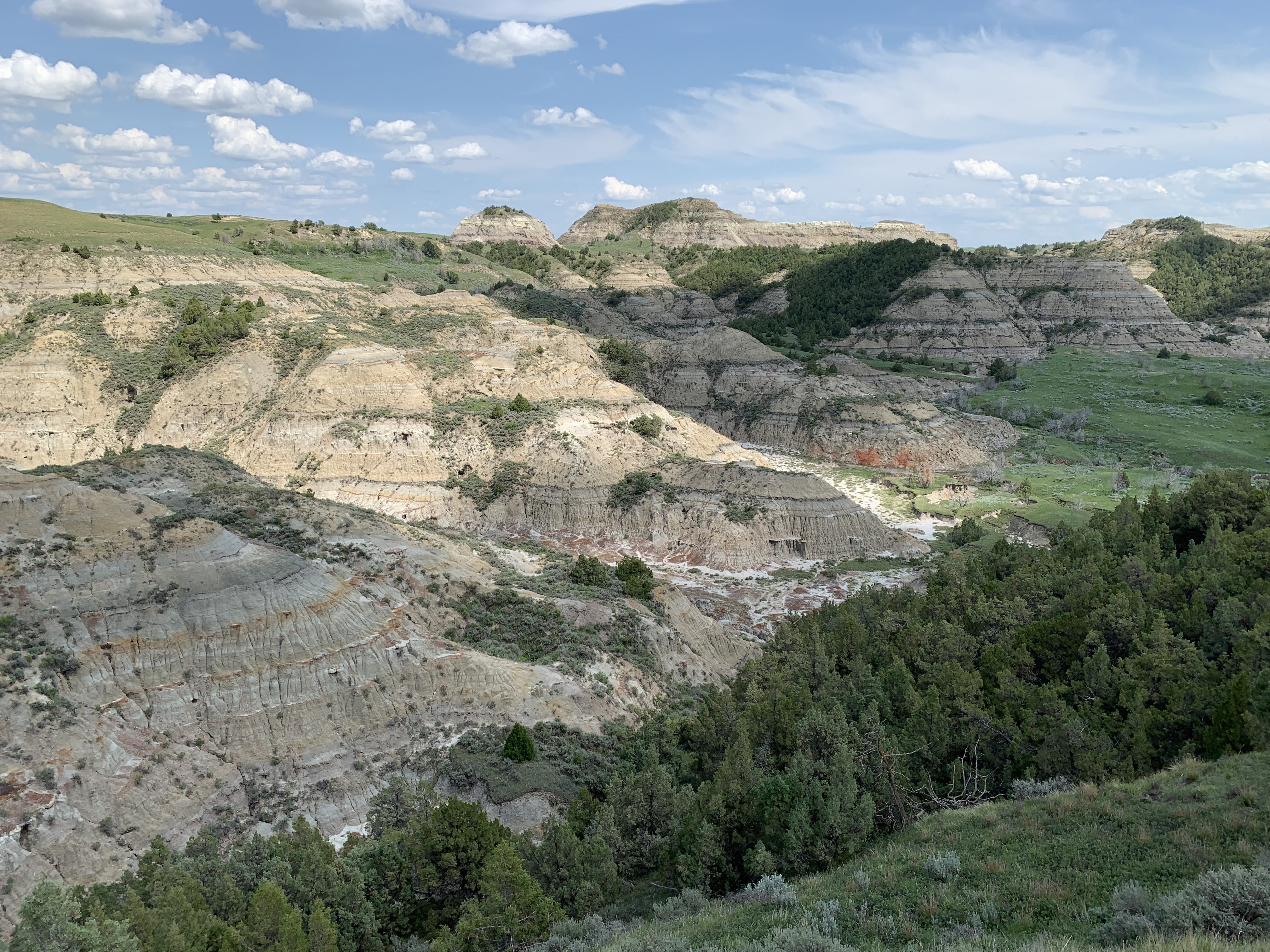
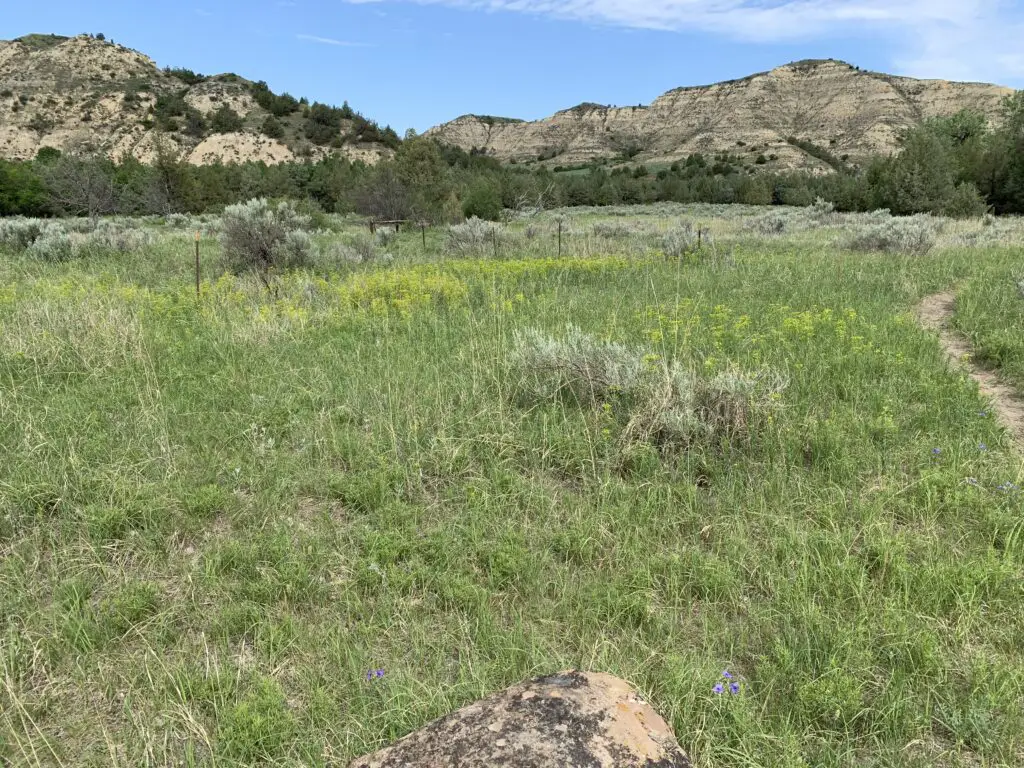
Green grass with tan and grey, rocky hills in the background all under a blue sky

Teddy helped create the US Forest Service and was a champion of protecting countless acres of land in the western US, as well as creating a number of national parks and monuments (many of which the Trekkers’ enjoy regularly.) He was also friends with John Muir (another of my favorites!) He was the OG #natureaddict/#natureboy!

A note on this park: the irony is the National Park named after the “Conservation President” sits on the edge of the Baaken Oil Fields!–For those who don’t know these are some of the largest oil fields in the US.

This really won’t affect your experience at Teddy Roosevelt National Park too much. You can see the flames burning off waste-natural gas from some of the overlooks and hiking trails in the North Unit. This is especially troublesome at night when they can affect the Dark Sky status of the park.

I don’t think Teddy would have liked to see his beautiful land in this state but who can stand in the way of progress? 🙃 “Black Gold, Texas Tea baby!” 😡

Where is Teddy Roosevelt National Park?

The park is situated in far, southwestern North Dakota about 130-ish miles west of Bismarck!

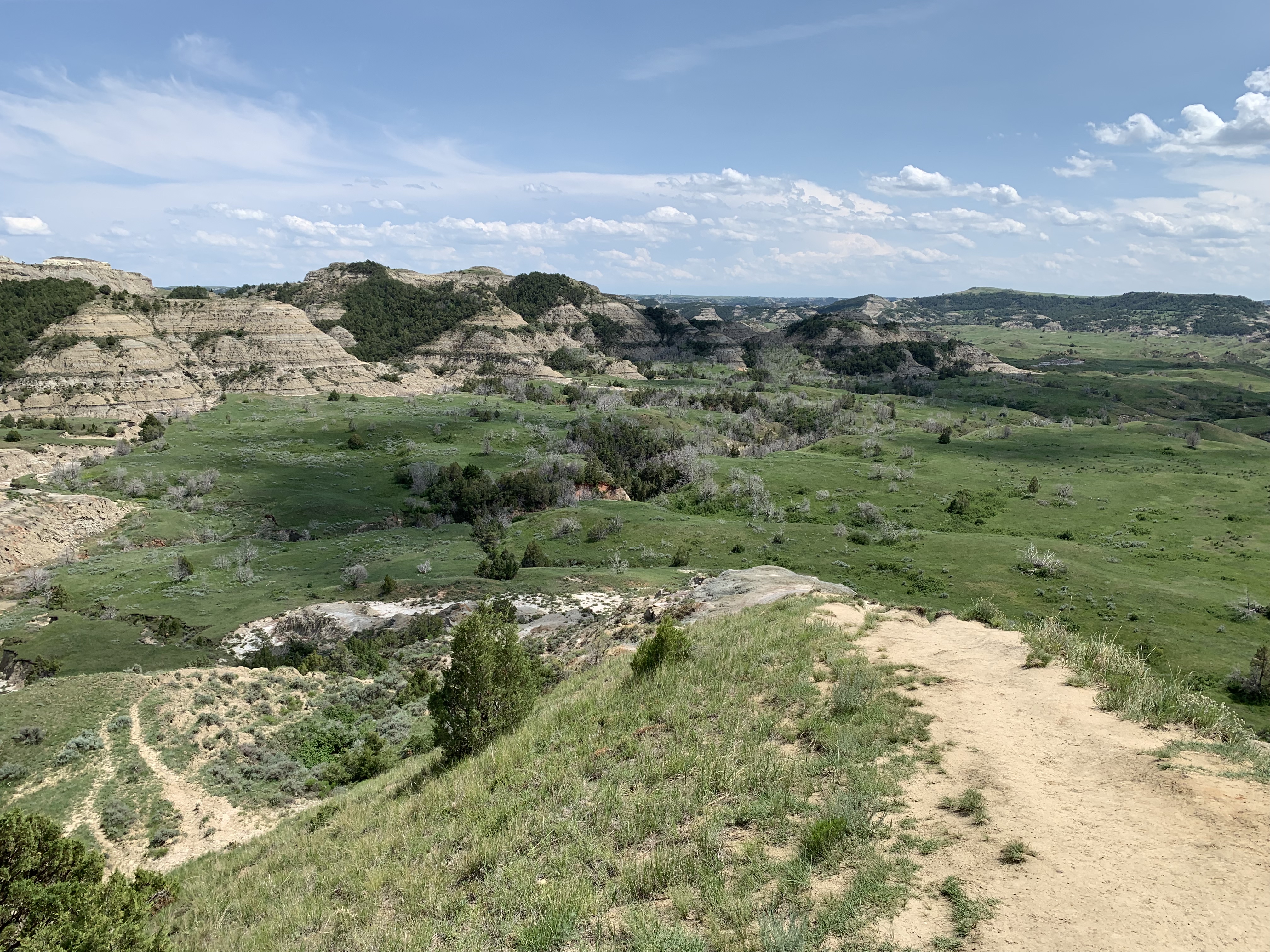
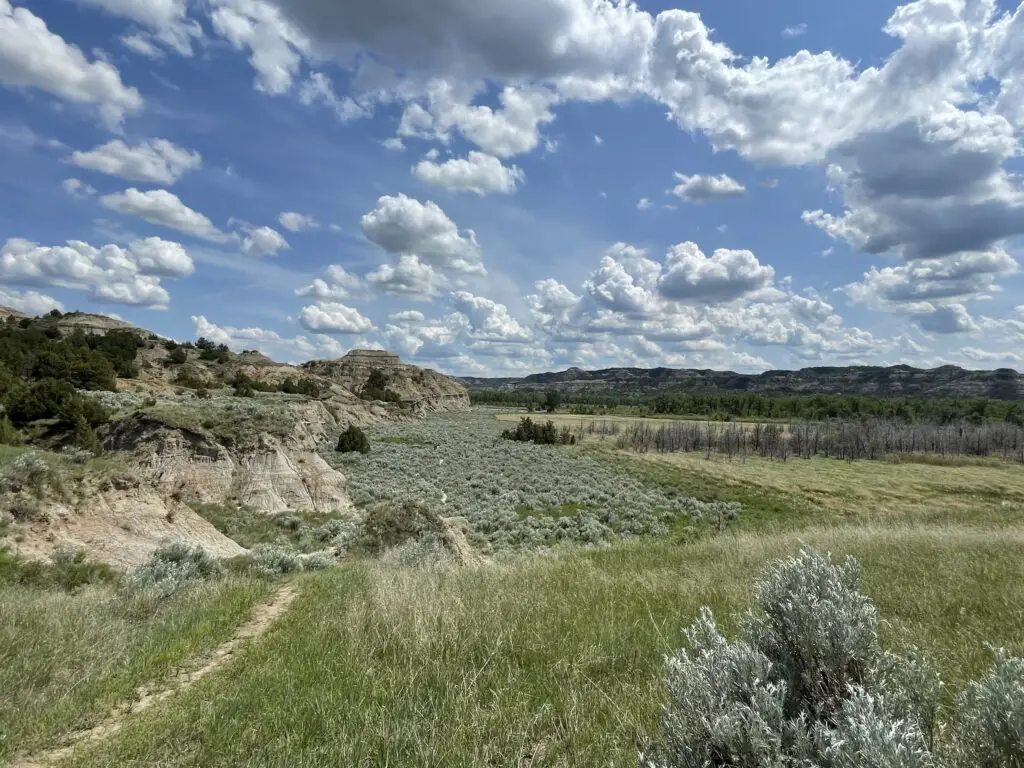
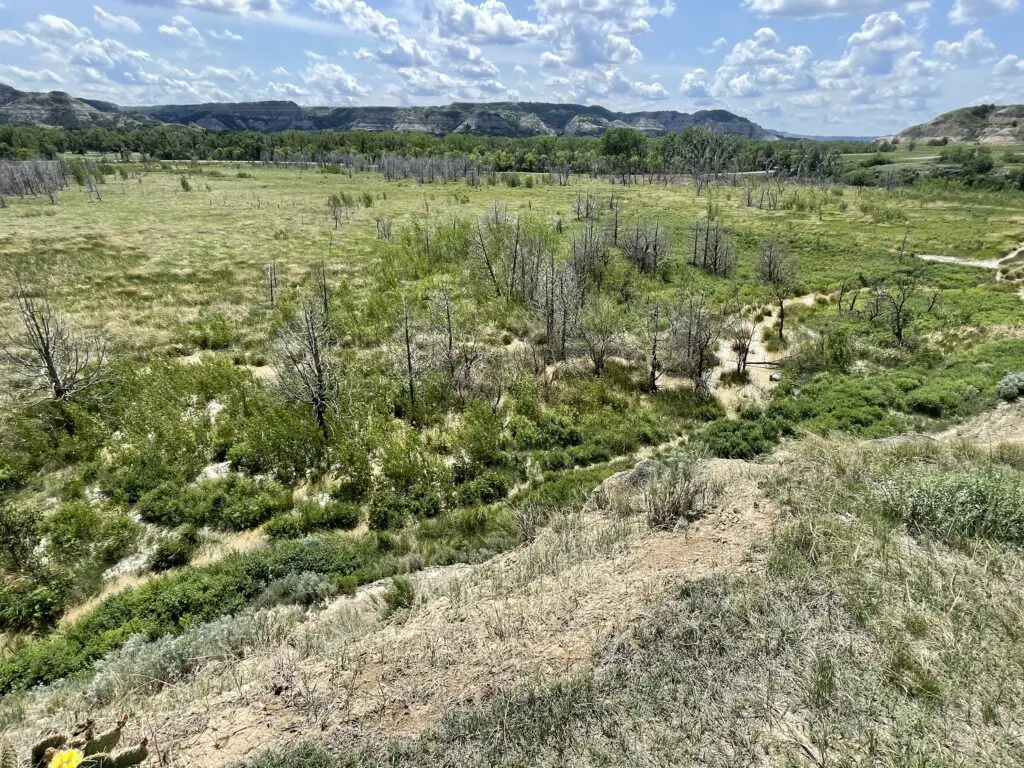
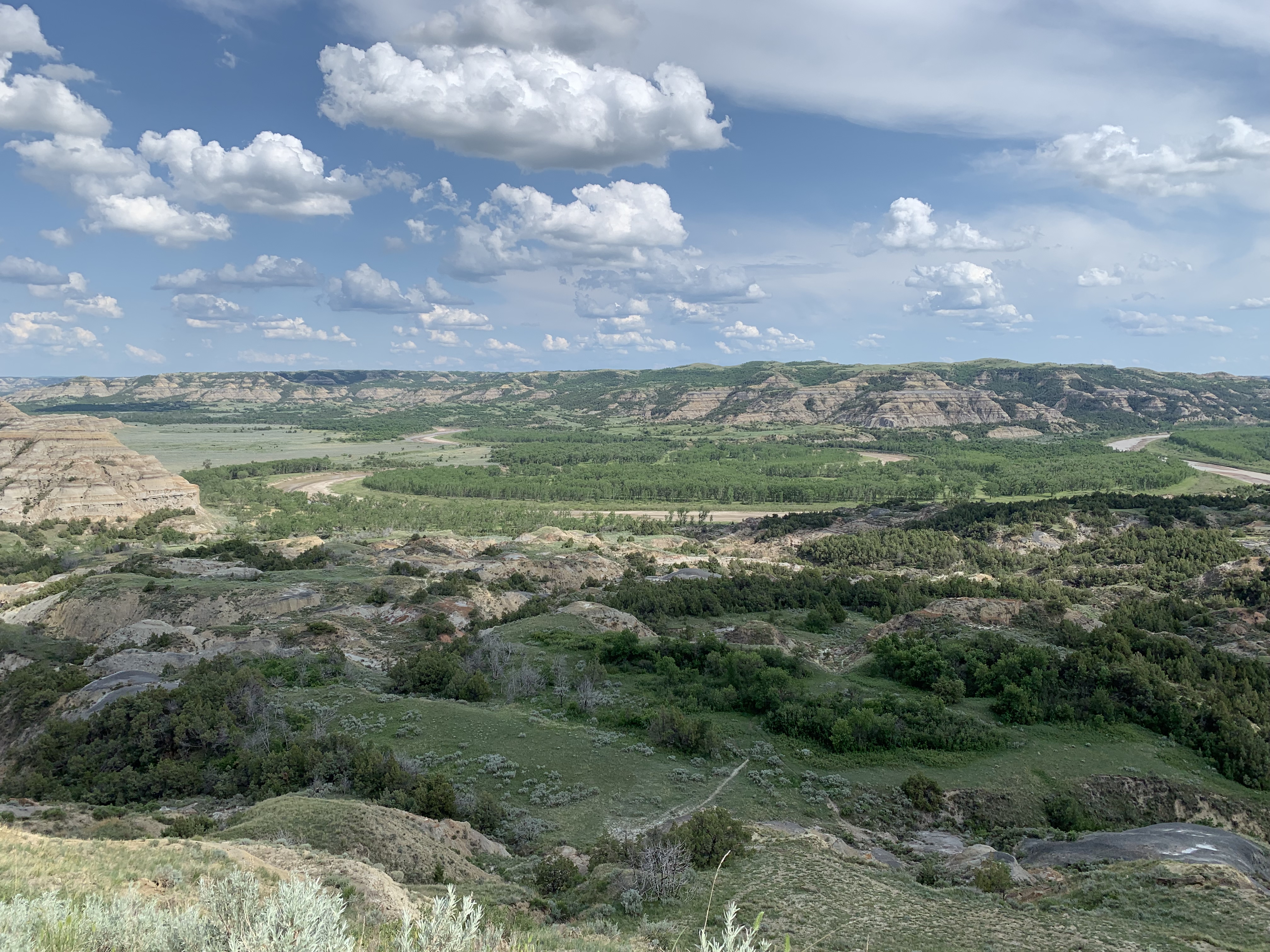
This park is also called the “North Dakota  Badlands”. While somewhat similar to Badlands National Park in South Dakota, this area is wetter and greener…

Teddy Roosevelt National Park is divided into three separate units. The North Unit was our favorite. It is known for being less developed but also prettier, offers more wildlife and is less busy. The South Unit is more developed and busier but offers more hiking options. (The two units are about a one-hour drive apart–around 70 miles).

There is also a bit of a “satellite” unit centrally-located to the west of the other two, main units. It is called Elkhorn Ranch. This is where Teddy literally lived when he was in North Dakota and it is LITERALLY in the Middle of Nowhere! This one is pretty far out there–about a one-hour drive (around 54 miles) northwest of Medora…

The park basically isn’t near anything except the tiny town of Medora. The town is cute but small. It wasn’t too busy when we were there in mid-June but it can get MUCH busier later in the season.

Driving around North Dakota was kind of weird. 😅  All of their traffic light poles are bright yellow. Not sure if this is to highlight them against the snow they get all winter?  Also, they don’t hardly have any good gas stations/Convenience-stores. All throughout Wyoming, rural South Dakota and Montana you have plenty of good, big, gas station stores (some are literally in the middle of nowhere with no other buildings in sight and double as catch-all grocery stores)–in western North Dakota these are HARD to find!

They have plenty of gas stations but they all look like they’re from about 1995–several we stopped at, while small, did at least have clean bathrooms! This was surprising to me because there aren’t a lot of gas stations up there, you’d think the ones they do have would be fairly good-sized and decent–even near major highways, like I-94, the stations were largely disappointing…

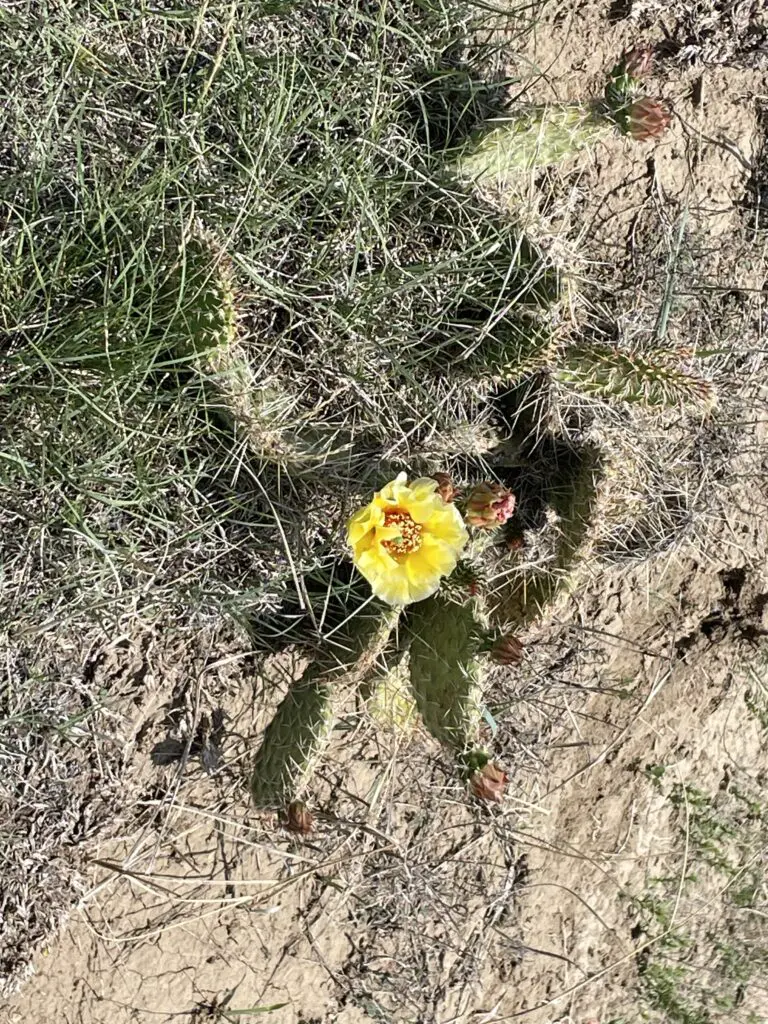
Yellow flower on a cactus on a green and dirt desert surface

Teddy Roosevelt National Park North Unit

We enjoyed camping and hiking around the North Unit more. It was definitely quieter, and it offers a 14-mile scenic drive (each way). Just realize this is NOT a loop, you have to drive out and back!

Camping at Juniper Campground

Juniper Campground, on the North Unit of Teddy Roosevelt National Park, is MUCH easier to get sites at than the Cottonwood Campground on the South Unit. We got into a First-Come-First-Serve site at Juniper, in the middle of the week, in mid-June, with no problem!

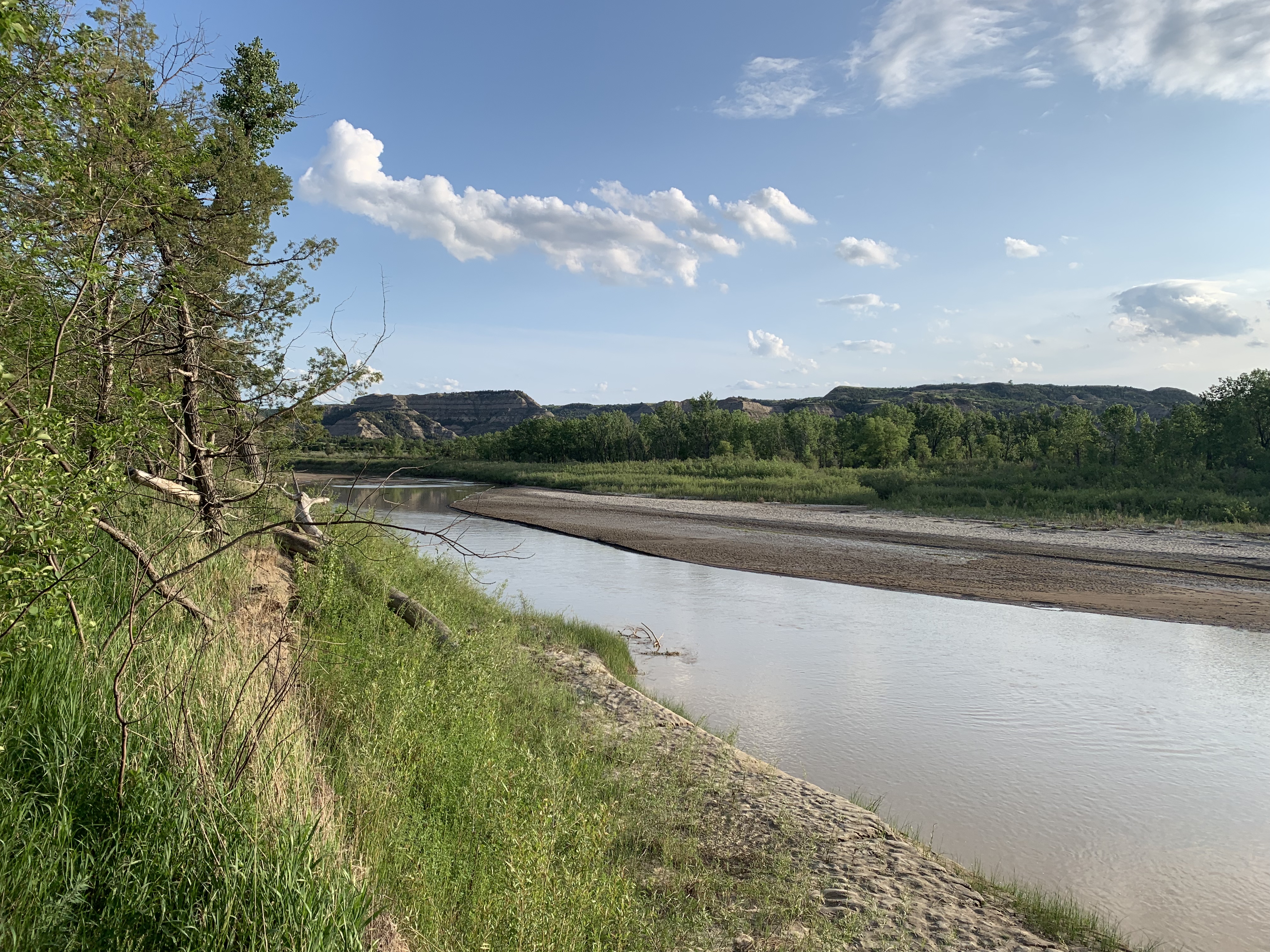
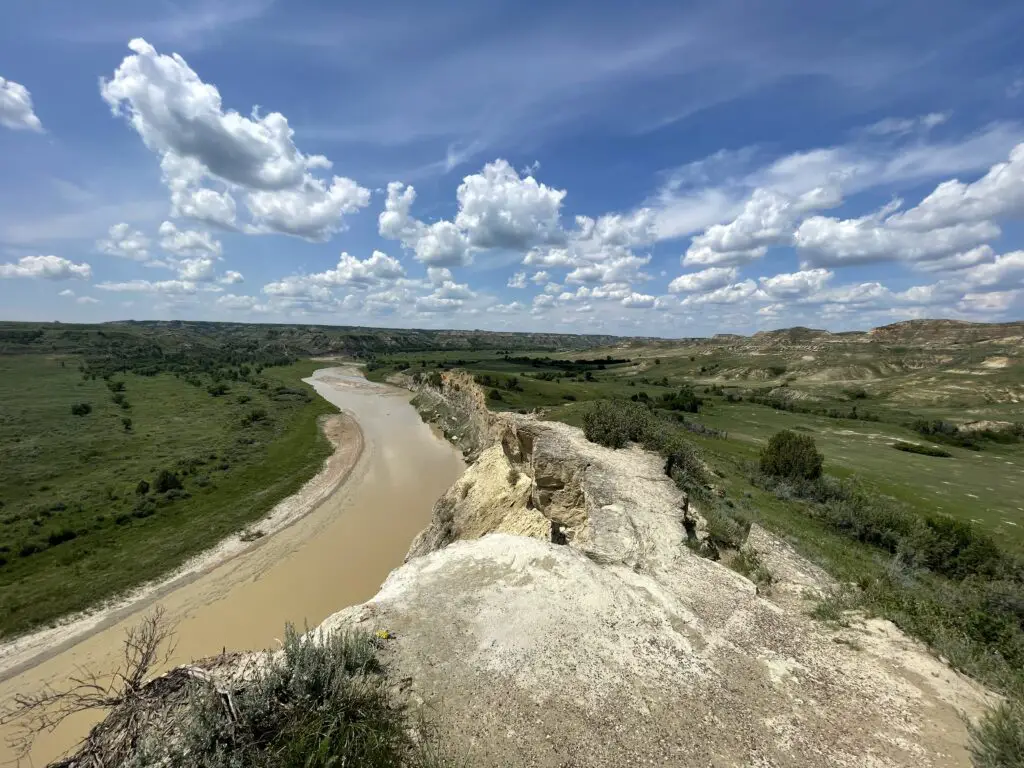
The Little Missouri River ran JUST on the north side of Juniper Campground–basically barely across the road from our campsite!

A brown river and sandy riverbed with a bank covered in green trees and grass on one side and a tree-covered hill on another, all under a blue sky and white, puffy clouds

I would not want to be standing there in a flash flood!

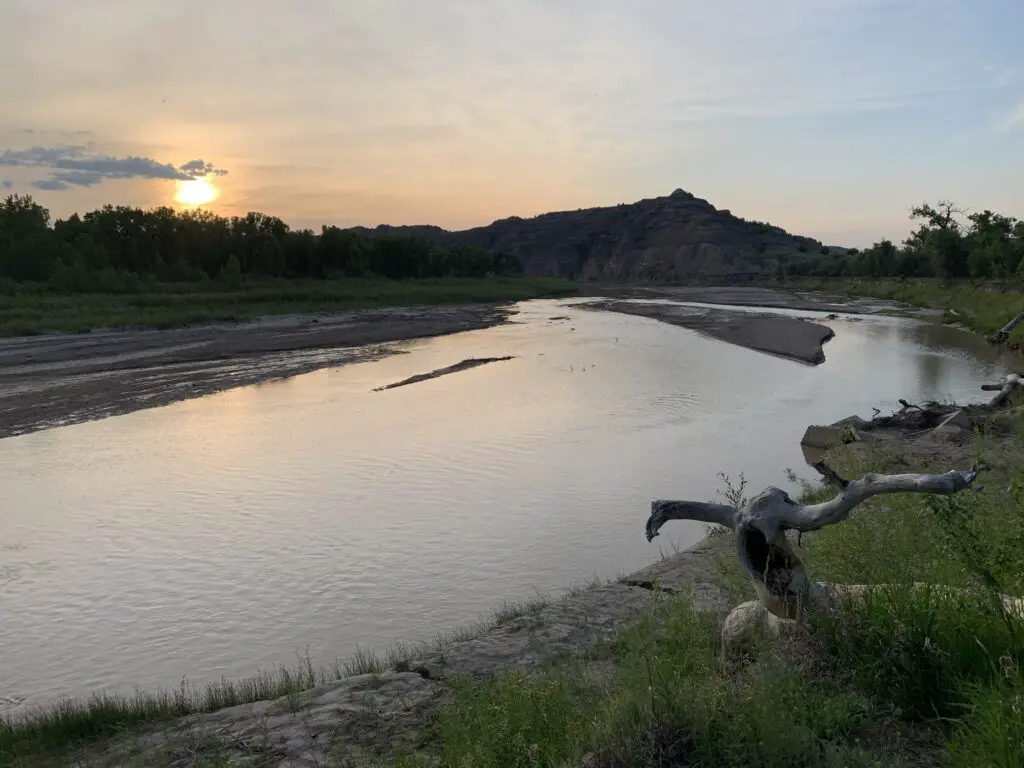
A calm river winds through rocky landscape at sunset, with gentle reflections on the water, grassy banks, a driftwood log in the foreground, and hills silhouetted against a soft, colorful sky.
I LOVE this pic Mr. Trekker took, it’s SO moody!

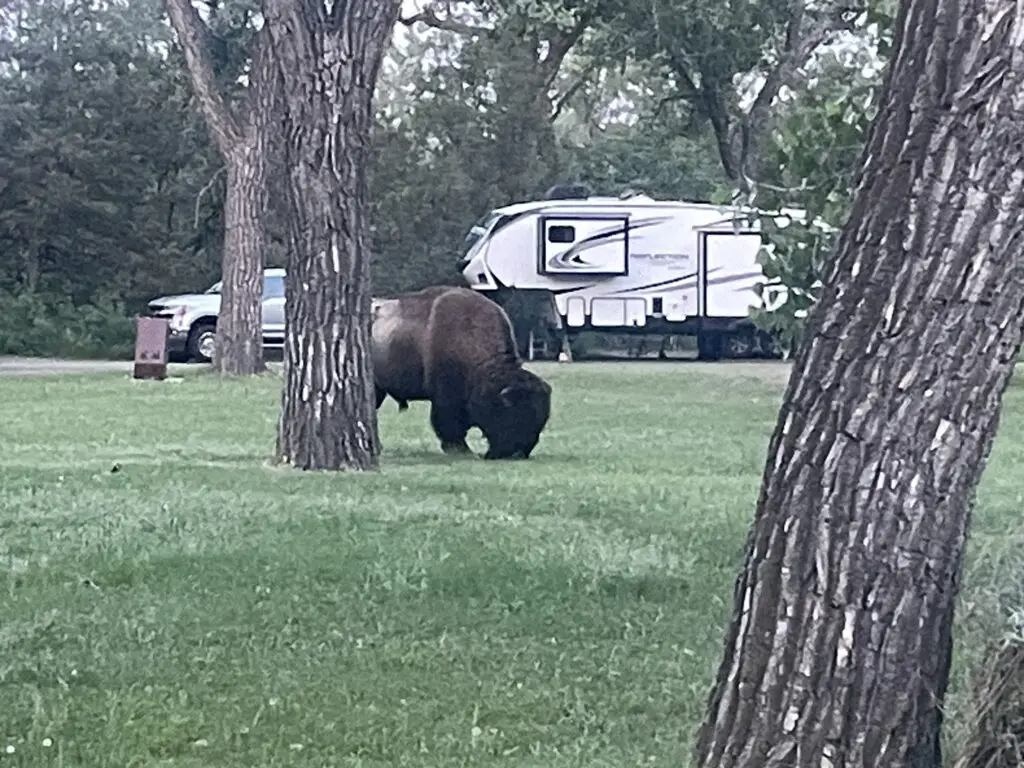
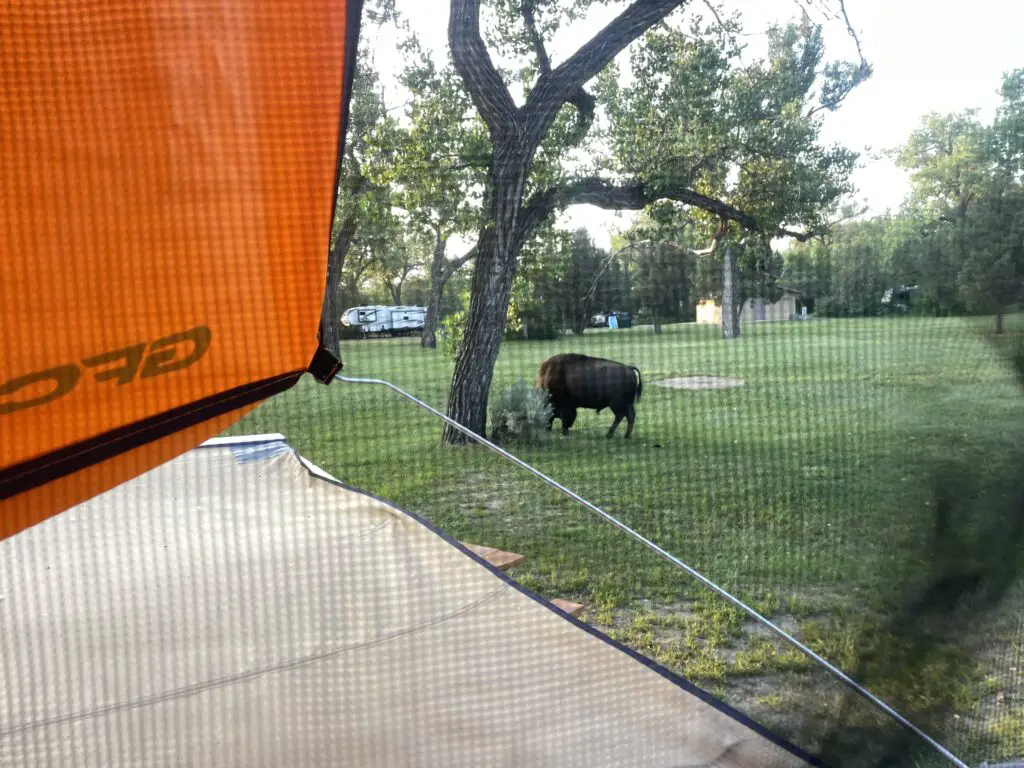
There was even a buffalo that hung out with us IN THE CAMPGROUND–watch out for these! #dontpetthefluffycows!

A bison grazes on green grass between trees in a campground with a white RV camper and a car parked in the background.
Big boy! Imagine running into him walking to the bathroom in the middle of the night!

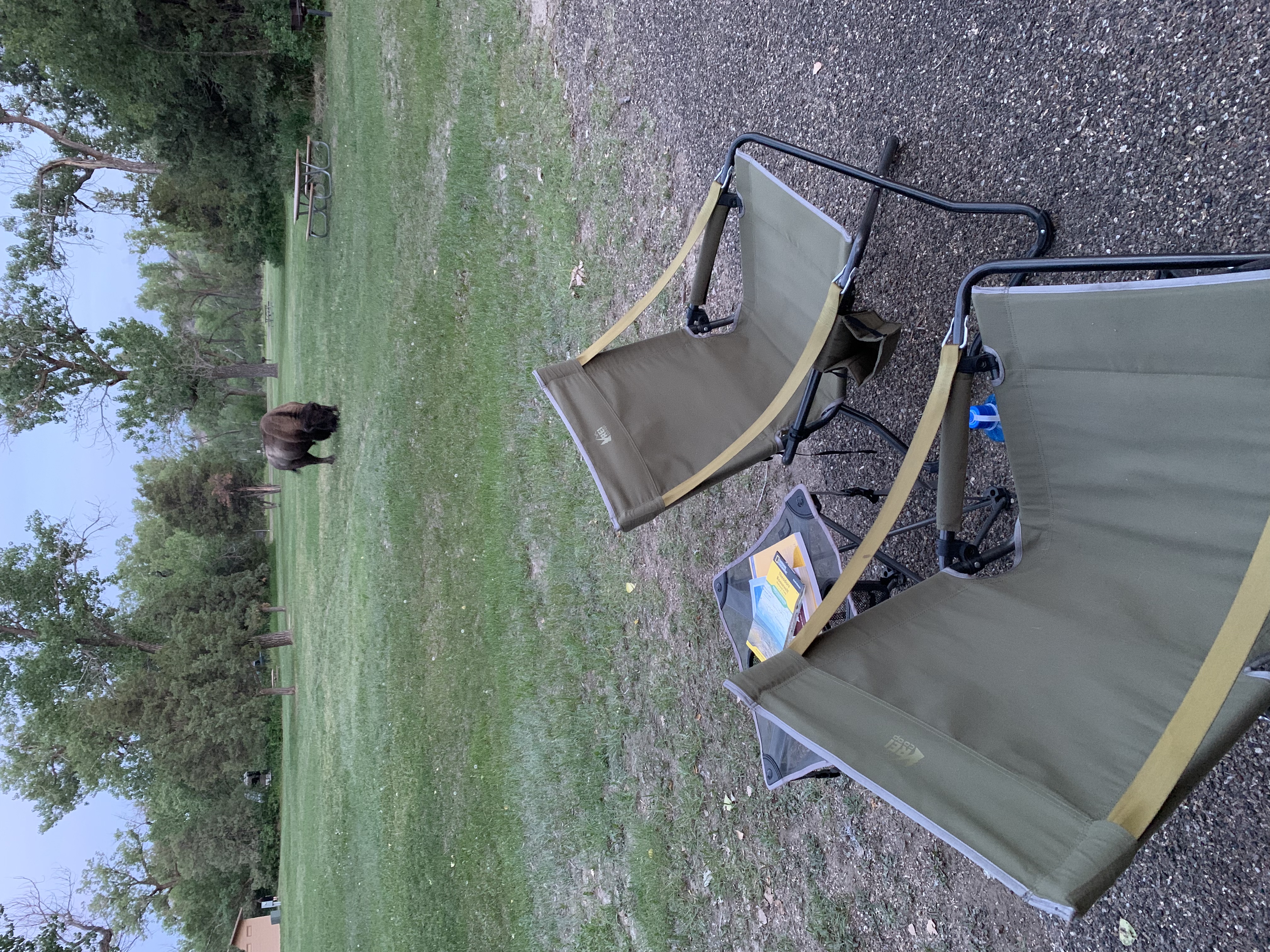
A large buffalo grazing in a grassy field very close to some camping chairs

A note about buffalo: it is NOT ADVISABLE to get as close to a buffalo as we were in the picture above. However, in this case, we were literally sitting on the truck bed and he came up to us so this was a bit of an exception. He seemed calm and other campers said he’d been there before.  As he was showing no signs of agitation we stayed still till he wandered off to a safer distance.

To be clear though, buffalo are known to be completely unpredictable and they can be DANGEROUS if they get irritated. So even in situations like this, DO NOT approach them, give them space, be calm and quiet and try to back off slowly but calmly if possible. DO NOT let dogs get near them (dogs can agitate them and they can easily kill a dog). ESPECIALLY, DO NOT APPROACH if they have babies!!! They may look oafish but these brutes can run at 30 mph–you CANNOT outrun them–and they’re equipped with sharp horns and a VERY hard head!

A bison grazes on grass near trees. Viewed through the mesh of an orange tent in a campground.
View from our GoFast Camper the next morning!

For more info on camping at Teddy Roosevelt National Park, click here!

Since the North Unit was so quiet we noted there was SO MUCH birdsong! Teddy actually mentions this in his book about being at his ranch, Ranch Life and the Hunting Trail. He describes the birdsong as:

“…the rider on the plains will hear bird songs unknown in the East…many are characteristic of this region. Throughout June the thickets and groves around the ranch house are loud with bird music from before dawn till well after sunrise.”

Your Moment of Zen: enjoy some birdsong from Teddy Roosevelt National Park (it was breezy too!)–turn UP the volume!:

Some hiking trails and good stops at the North Unit of Teddy Roosevelt Park: 

We enjoyed several fun pull-offs and short hiking trails in the North Unit:

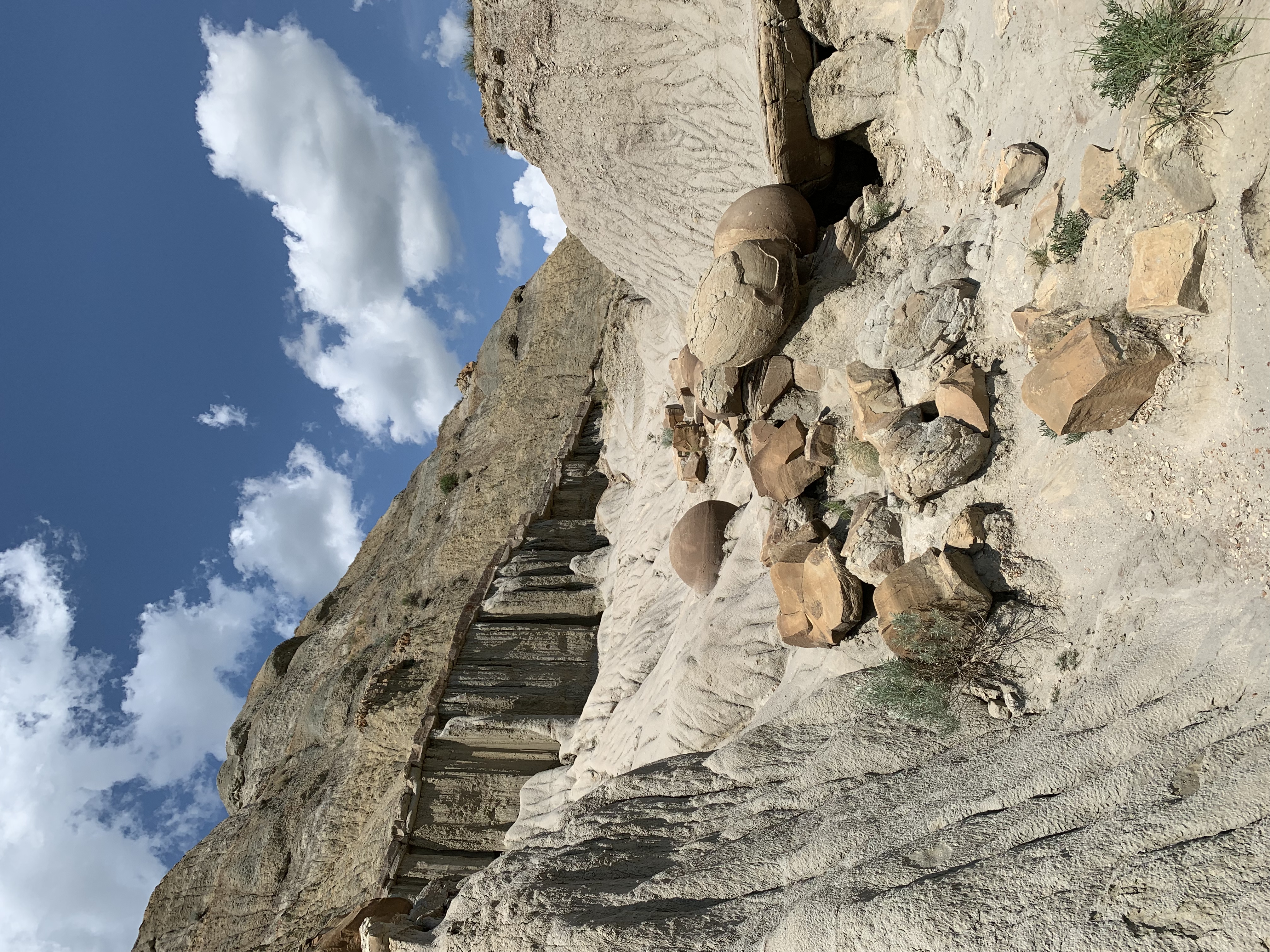
The Cannonball Concretions Pullout was the first one we came to and is just across the road from the entrance to Juniper Campground:

Rocky hill with large rocks that look like cannonballs water-falling down it, all under a blue sky with white, puffy clouds
The Cannonball Concretions!
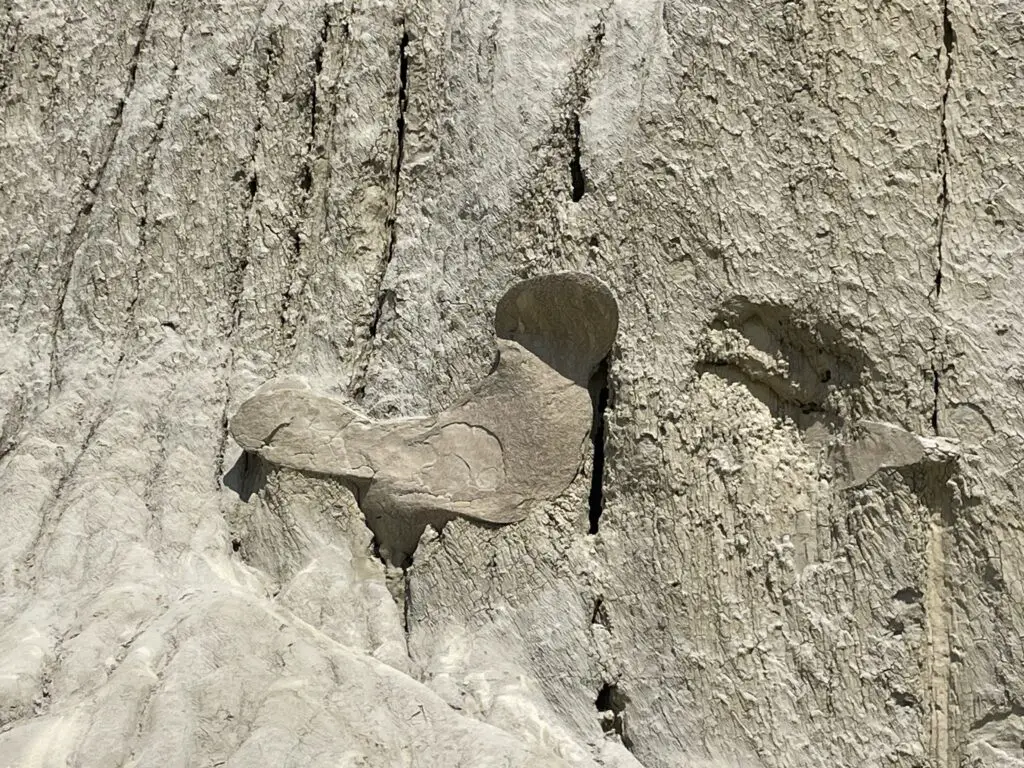
Rocky wall with a stone shape that resembles a bird or Mickey Mouse
Whaddya think…a bird or Mickey Mouse?

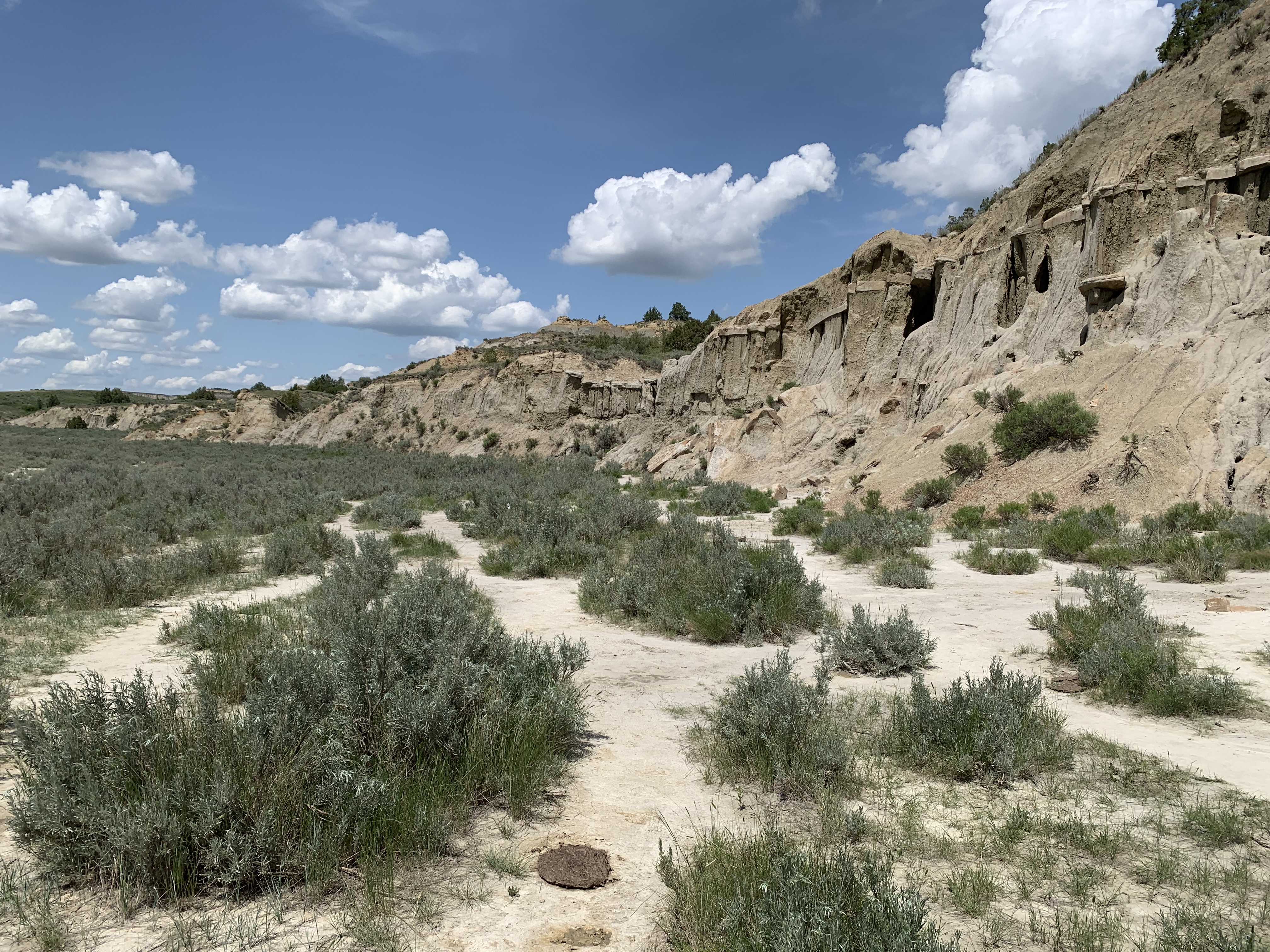
Buckhorn Trail starts from the Cannonball Concretions pullout. We only did a small portion of this trail, basically just up the hill from the pullout. It’s full length is more than 10 miles long and wanders throughout the North Unit of the park!

A dry, sandy stream-bed with green, scrub brush growing in it and a sandy, rocky bank, all under a blue sky with puffy, white clouds

A dirt hiking path meanders down a grassy hill with a green valley and tan, rocky hills in the background, all under a blue sky.

A dirt, hiking trail traverses green grassland with rock hills in the background, under a blue sky with white, puffy clouds.

Stream running through a green, wetland-meadow with green hills in the background, all under a blue sky with white, puffy clouds.

Riverbend Overlook was just a quick (but pretty!) jump out of the car:

A green, river valley with a horseshoe river and rocky hills sparesely covered by grass in the background, all under a blue sky with white, puffy clouds

Green grass surrounded by green bushes, tan, rocky hills are in the background, all under a blue sky filled with white, puffy clouds.

Oxbow Overlook was an easy, pretty and short hike to and around the overlook–the shelter also makes a great place for a picnic or snack:

Seen from a distance: a large, stone, picnic shelter sits on top of a rocky, tan hill. A green, river valley and other tan, rock and grass-covered hills are in the background all under a blue sky spotted with white, puffy clouds.

Teddy Roosevelt National Park South Unit

The Scenic Loop Drive circumvents the majority of the South Unit of the park. It is about 36 miles round trip though we couldn’t do the whole loop as the southern half was closed for construction…

Note: The time zone change between Central and Mountain time runs along the Little Missouri River. This results in the main, two units of the park being in separate time zones (the North Unit is on Central Time while the South Unit is on Mountain Time.) So the North Unit is one hour ahead of the South Unit–life is weird out West! 😀 

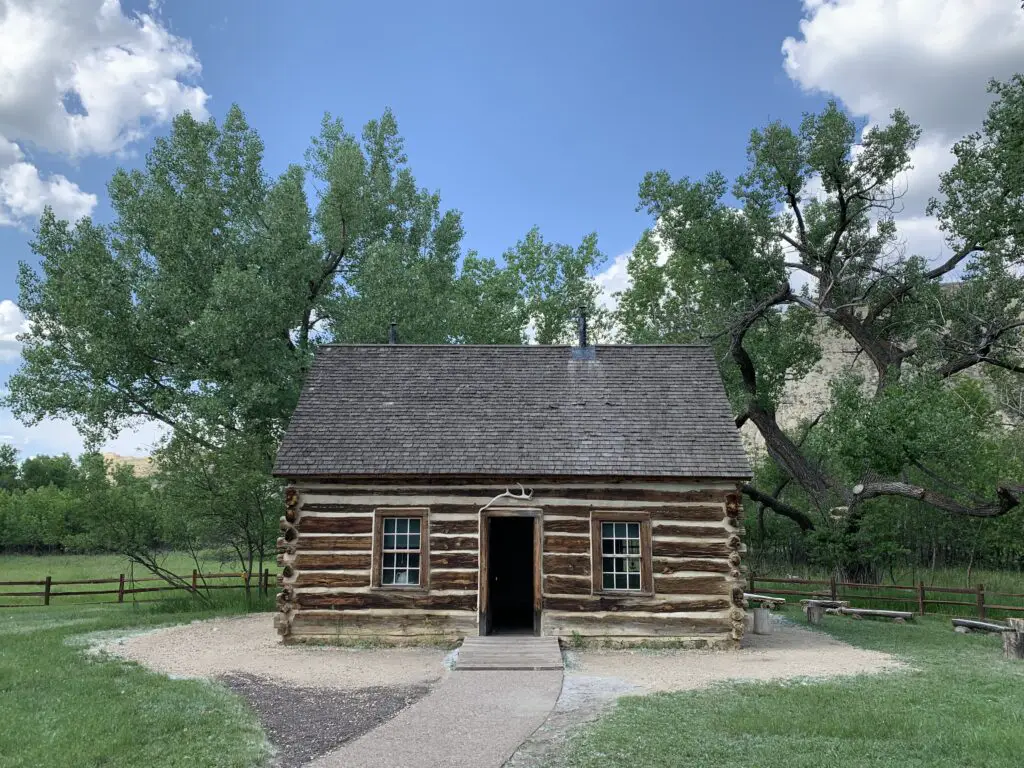
Log cabin with green trees in the background under a blue sky with white clouds
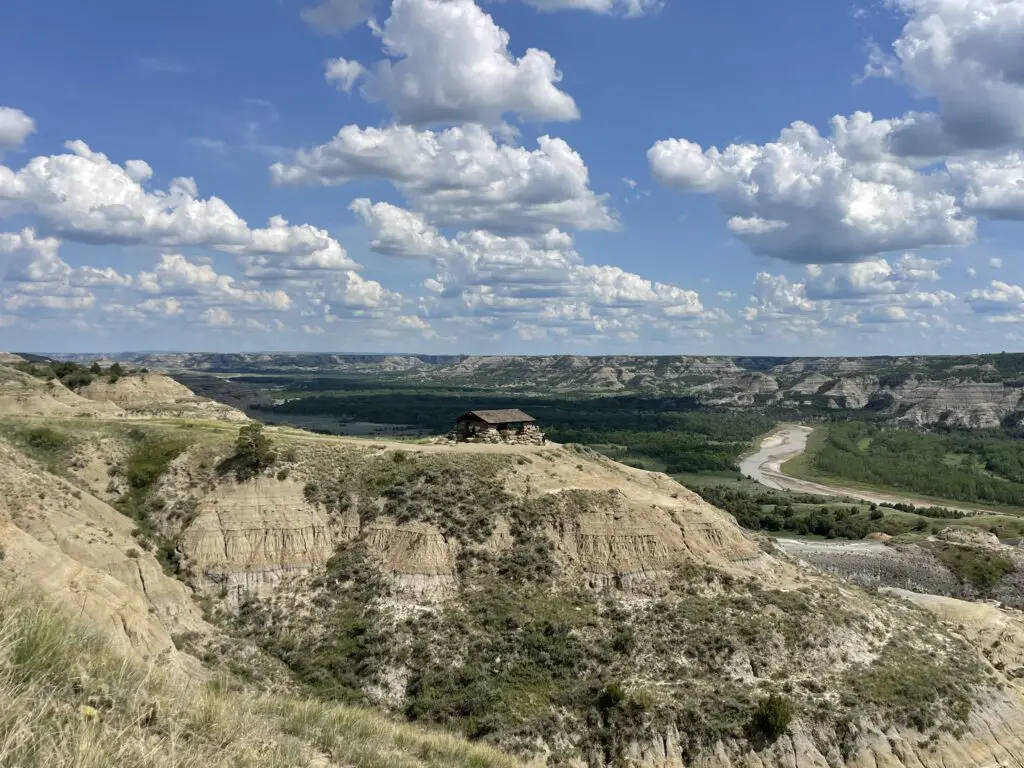
This was one of the actual cabins Teddy lived in when he was in North Dakota!

You literally drive through the South Unit on I-94 which is kinda cool. One of the rest stops is literally part of the park and you can hike a bit from here!

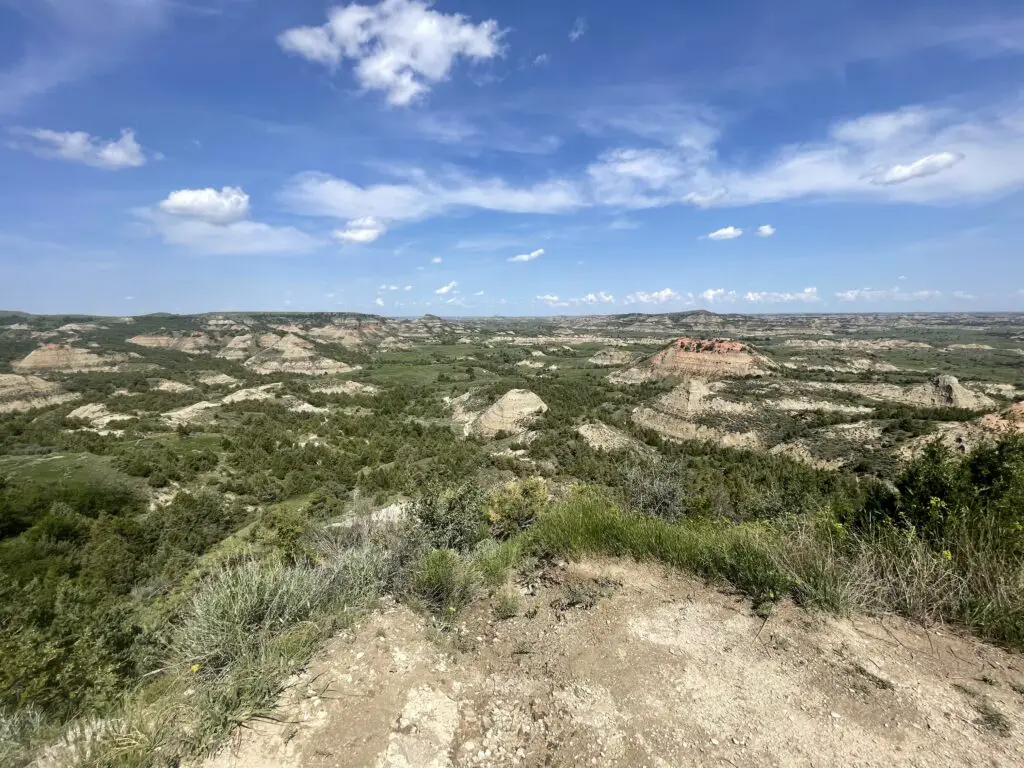
View from an overlook: green, grass-covered and tan, rocky mounds expand to the horizon, all under a blue sky
This pic was taken from the rest stop on I-94. This is a portion of the Painted Canyon Trail. You can hike around down there and access it from the rest stop!

Painted Canyon trails: These trailheads are locate at the I-94 rest stop that sits in Teddy Roosevelt National Park.

The Painted Canyon Nature Trail is an easy trail, only about 1/2 mile long and it runs along the rim of the canyon, just behind and around the rest stop building. Pets can be on this portion of the trail!

The Painted Canyon Trail departs from this same area. It’s fairly steep to get down into the canyon. It’s about four miles in total length and be aware there is NO SHADE on this trail. It also connects to other backcountry trails throughout the northern portion of the park.

Moment of Zen 2: Buffalo at Teddy Roosevelt National Park!:

Rocky hills sparsely covered in green pines and grass with reddish-rock lines all under a blue sky and puffy, white clouds

Some hiking trails and good stops at the South Unit of Teddy Roosevelt Park:

Boicourt Overlook/trail: The park website says this trail is only .3 miles and handicap accessible–this is “kind of” true. This description is true for the main trail but you can keep going further along the ridge for probably close to another 1/2 mile (that portion is not accessible).

Green grassland with rocky hills in the background, under a blue sky

Buck Hill: The entire trail is less than 1/2 mile but it’s quite steep! The steepest portion is paved (though I wouldn’t call it “accessible” as it’s so steep) while the rest of the route is a good, packed-dirt trail.

Wind Canyon Trail: This trail is about 1/2 mile in length. It has a few steep sections but overall this one isn’t too bad. It was a nice overlook of the river!

A wide, brown river meanders through a green, grass field with a tan, rocky outcrop on one side, all under a blue sky with puffy, white clouds
View of the Little Missouri River from the Wind Canyon Trail

For more info about hiking at the South Unit of Teddy Roosevelt National Park click here!

Teddy Roosevelt National Park Elkhorn Ranch Unit

There are a few ways to get to the Elkhorn Ranch unit:

The easiest (though it is longer) is to take Exit 1, on I-94 at Beach, and go north on Route 16. Then take Black Tail Road to the east until it becomes Belle Lake Road. Then take a left turn at Elkhorn Ranch Road. We went to the Unit this route and found it pretty easy to follow…

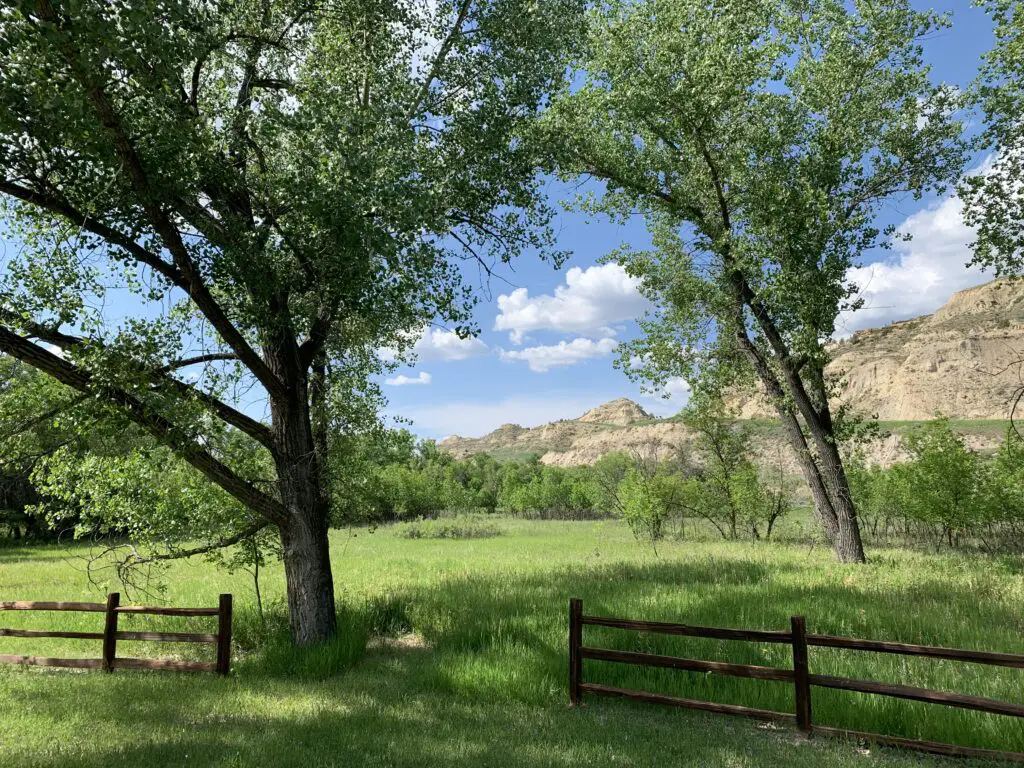
Split-rail fence covered and large, green cottonwood trees. A dirt hill is in the background, all under a blue sky
The actual location of Teddy Roosevelt’s ranch in western North Dakota

You can also take I-94 west from Medora, to Exit 10 for Belle Lake Road. Google will get you there going this way though it is out in the middle of NOWHERE with a lot of twists and jogs. We brought this route back to the highway and found it fairly easy to follow.

Note: while they were in great condition when we were there, be aware most of these roads are dirt!–Your car may get a little dusty!

Red gravel drive surrounded by grass with a rocky hill behind, all under a blue sky
View from our campground near Elkhorn Ranch

It’s all dirt roads to get there but they’re in pretty good shape and your sedan can make it, at least in good conditions. 🌞 (In mud or snow, you’re on your own! 😇) 

Enchanted Highway

On the way back to the Black Hills we checked out the Enchanted Highway!

Most people can only take so much Interstate driving (and that only gets you so far in North Dakota) and the straight, flat, state routes can get a little dull too.  So spice things up with this interesting little stretch of highway that runs 32-miles north and south between Exit 72 on I-94 and the tiny town of Regent, ND and Route 21 (that’s right, western North Dakota is so rural they just identify places based on their corresponding exits on the highway!)

An enterprising, local sculptor put a series of large, metal critters (ants, grasshoppers and kinda freaky-looking fairy tale creatures) all along the highway. It’s worth a looksie if you’re heading that way anyway!  (There are even signs on the highway to help you find this!)

We had a good time in NoDak! I’m not “dying” to go back again but Teddy Roosevelt National Park is definitely worth a drive to this random state that is often one of the last on everybody’s 50-state list! 😀 

Like what you read here today?  Please feel free to leave a comment, like, or share this post!  Add your email at the bottom of the page, or the sidebar to the right, to be notified when a new post is published.  

Colorado National Monument

In this post, I discuss hiking trails, a scenic drive and amazing sites that we saw on our 15th wedding anniversary trip to this National Monument.


**Author’s note: Just a word of warning, as this is a federal, National Monument, no dogs are allowed on any trails (exceptions for Service Animals). They are only permitted in the campgrounds and parking lots.**

The Trekkers spent our 15th wedding anniversary trip in Grand Junction, Colorado hanging out at the Colorado National Monument! Funnily enough, for our 10 year anniversary we had visited Dinosaur National Monument which sits about two hours to the north. You can read about that adventure here and here.

Grand Junction/the Grand Valley:

The Colorado National Monument is found in the Grand Valley, which is located in far, western Colorado, only about 30 miles from the border with Utah. The Grand Valley is comprised of a number of small towns including Fruita, Palisade, and the much larger city of Grand Junction. This is the true, drier, more desert-like, western slope of the Rocky Mountain state.

While Grand Junction proper is smaller than Rapid City, the entire Grand Valley area is actually larger than Rapid so the end result was it felt busier/more crowded driving through town.

The streets in Grand Junction are hella weird! I’ve never experienced anything like it! You may have 25 1/2 street or 35 3/4. We even saw a 7/8 street once! What the heck does that even mean?! How do you have 7/8 of a street?! I was SO CONFUSED! 🥴

Dry, rocky cliffs that resemble books sitting on a shelf and lit pink by the sunset sit in the far background with a metro area spread in the foreground.
Little Book Cliffs that frame the northern side of Grand Valley shining in the evening sun
Tall, rocky cliffs in the background with trees and a small city amongst a drier, desert-like environment in the foreground, as seen from above.
The Grand Valley

Hiking at Colorado National Monument:

There are a number of awesome hiking trails throughout Colorado National Monument. Many are short and relatively easy day hikes while others are lengthy and challenging hikes through some of the canyons. The few we enjoyed are outlined below:

Please note there is basically NO SHADE on most of the trails throughout the Monument. Also, you ARE in Colorado so even the “easier” trails sit at around one mile in elevation.

Devils Kitchen:

The Devils Kitchen trailhead is the first one you come to when you enter the park on Monument Road (from the Grand Junction side). It is less than a mile in each direction and is a simple, out and back hike.

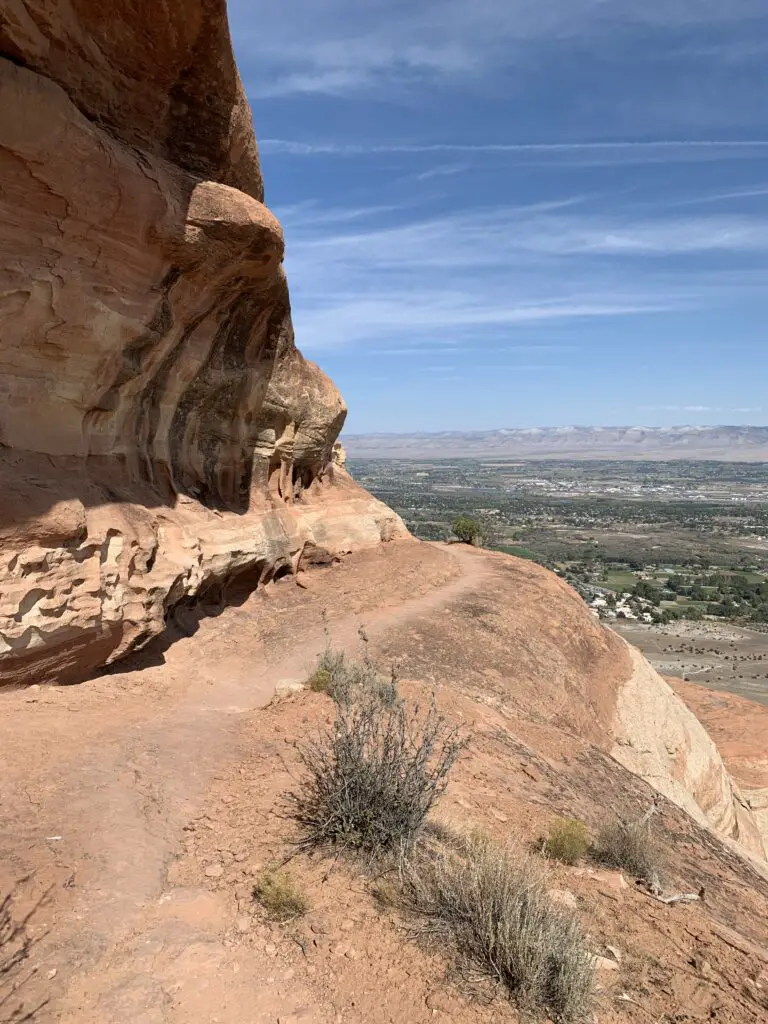
It is fairly well-marked and largely flat as it traverses a canyon floor. Shortly before you reach the actual rock formations there is some scrambling required and the signage isn’t great. Basically just keep aiming for the rocks like what are shown in the picture below (there really isn’t anywhere else to go. 😊)

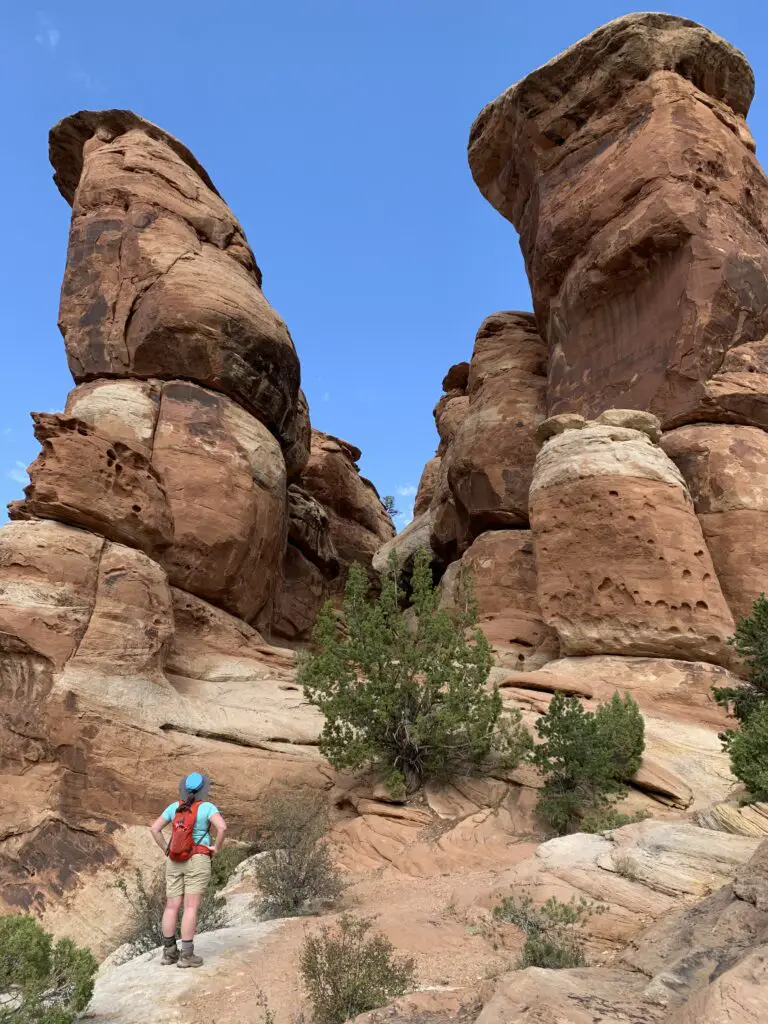
Devils Kitchen is basically just a small, rock circle made of rock spires. It’s pretty and pretty cool! This trail is family friendly for anyone who can handle basic walking/hiking and a little clambering. This is definitely a great trail for kids who want to scramble!

A circle of red-rock spires
The Tranquil Trekker enjoys Devils Kitchen
A circle of red, rock spires with green plants poking out, all under a blue sky.
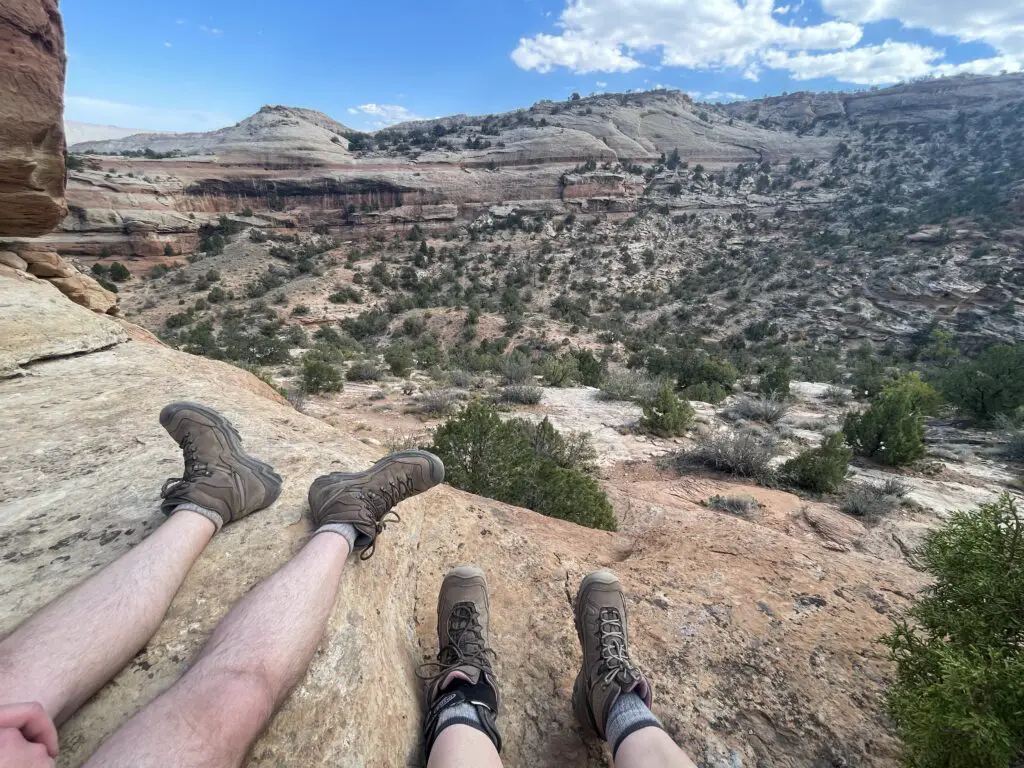
Two pairs of hikers legs and feet-in-boots sitting on a stone overlooking a dry canyon filled with green scrub brush under a blue sky.
The Trekkers take a break and enjoy the canyon view
Serpents Trail:

Assuming you can find parking, you can do the Serpents Trail and Devils Kitchen the same day. The trailheads are directly across the road from each other–there is also a nice picnic area to enjoy here!

The Serpents Trail is about two miles one-way. It does connect with Monument Road again about three miles further down the road.

Serpents Trail was the original, dirt road that brought visitors into the Monument. It is now closed to vehicles and serves only as a hiking trail. It gets it’s name from the many switchbacks that the trail uses to “snake” it’s way up the side of the hill.

This trail is not overly difficult as you’re basically just walking on a gravel road. Depending on which direction you choose you will often be walking “up” the entire route.

A large boulder in the shape of an alien head and face sit alongside a dirt trail with rocky canyon walls in the background.
Do you see what I see in this boulder? …come on now! 👽 🖖 (Mr. Trekker says I’ve been watching too much Ancient Aliens! 😇)
Rocky, gray cliffs in the background overlook a red-gravel and green scrub brush-filled canyon.
This pic gives you an idea of the switchbacks that circle back on each other on Serpents Trail.
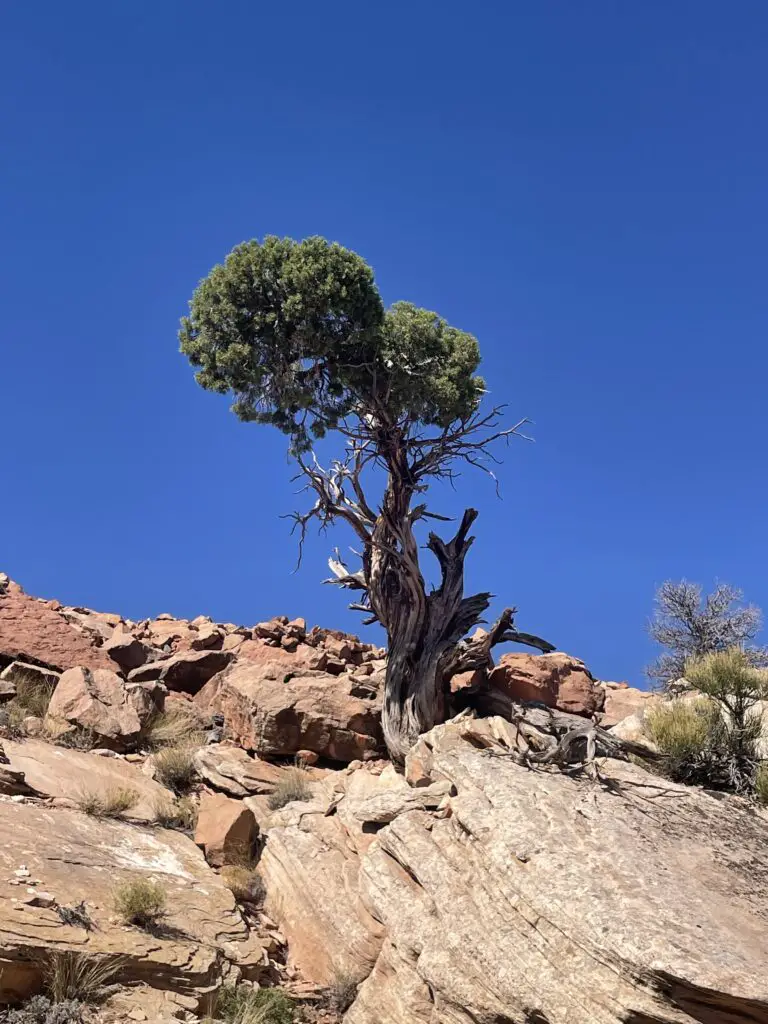
A small, green, pinyon pine juts out of the rock, under a clear, blue sky
I found this tenacious, little tree facinating!
Liberty Cap (the short–difficult–way!) with return on Corkscrew Trail:
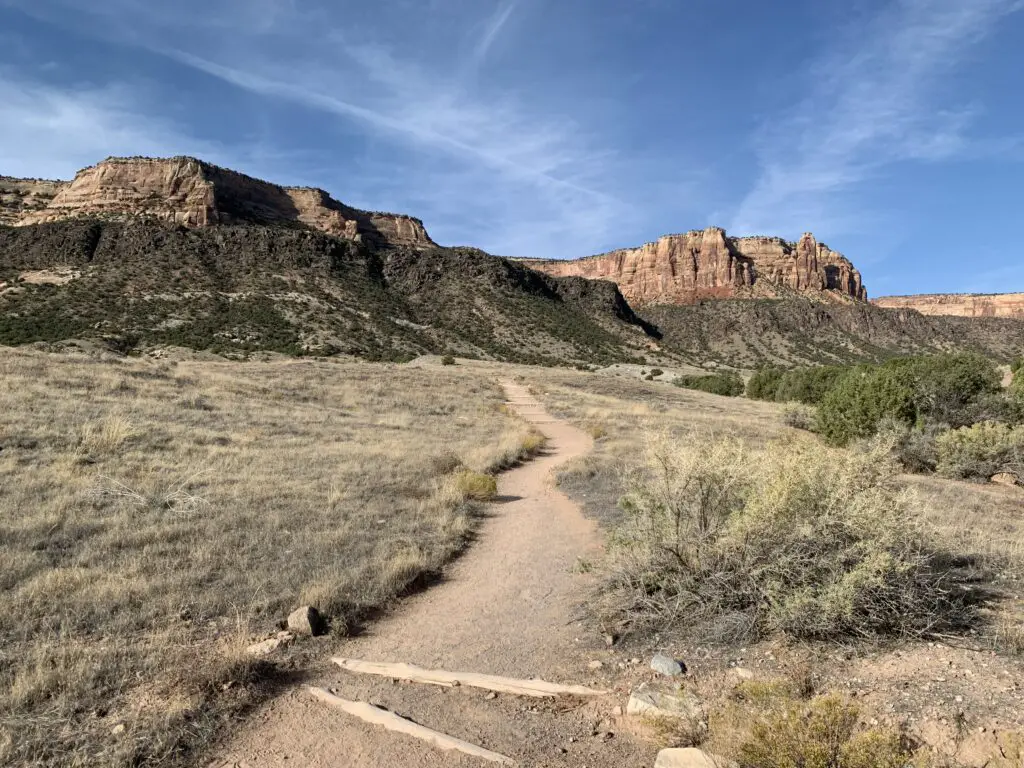
Rocky, gray cliffs tower over green, scrub brush covered rock and grassland
The start of the short, fun, steep section of Liberty Cap trail. Yes, you hike all the way to the top in less than 2 miles!

This trail is on plenty of maps but it’s a little confusing to reach. To make it easier I’m going to quote the directions from the park website to reach the trailhead from the eastern side of the park–you can find this info on the Monument’s website here.  (Note: this trailhead takes you to the quick, difficult, pretty portion of the trail! It begins near the Grand Junction entrance.)

“From the east entrance, proceed north on Monument Road 0.6 miles (1.0 km); turn left on South Camp Road; drive 2.6 miles (4.2 km) to its junction with South Broadway; turn left and go 0.5 miles (0.8 km); turn left onto Wildwood Drive and go 0.5 miles (0.8 km). Watch closely for a brown trailhead sign on the right at what appears to be a driveway; turn down this road to the trailhead…” 

This trail made for a great loop! There are many different options to complete this trail section:

–Liberty Cap up, Corkscrew down
–Corkscrew up, Liberty Cap down
–Just take one of these two trails both up and down

We opted to take Liberty Cap up and Corkscrew down, partially because we hadn’t seen the Corkscrew trail yet, partially because we like loops and not returning the same way we started (already saw that part of the trail!) and also because Corkscrew is listed as “moderate” on the trail map while Liberty Cap is listed as “difficult”. Due to this, we figured Corkscrew would be less steep for the descent–we were right and I would agree with these difficulty designations.

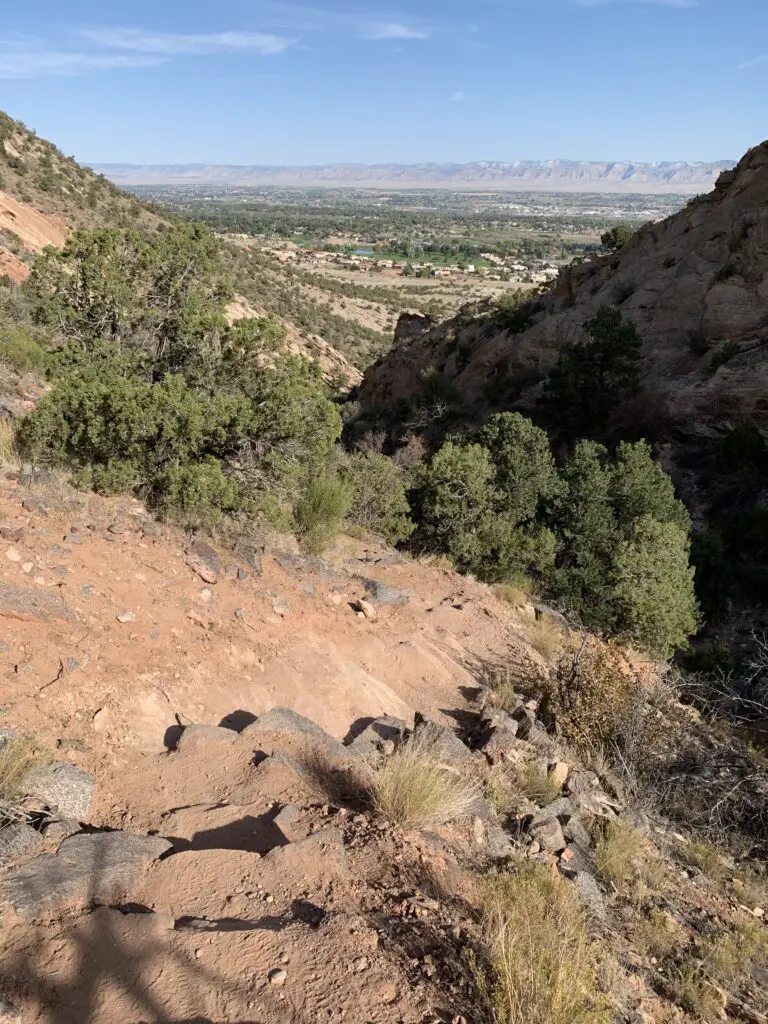
Stone and dirt steps carved into the side of a hill as it traverses the side of a steep canyon
You can just make out the steps in the rock trailing down the side of the hill
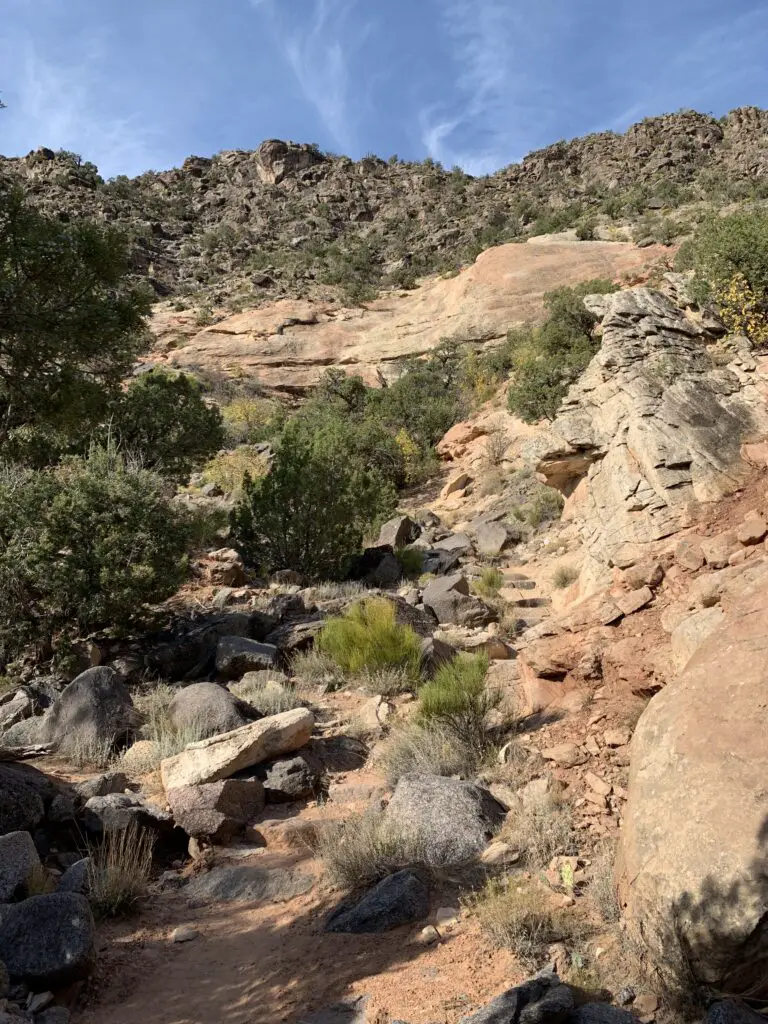
Green scrub brush and brown rock cover a steep, canyon wall
There is a trail there somewhere!

This is actually a lengthy trail if you do the whole thing. If you want to access the other trailhead it can be found on the western side of the park about halfway along Rim Rock drive. The majority of that route from the west is fairly easy and traverses a canyon within the central part of the Monument. The fun part then comes at the very end of the trail. (This is the beginning of the trail if you start where we did from the trailhead on the eastern side of the park near Grand Junction). If you want to hike it the way we did, the actual route is fairly short though you gain over 2000 feet in elevation in less than three miles! (it’s steep folks…but VERY fun!)

I wouldn’t recommend taking Corkscrew up because it’s a lengthy slog through soul-crushing switchbacks with NO SHADE. There is also a lot of black rock on this portion of the trail that will absorb/radiate the sun’s heat on hot days–and there are a lot of hot, sunny days in Grand Junction!

I also wouldn’t recommend taking Liberty Cap down if the trail is at all wet/snowy/icy/slippy-in-any-way. Not that it can’t be done, but there are a number of steep sections where you may end up crab-crawling your way down on a good day. In wet/slippy conditions this could become dangerous very quickly.

A dirt trail traverses a narrow, rock ledge with rock walls on one side and steep drop-off on the other,
It’s a bit difficult to see the steep drop-off at the side of this cliff but a fall here could easily result in serious injury if not be fatal!

Please note: along with being steep this trail includes a number of steep drop-offs. My acrophobia was definitely triggered (but I made it!–and the view at the top is ABSOLUTELY worth it!)

This trail was especially momentous for me as it just so happened we hiked it exactly 10 months to the day after I had major abdominal surgery! It was completely reasonable that I had recovered enough to complete this hike in that amount of time. However, knowing where I was 10 months ago–when I needed hard-core, pain meds just to be comfortable enough to get out of bed to walk to the bathroom–and here, 10 months later, I was able to scramble on all fours; stretch, bend, twist and even crab-crawl my way down steep sections of trail and feel AMAZING doing it–this was such a feeling of accomplishment!

Also, not having any pain, heartburn or needing to desperately pee on the trail for the first time in years 🤣 (especially hiking a trail this difficult) reminded me of the new lease on life I had now that surgery was behind me! Turns out my doctors’ promises were right, I really am a new woman! 😁

Colorado is one of my favorite places to visit. Click here for more posts on this awesome state!

Rimrock Drive:

Rimrock drive is the main road through the park. It’s paved and an easy drive throughout. It offers INCREDIBLE views of the canyons/rock formations that make up the park. Numerous pull-offs are spread along the length of the route and there is a Visitor Center near the west entrance (the Fruita side). Numerous opportunities for hiking are also available off the road. The park also offers some camping options.

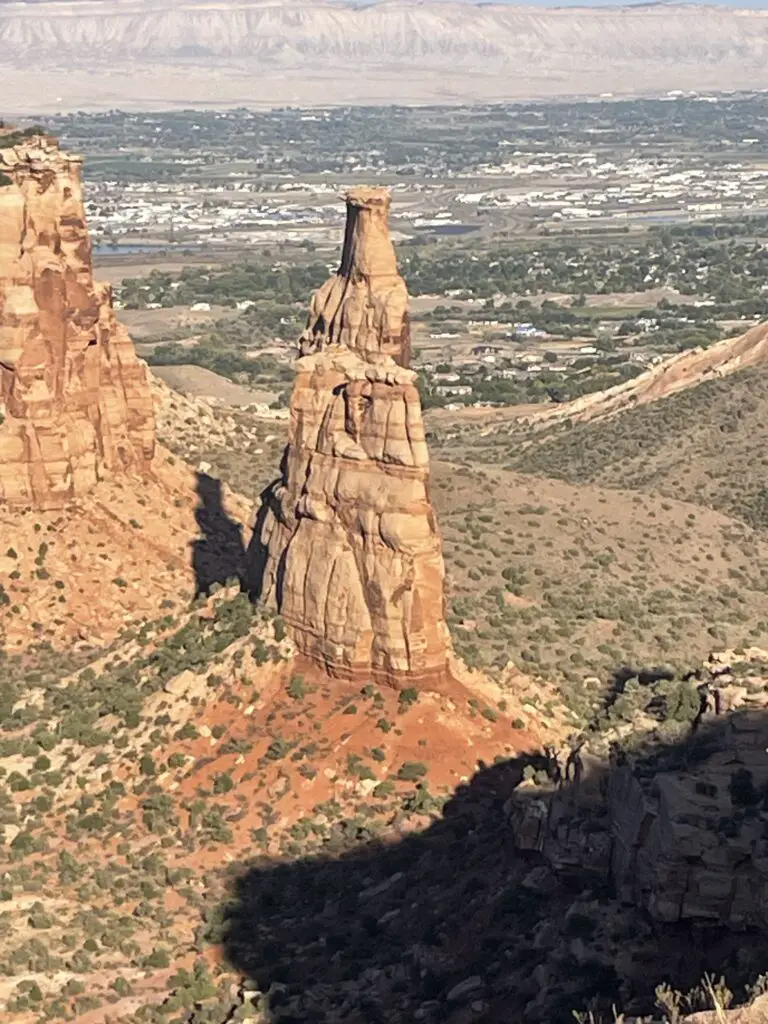
Brown rock monolith rises up from the scrub-brush covered canyon floor
Independence Rock
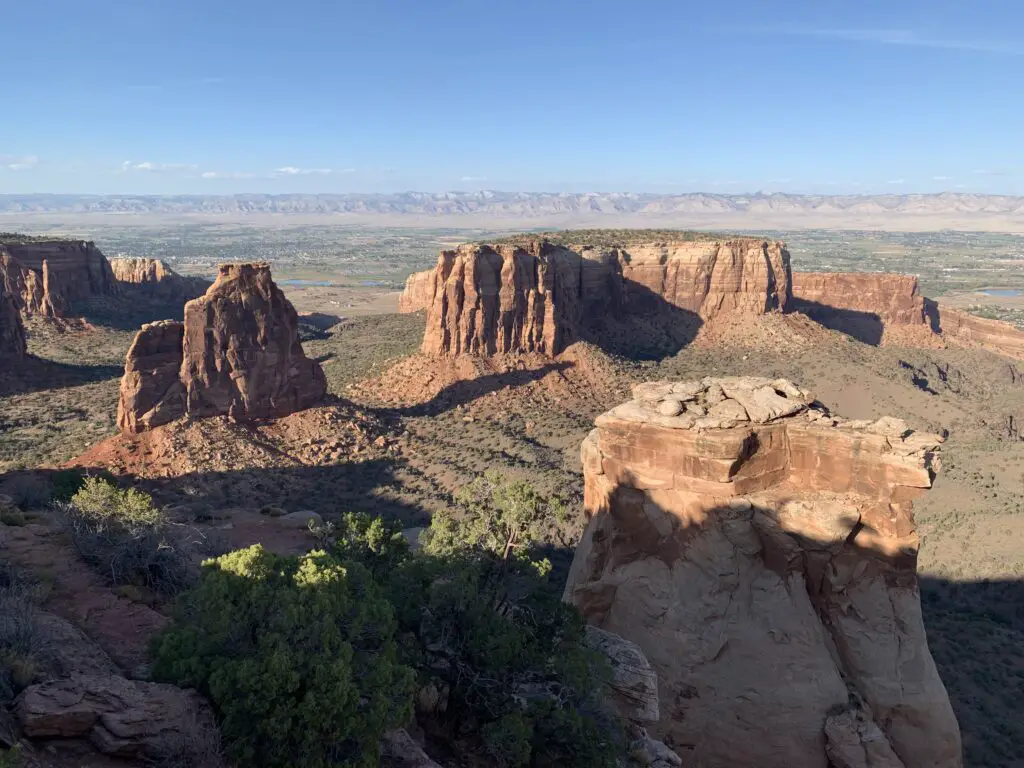
Red rock formations rise from a scrub brush-covered canyon floor, all under a clear, blue sky
It almost resembles Monument Valley in Arizona!
Red rock formations rise from a scrub brush-covered canyon floor, all under a clear, blue sky
Monument Canyon
Large, rock boulder fallen off a rocky cliff and sitting on the floor of a scrub-brush covered canyon floor
Fallen Rock–I wonder why they named it that? 😉

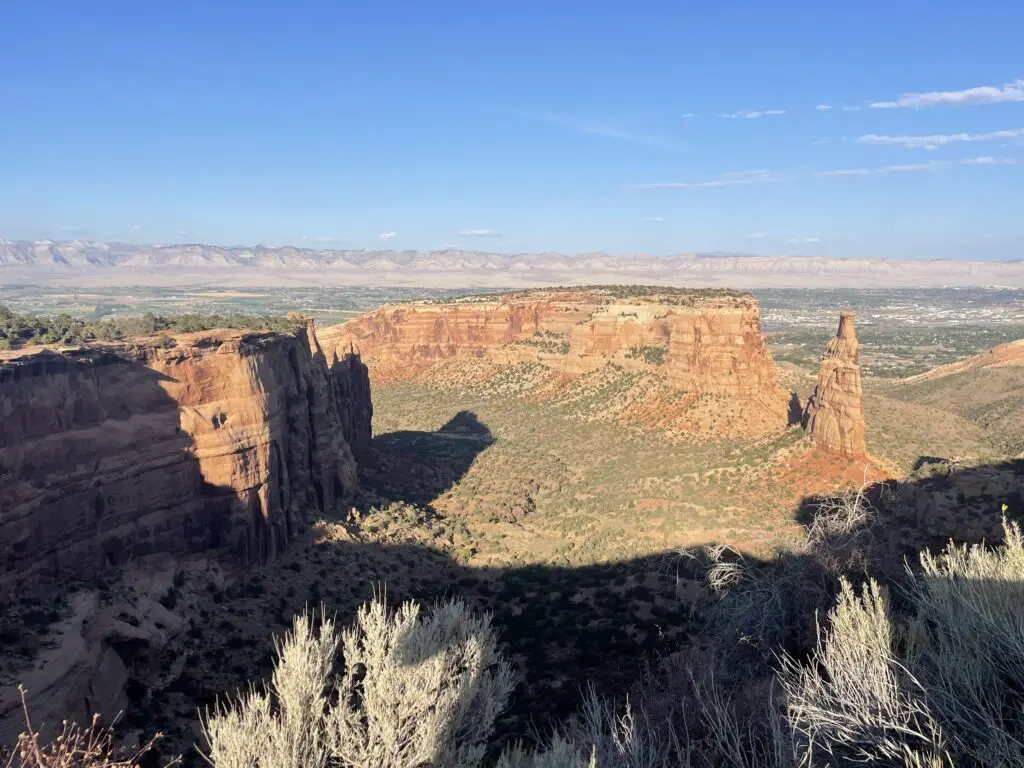
Scrub-brush covered canyon floor with red rock walls rising on the sides; brown, rocky cliffs in the background all under a blue sky with some white, puffy clouds. Rock monoliths also rise from the canyon floor. Scrub-brush covered canyon floor with red rock walls rising on the sides; brown, rocky cliffs in the background all under a blue sky with some white, puffy clouds. The road Broadway runs through several of the towns in Grand Valley and connects the two ends of Rimrock Drive between Fruita and Grand Junction. This road, along with the Rimrock route, make for a great loop drive!

Some other pics from our trip!
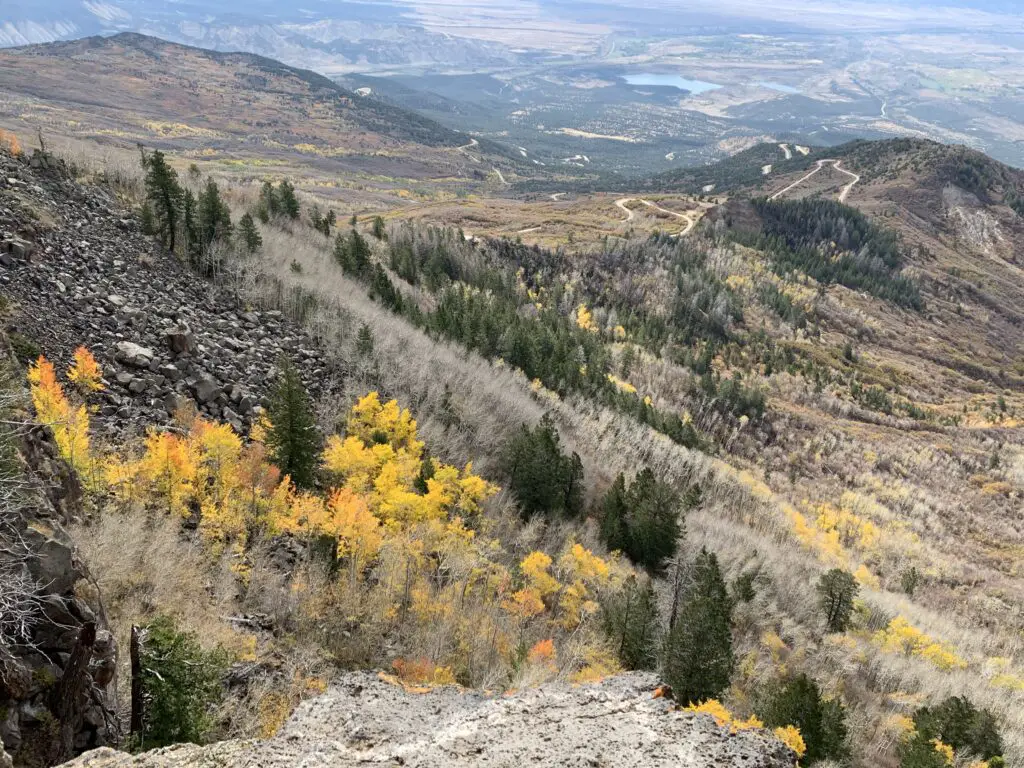
A hillside of yellow-leafed trees mingled amongst dark green, pine trees.
The Grand Mesa

We first visited Grand Mesa on our Southwestern Road Trip in 2017–we couldn’t do much because I was recovering from a TERRIBLE flu that I had caught on the trip and it was still so early in the summer much of the park had snow. Then we returned in summer of 2018 for our Colorado Road Trip and were able to enjoy a lot more hiking. It was fun to come back in fall of 2024 and see it again in a different season and from another perspective!

View down a mountain slope with yellow-leafed and dark, pine green trees. A dirt road snakes along farther down the hill and small lakes can be seen in the far distance.

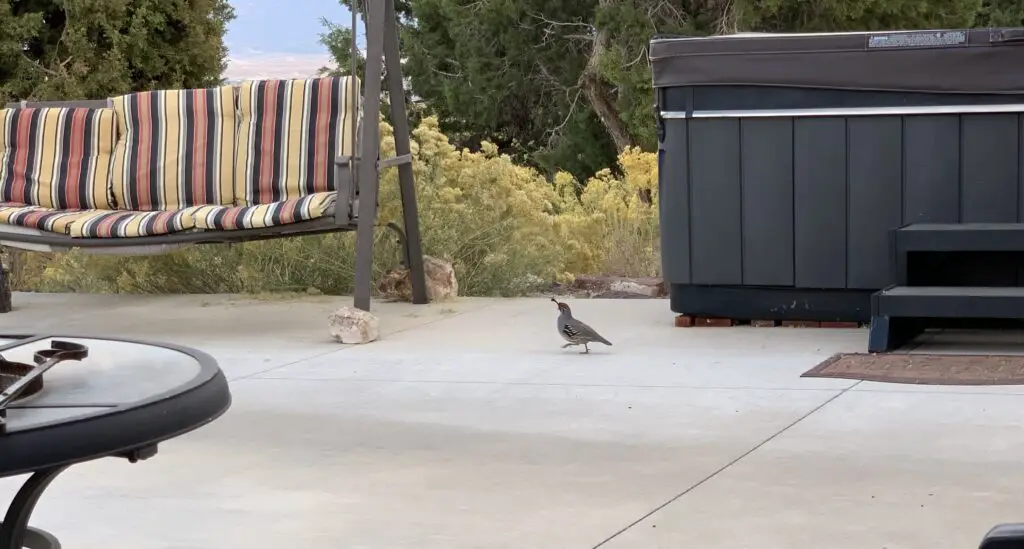
These quail were ADORABLE and ran all over the porch at the Air B&B we stayed at making squeaky noises.
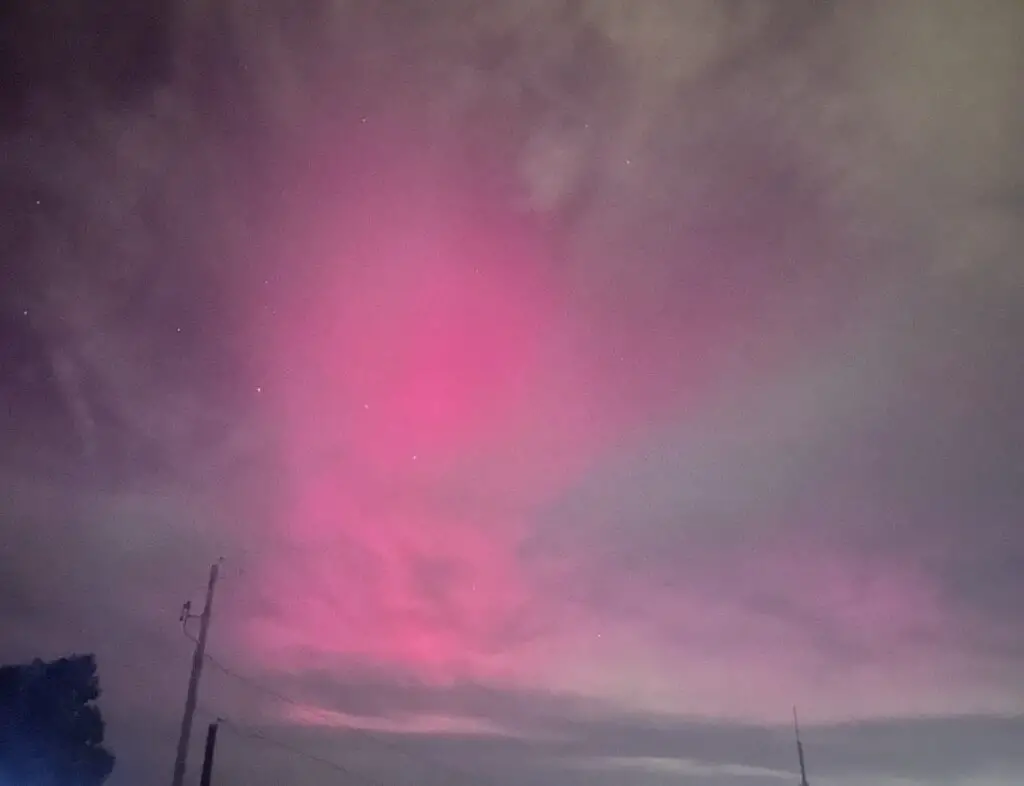
Rosy pink and blue-green light spreads across a dark, night sky.
A surprise Northern Lights viewing!
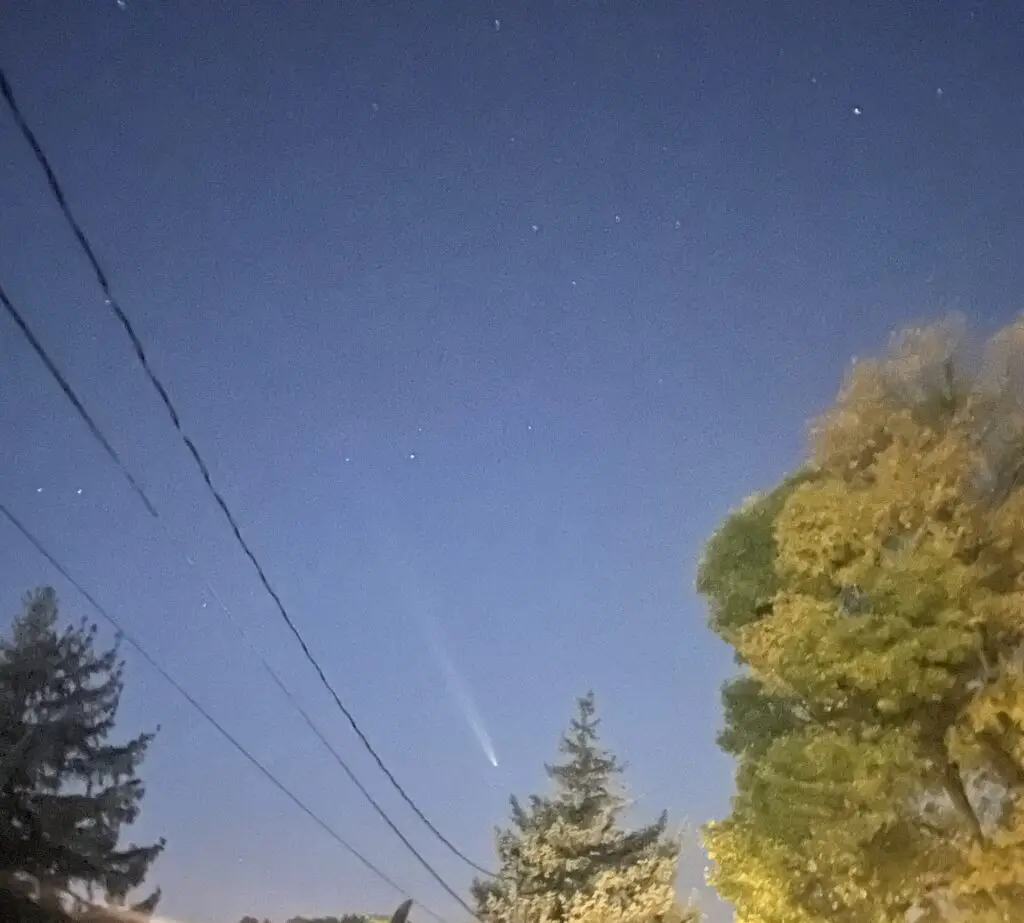
Light comet tail flies across a dark, night sky
We caught the ATLAS Comet when we got home!


If you’re looking for a fun and beautiful place to visit, check out the Colorado National Monument on Colorado’s Western Slope!

Have you visited the Colorado National Monument?   Tell me about your experience in the comments! 


Did you enjoy this post? Pin it!

Red rock formations rise from a scrub brush-covered canyon floor, all under a clear, blue sky. Text reads, "Colorado National Monument. Visit this amazing site in far, western Coloroado"

Like what you read here today?  Please feel free to leave a comment, like, or share this post!  Add your email at the bottom of the page, or the sidebar to the right, to be notified when a new post is published.  By signing up for the email list, you will also receive a free copy of the Tranquil Trekker’s Top 10 Tips of Trekking Do’s and Don’ts! 

Go Fast Camper!

In this post, I review our recent purchase of a Go Fast Camper!


*Author’s Note: This post is NOT sponsored and I have received NO compensation for it. I’m just REALLY excited about our new camper!*

In Summer 2024 the Trekkers achieved a major goal!  After years of discussions, research…and more discussions…we FINALLY agreed on and acquired a Go Fast Camper!

Why a Go Fast Camper?

We started our camping experience with a simple, ground tent Mr. Trekker picked up during our college years, for about $30 at a local Walmart. Eventually we moved on to a fancier and bigger, REI, ground tent we acquired as a wedding present (and still use from time to time!)

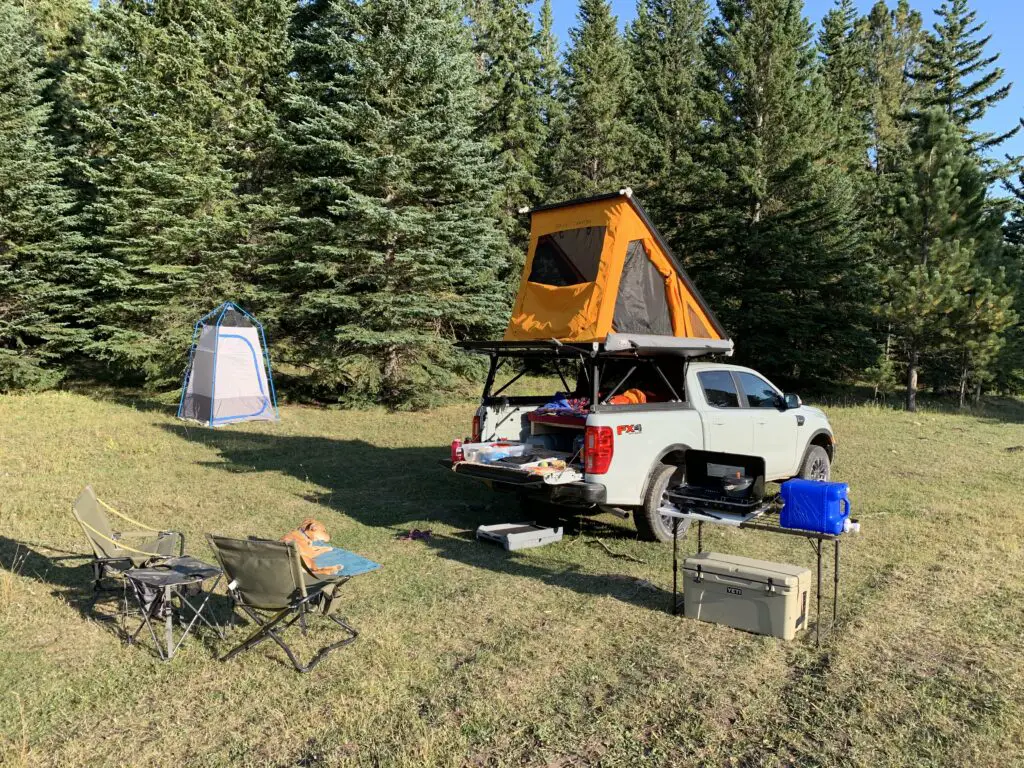
Opened-tent on top of truck with camping equipment and dog scattered about a meadow-area with pine trees in the background
Go Fast Camper fully deployed in its natural habitat!

As we aged and our backs got a bit more grouchy 😉 we decided we preferred the FAR more comfortable foam beds offered by the fancier, above-ground tents. We also preferred being off the ground some  (especially as we’re spending more time alone, in the Wilds, disperse-camping outside of established campgrounds–sometimes in Grizzly country!)   

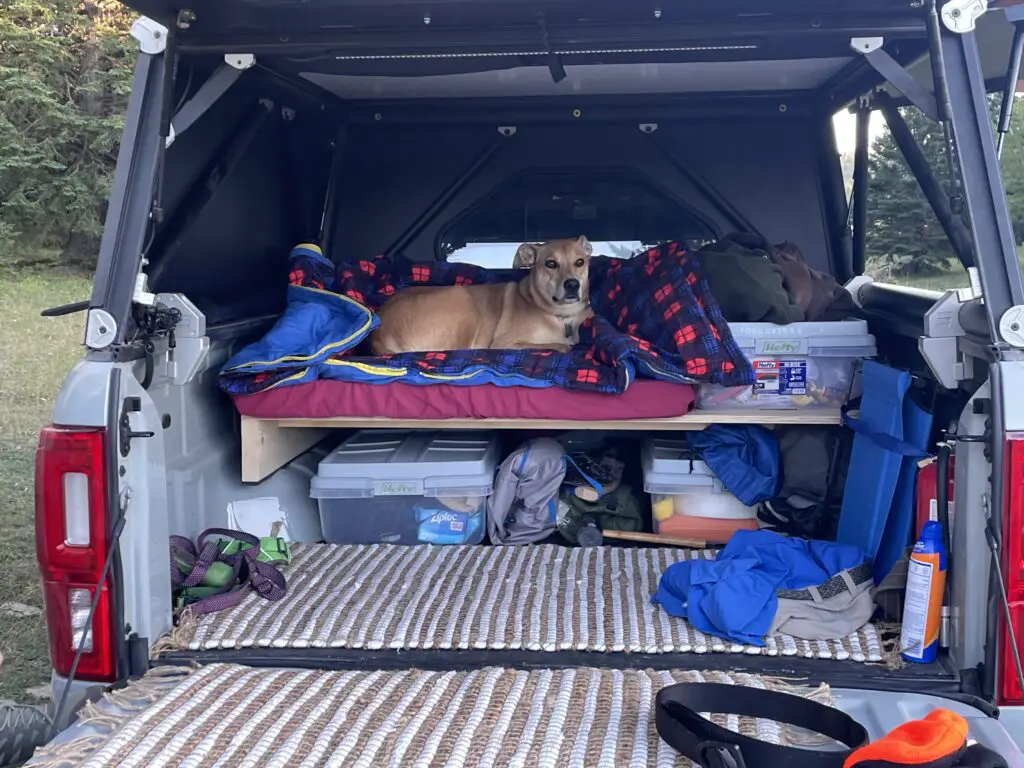
Dog lays on a dog bed and sleeping bag, that sits on a shelf, in a truck capper, with camping equipment underneath.
Our “stuff” packed in the truck bed. Puppers LOVED her bed! You’ll notice that the sides of the camper fold up so they can act like windows (and rain shields) when you’re stopped, they call it, “Cabana Mode”.

Initially we acquired and tried out a rooftop tent on a trailer for several years. While we liked this option it still took a little while to setup and the trailer got kind of annoying on some tight trails, or when trying to park in small, mountain towns.

We could have put the rooftop tent on the “rooftop” of the truck, but that would have meant we needed to acquire another truck capper that could handle the weight–to the tune of several $1000s. Also, rooftop tents are HEAVY and difficult to get on and off the truck so once they’re on, you tend to leave them there as much as possible–this puts a lot of strain on the truck not to mention kills your aerodynamics and gas mileage–all for equipment you only use a few times a year.

So we mostly decided we weren’t interested in another trailer of any sort, so then we considered a regular truck camper. However, we really enjoy the smaller footprint and better gas mileage of the mid-size trucks and the in-bed, truck campers that fit these are TINY–especially for two people and a dog.  Also, even the smallest, most basic ones are PRICEY!

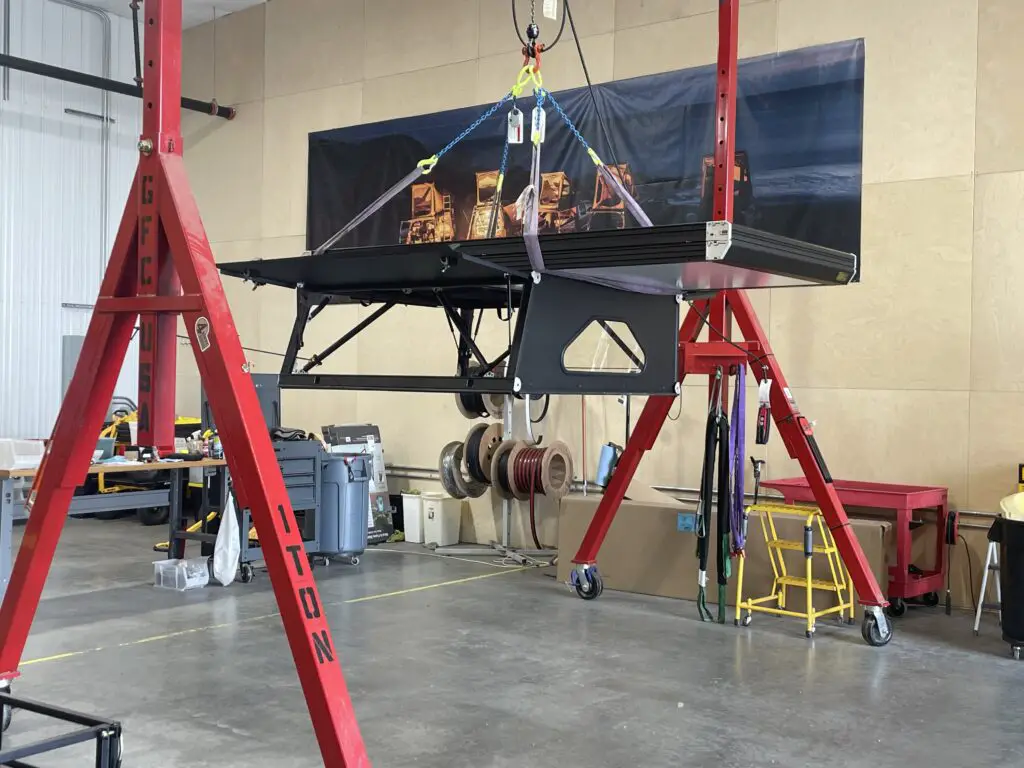
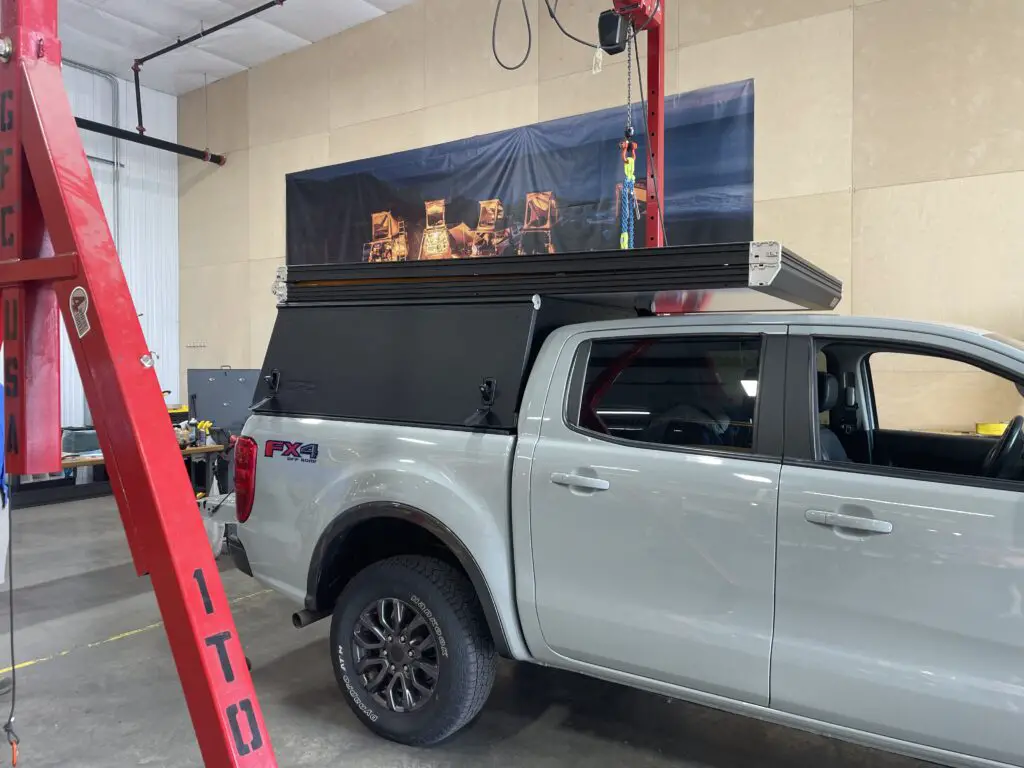
Black camper, truck topper folded closed with the side windows open
Inside the Go Fast Camper shop. What the Camper looks like on it’s own, when it’s folded up!
Black truck capper with thin, black camper on to--all folded down on the back of a truck.
Go Fast Camper all buttoned up and installed on the truck!

So finally we started looking at wedge campers! These offer the benefit and simplicity of a tent, while keeping you well above the heads of any critters that may be lurking around below you! Their footprint also matches that of the truck, meaning if you can fit the truck on a narrow trail or in a tiny parking space, the camper goes right along with it. The uniqueness of the Go Fast Camper also means you don’t lose the utility of the truck bed when the camper isn’t in use–you can literally have your cake (the use of the regular truck bed) and eat it too (the camper)!

The only negative was, we had to travel to Western Montana one weekend to pick up our new toy…or darn! 😉 And then we promptly enjoyed it while camping in the BigHorns for a night! 😀  

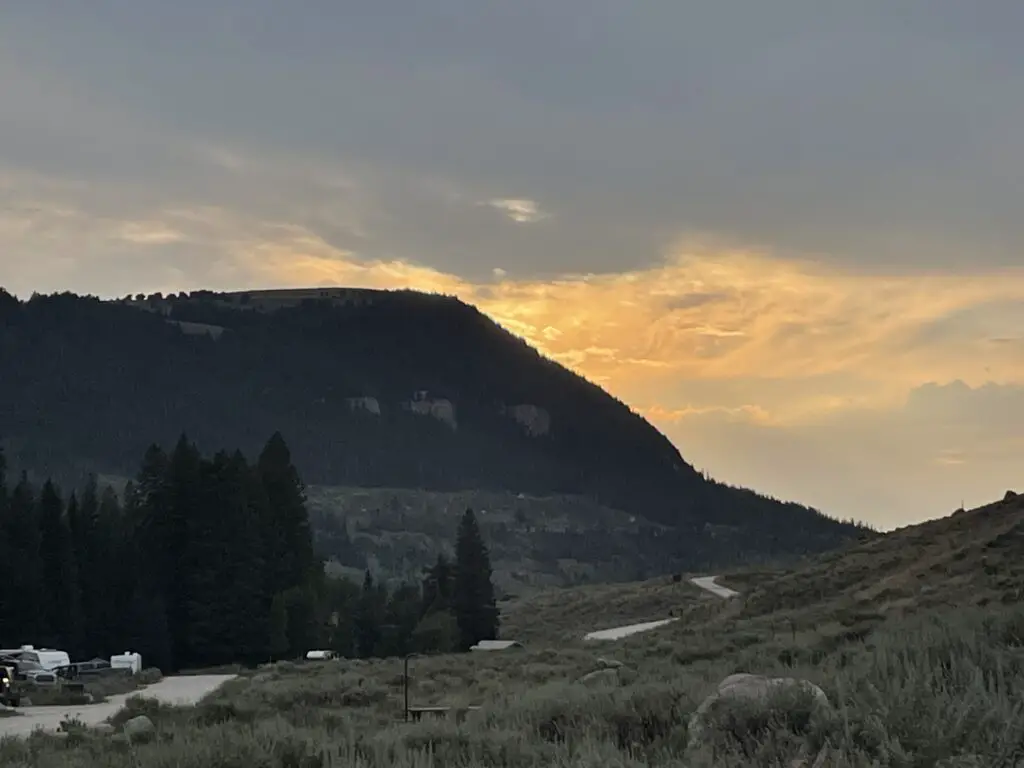
Sunset view of gray clouds over a tree-covered mountain in the background with a small campground and campers in the foreground--the whole picture looks a little hazy due to wildfire smoke.
Smoky campsite in the Big Horns the first night with the new Camper!

What is a Go Fast Camper?

A Go Fast Camper is essentially a rooftop tent that sits and opens from the top of a typical, truck-bed capper. It is installed at a factory and stays on the truck permanently–unless you were to take the capper off. When the tent is down the truck bed can be used for any purpose you want as any normal truck bed and the bottom of the tent forms the top of the truck capper. Removable cushions/panels form a pass-through between the truck bed and the tent when the tent is open. Some models also allow for an outside ladder to be installed (like those on regular rooftop tents). 

With this setup you are also free to design your truck bed however you want with a power pack, a fridge, or an in-bed drawer system if you want to use the truck more for camping-only. 

View from below of two black, removable, foam panels.
View is from the truck bed below. These panels are removable and form the pass-through that you climb up through to get into the tent.

How do you use a Go Fast Camper?

Setup/tear down of this camper is incredibly quick! To open the tent you simply unlock it and let it rise on it’s own (it literally takes about 30 seconds!) Tear down takes about 1.5 minutes (grab the top, push the soft sides in, pull down and fold it up!)…LITERALLY, that’s all there is to it! (It takes longer to put the tent away because you have to make sure it folds in well and none of the fabric is pinched.)

Full disclosure:  the price point of a Go Fast Camper can be a barrier for some. While not “cheap” per se, a Go Fast Camper is FAR more affordable than any other trailer or regular truck camper out there–comparable in price to a combination rooftop tent/new capper for the truck. This is 1/2 (or less!) the price of a typical truck camper and 1/4 (or FAR less!) than the typical cost of a camper trailer/RV.

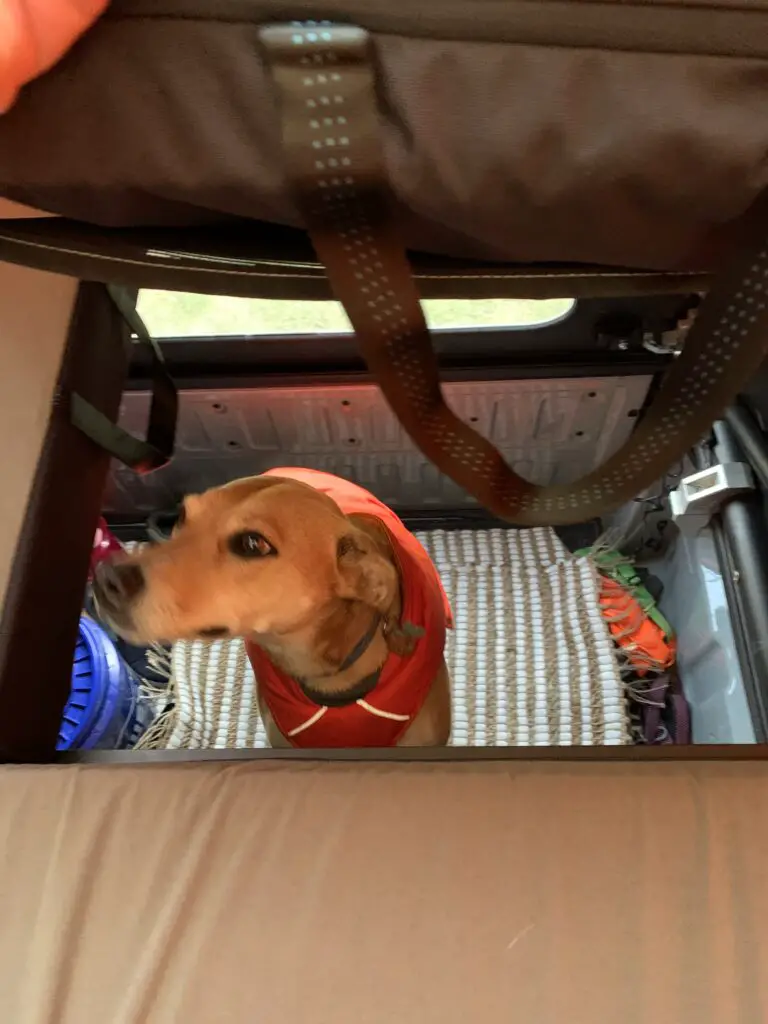
View from above of a dog that peers through a hole in the tent floor where a removable panel has been moved.
View from above! Puppers is demonstrating the pass-thru from the truck bed into the tent (when a removable panel is moved)! It’s blurry because…you try getting an excited dog to hold still for a picture! 😇

The Go Fast team was also great to work with! They are based near Bozeman, Montana, meaning they are a small-town company that employs local, American workers! We have had great luck with this team and appreciate the regular communication and continued service they offer!

They also contract with several other dealers throughout the country including some on the West Coast, and a few in Colorado, Texas, Missouri and North Carolina.

Be aware, there is a fairly lengthy lead time between placing the order and receiving your product. We ordered our camper in March and didn’t receive it until early August. We were aware of this situation when we made the purchase and the Go Fast team stayed in regular contact with us about how our build was proceeding.

In the interim months they actually changed the build platform some from what we’d originally ordered. As our build was still in progress the Go Fast team went ahead and added the upgrades with little-to-no additional cost to us! There were a few upgrade items they weren’t able to add at the time due to supply-line issues. But, they kept us updated regularly on the status of those and shipped them along when they were available.

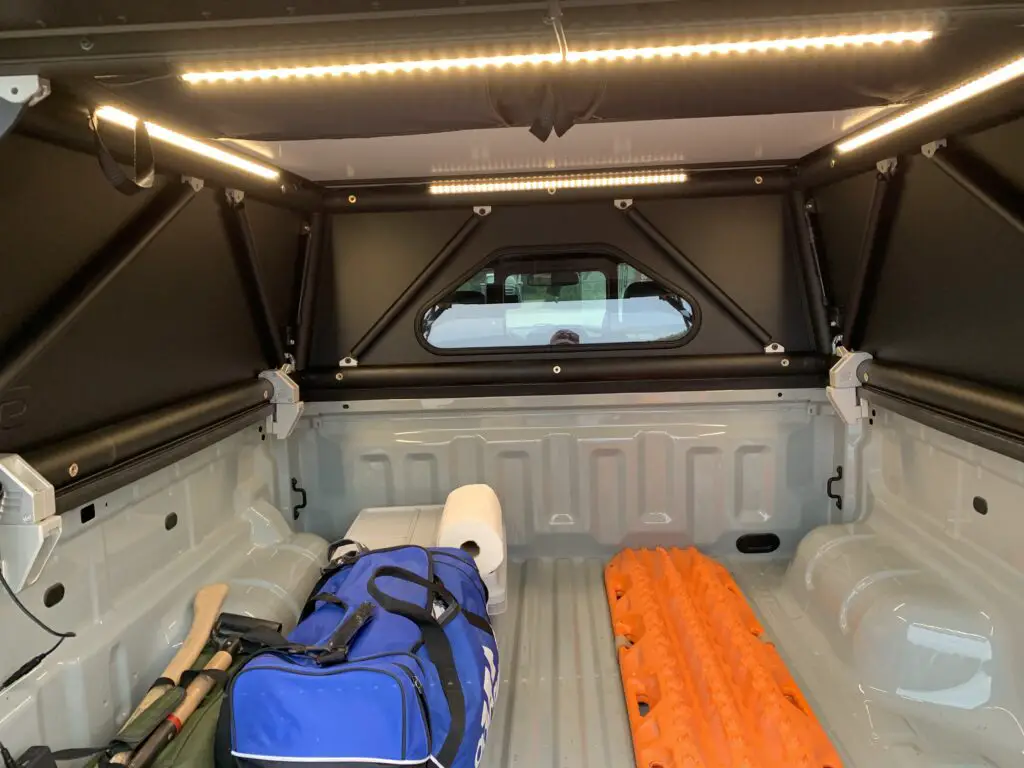
Inside of a truck bed capper topped with LED lights
This requires a power source but these lights were one of the add-ons Go Fast Campers added for us! You can also see here what the regular truck bed looks like when the camper is down.
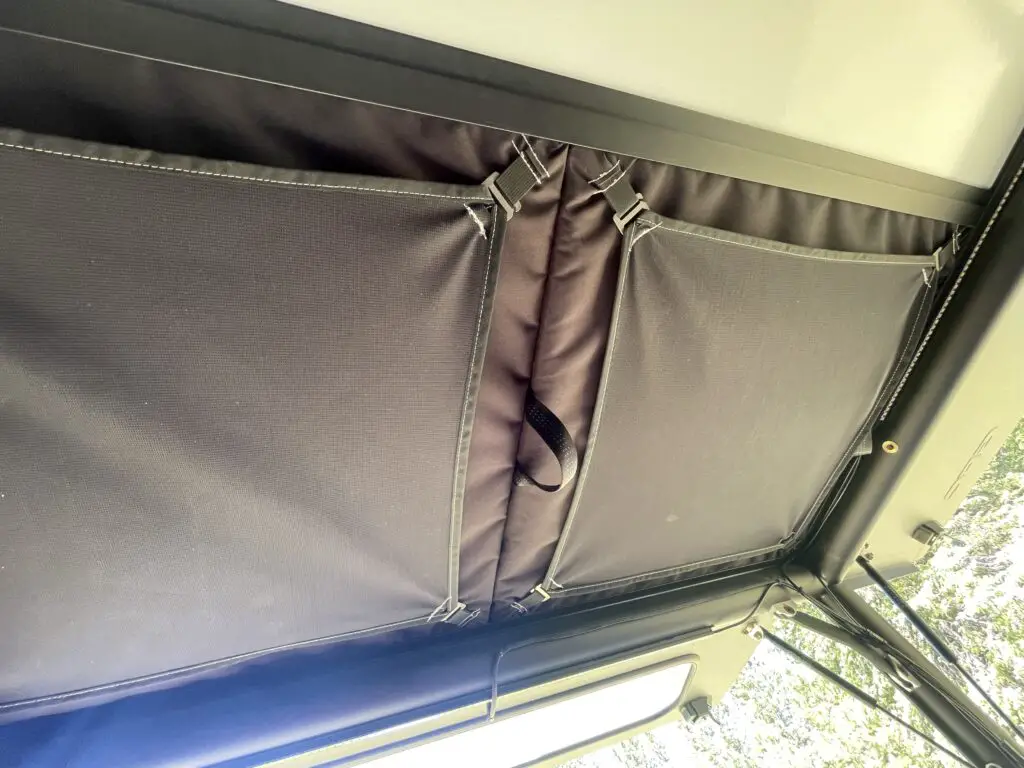
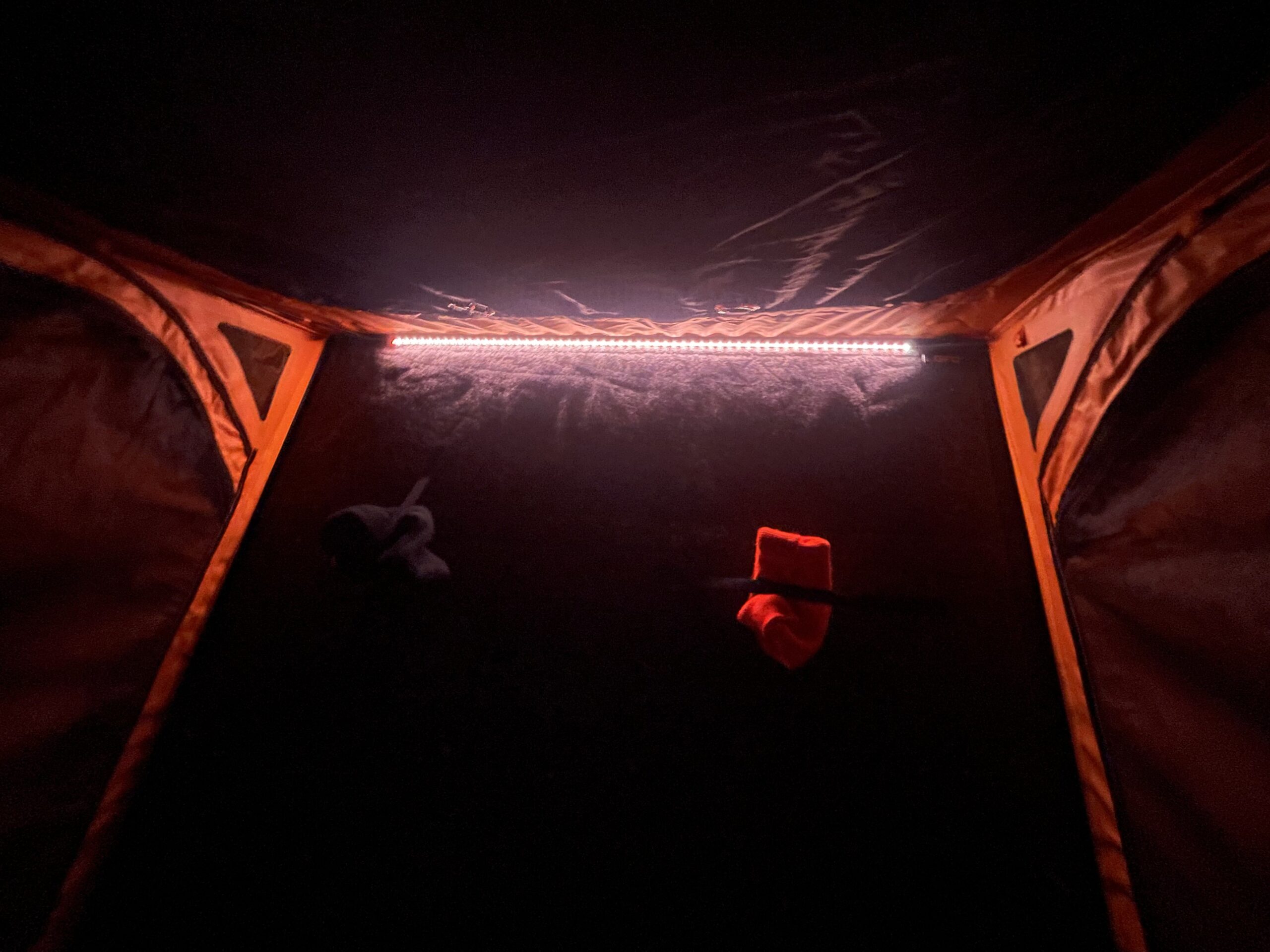
The dark inside of a tent with stocking hats, strapped by velcro to the roof, and an LED light rope on one corner
The same lights inside the tent!

Since we got the camper late in the summer we were only able to use it a handful of times, though we’re looking forward to getting out in it quite a bit this coming summer!

Super secret, dispersed camping area in the Black Hills on Labor Day Weekend–though I have it on good authority this is a great place to get a Christmas Tree

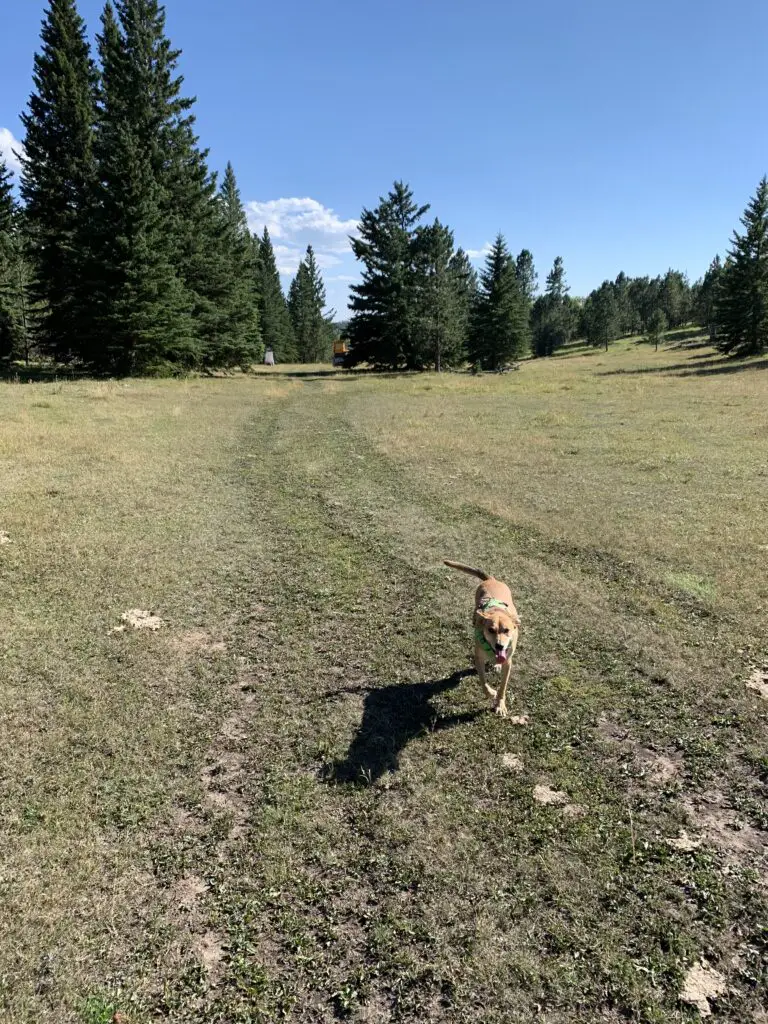
Happy-looking dog running through a grassy meadow with large pine trees in the backgound
Puppers thoroughly enjoyed having the lengthy meadow to chase her ball!
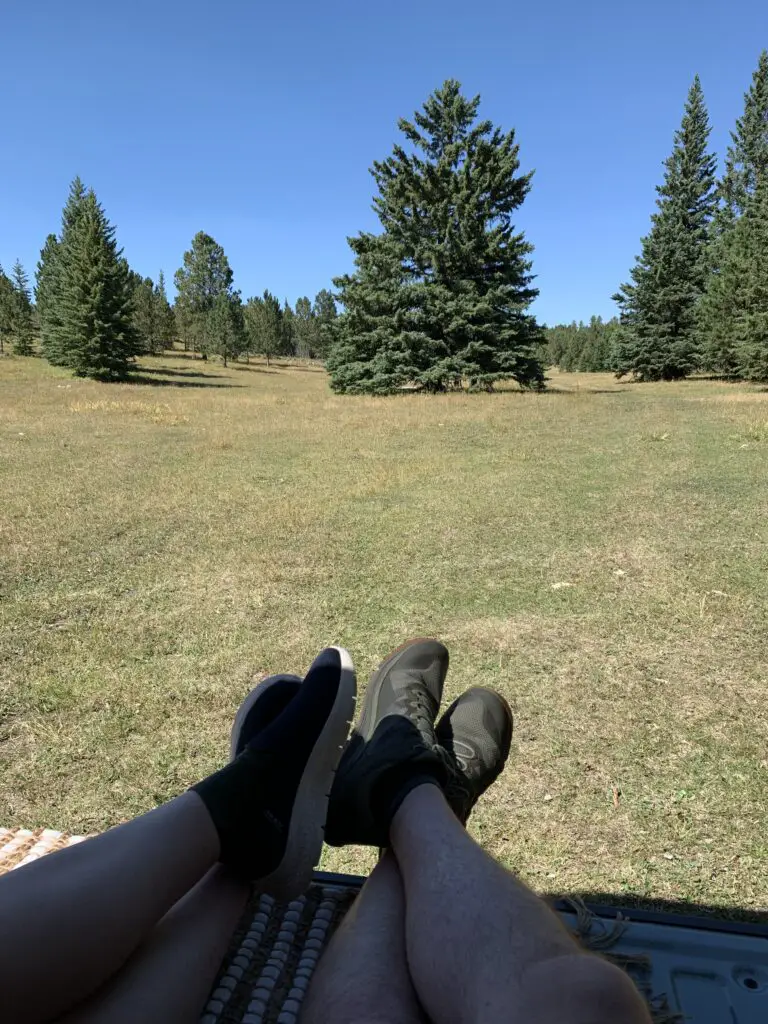
Sneaker-clad feet of two people sitting in a truck bed, overlooking a grassy meadow interspersed with large, pine trees, all under a clear, blue sky.
Trekker Feet enjoying the still-usable truck bed and relaxing in the shade on a hot day!

If you’re looking for a fun, affordable alternative to a full truck camper or trailer, consider a Go Fast Camper!

Do you have a Go Fast Camper? Or are you interested in one? Let me know about your experiences or any questions you may have in the comments! 


Did you enjoy this post? Pin it!

2 pictures: 1) a truck with closed capper sits in a utility shop; 2) A truck with open tent on top of capper sits in the wilderness. Text reads: "Go Fast Camper. Get one for yourself!"


Like what you read here today?  Please feel free to leave a comment, like, or share this post!  Add your email at the bottom of the page, or the sidebar to the right, to be notified when a new post is published.  By signing up for the email list, you will also receive a free copy of the Tranquil Trekker’s Top 10 Tips of Trekking Do’s and Don’ts! You can also follow the blog on social media by clicking the links below!
Facebook

Twitter

Instagram

Pinterest

Visit the Laura Ingalls Wilder Historic Homes

In this post, I review our visit to the home of my childhood hero!


When the Tranquil Trekker was a little girl, I LOVED the Little House books by Laura Ingalls Wilder! (We watched the TV show some too, but I always liked the books better.)  I read the entire series numerous times and had half the story memorized!

If you had told the Little Trekker that in 30 years I would be living in the SAME STATE as Laura I would have freaked! 😂  

For the last decade that we’ve lived in South Dakota, whenever we drive down I-90 through the eastern part of the state and see the sign for the Laura Ingalls Wilder Historic Homes, I would say, “We really need to visit there sometime!”

Well, we had plans to travel for a conference for Mr. Trekker’s work one fall, and he suggested we leave a few days early and stop at “Laura’s House” on the way.  I readily agreed!–The eight-year-old Tranquil Trekker was fangirling hard that day!

We knew I had surgery (and a lengthy recovery) looming in the next several months, so after our visit, Mr. Trekker got me several of my favorite Little House books for Christmas that year. I LOVED rereading them again during my convalescence!

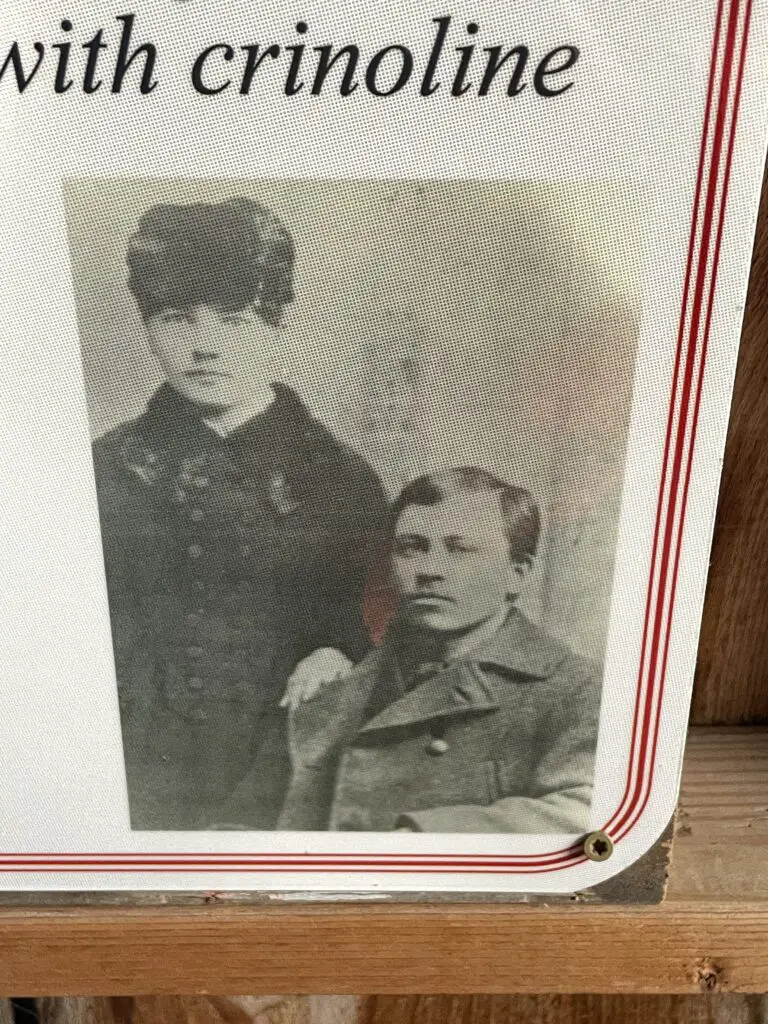
A black and white picture of a woman standing next to a seated man. They are both wearing overcoats and the woman is wearing a fur hat.
Laura and her husband Almanzo, later in their marriage

Where are the Laura Ingalls Wilder Historic Homes?

The Laura Ingalls Wilder Historic Homes museum is located in the tiny town of De Smet, in eastern South Dakota. The main museum and visitor center is found right off of US 14, almost downtown.

There are a few other sites related to Laura’s life scattered around the local area, as well. These include a marker to her husband, Almanzo, on Route 25 North and the Ingalls’ Homestead, an open-air museum, located off of 25 South.

You can also do a driving or walking tour through town and see where many of the buildings are (or used to be) from some of her later books. (If you stop at the main museum first, they have maps that show you all the other locations.)

For more information on visiting the museum, click here.

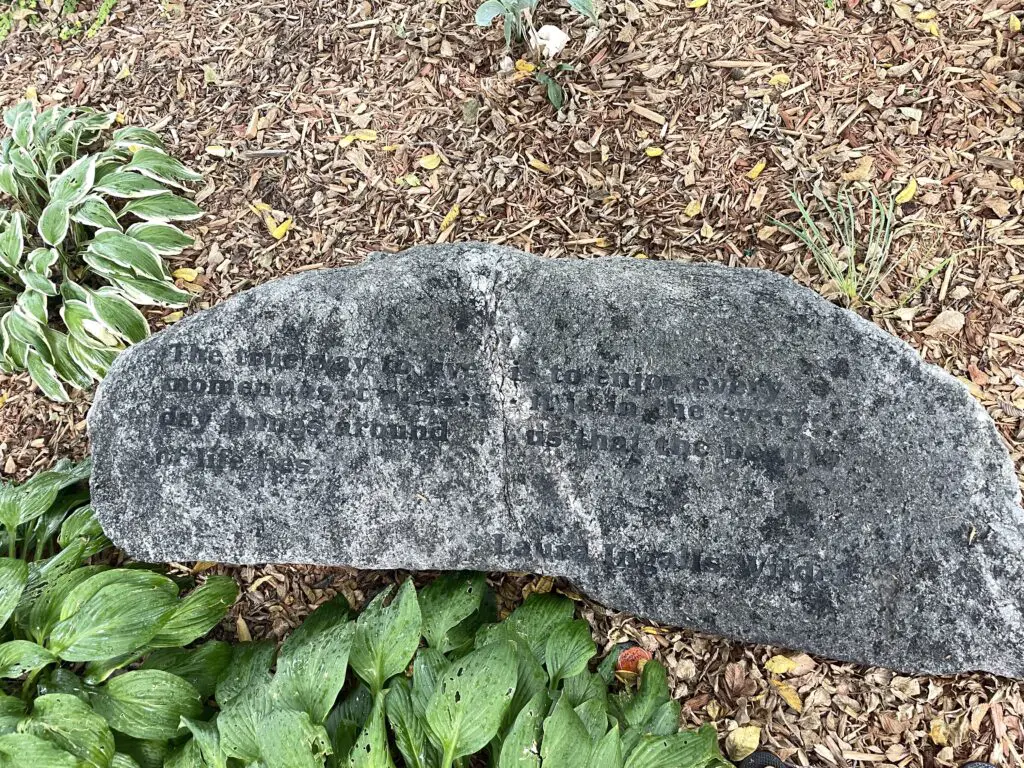
Large rock on the ground that reads, ""The true way to live is to enjoy every moment as it passes. It is in the everyday things around us that the beauty of life lies".
This rock was inscribed with a quote of Laura’s, “The true way to live is to enjoy every moment as it passes. It is in the everyday things around us that the beauty of life lies”–she was mindful! No wonder I liked her! 😁

What you will see at the Laura Ingalls Wilder Historic Homes

At the main, museum site you can tour the Surveyor’s House, where the family actually lived their first winter in De Smet. There are several other structures located on-site, as well that are available to tour, including a schoolhouse and a mock-up of a covered wagon.

While many of the structures are original this was not their original location. Some have been moved from their true location to the museum site to make touring easier. Others are re-creations and some are from a similar period even if they weren’t the actual buildings Laura and her friends used.

The Surveyor’s House:

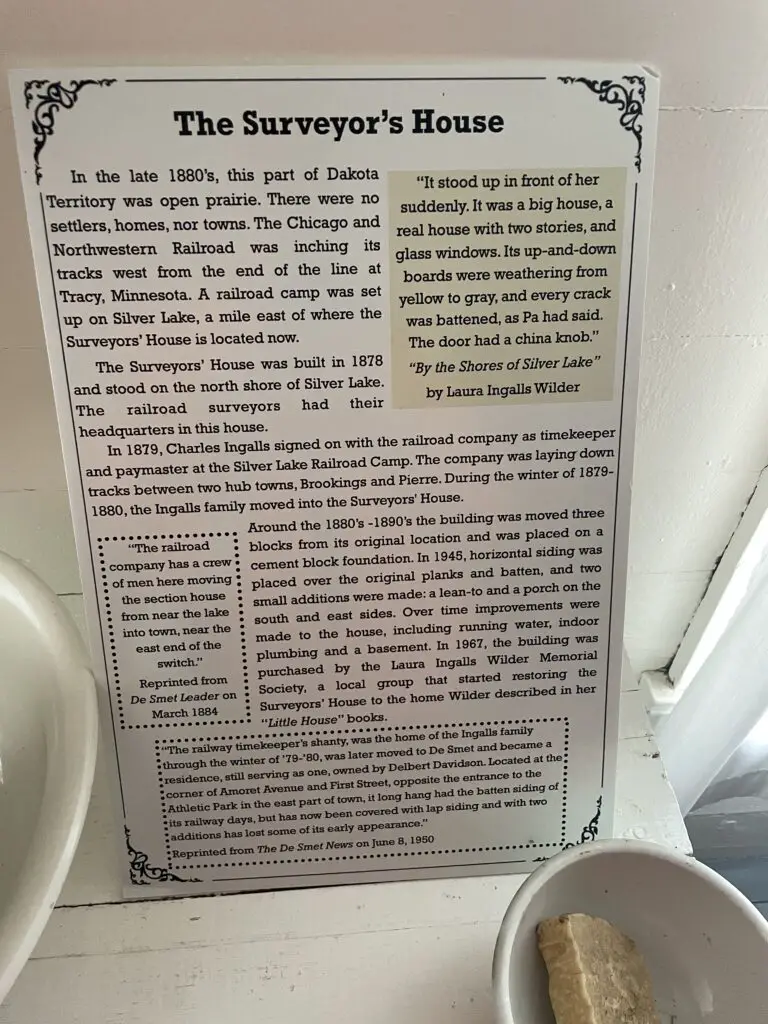
The Surveyor’s House is the actual home Laura and her family lived in their first winter in De Smet.  This story is portrayed in the book By the Shores of Silver Lake.

A poster describes the significance of the Surveyor's House to Laura's story

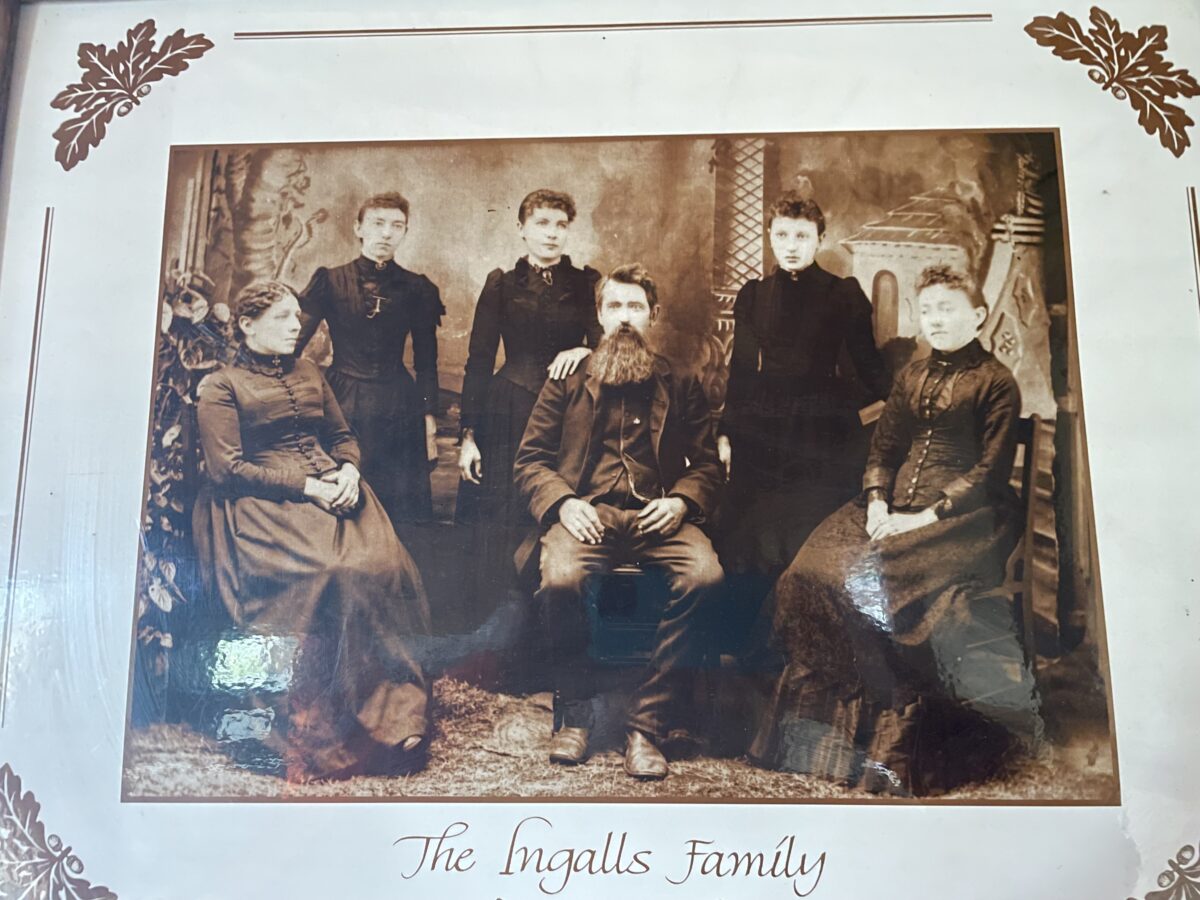
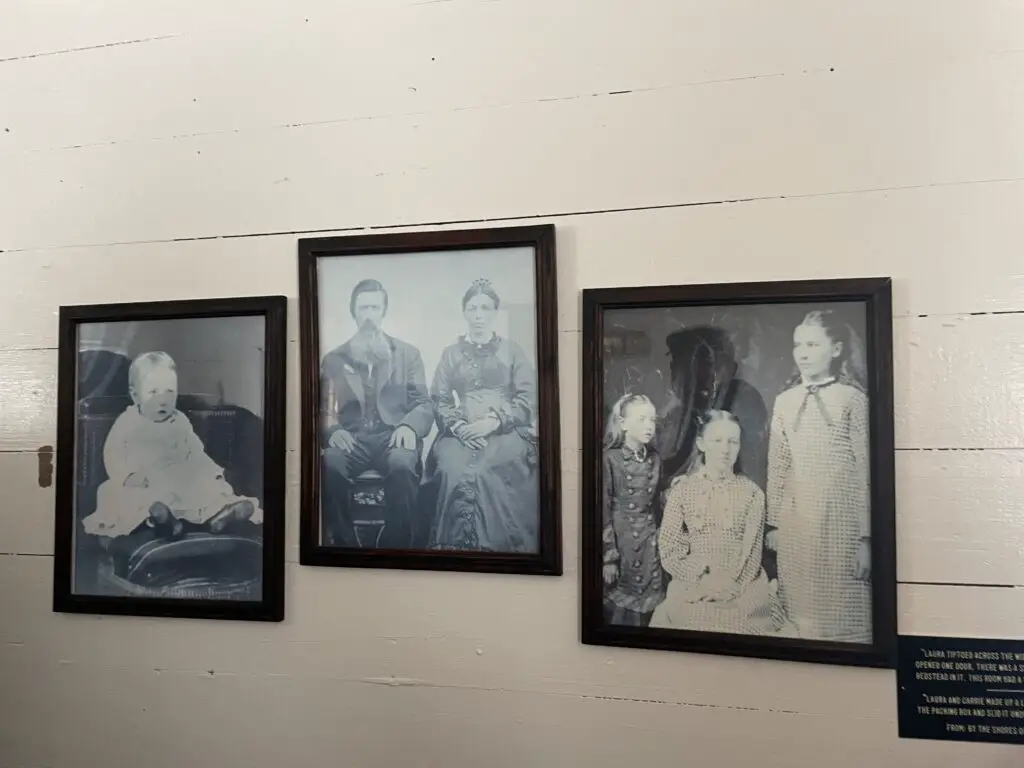
3 black and white photos of a baby, a couple and 3 young women
Photos of the Ingalls on a wall of the Surveyor’s House (Baby Grace is on the left, Pa and Ma are in the middle and Carrie, Mary, and Laura are in the 3rd picture–Laura is standing, Mary is sitting)


The Final, Ingalls Home

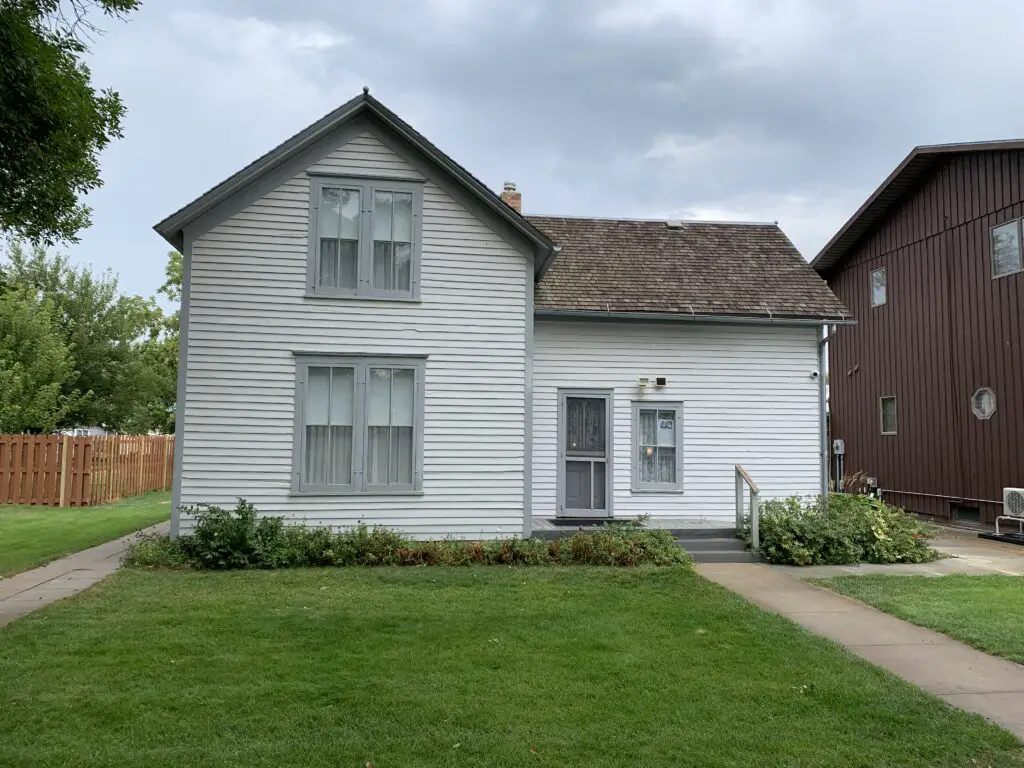
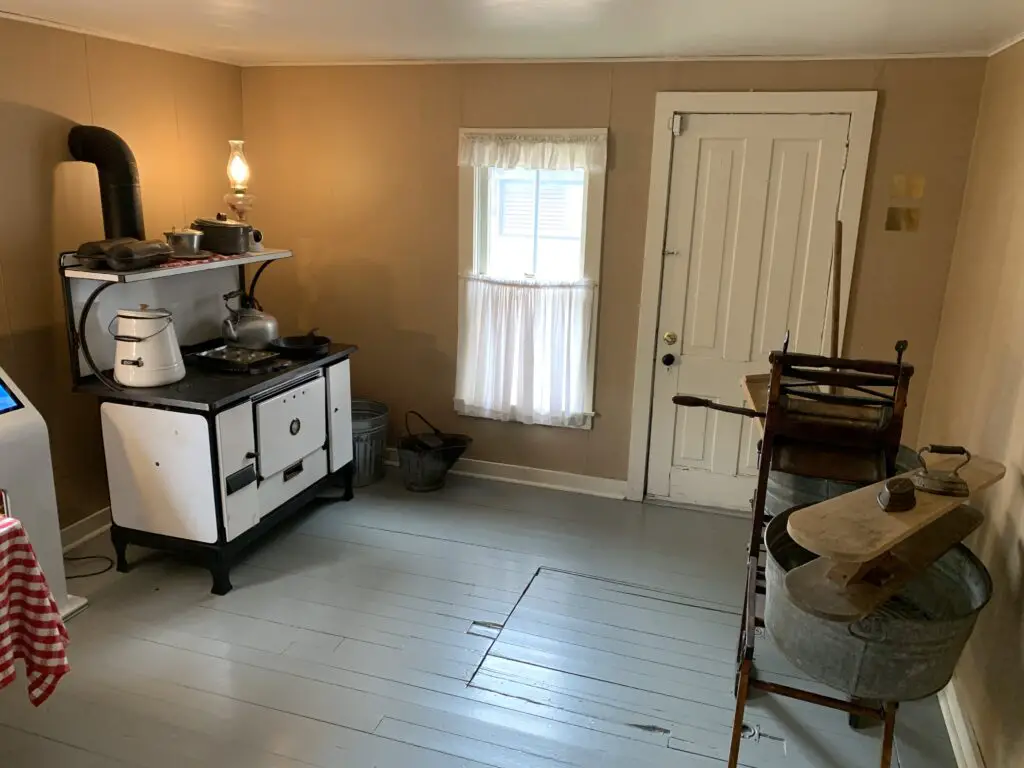
In town, a few blocks from the main museum is the final home the Ingalls all lived in as a family. The house still contains furniture, mementos, and pictures from when the family lived there.

A white house stands in town
The final home the Ingalls lived in together in De Smet

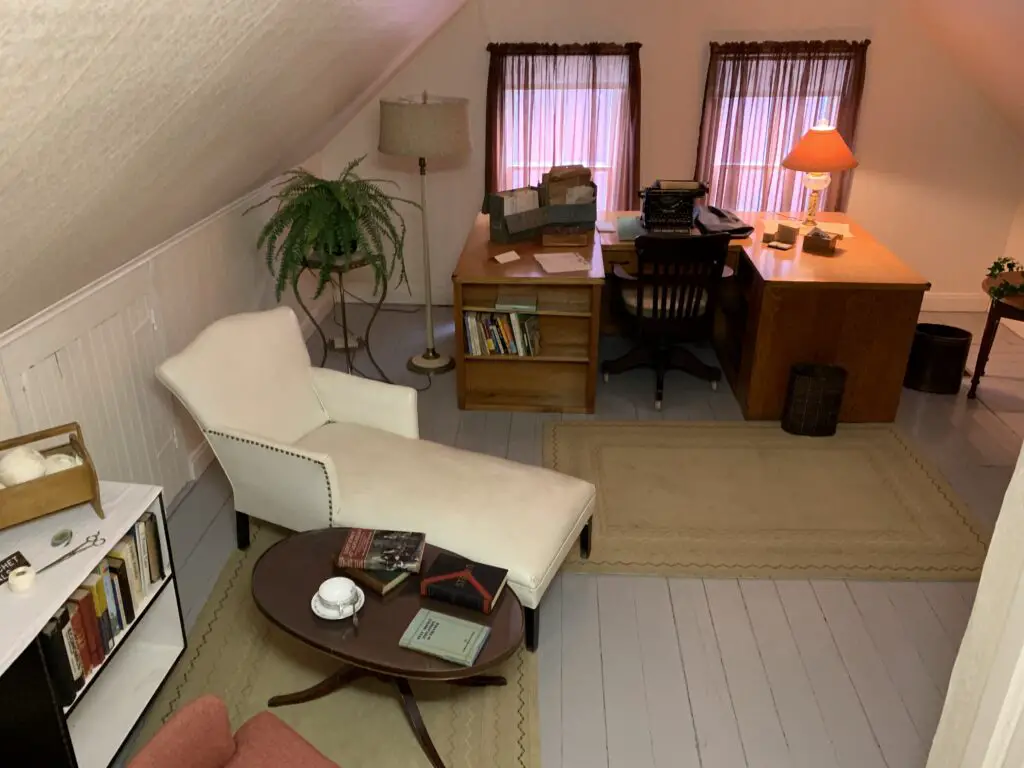
A lounge chair surrounded by a desk, table and bookcase.

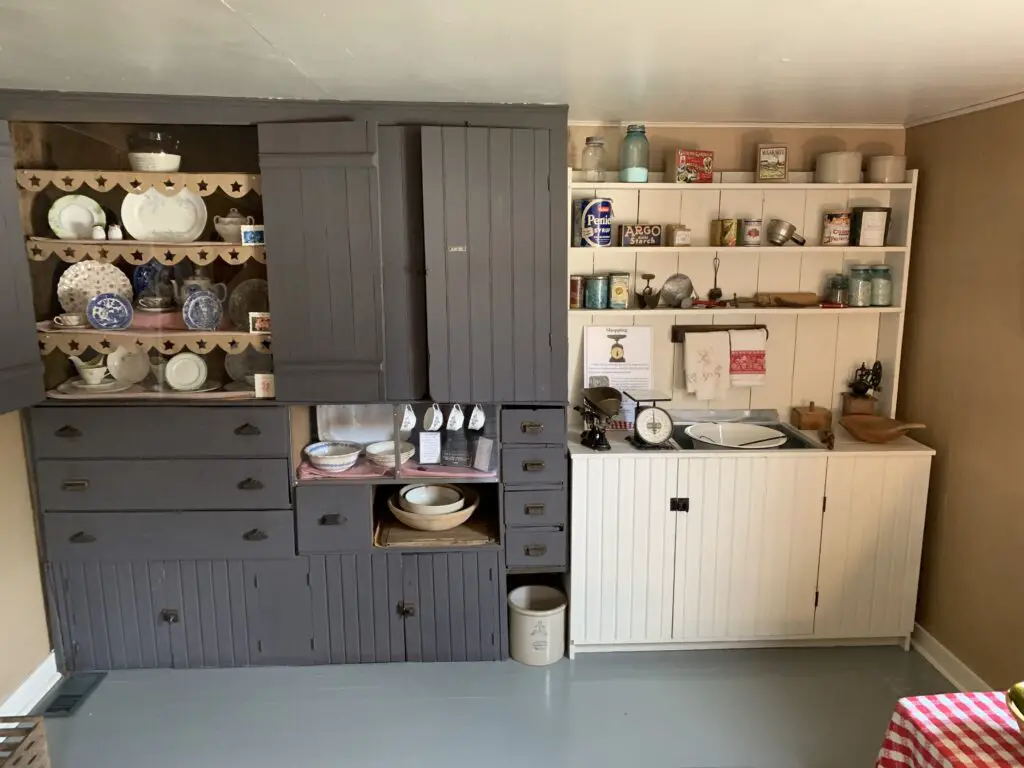
Large cabinets with dishes and cooking ingredients/equipment
Ma’s kitchen where Pa built the cabinets by hand!

The Ingalls Homestead:

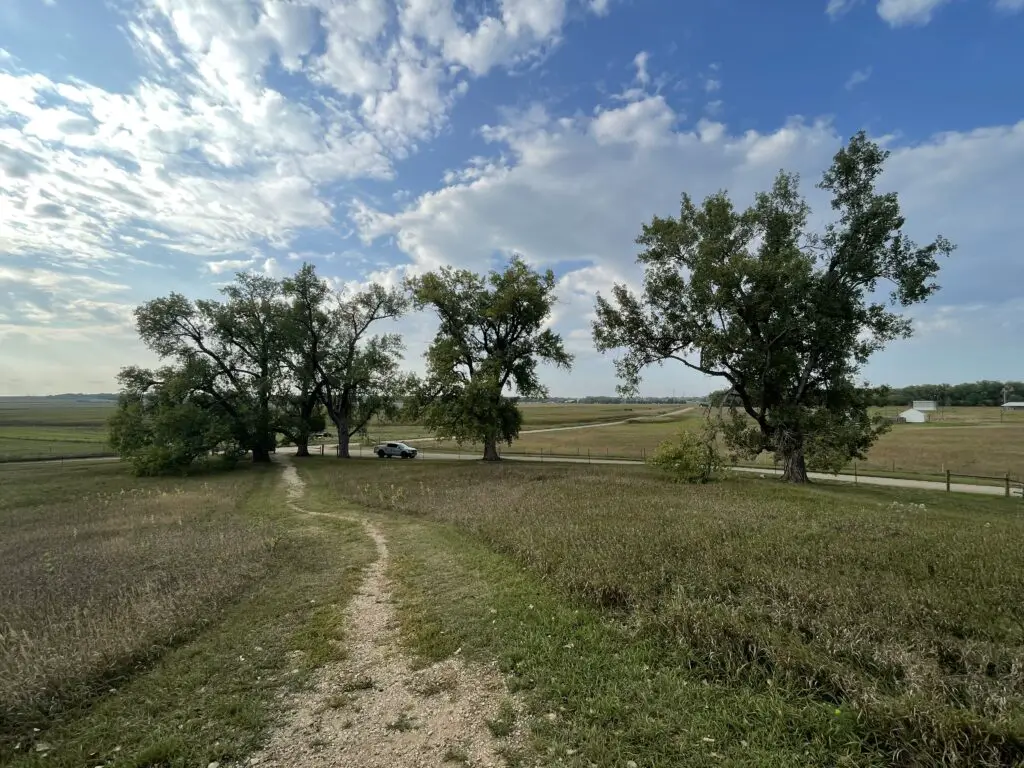
South of town, south of Big Slough, is the actual Ingalls’ homestead!

5 cottonwood trees stand in a field
The actual, five cottonwood trees Pa planted for “his girls” in the book “On the Shores of Silver Lake” are all still standing!

There is a mockup of a barn, a church, and a one-room schoolhouse, among other sites you can tour.

A white church stands amongst some trees in a field with a dirt path leading to it

A white schoolhouse sits in a field
A model of the type of schoolhouse Laura would have attended and taught at

A wooden barn stands in a field near an old windmill

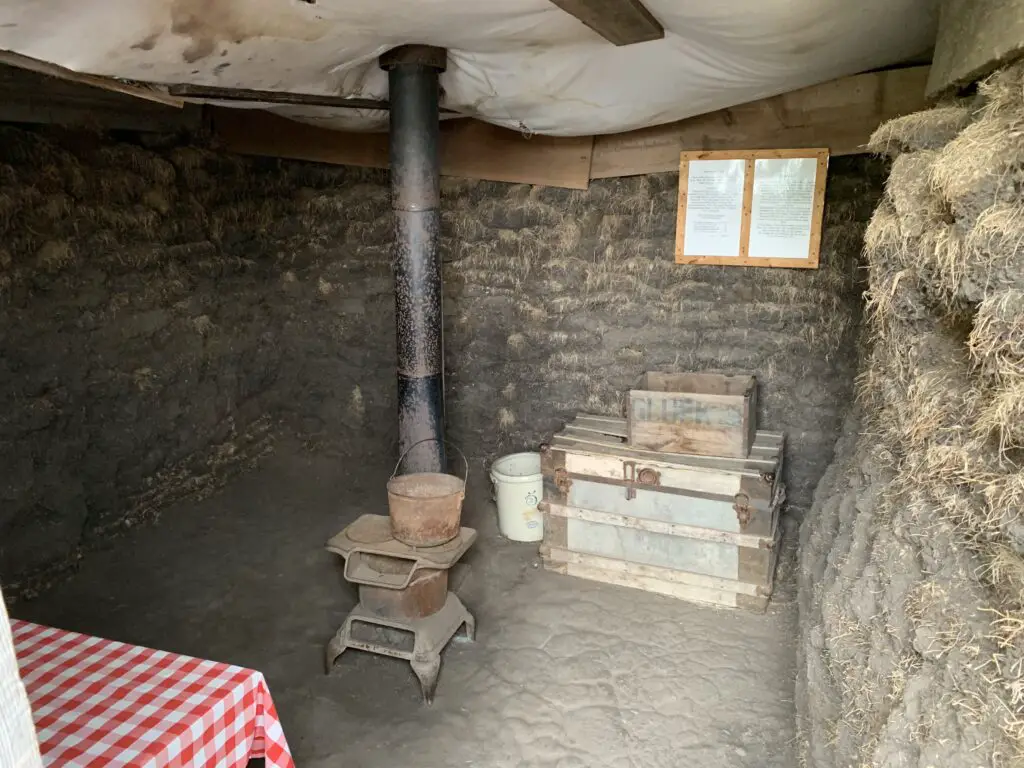
There is also a mockup of the shanty the Ingalls lived in on the prairie as well as an earthen dugout that some people used then (similar to what the Ingalls family lived in, in the book, On the Banks of Plum Creek.)

A papered shanty with no door stands amongst trees
This is a model of the shanty houses used during the time of Laura’s books
A small table, iron stove and wooden dressing inside a rock and mud duggout house
A model of the type of dugout home Laura and her family lived in, in the book “On the Banks of Plum Creek”

There is a wagon ride that runs at certain times throughout the year that will take you to these sites.

This is also a decent walk/hike if you’re able and interested–this is a great way to release some energy for the two–and four-legged–“kids” in the family (just remember the four-legged kids have to stay outside the buildings).

This site is a great historical place to visit that is educational but fun too. I’ve talked to several parents who said their children still love the Little House books (boys and girls). While they are definitely “stories about girls” they are much more “pioneer stories” than they are “girl stories”.

So if you’re looking for something educational and active to do in eastern South Dakota, check out the Laura Ingalls Wilder Historic Homes!


Did you enjoy this post? Pin it!

A collage of 4 pictures: 1) A white house stands in town; 2) Old, brown and white photograph of a man and two women sitting with three other women standing behind each of them; 3) A wooden barn stands in a field near an old windmill; 4) A small table, iron stove and wooden dressing inside a rock and mud duggout house. Pin reads, "Laura Ingalls Wilder Home"


Have you visited the Laura Ingalls Wilder Historic Homes in De Smet, South Dakota?  Did the site bring back fond memories of the Little House books from your childhood?  Tell me what you thought in the comments! 

Like what you read here today?  Please feel free to leave a comment, like, or share this post!  Add your email at the bottom of the page, or the sidebar to the right, to be notified when a new post is published.  By signing up for the email list, you will also receive a free copy of the Tranquil Trekker’s Top 10 Tips of Trekking Do’s and Don’ts! You can also follow the blog on social media by clicking the links below!
Facebook

Twitter

Instagram

Pinterest

Medicine Bow Mountains (the Snowy Range)

In this post, I detail some great places to hike and camp in the Snowys!


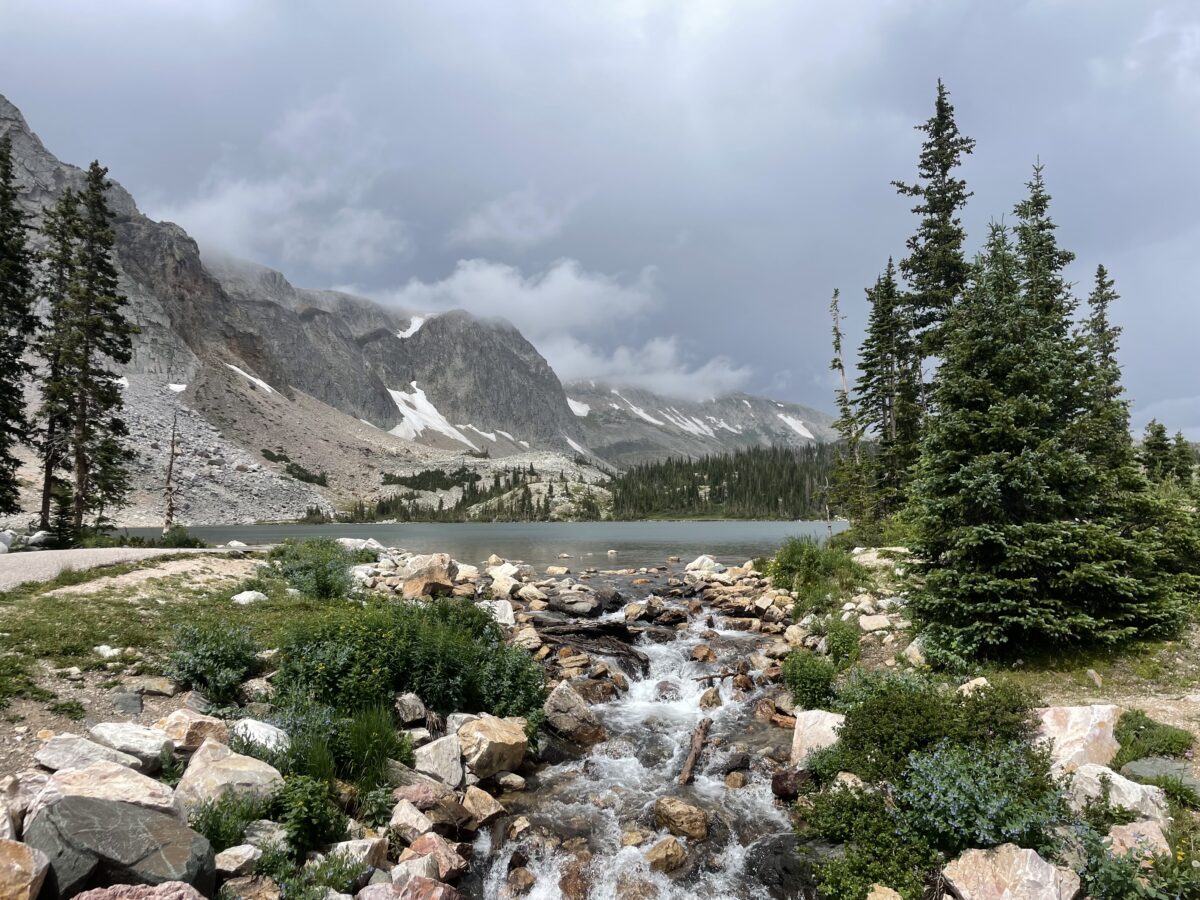
The Trekkers usually go to the Bighorn Mountains each summer. But this particular year the West had a VERY snowy and wet spring/summer (GREAT for avoiding wildfires, not so great for road conditions or mosquitoes). When we were making reservations all the roads/places we enjoy visiting in the Bighorns were closed due to mud and we figured the skeeters would be ATROCIOUS, so we thought why not try out the Medicine Bow Mountains (the Snowys) in south-central Wyoming instead?

Where are the Medicine Bows?

The Medicine Bows are a small area of mountains that run from north-central Colorado (near Rocky Mountain National Park) into south-central Wyoming (near Laramie).

The Wyoming portion is what most people think of as the Medicine Bows. Here they are divided into three main areas: the Sierra Madres to the west, the Snowy Range (the Snowys) in the middle, and the Laramie Peak area to the east. Our trip focused on the Snowys…

The Snowy Range reminded us of Colorado!

This area felt a lot like that around Walden, Colorado, and State Forest State Park which makes sense as it’s the same National Forest. Also, less than 100 miles separates the two…

There was still snow on some of the peaks. There is a reason they call this area “the Snowys”! 😉  Fortunately, the bugs weren’t too bad though!

–We also enjoyed the “singing” hummingbirds that we’ve noticed in Colorado before…

Ryan Park Campground

There are multiple Forest Service campgrounds in the Snowy Range.  We chose Ryan Park as it was lower than many of the other campgrounds in the Snowys (at “only” around 8,000 feet rather than 10,000 feet.)  This proved an obvious benefit as it was slightly warmer (especially at night) and may have had less rain (but was still FAR cooler than the lower elevations of the surrounding plains!)

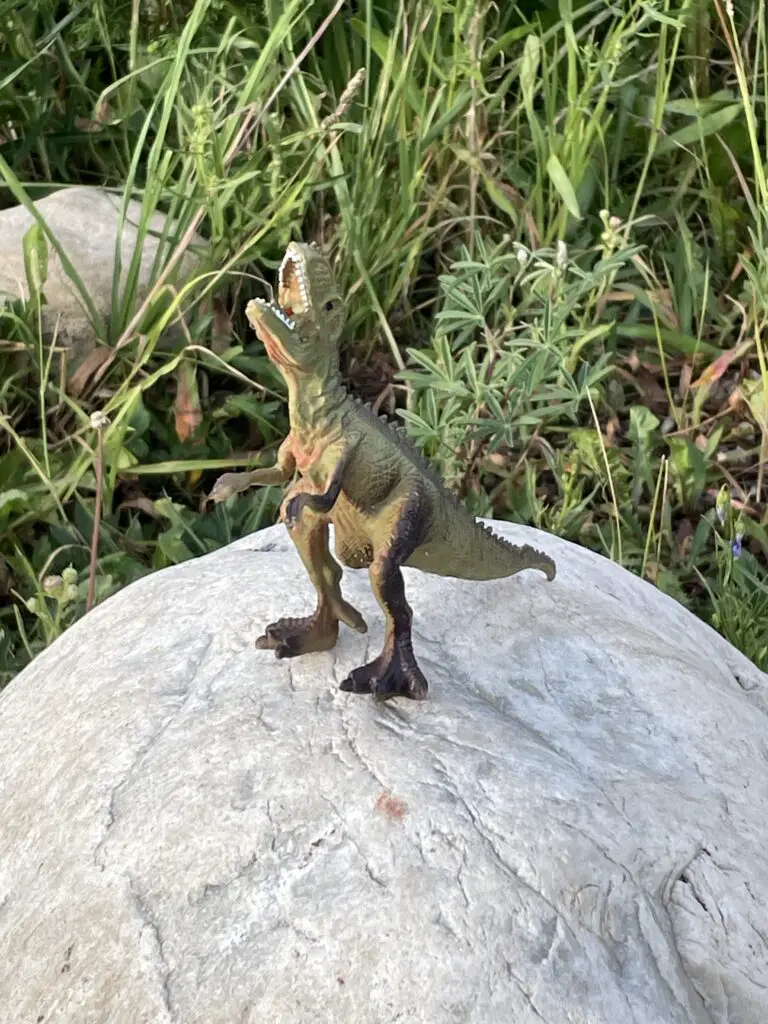
A toy dinosaur with it's head back roaring sits on top of a rock with tall grass surrounding it
Our camp protector! (He was there when we arrived and we left him for whoever came next!)

To be clear, Ryan Park is still a Forest Service campground so it is rustic…

I’ve mentioned before that we REALLY enjoy US Forest Service campgrounds as they usually offer more secluded campsites and more rustic locations. Forest Services campgrounds are perfect for tent camping though most can accommodate RVs, as well (at least in some sites). Just be aware of what you’re getting into as most Forest Service campgrounds only offer:

      • potable water–at least in-season
      • decent campsites with fire grates and picnic tables (Always check local regulations to see if there are any current fire bans in place!)
      • …and that’s about it! 😀  Forest Service campgrounds also usually only offer vault toilets. (And,  let’s be honest, a vault toilet is still just a hole in the ground that you pee in 😉 but, the bathrooms at Ryan Park Campground were some of the cleanest and nicest-smelling outhouses we’ve ever been to! 😉)

I should do a post sometime about decent vault toilets we’ve visited around the country.  Note: Yellowstone National Park and State Forest State Park, in Colorado, sport some of the NASTIEST! 🤥)

There wasn’t much shade at the campground. Sadly, this area has been hit BADLY by beetle kill in recent years. The Forest Service has done a good job of cleaning up all the dead trees near the Snowy Range campgrounds which is incredibly important for safety, it just means most of them are fairly bare of trees now. 😕  This does equate to lovely views of the night sky and sunsets/sunrises though!

Hiking in the Snowy Range

We found some great hiking trails in the Snowys!

Medicine Bow Peak Trail

We hiked from the Sugarloaf trailhead near Lewis Lake.  This is one of the shortest routes to Medicine Bow Peak, though we decided not to hike all the way to the peak–it was less than a mile from where we stopped but it was incredibly steep, rocky, loose, potentially slippy, and exposed on a shelf-like trail. (Thunderstorms were also forecast for the afternoon and we didn’t want to get caught out in such an exposed area.)

In addition to the Sugarloaf Trailhead, there are multiple trailheads you can use to access Medicine Bow Peak.  The longest (but relatively easiest) is from Lake Marie.  You can also access the trail from Mirror Lake and Brooklyn Lake, though these routes require a longer trek and combining multiple trails.

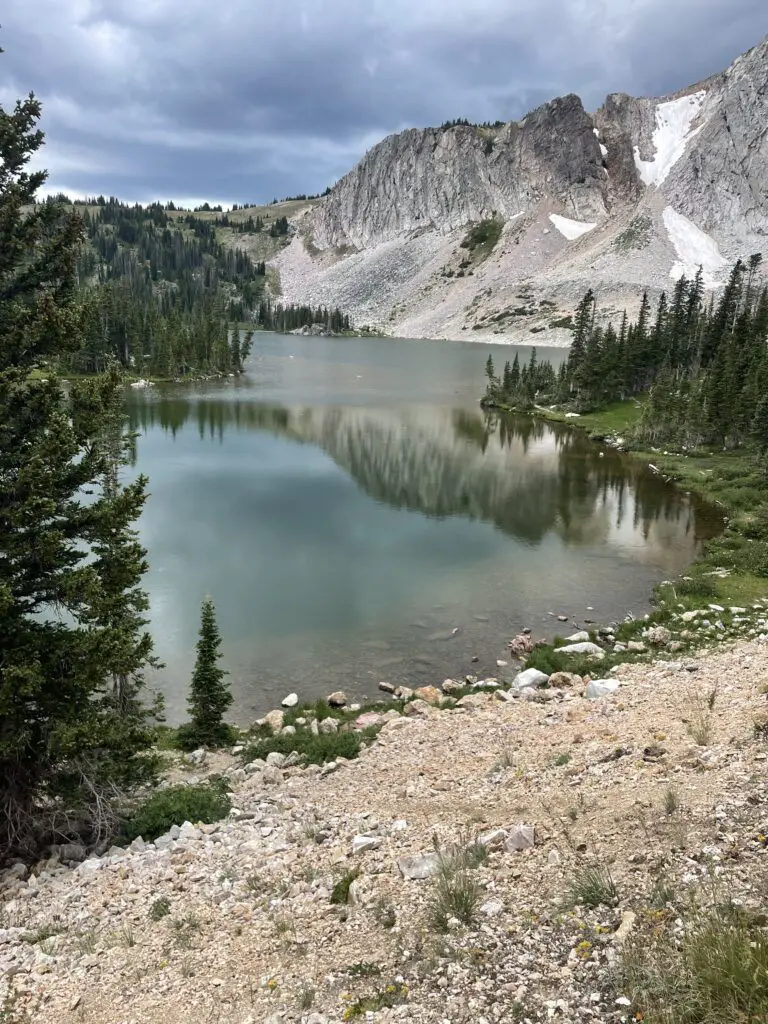
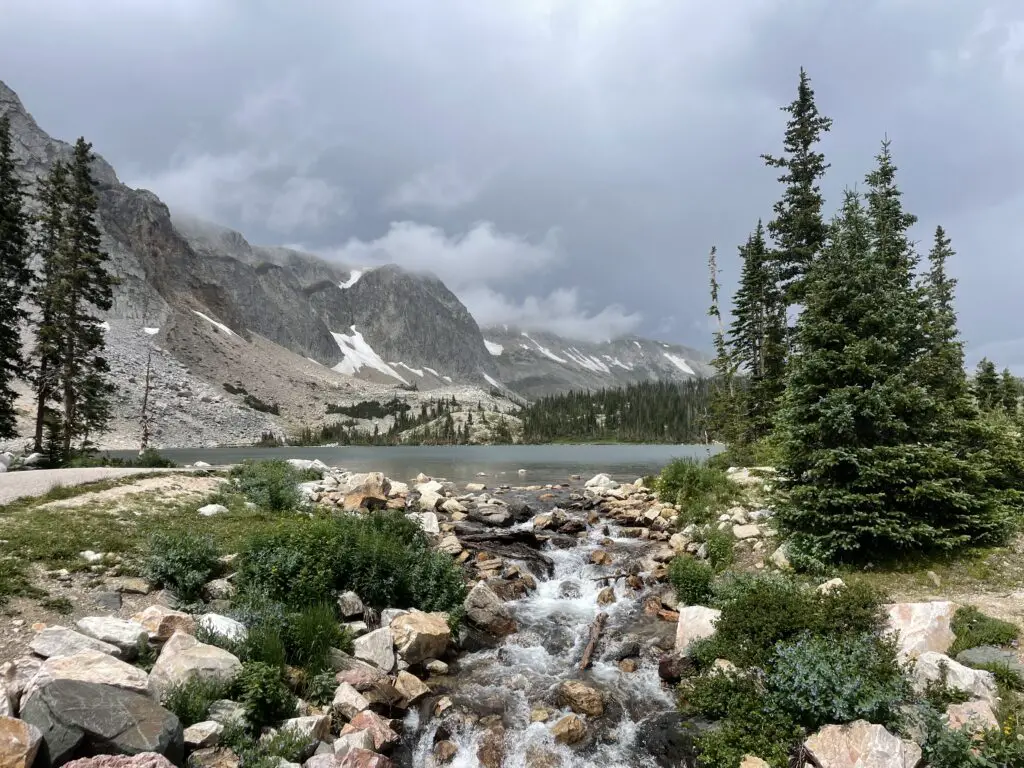
Grey mountains with bits of snow loom over and are reflected in the still waters of a small lake surrounded by pine trees.
Lewis Lake
Is Medicine Bow Peak Trail Hard?

The trail from Lewis Lake is only about three miles long in total length but don’t let that fool you. It gains more than 1000 feet in elevation during the hike up.  It’s also INCREDIBLY rocky and exposed, not to mention HIGH. (You start at over 10,000 feet and end up at almost 12,000 feet.)

Also, you’re above the tree line for the entire route so there is NO SHADE!  This can also cause the trail to become INCREDIBLY slick in the rain, mist or snow–and note, snow and ice lasts LATE into the season and comes EARLY in the High Country.  It can snow at any time of the year and thanks to monsoonal moisture, rain was forecast for our entire trip (it rained on us every day).  Also, there is absolutely NO PROTECTION from lightning up here during the violent summer thunderstorms that frequently occur.

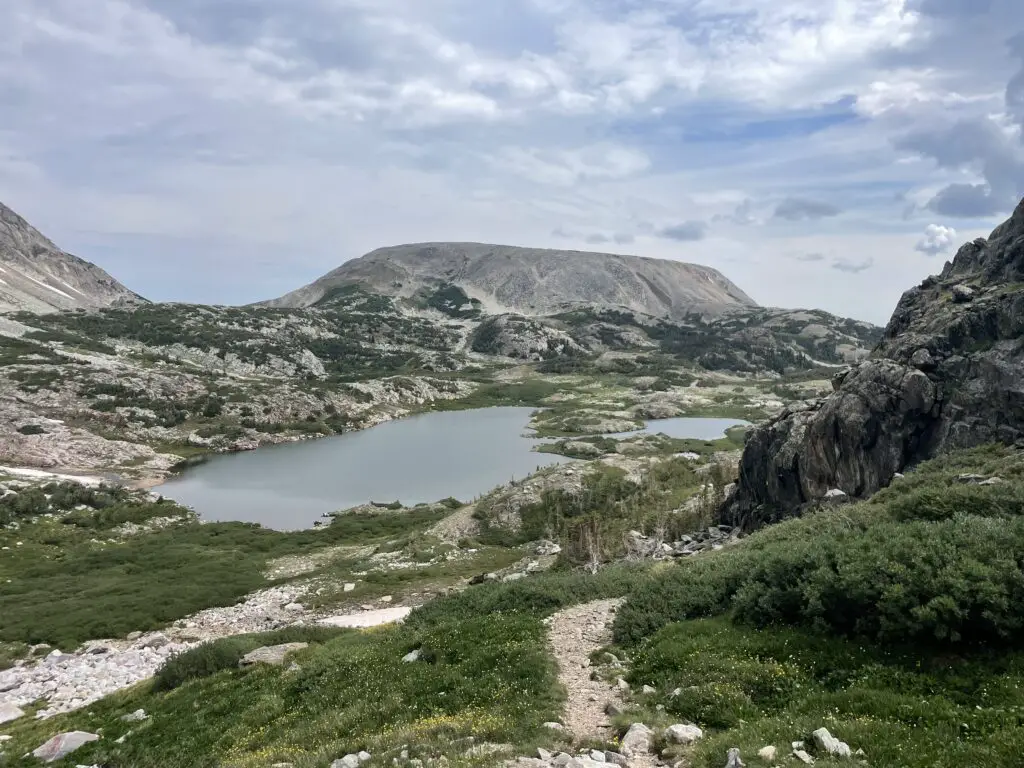
A lake with rocky mountains rising in the background and a green meadow with trails running through it in the foreground.
Libby Lake

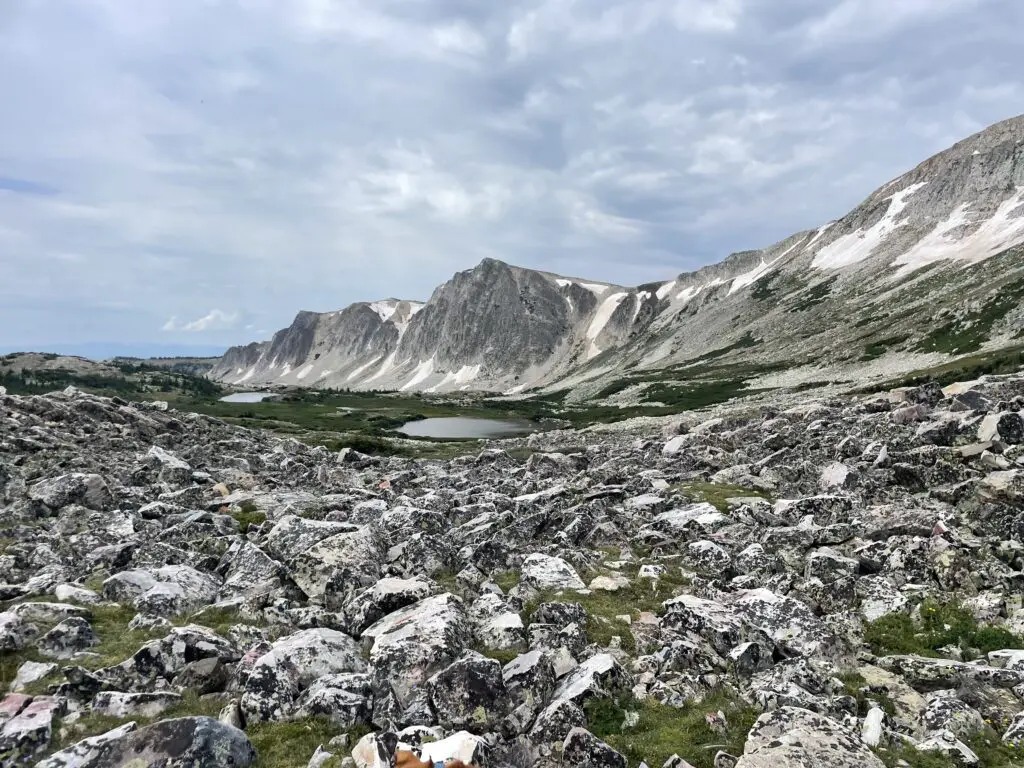
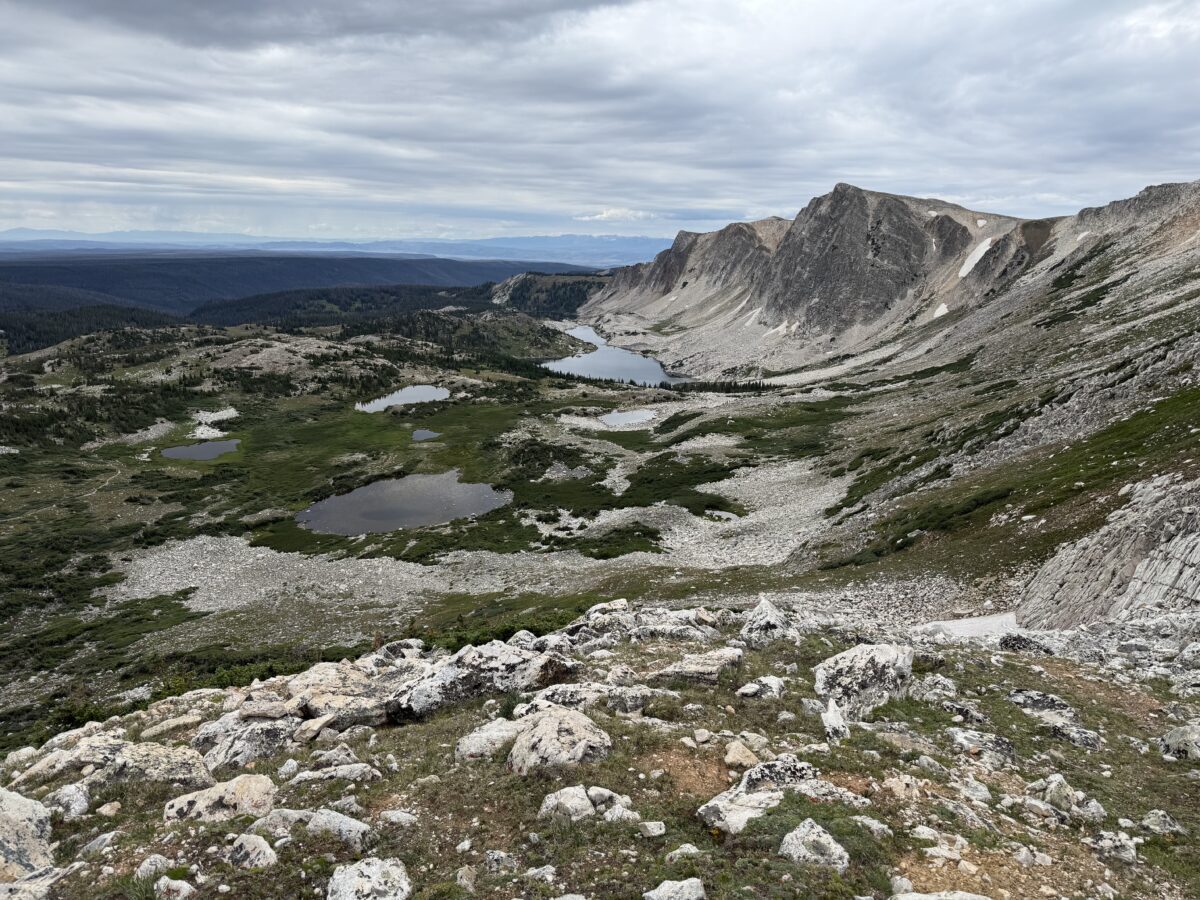
We chose to stop at a saddle where the HARD part of the trail starts. Here it also meets up with the other end of the Medicine Bow trail that comes up from Lake Marie.  This trail is LOVELY though! You hike along the spine of the Snowy Range getting amazing views of the local lakes, the nearby mountains, and the surrounding landscape. At one point we could make out eight separate, small lakes!

A gray, rocky, mountain wall spotted with snow looms over two small lakes with a small rock-field in the foreground.
This is the amazing view from the saddle. Medicine Bow Peak is to the right and the trail gets considerably more difficult from here…

Grey, rocky mountains rise behind a small lake and flat scrubland, all covered in bits of snow.

I would rate the early portion of the trail (before the saddle) as moderate for sure.  It isn’t overly difficult or long–we saw several families with young children. It is a bit rocky and there is some scrambling required in a few, short areas.

The most difficult part about this trail is just that it’s incredibly exposed and high (as I said before, entirely over 10,000 feet).  There are no steep drop-offs directly from the trail though, so as long as you are a fairly capable hiker, you take it slow and you respect the conditions, you should do okay.

Though we didn’t have to navigate any actual snow in early August, there were still some snowfields along the trail.  I can’t speak for how normal this is due to all the snow the West got that year (though they must call this area the Snowys for a reason!)

Grey, rocky mountains rise behind two small lakes and flat scrubland. A rocky trail rises up a grassy hill in the foreground.

Lost Glacier Lakes Trail to Lost Lake

Lost Glacier Lakes trailhead is found on the east side of the Snowys. It starts from Brooklyn Lake and heads west. The route to Lost Lake is about six miles in total length (out and back).

From Lost Lake, the trail continues on to where it meets up with the Medicine Bow Peak trail at Lewis Lake and the Sugarloaf Trailhead (see above). The entire Lost Glacier Lakes Trail from Brooklyn Lake to Lewis Lake is a little over eight miles (in one direction).  

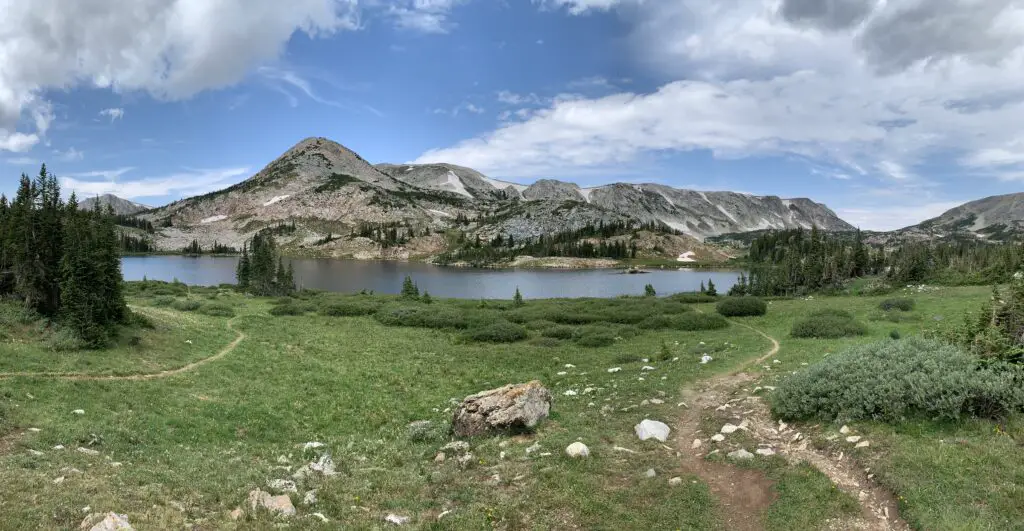
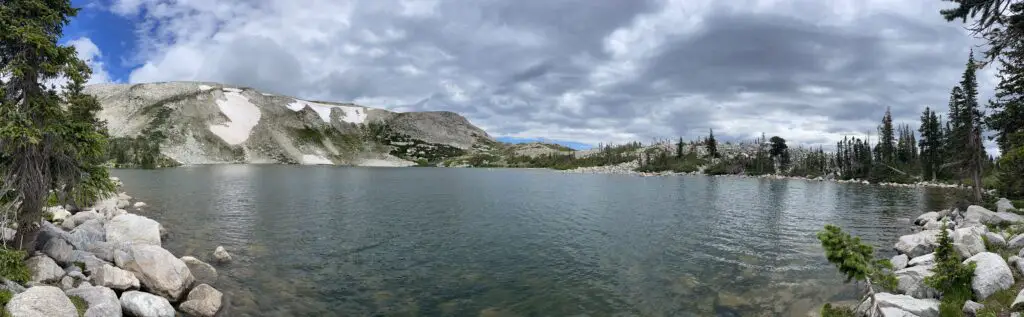
A panoramic of a large, alpine lake with gray, stony mountains spotted with snow looming in the background.
Lost Lake

Lost Lake was SO BEAUTIFUL! It reminded me of Lake Helen in the Bighorns!

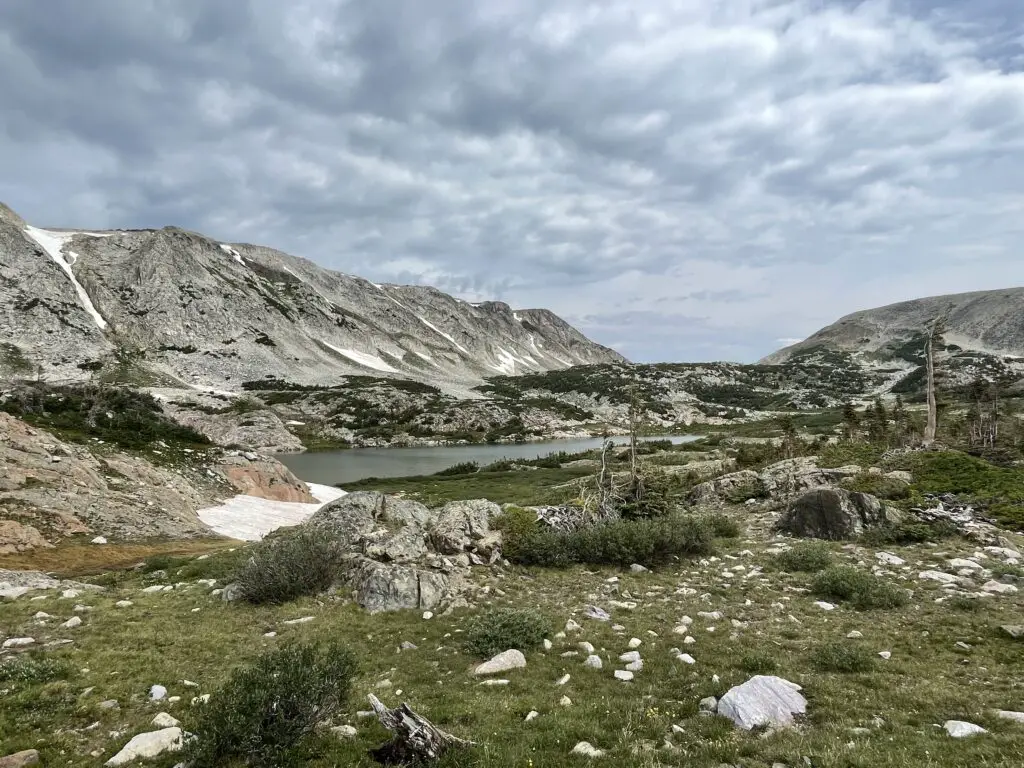
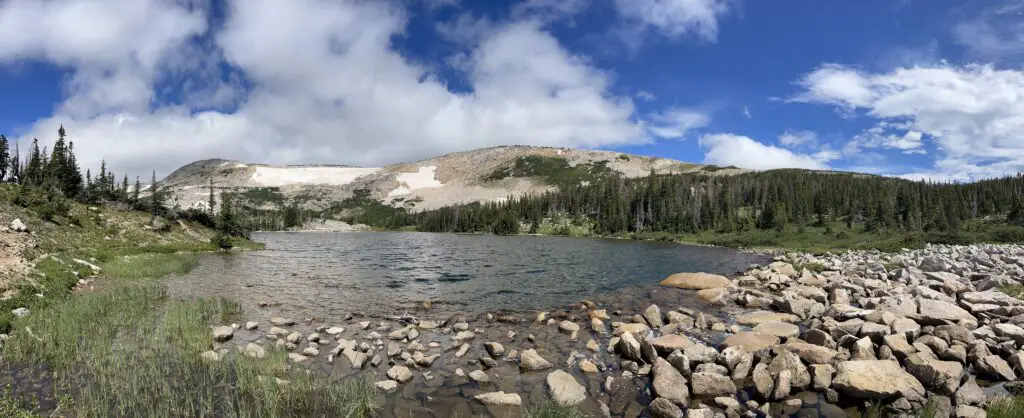
A high, alpine lake surrounded by rocky shores, pine trees and gray, stony mountains spotted with snow.
One of the two Glacier Lakes

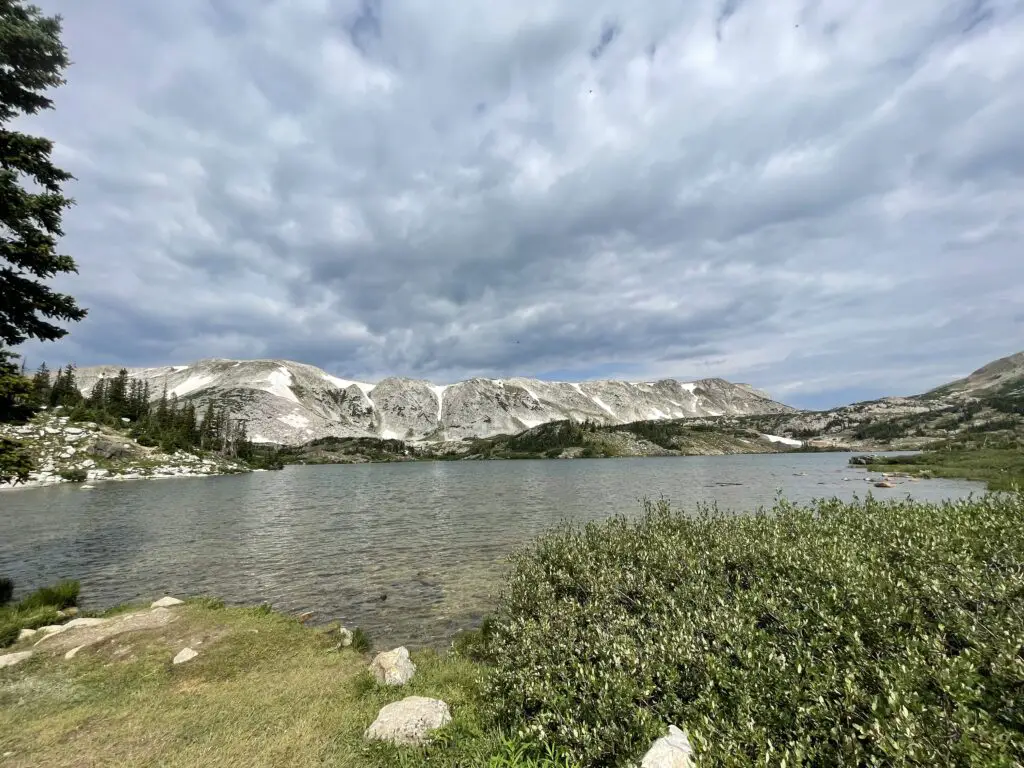
Gray, rocky mountains dotted with snow loom over a mountain lake with green grass and bushes in the foreground.

Is Lost Lakes Trail Hard?

The Lost Glacier Lake Trail is a lot of fun! It offers very little elevation gain and is mostly a wide, dirt path throughout. Be watchful for the occasional tree root and rock, but there is very little scrambling required. This is a kid-friendly trail! (Just remember the entire trail is still above 8,000 feet!) This trail is also below tree line so there is a lot more shade (and it’s much less exposed) than what you’ll find on the Medicine Bow Peak Trail.

A long lake surrounded by a pine-tree forest. Tree covered mountains rise in the far distance. There is a stony cliff in the foreground.
Telephone Lakes as seen from the Lost Lake Trail

We really enjoyed this trail! It offered nice views of the lower lakes and plains of eastern Wyoming. On clear days you can also spot some of the high peaks of the Rockies down in Colorado.

Gray, rock mountain mostly covered in a snowfield in the background. Pine trees and a rocky meadow in the foreground.
You can see why they are called The Snowys! (This was in early August!)

Below are some pictures of the wildflowers we saw on the Lost Glacier Lakes Trail. The pictures don’t do the colors justice, of course. The flowers were absolutely BEA-Utiful!

A grassy meadow full or yellow and red wildflowers backs up to a pine tree-covered rock wall.

A green meadow full of yellow, wild flowers back up to a pine forest

Camping in the rain!

As I mentioned earlier, our trip was at the start of Monsoon Season in that area so it rained every day of the trip. That’s okay though, part of “roughing it” in the wild is dealing with whatever weather Mother Nature decides to throw at you! A few tips on tent camping in the rain…

If you’re camping with your spouse, marry someone who you can belly-laugh with rather than yell at! 😍

—-Spend money on a NICE tent (I recommend the REI brand) with a rainfly that covers the entire tent and reaches almost to the ground. Our tent stayed completely dry inside even though we got rained on all three days we were out!

—-Make sure nothing important is touching the walls of the tent (clothes, bedding, etc.) I can’t explain it but there is this phenomenon where if the tent is wet outside the water stays outside as long as nothing touches it from the inside. If something does touch it, that thing gets wet and the water seems to start seeping inside the tent.

This is probably some weird phenomenon of physics, but since I’ve never taken a physics class I can’t tell you any more about it. 😇

Scenic Byways!

We also drove several scenic byways in the Snowy Range! (Note: both of these routes are closed in the winter–they’re really only open May through November–and this is weather-dependent).

Snowy Range Scenic Byway

The Snowy Range Scenic Byway is Wyoming Route 130 that travels east-to-west through this portion of the Medicine Bow mountains.  It runs from the Encampment/Saratoga areas in the West to Centennial, Wyoming in the East.

There are several nice pullouts along the Byway. Some of our favorites were:

Libby Flats: an open, meadow area in the higher elevations of the Snowys. It offers an observation tower and spectacular views of the surrounding countryside. We also saw a bunch of marmots here!

Lake Marie: a VERY pretty stop on the western side of the Byway. It offers a nice boardwalk and paved walking path that connects to the Mirror Lake picnic area just to the east. Other hiking trails break off from here, as well.

An alpine lake back by a rocky wall in the background feeds into a small, stony, waterfall-creek in the foreground.
Lake Marie–this was one of my favorite spots in the Snowys!
The Continental Divide! –Battle Pass Byway

Battle Pass Byway is Wyoming Route 70 that travels east-to-west through the Sierra Madre portion of the Medicine Bow mountains.  It runs from Baggs, Wyoming in the West to Encampment in the East and crosses the Continental Divide.

A narrow spine of grassy ground with pine trees on both sides
The Continental Divide! From this point, water either flows West to the Pacific or East to the Gulf of Mexico/the Atlantic.
Overlooking a paved road and pine trees in the foreground. A green mountain vista stretches to more mountains on the horizon,
View to the west!
Yellow wildflowers interspersed with overgrown grass and shrubs on the side of a paved trail
Even more wildflowers!
Monument that reads: "Thomas A. Edison camped near this spot in 1878 while on a fishing trip. It was here that his attention was directed to the fiber from his bamboo fishing pole which he tested as a suitable filament for his incandescent electric lamp.--Born February 11, 1847 - Died October 18, 1931 Age 84
History happened here!

So, if you’re looking for a great place to hike and camp that’s just across the border from the crowded trails in Colorado, check out the Snowys!

Have you spent time in the Snowy Range?  Tell me about your experience in the comments! 


Did you enjoy this post? Pin it!

Grey mountains with bits of snow loom over and are reflected in the still waters of a small lake surrounded by pine trees. Pin reads, "Medicine Bow Mountains (the Snowy Range)


Like what you read here today?  Please feel free to leave a comment, like or share this post!  Add your email at the bottom of the page, or the sidebar to the right, to be notified when a new post is published.  By signing up for the email list, you will also receive a free copy of the Tranquil Trekker’s Top 10 Tips of Trekking Do’s and Don’ts! You can also follow the blog on social media by clicking the links below!
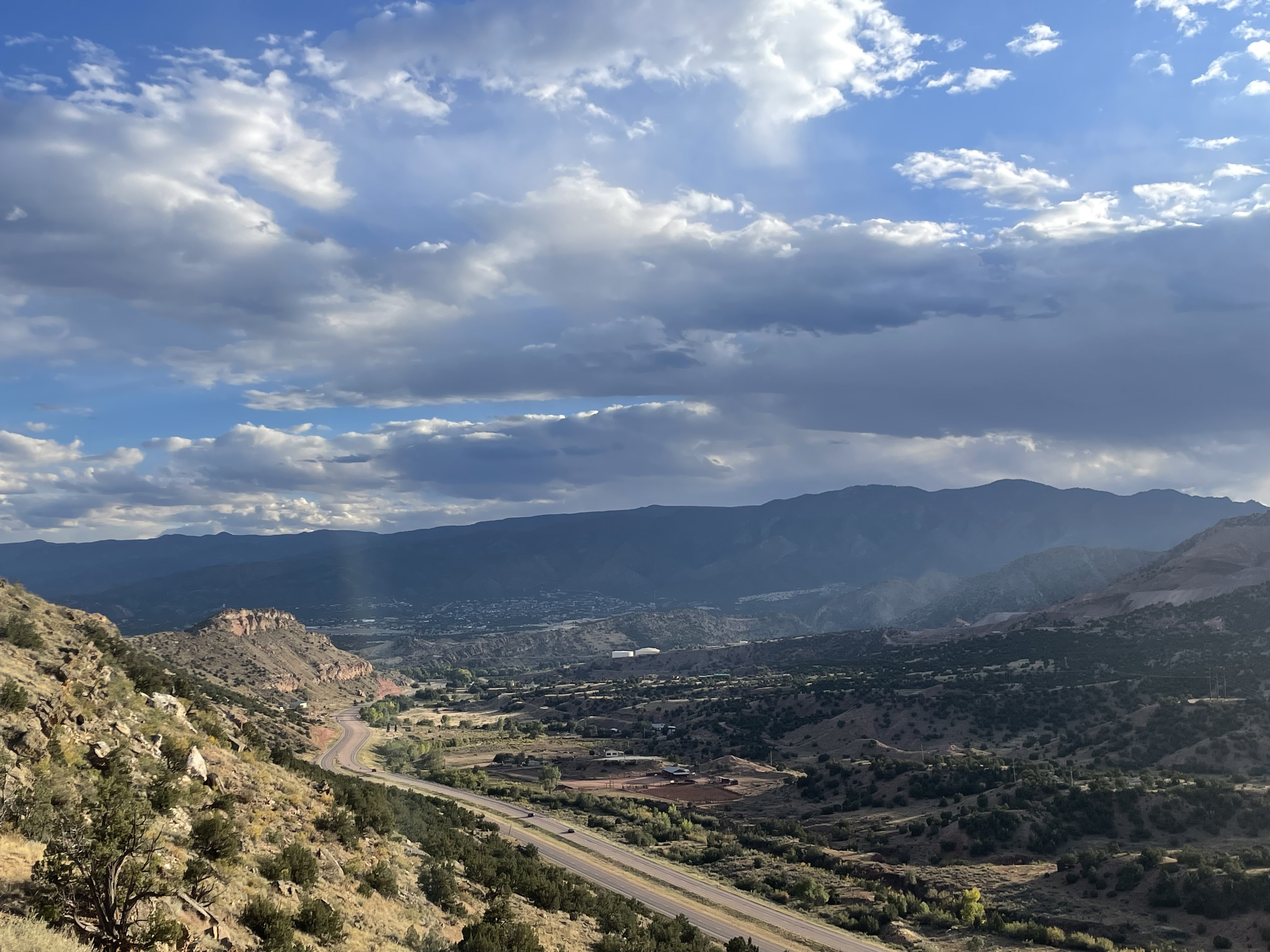
Facebook

Twitter

Instagram

Pinterest

7 Things to See in Death Valley National Park

In this post, I detail a Spring Break trip we took to Death Valley!


**Author’s note: Just a word of warning, as this is a National Park, no dogs are allowed on any trails (exceptions for Service Animals). They are only permitted in the campgrounds and parking lots.**

The final stop on our epic, Spring Break trip to celebrate the Trekkers’ 40th birthdays was Death Valley National Park!  We’ve been wanting to visit Death Valley for a long time. We figured early March was hopefully a good (and cooler!) time to do it!

Tips for Your Visit to Death Valley:

–The heat in Death Valley!

The heat in Death Valley is NOT a joke so PLEASE be careful!  We were SO LUCKY that it was so cool when we were there (FYI, early March is a GREAT time to visit!)  This place is literally on record as being the hottest place on Earth!

Death Valley is also extremely dry and can be very windy, which means you may be sweating (and getting dehydrated) and not even realize it.  Some years, it has been known to be over 100 degrees here for almost HALF THE YEAR!  I cannot stress enough the potential danger this type of heat can bring.  Dehydration/heat stroke are very real dangers here for much of the year.  This park can LITERALLY kill you!

A digital thermometer on a sign reads 68 Fahrenheit, 20 Celsius. The sign on the building reads, Furnace Creek Visitor Center
Check out the name of the Visitor’s Center…Furnace Creek! This area is where the hottest temp ever recorded on Earth was taken. I doubt it’s rarely this “chilly” there.

The heat can also be VERY hard on your car, and if it breaks down in the middle of the desert, you’re now stuck in the heat.  There are almost NO TREES in Death Valley so there is also almost NO SHADE.  We even saw one remote section of road where signs told you to turn off your car’s air conditioning to take the stress off the car’s engine (the road was also going uphill)–again, this wasn’t an issue with the cool temps when we were there. 😂

View through the front window of a car onto a road, a brown, sandy desert, and hills. Raindrops spatter the windshield
It rained on us…in DEATH VALLEY! (There was also sleet and a 30 mph wind.  It was COLD during that storm…in Death Valley!)
–No cell coverage in Death Valley

One big thing to plan for when you visit Death Valley is that the park is HUGE!  It covers more than THREE MILLION acres so you should plan to do A LOT of driving!  Also, it is a valley (duh! 😉) surrounded by mountains, so there is very little cell coverage–this adds to the danger the park poses if you encounter a problem.

Also, something to be aware of, Death Valley isn’t the prettiest of our national parks.  This comment is not intended to dissuade you from visiting in any way.  I just don’t want you to be disappointed.  Glacier NP this is not! 😇  It’s called DEATH Valley for a reason!  There isn’t much that grows or lives here! 😉

Small, yellow flowers on green plants spread across gravel
The only flowers we saw in Death Valley

Where is Death Valley?

National park entrance sign with rocky, desert mountains and a sunset in the background. The sign reads Death Valley National Park.

Death Valley is located in southeastern California, right on the border with Nevada.  The park is situated about 130 miles west of Las Vegas and a little more than 200 miles to the northeast of Bakersfield, California.

The easiest way to reach Death Valley is to bring Nevada Route 160 west from Las Vegas to Pahrump.  Then take State Line Road west to the Death Valley Junction on California Route 127.  From there you pick up Route 190 and take that into the park! (Don’t worry, there are signs.  Also, these are basically the only paved roads out there! 😉)

You can also reach Death Valley from the north by taking US 95 south through Nevada to California Route 374, or from the west on California Route 190.

Places you don’t want to miss in Death Valley:

There are a number of awesome sites to see at the park!

Badwater Basin:

Badwater Basin’s claim to fame is that it is THE lowest point in North America, at more than 200 feet BELOW sea level!

Panoramic picture of a flat valley, filled with a salt-flat, and sand and surrounded by rocky mountains.
Panoramic of Badwater Basin
Panoramic picture of a flat valley, filled with a salt-flat, and sand. A salt-flat path heads toward a towering, rocky mountain.
Dante’s Point is at the top of that mountain (this will be important later.)
A sign on a boardwalk reads, "Badwater Basin, 282 feet/865 meters BELOW sea level!"
Badwater Basin is THE lowest point in North America!


For additional info on Death Valley, please see my friend Megan’s blog posts on Things to do in Death Valley that aren’t hiking and Sites to see on Badwater Road!


A rocky, salt-flat spreads to the rocky mountains on the horizon. A puddle of water reflects the sunlight in the foreground.
The shiny stuff in the foreground IS the water in “Badwater Basin”! This is one of the rare places where water can regularly be seen in Death Valley.
A rocky, salt-flat spreads to the horizon, surrounded by rocky mountains.
Death Valley!
A rocky, salt-flat spreads to the horizon, surrounded by rocky mountains. A dusty cloud fills the valley.
Haboob! (Dust storm)
Father Crowley Overlook: 

This locale is otherwise known as, “Star Wars Canyon”! Ironically this was NOT a Star Wars filming site (to learn more about those, scroll down!)–although portions of the new, Top Gun: Maverick were filmed here!

The proper name for this canyon is Rainbow Canyon, from the colorful rock and gravel that comprises it.  However, it got its nickname as fighter jets have often practiced low-altitude moves here (the terrain mimics much of where they fly throughout other parts of the world.)

This has been a Bucket List item on both the Trekkers’ lists since Mr. Trekker heard you could see fighter jets here and I found out it was called Star Wars Canyon (and why!)  This meshed well with our watching planes at Nellis Air Force Base in Vegas and touring the Extraterrestrial Highway earlier in the trip!

Rocky, short, narrow canyon with red, brown, and tan gravel, all under a clear, blue sky.
Rainbow Canyon, otherwise known as…Star Wars Canyon!

Sadly, several years ago there was an accident where the pilot was killed and spectators on the ground were injured so they’ve limited what all the planes can do here…but, you can sometimes catch a plane and…WE DID (two actually)!  We didn’t get any pics or video (literally, we heard it, we saw it, it was gone, all in a total of about three seconds). 😁

Info sign with a picture of a military jet flying above the canyon reads in part, "...Before you is a part of one of the largest, military aircraft training areas in the US...Rainbow Canyon, below, is used for low-level navigation training. It earned the nickname, 'Star Wars Canyon" due to technical flight maneuvers done here..."

View down a rocky hillside traversed by a road with red, brown, and tan gravel. A grey, flat valley is in the background backed by a rocky mountain.
View from Father Crowley Overlook! (We saw a fighter jet fly down that valley in the distance too!)

View down a rocky hillside with red, brown, and tan gravel. A grey, flat valley is in the background backed by a rocky, snow-capped mountain.

Panamint Valley

This GORGEOUS valley is situated just down the road (about seven miles) to the east of Father Crowley Overlook.  This was my absolute, favorite spot in all of Death Valley (that we saw anyway). (We also saw a fighter jet flying through this valley (from the Father Crowley Overlook!)

One weird thing about this valley was that it was SO QUIET! All you could hear was the light breeze ROARING in your ears (and occasionally a fighter jet flying overhead! 😝)  We realized what was missing, there were no birds and there weren’t even any bugs buzzing about.  I’m not sure if this is unique to Death Valley or because we were there in early March (though a lot of literature on the park talks about the extreme quiet.)

Empty, two-lane road stretches across a rocky, flat desert (with scrub brush) to a rocky mountain towering far in the distance
My favorite place in Death Valley (Remember my love of long, empty roads on this trip?)
Rocky, flat desert (with scrub brush) surrounded by rocky mountains in the distance, all under a clear, cerulean sky
Look at that sky! That is my favorite shade of my favorite color, blue! (Also, this pic is now the background for my work laptop! 😁)
Flat, brown, rocky valley surrounded by rocky mountains, all under a clear, blue sky
This is what a lot of Death Valley looks like. I told you it wasn’t super pretty. 😇 
Zabriskie Point:

This is supposed to be a great place for sunrise/sunset with the varying colors in the rocks!

Yellow-grey dunes made of gravel sit under a grey, cloudy sky

Star Wars Sites in Death Valley National Park

Many people don’t know this but several scenes from the ORIGINAL Star Wars trilogy were filmed in Death Valley!  Most were from Star Wars, Episode 4: A New Hope (SW), but a few were also from Episode 6: Return of the Jedi (ROTJ)!  Prepare yourself, my nerd flag is about to fly high! 😉

Note: There were no signs or literature that we saw at the actual park that show where filming sites are. There is plenty of info on Google about where to look, then you have to kind of use your imagination to put droids, Luke Skywalker, and Obi-Wan Kenobi there. 😉

Artist’s Palette:

The scene where the Sand People attack Luke in SW…

Brown and tan gravel in a dry wash area, hills in the background are made from dark brown, tan, white and red-brown dirt.
This area is especially known for the beautiful colors in the gravel

Brown and tan gravel in a dry wash area, hills in the background are made from dark brown, tan, and red-brown dirt.

Mesquite Sand Dunes:

The droid scene near the beginning of SW was filmed here (where R2-D2 and C-3po walk through the dunes after their spacecraft, life raft crashes.  Jabba the Hutt’s sail barge scenes from ROTJ were also filmed here.)

Yellow-colored hills lead to a mountain in the background, greenish scrub brush is in the foreground.

20-mule canyon:

The scene where the Jawas grab R2-D2 and where Obi-Wan’s home is located/where he meets up with Luke for the first time in SW.  Also, the first droid scene from ROTJ was filmed here.

A flat, gravel plain in the foreground with brown, gravel hills rising in the background under a blue sky. Grey-gravel road, in-shadow, with brown hills rising in the background

Dante’s Point:

The lookout on top of the Point gives you this view down into Badwater Basin (this was the filming spot for the Mos Eisley Spaceport in SW–“you will never find a more wretched hive of scum and villainy…” 😁)

View from above, looks down a rocky and scrub brush-covered cliff to a gravely plain streaked with salt stains and water puddles
This is from the top of the mountain I showed the view of from Badwater Basin earlier. Badwater Basin is at the bottom.
Grey valley streaked with salt stains leads to dark, shadowed mountains. A yellow, sun arc rises out of these mountains and clouds as the sun sets.
Sunset over Badwater Basin

View from above, looks down a rocky and scrub brush-covered cliff to a gravely plain streaked with salt stains and water puddles. An orange sunset and clouds cover dark mountains in the distance.

I-70 through Utah is GORGEOUS! 

On our trip home, to South Dakota, we took I-70 through Utah.  I’ve always thought I-70 through Colorado was pretty (and it is!) but the highway through Utah is INCREDIBLE!  And literally, anyone can see these views, all you have to do is drive the highway!

Panoramic picture of grey rock in the foreground overlooking a flat, red-rock plain, all under a clear, blue sky
This is at a rest stop on I-70!

A red-rock mountain rises from a flat, yellow, scrub brush-covered, desert landscape. Scrub brush-covered grey rock in the foreground overlooking a red-dirt, desert plain spotted with scrub brush. Rocky mountains are in the far distance, all under a clear, blue sky.


Incredible views, Hollywood film sites, and potentially VERY hot temperatures.  If you’re looking for a unique vacation check out Death Valley (but maybe not in the summer. 🥵)

Have you visited Death Valley? Tell me about your experience in the comments! 


Did you enjoy this post? Pin it!

3 pictures: 1) National Park Entrance sign reads, "Death Valley National Park"; 2) A rocky, salt-flat spreads to the horizon, surrounded by rocky mountains; 3) A sign on a boardwalk reads, "Badwater Basin, 282 feet/865 meters BELOW sea level!" Pin reads, "Death Valley"


Like what you read here today?  Please feel free to leave a comment, like or share this post!  Add your email at the bottom of the page, or the sidebar to the right, to be notified when a new post is published.  By signing up for the email list, you will also receive a free copy of the Tranquil Trekker’s Top 10 Tips of Trekking Do’s and Don’ts! You can also follow the blog on social media by clicking the links below!
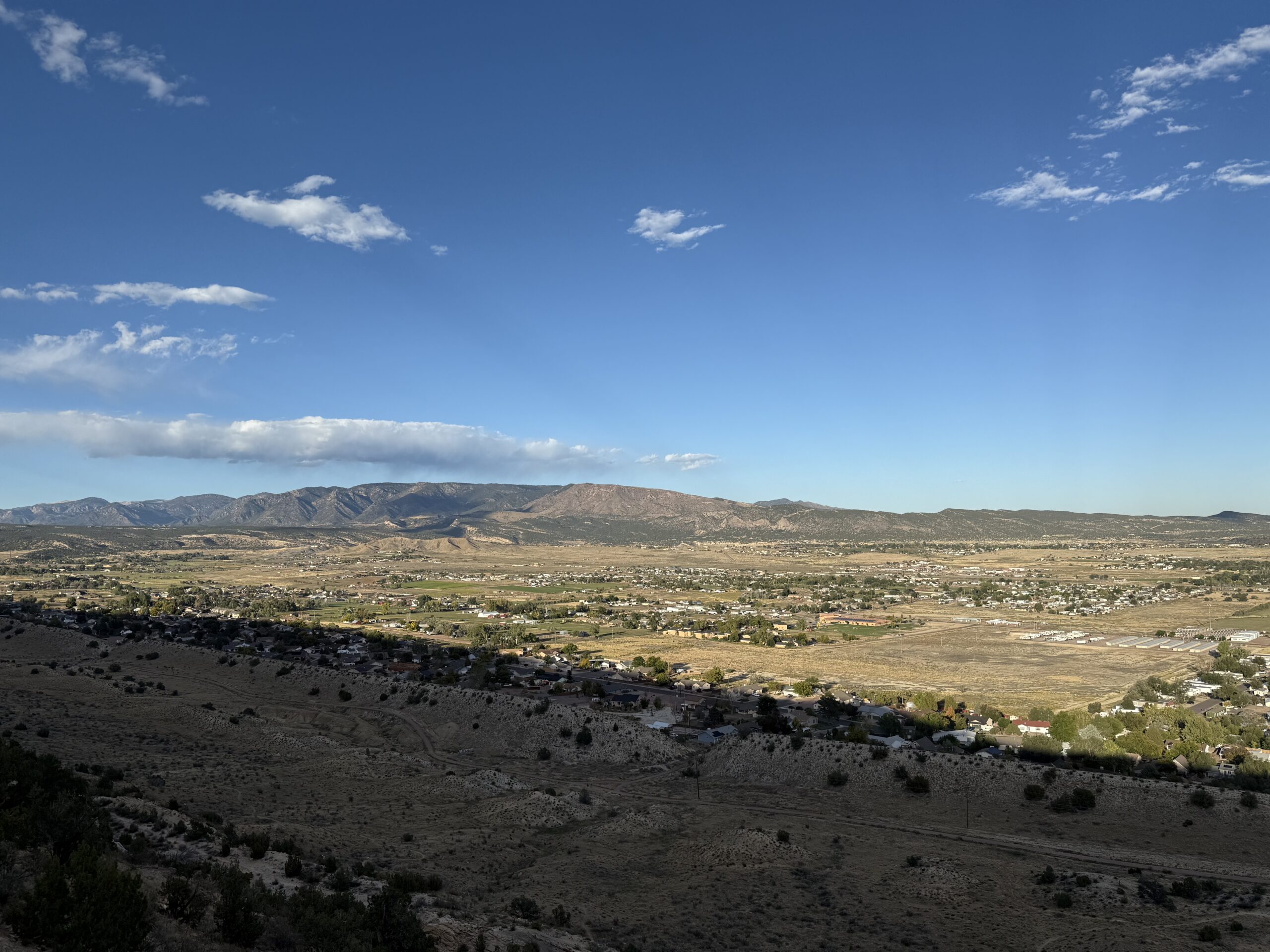
Facebook

Twitter

Instagram

Pinterest


Drive the Extraterrestrial (ET) Highway

In this post, I detail our adventure through the Nevada desert on the ET Highway!


For me, the Extraterrestrial Highway was the highlight of our Epic, 40th birthday, Spring Break Trip!  We actually somewhat designed the entire trip around THIS drive. 😁  In fact, I enjoyed the ET Highway so much that I am dedicating an entire post to what amounted to only a few hours of our trip!  Mr. Trekker gets nerdy about fighter jets (and the weather 😉), I get nerdy about aliens! 👽 🖖

Related post: Tips for your First Time in Vegas!

The Extraterrestrial Highway has been a MAJOR Bucket List item for me for YEARS!  It’s all thanks to one of my favorite movies, PaulPaul is an amazing movie with awesome stars…that you’ve probably never heard of.

The movie came out in 2011 and is stupid-fun. 😁  It isn’t well-known and I have no idea why?  It stars Simon Pegg, Nick Frost (if you are familiar with these two actors you can already guess what type of movie it is 😇); Kristin Wigg, Jason Bateman, and Seth Rogen voices the alien.  It’s hilarious, fun, and literally one of my favorite movies EVER!

As you may have guessed from the actors, there is A LOT of swearing and adult humor in this movie.  Depending on what kind of movies you let your kids watch I’d say it’s older teen-friendly. (It is rated R, for more info and a preview, click here!)

I won’t give away too many details but the basic plot of Paul is that an alien escapes from Area 51, finds a couple of nerds who he needs to help him get home and hilarity ensues.  It’s kind of an ET for adults! 😁

Part of what makes the movie fun is that it spoofs so many other great alien movies:  Star Wars, ET, Indiana Jones (ok, not an alien movie) Close Encounters of the 3rd Kind, and of course, Alien.

An old train car with a mural of aliens painted on the side

As part of the plot they visit a bunch of the “alien sites” in the desert southwest, and I’ve been wanting to see these since I first saw the movie. This trip was the perfect opportunity! (And it also inspired a book idea!)

Where is the Extraterrestrial Highway?

The ET Highway runs along the VERY rural Route 375 between Crystal Springs/Hiko and Warm Springs in southern Nevada!

The road got its name because it runs very near the infamous Area 51.  It is also located in an extremely rural area where people claim to see strange lights in the dark, night sky. (We did talk to some locals who say they’ve seen weird stuff that they can’t explain.)

Alien Sites on the Extraterrestrial Highway

All of these sites can be found along and/or directly off of the ET Highway.

Green road sign covered in stickers. The words "Extraterrestrial Highway" are barely visible through the stickers.

Alien Research Center:  This awesome place is located about seven miles south of Hiko, Nevada, and just to the west of Crystal Springs, on Route 375. (It’s literally the only thing in this spot, you really can’t miss it. 😉)  It’s really just a tourist trap situated inside a Quonset hut.  That being said, it is a MUST visit for any alien nerd.  It is AWESOME! 😁

Two-story tall, metal alien stands outside a small building.
I love this guy!

Sign in the foreground reads, "Alien Research Center, Earth Station Area 51, Welcome to our Universe". The top of a 2-story tall, metal alien stands behind the sign.

Little A’Le’Inn:  (pronounced “Little Alien”–get it? 😉)  This is a small inn and cafe in the TINY “development”–can’t really call it a town–of Rachel, Nevada.  It’s a good place for a potty break.  The food is also good and the workers offer AWESOME tips on finding Area 51!

Some security guys from Area 51 were eating lunch there when we visited.  How do we know they were from Area 51 you may ask?  Well, they were wearing military fatigues, and driving creepy-looking, inconspicuous, government trucks (and the only government site for MILES around is, Area 51. 😁)

Parking lot with a sign that reads, "Restaurant, Bar, Motel, RV." A drawing of an alien and the sign reads, "Earthlings Welcome. Little AléInn". Also, a very old, upside down satellite dish hangs from a small crane, appearing like a small flying saucer. A small flying saucer with lights sits on a short pedastal near some picnic tables A small restaurant with alien and flying saucer drawings, A short, green alien statue stands in front and a sign reads, "Little AléInn, Earthlings Welcome".

The Black Mailbox:  Rachel, Nevada–this is nothing but a dumb mailbox in the middle of nowhere but it’s fun!  People put stickers on it and leave trinkets in it–it reminded me of the UFO Watchtower we visited on another Spring Break trip to the San Luis Valley of Colorado!  The story goes that this is where secret, government mail for Area 51 was delivered (though there doesn’t appear to be ANY historical evidence this is true.)

A black mailbox covered in stickers sits in the desert
The Black Mailbox

Area 51 (Dreamland Resort):  Has anyone not heard of Area 51? I mean really?  Watch the History Channel for five minutes! 😉

Area 51 goes by several names.  It is also known as Groom Lake as this was an ancient lake bed.  It is factually known to be an area where military aircraft have been tested and military, practice drills still occur (the infamous SR-71 was tested here during the Cold War).  If you are lucky you may get to watch (and hear) military aircraft practicing not far above your head!

This page gives you all sorts of info on Area 51, the local area, “unexplained sightings” locally, and possible military traffic you can watch for.

A stop sign covered in so many stickers it is almost unreadable. Another sign above it reads, "WARNING, US Air Force Installation. PHOTOGRAPHY OF THIS AREA IS PROHIBITED. NO DRONE ZONE.
NOTE: This is NOT Area 51. It’s a sign in the parking lot at the Alien Research Center that is supposed to mimic the signs at the actual Area 51.

We “almost” made it to THE Area 51!  We were basically right next to it, but since it was actively raining (and had been raining/snowing for several days–because why wouldn’t it, in the desert? 😝)  we opted not to take my CRV down the rutted, muddy path to reach the actual site. 😇  We did see the two roads that take you to the infamous locale, though.

Note: if you venture to the site, you will be on a public road.  Stop BEFORE you reach the gates.  You will likely see security forces but they will leave you alone as long as you remain at a respectful distance.  This is NOT a joke.  From the stories we heard, these military police DO NOT have a sense of humor. 😝  For good tips on how to lawfully view Area 51 (and how to find it!) talk to the locals at the Little A’lé Inn.

Desert scrub brush and cacti reach to the horizon on a cloudy day.
Somewhere out there, amongst the Joshua Trees, IS Area 51.
An empty, two-lane road stretches across the desert, to the horizon and up a hill towards mountains in the distance.
We saw SO MANY views of long, empty roads like this on the trip. I LOVE them! They even inspired a new book idea!

So if you’re in the mood for a Road Trip and some Out-of-This-World fun, check out the Extraterrestrial Highway!

Have you driven the ET Highway?  Did you have any otherworldly experiences?  Let me know in the comments! 


Did you enjoy what you read here today? Pin it!

Green highway sign covered in stickers. Can barely make out the words "Extraterrestrial Highway". Pin reads, "Drive the Extraterrestrial Highway" Three pictures: 1) A stop sign covered in so many stickers it is almost unreadable. Another sign above it reads, "WARNING, US Air Force Installation. PHOTOGRAPHY OF THIS AREA IS PROHIBITED. NO DRONE ZONE; 2) Green highway sign covered in stickers. Can barely make out the words "Extraterrestrial Highway; 3) Parking lot with a sign that reads, "Restaurant, Bar, Motel, RV." A drawing of an alien and the sign reads, "Earthlings Welcome. Little AléInn". Also, a very old, upside-down satellite dish hangs from a small crane, appearing like a small flying saucer. Pin reads, "Drive the ET Highway"


Like what you read here today?  Please feel free to leave a comment, like or share this post!  Add your email at the bottom of the page, or the sidebar to the right, to be notified when a new post is published.  By signing up for the email list, you will also receive a free copy of the Tranquil Trekker’s Top 10 Tips of Trekking Do’s and Don’ts! You can also follow the blog on social media by clicking the links below!
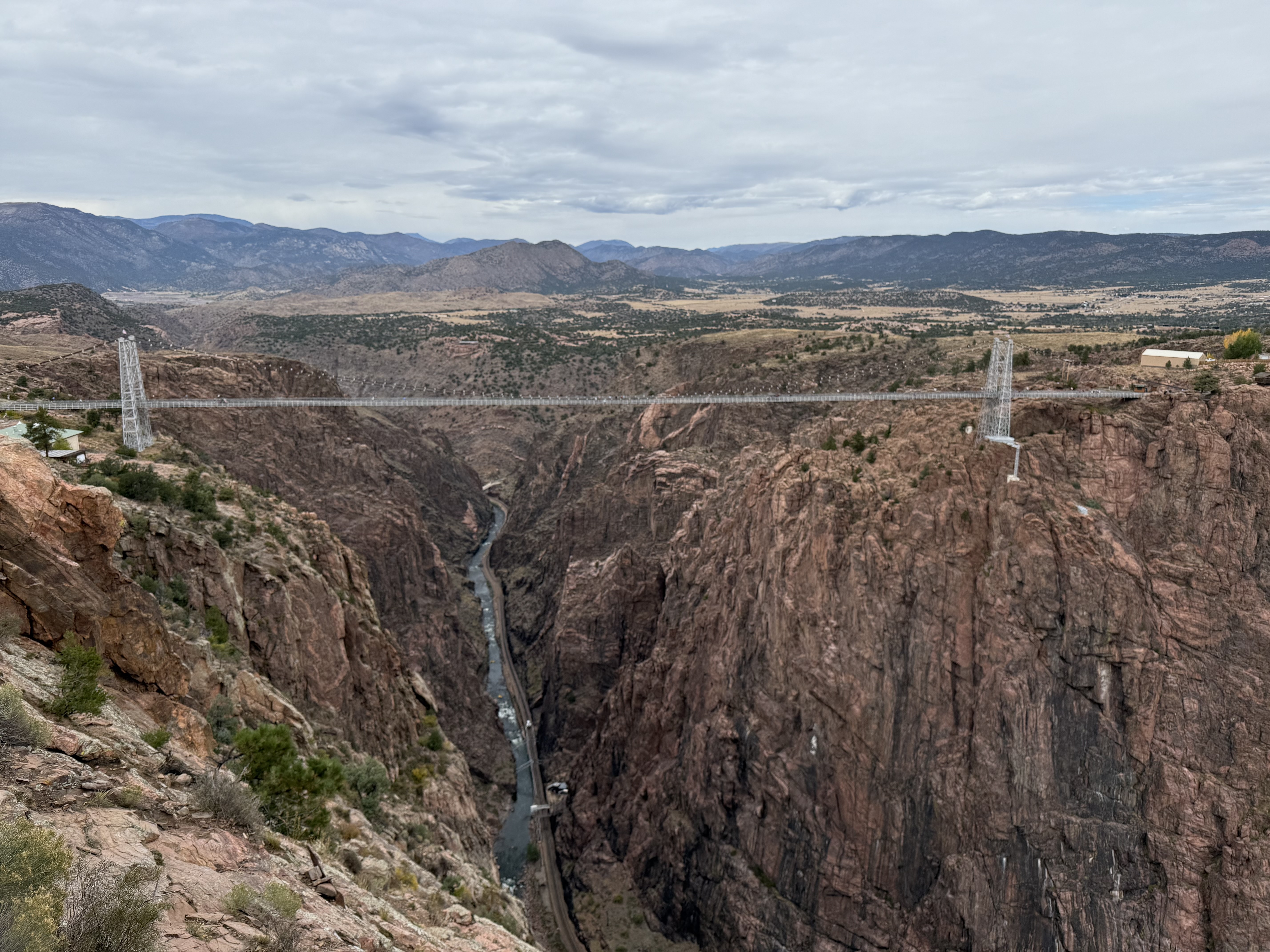
Facebook

Twitter

Instagram

Pinterest

Tips for your First Time in Vegas!

In this post, I detail our 40th birthday trip to Las Vegas and the Hoover Dam!


Mr. Trekker and I enjoyed an epic Spring Break trip to Las Vegas and the surrounding area to usher in both of us turning 40!  We drove 3270 miles that week!

We had to take the LONG way to Vegas to avoid snowstorms on both I-80 through Wyoming and I-70 through Colorado. So, we drove south through Nebraska and the Colorado plains all the way to Trinidad, CO.  Then we picked up I-25 to Albuquerque, New Mexico where we joined up with I-40, and took that to US 93, then the Hoover Dam, and Vegas!

This was not a typical vacation for us.  The Trekkers are probably some of the worst people to visit Vegas.  We barely drink or gamble (we only played–and lost–$5 on this trip! 🤑) and there weren’t any shows we were really interested in. 😂  When we go on trips we spend most of our time in the woods, not showering and using holes in the ground for toilets. 😯  Yet, we still had a pretty good time!

Las Vegas Casinos

We checked out most of the well-known casinos along the Vegas Strip.  I was impressed that you can go into all the casinos/enjoy all the entertainment they offer regardless of where you are actually staying. You may have to pay an additional fee of course, but everything is accessible to everyone. Even places like the Bellagio Conservatory were free to everyone!  It felt very egalitarian there…

–We liked Treasure Island, it looked like a pirate ship inside. I also liked the pirate ship in the pool out front!

Treasure Island casino with palm trees. Also the neon lights of Vegas and the Mirage casino. The casino is reflected in the pool of water in the foreground.
The Mirage was cool. I especially enjoyed the Volcano show set to music! We LOVED the fountain show and the incredible conservatory at Bellagio!

Thin fountains of water that are lit from below rise and dance from a pool of water.
The fountain show at the pool in front of the Bellagio!

Caesar’s Palace was very fancy but I found it felt somewhat confining with all the heavy wood and dark carpet/chair coverings.

The marble tower of the Ceasar's Palace casino rises from the ground below
The Paris was our favorite, if we ever go back again we’d like to stay there.  The actual atmosphere inside was almost calming.  The ceiling looked like blue sky with white, fluffy clouds. It was set up like you’re walking through the streets of Paris along shops and restaurants.  They even had a city-like walking bridge in the center of the main room!

A red, white and blue-colored, miniature version of the Eifel Tower. Another casino stands in the background with a pool of water in the foreground.

Flamingo Hotel

We actually stayed at the Flamingo.  First, the bad news…

Customer Service was difficult to navigate…

The Ceasar’s online/phone customer service that I tried to use before we arrived was TERRIBLE!  The woman on the phone could barely give me any helpful information regarding parking.  I’d ask her things like where to park and she’d say, “talk to the front desk”.  Then I asked her for that number or if she could transfer me and she said “Well, I really don’t know that.”  Then she’d follow up with, “Is there anything else I can help you with today?”  My literal response was, “Well you haven’t really helped me at all so far!” 😝

To be clear, I ALWAYS strive to treat customer service workers, housekeeping staff, waiters, etc. with the UTMOST respect and politeness. They work hard for little money and they put up with A LOT of crap! (I’ve done LOTS of customer service work.)  But it was obvious this woman was just reading from a canned script and didn’t really care if I got the info I needed or not, she just wanted me off the phone as soon as possible.  THAT does NOT sit well with me! 😤 

A large hotel/casino with "Flamingo" written on it. A smaller hotel rises in front and a large, lighted ferris wheel stands behind the casino.

Then I did some searching on Ceasar’s website and found a little more info. They even had a phone number for Ceasar’s Parking Customer Service!  Of course, when you called that number, it rang a few times and then informed you it was a Ceasar’s nonworking number! 😝

Check-in was difficult to complete

Check-in also SUCKED! When we arrived on-site it took almost an hour to get through the line. We couldn’t get the online check-in to work using our phones.  Then they had mostly kiosks available with very few actual humans working.  Hardly anyone in line could get the kiosks to work so they had to resort to the humans anyway.

Though I will say, the Customer Service lady we dealt with was WONDERFUL.  She was incredibly polite, helpful, and fast. I felt really bad for her. There were A LOT of irritated people and she was doing a great job of helping them.  So KUDOS to her. And Ceasar’s, you should be paying her more!  Whatever she is making, it isn’t enough!

Several pink flamingos stand in a pool of water, or on rocks/grass surrounding the pool.
Real flamingoes at our hotel!
The Flamingo was a good, lower-cost hotel option in Vegas!

Now for the good news!  Once we finally survived check-in, the remainder of our stay was wonderful!  The hotel itself was clean, it provided perfect access to the rest of The Strip, our room was nice and it was relatively quiet (other than our neighbors who seemed to enjoy coming home arguing at 3 in the morning for several nights straight! 😝  We considered yelling outside their door when we left at 8 am but thought better of it. 😇 ).

I was actually impressed with the room.  The Flamingo is kind of a “budget hotel” on The Strip.  I was worried it would feel more like a Super 8 or Motel 6.  This felt more like a Hampton Inn.  Also, “budget” is relative. We still spent more than $500 for our stay there (three nights, Sunday through Wednesday) but that’s comparable to one night at many of the other hotels.

We used this website to easily check hotel availability in Vegas!

The accommodations at the other hotels are swankier but concerning location, Ceasar’s and Bellagio were literally right across the street from our room (also we paid extra for a room with a LARGE window and a Strip View.)

We spent more than an hour one night just staring out the window in awe, watching the well-oiled machine that is the Ceasar’s Palace limo system parade before us (we were getting Vegas-ed out by that point. 😂–it was impressive though!)

Nighttime view of the neon-lit casinos of Vegas through a hotel room window.
The view from our room!

The Flamingo offers EASY access to EVERYTHING not to mention GREAT views. You could literally park your car once and not have to move it again till you leave.  You can walk most places but for things that are further away the Vegas Monorail stops right by the hotel.

My final verdict is that the Flamingo is a good place to stay, especially for first-timers or “normal” people who are trying to stick to a budget.  Aside from check-in, I would even consider staying there again.

Tips for Visiting Las Vegas

Author’s Note:  This was our first time in Vegas so these tips are intended for first-time visitors.  Some of this info may seem rather “duh!” to people who frequent Vegas. 

I was a little anxious about this trip.  I’ve always wanted to visit Vegas but the Trekkers don’t usually do big cities so I worried we might be biting off more than we could chew.  I was actually much more impressed by Vegas than I thought I would be.  I could never live there (it’s still a big city).  I would also hate the heat and I’d REALLY miss the color green.

On that front, I was very impressed that even in the very nice neighborhoods people didn’t really bother trying to keep grass growing.  Obviously, it’s the desert, so they seemed to use desert-friendly plants, rock gardens, patios, turf, etc.  I was very impressed that they weren’t wasting such a precious, natural resource (water) on such a futile fight (keeping grass alive where it usually doesn’t grow.)–So good on you Vegas! 

A sign stands in the middle of a busy boulevard that reads, "Welcome to Fabulous Las Vegas Nevada!"
The iconic, Vegas sign!

–Everyone was VERY friendly.  I think I was a little intimidated to go to Vegas with the whole idea of rich, High Rollers walking around. I know they’re around and I’m sure there are places you can go that cater to those types of people (note: the Trekkers ARE NOT those types of people! 🤣) but everyone we encountered from fellow tourists to Locals, hotel staff, and servers were all very friendly!  It felt like a city in the Midwest–which, shouldn’t really be surprising as Westerners tend to be pretty friendly too. 

–It was pretty casual.  We didn’t feel out of place at all in our hiking pants when we arrived. 😊  I expected to see lots of dressed-up people so I was pleasantly surprised to see so many people dressed comfortably like we were.  I was a little surprised to see the “Sturgis Wear”, as I called them. 😂

So the standing rule in the Black Hills, during the Sturgis Motorcycle Rally, is you have to wear at least “pasties or paint”–mind you, this is in reference to what women wear to cover up their “upper halves.” 🤭 

–Depending on what you want to do (and how much you can afford 😇) 2-3 days is a good amount of time to plan to spend in Vegas.

–I would definitely advise you to stay on The Strip if you can.  It’s beautiful, you have the iconic, “Strip views” and it gives you easy access to everything available there (food, shows, casinos, people watching.)

The neon lights of the Vegas Strip surround a pool of water and are reflected in it, at night.
Panoramic view of The Strip from the pool at the Bellagio

–Bring comfy shoes!  We walked SO MUCH!  We were EXHAUSTED every night!  It felt like it took 20 minutes just to walk to the car, in the parking garage, that was attached to our hotel!  We both lost weight on this trip and it DEFINITELY wasn’t from eating healthy. 😂 

–Whoever invented the raised walkways was a GENIUS!  People/cars hardly intersect except for the driveways leading into the casinos.

A large roadway with a row of palm trees in the middle and surrounded by the neon-lit, Vegas Strip, at night.
Strip view from one of the raised walkways

A few negatives to be aware of:

It stunk like Pot…EVERYWHERE! 🤥 (All of my 40 years may be showing with this comment but I was a DARE child of the 90s so, deal. 😉)  It was kinda weird because we never saw anyone smoking.  I lean Libertarian so I’m not looking to impede people doing what they want but holy smokes (no pun intended!) does that stuff STINK!  After smelling that for three days, when we actually smelled skunk later in the trip it almost smelled good! 😝 –that’s saying something!  I will say though, it seems to bother my asthma much less than cigarette smoke, interestingly enough.

–It was PRICEY!  I mean, I get that we were on “The Strip” but the thought used to be you could get things like food and hotels cheap in Vegas because they wanted you to spend your money on gambling…NOT SO ANYMORE!  $75 for a couple of burgers, some fries, and two milkshakes?!  We spent $60+ one morning for Dunkin’ Donuts!  I mean COME ON! (To be fair, you go off The Strip just a couple of blocks and prices return to normal.)

A large road surrounded by the lights of the Vegas Strip, at night

“Affordable” Vegas Restaurants

We definitely didn’t need to gamble to lose all our money on The Strip!  That being said, below are a few food suggestions that shouldn’t break the bank:

Blueberry Hill: this restaurant has multiple locations around town (all off The Strip.). It was your basic, DELICIOUS, home-cooked meal.  I especially recommend them for breakfast. (If it helps, the parking lot was full of local cars–on a Monday morning–which is ALWAYS a good sign!)

Related post: Drive the Extraterrestrial (ET) Highway

Bobby V’s Ristorante:  This place was VERY good.  I had some of the best cheese ravioli I’ve ever had!

Apparently, this is owned by Chef Buddy Valastro from Cake Boss–and that’s literally the extent of my knowledge on that subject. 😂

Bobby V’s is right on The Strip and not “cheap” but definitely a more “budget-friendly”, option, at least by Vegas standards.  (It also offered some great views out the windows!)

Hoover Dam!

The Hoover Dam is a fun, interesting side trip when you’re visiting Vegas!

The Hoover Dam was built in the 1930s to help control the unpredictable floods of the Colorado River.  The dam is used for hydroelectric power.  There are a variety of tours of the dam offered at various times and days (unfortunately none were being offered while we were there as the elevators were being worked on.)

You can check out the dam’s website for info on tour times, days, and prices (which range from $15 – $30. Typical cost to view the Visitor Center and see the short documentary on the building of the dam is $10).

Cement wall with the seal of the US Department of the Interior Bureau of Reclamation. Dates shown 1931 and 1935 and the title "Hoover Dam"

The dam was cool! We did feel a bit like cattle being herded through a pen as they guided us into the movie theater for the short info movie; then guided us upstairs to the Visitor Muesum portion and viewing decks. 😂  The sites and info were pretty cool though!

Cement dam with the Colorado River leading to it. Higher water levels of the pool behind the dam, all in a rocky canyon.
The Hoover Dam!
Cement pylons rising from the pool behind the Hoover Dam
Where is Hoover Dam?

Hoover Dam is located off of US 93, right on the Nevada/Arizona border, about 40 miles east of Las Vegas.  It spans the Colorado River in this area.

A bridge spans a rocky canyon. People stand on an observation deck in the foreground with high-tension electrical towers and wires rising overhead
Pat Tillman Memorial Bridge

Lake Meade

As the Hoover Dam slows the mighty Colorado River, it forms Lake Meade, the largest reservoir in the US.  The lake has been incredibly low for the last several years due to drought (like 20 to 30 feet low). 

A large lake surrounded by rocky cliffs with rocks rising out of the middle
A VERY low Lake Meade!

Watching Fighter Jets at Nellis Air Force Base

Nellis Air Force Base sits just outside of town and Mr. Trekker was very excited to find out some military exercises were being held while we were in Vegas (yep, I married a nerd! 😉)  So we spent a sunny, 70-degree afternoon sunning ourselves next to the Vegas Speedway (which sits just across the road from the Nellis runway). 

For some insider info on when you can catch planes flying at Nellis, click here!

WORD OF WARNING!  You will be perfectly fine if you sit and watch planes on the roadside next to the Speedway.  DO NOT sit across the road next to the Base fence!  Technically both are portions of a public road, but the Base Police are known to get cranky if you sit on their side. (Just a tip to help your trip stay fun and uneventful. 😇)


So, take a trip to check out the Vegas Strip, the Hoover Dam, and maybe watch some fighter jets roar through the skies above you!

Have you been to Vegas or the Hoover Dam?  Tell me what tips you would have for first-time visitors in the comments! 


Did you enjoy this post?  Pin it!

Four pictures: 1)The marble tower of the Ceasar's Palace casino rises from the ground below; 2) A red, white and blue-colored, miniature version of the Eifel Tower. Another casino stands in the background with a pool of water in the foreground; 3) Look up towards the Vegas Eiffel Tower from below; 4) Cement dam with the Colorado River leading to it. Higher water levels of the pool behind the dam, all in a rocky canyon; pin reads: "Las Vegas: Tips for your First Trip"

Like what you read here today?  Please feel free to leave a comment, like or share this post!  Add your email at the bottom of the page, or the sidebar to the right, to be notified when a new post is published.  By signing up for the email list, you will also receive a free copy of the Tranquil Trekker’s Top 10 Tips of Trekking Do’s and Don’ts! You can also follow the blog on social media by clicking the links below!
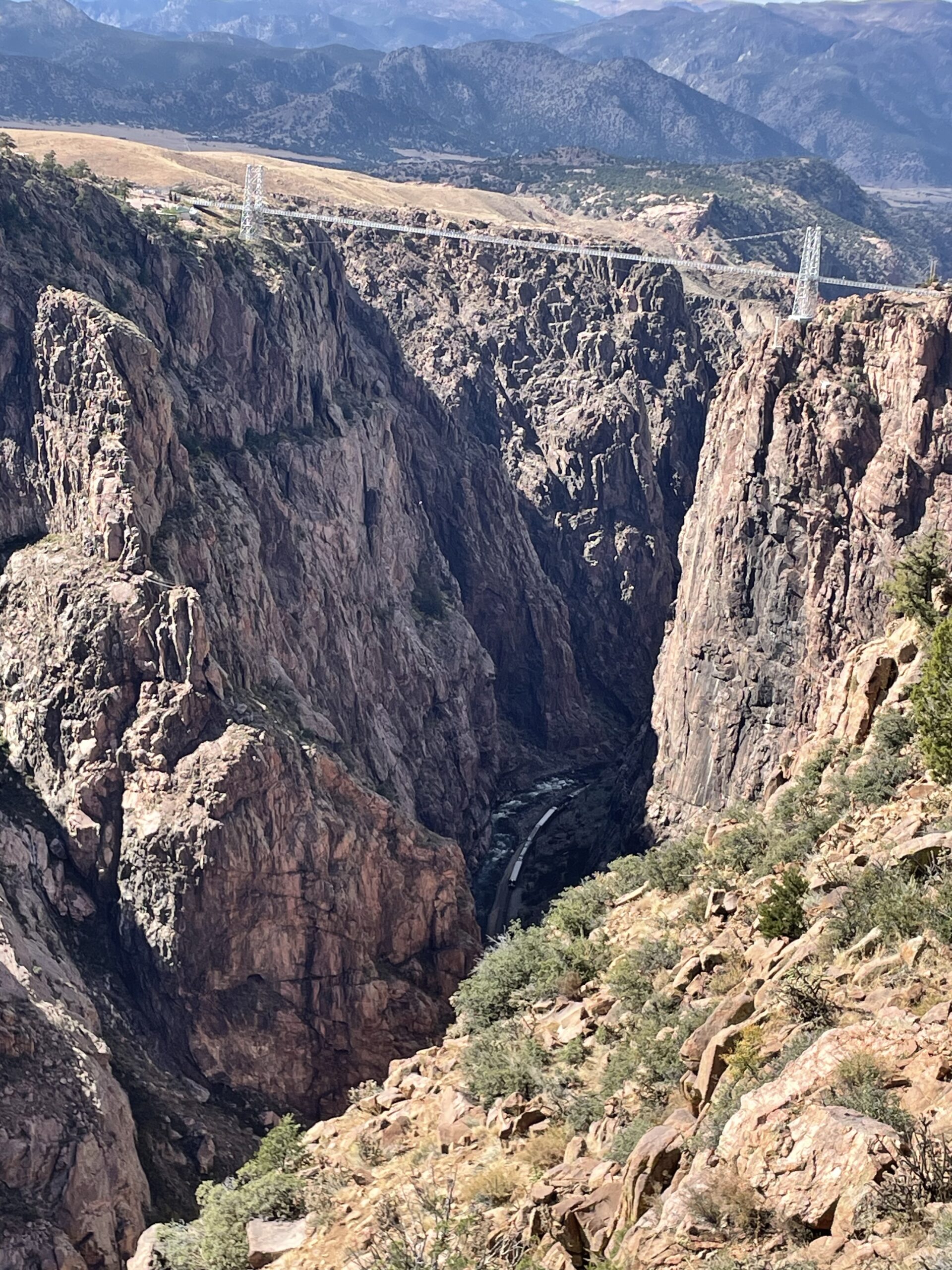
Facebook

Twitter

Instagram

Pinterest