My posts!

10 “Don’t Miss” Places for your Great Plains Road Trip

In this post, I review our adventures while traversing the Great Plains on our 2017 road trip.


The Trekkers had an adventurous, 2017 Road Trip.  It included 3500 miles (only 185 on Interstate and that was by choice); two days sick in a hotel with one trip to the urgent care; a nasty road rash; difficulty locating firewood; countless cows; interesting people; beautiful countryside and one “Close Encounter of the Furry Kind”! 

We spent two weeks roaming a landscape that spanned almost 1000 miles north to south and almost 700 miles east to west.  It was an interesting, frustrating, challenging, exhausting, wonderful trip that I can’t wait to share with you.  So, without further ado… let’s get started with our first portion, The Great Plains!

Note:  This was more of a sightseeing trip rather than our usual recreational adventures.  We did some hiking, which I’ll touch on, but I’ll mostly be drawing attention to family-friendly, roadside attractions available in small towns throughout the Great Plains and the West.  I hope this will inspire you to visit these sometimes little-known areas, and that the challenges we faced will encourage you to persevere when the going gets tough (or well-intentioned plans get altered) as grand experiences may be waiting just around the corner.

Carhenge and Chimney Rock in Western Nebraska

On the first day, we visited Carhenge and Chimney Rock (we learned throughout the trip there are several Chimney Rocks in the country).  Carhenge is a unique art sculpture in the middle of the Nebraska plains near Alliance. 

It looks exactly as it sounds!  It is a sculpture made of old, half-buried, American cars arranged in a pattern resembling the ancient European relic, Stonehenge.  It’s been on my Road Trip Bucket List for some time, so I was thrilled to visit, and it did not disappoint. 

A circle-monument made of gray cars sits in a green field on a dirt path
Carhenge

We also stopped at Chimney Rock near Scottsbluff, a key landmark used by pioneers on the Oregon Trail on their westward trek into the frontier.  It looks about like the name sounds (the old American Indian name for it basically translates to “elk penis” which is apt as well…hey, I’m just the messenger! 😇)

A red rock spire rises from a red rock hill on a green plain
Chimney Rock

Enders Reservoir State Recreation Area, Enders, Nebraska

The first night we arrived at our pre-determined stop, Enders State Park in southwestern Nebraska.  The park is nice, though the website was a bit misleading.  It highlighted “showers and modern toilets”.  We never found the “modern” toilets–unless in Nebraska a pit toilet is considered “modern”–and the only “showers” we saw were outdoor cement slabs, with drains, that would be suitable for hosing off. 

As we didn’t arrive until after six on the Saturday of Memorial Day weekend, there were no attendants on duty and registration was self-pay.  That was fine, though it was confusing as to where exactly you should pay as there were multiple entrance points/camping areas. 

A Frustrating Road Trip

We encountered quite a few frustrations on the Great Plains portion of our Road Trip…

Lack of Firewood

Unlike the Black Hills, where firewood is available at just about every corner gas station/grocery store, we found locating it in the Plains to be almost impossible.  As it turned out, the camp store just outside the park sold firewood, but it closed at 7 pm.  We arrived around 6:50, not knowing when the store closed or that it was our only option to acquire firewood.  Needless to say, by the time we realized our error…it was about 7:15 (this lousy luck would become a pattern throughout the trip). 😝 

Lack of nice tent-camping areas

Enders State Park provides plenty of tent-camping areas, the problem was they were difficult to locate, all terribly overgrown and extremely primitive–to the point where you’d have to walk a large distance or take your car to reach the nearest pit toilet.  Fire rings were also not available in the tent camping areas.  We ended up disperse camping in a nice picnic area which allowed us a covered picnic table to prepare dinner (there were no signs forbidding us from pitching our tent there and the ranger we saw the next morning didn’t chastise us for our choice). 

A surprise event!

Needless to say, by this point, we were getting rather frustrated…not a good way to start the trip.  That was until we were packing up for bed, and we noticed faint blue flames in the northern sky, wisps dancing from left to right…the Northern Lights!   At one point they resembled pillars rotating around a cylinder, like a campfire.  They were eerie, awesome, and utterly beautiful.  Needless to say, our bedtime was delayed that night! 

Sometimes lousy luck is just a prelude to grand things to come!  If we had found a different campsite that wasn’t as isolated or had sat by a roaring fire that night, we may have missed the pale light show dimly burning in the night sky…


Related Posts:  Lessons Learned on a Road Trip11 “Don’t Miss” sites in Colorado5 “Don’t Miss” Places for Your New Mexico Road Trip 

Monument Rocks and Dodge City, Kansas 

On Day 2 we visited one of the most interesting sites I’ve ever seen, Monument Rocks near Oakley, Kansas.  These are large, sedimentary rock formations that rise out of the middle of the Kansas cornfields!  They reminded me of those found in Badlands National Park.  They loom oddly out of place as they rise from the Kansas prairie, though they are quite beautiful.  

White, rock spires rise from the ground in a sandy, desert-like area
Monument Rocks

White, rock spires rise from the ground in sandy, desert-like scrubland

A large, white, rock rises from the ground with a large hole in the middle in a sandy, desert-like area
The Keyhole at Monument Rocks

Later, we visited Dodge City, Kansas.  For anyone who’s been to the tourist trap that is Keystone, SD, that’s what I was expecting, but on a grander scale.  Sadly,  I was disappointed. 

There was an interesting “Pioneer Town” which offered a museum you could tour, but it was in the middle of town.  You could literally see the double arches at the McDonald’s across the street through the clapboard fence. 🙃  The town did have a nice downtown area with trendy shops, but we decided to press on.

Meade State Park, Meade Kansas

That night we attempted to stay at Meade State Park in extreme southern Kansas, but to no avail.  It was our own fault for not making reservations on Memorial Day weekend (and as it turned out it was one of the only state parks in the area), though I was rather glad we didn’t. The place was absolutely packed! 

Meade State Park was lovely, shaded, and situated around a lake.  Unfortunately, not just every campsite was full, but people were also pitching tents almost on top of each other in picnic areas, music was blasting from every corner, and people were milling about so badly it was difficult to drive through them in some spots…not very tranquil.  Needless to say, due to this and the fact we still hadn’t located any firewood*, we ended up having a lovely dinner at Arby’s and staying at a hotel in Liberal, Kansas that night!

*It’s not that we’re terribly unprepared, we intentionally planned to acquire firewood along the way rather than bringing it with us.  This is because many parks that we’ve visited out West don’t allow firewood from outside the state due to the concern of spreading pests.  As we learned, this was not the case in the Plains.  Not sure if the lack of firewood is due to fewer trees on the Plains, or if it’s just that the regulations are so lax everyone just brings their own, but either way, come prepared!

Liberal Kansas

Day 3 was one of the highlights of the trip, we visited Dorothy’s House (along with the Coronado Museum) and the Mid-America Air Museum in Liberal, KS!  As it turned out, not camping the night before and having already made the hour drive to Liberal meant we could start the morning touring straight from there!  

Dorothy’s House and the Coronado Museum, Liberal Kansas

Dorothy’s house was as cheesy as you can possibly imagine such a place would be…and I absolutely LOVED it!  I was impressed with how in-depth it was. 

You actually tour a historical home from that area that was built around the time the book, Wizard of Oz, was originally written.  It was laid out just like Uncle Henry’s and Aunt Em’s home from the movie. 

Then you meander through the Land of Oz, complete with Dorothy as a tour guide.  She gave us the choice of hearing the story again or getting random trivia from the making of the movie.  The group agreed that we’d all seen the movie so we opted for the trivia! 

There was a good amount of movie memorabilia, including the actual model of the home used during the tornado scene.  Our tour guide gave us plenty of unique tidbits, but I won’t ruin those surprises.  You’ll have to visit this fun roadside attraction yourself if you’re ever in that area and offer patronage to Liberal’s Historical Society to boot! 

While we were there we also toured the neighboring Coronado Museum and saw many unique figurines from that era, including some disturbing medical/dental equipment!

Mid-America Air Museum, Liberal Kansas

If you enjoy air museums, this place has quite a bit to offer.  It was started by a former pilot from Oklahoma City who donated his collection of over 50 planes.  The Mid-America Air Museum offers a mixture of military and civilian aircraft in a spacious, air-conditioned hangar.  They put on quite a show for such a small non-profit!

**I was also able to knock two more items off my Road Trip Bucket List in the early part of the trip.  I can now say that I’ve visited both Oklahoma and Texas.  We only drove through the panhandles of both states, they were flat. 😉   

The “Mother Road”, Route 66 in New Mexico

We ended the 3rd night on the famed Route 66 in northeastern New Mexico.  Otherwise known as “the Mother Road”, Route 66 was one of the first highways to span the country, connecting Chicago with the California coast, and it’s definitely worth a visit! 

Locating the actual Route 66 can be difficult due to the current highway systems (sometimes it runs with a current highway, other times it almost disappears completely).  The road has also been re-routed throughout the years, making its “true” location even more cryptic.  Truly enterprising adventurers can track it, though a high clearance, 4WD vehicle may be required to navigate what’s left of the pockmarked, scrub-covered pavement in some areas.

Fortunately for us, where the route traverses northeastern New Mexico is one of the easier portions to locate.  It serves as the main drag for several small towns—including Tucumcari and Santa Rosa—and parallels I-40 as a service road in this area. 

There are still some signs of life on this section of the old road, some still-functioning hotels and gas stations lit with neon lights that maintain the motif of ages past.  Without the large, classic cars of that era though, it’s hard to imagine the atmosphere is anywhere near comparable. 

Unfortunately, most of the still-standing buildings are dilapidated skeletons of their once-great selves, frequently forming ghost towns with other structures of that bygone era.  We ended our 3rd night, traveling Route 66 westward into a bank of thunderheads in Tucumcari, New Mexico.

Roof of a gas station reads, "The Mother Road Route 66"
Route 66, Tucumcari, New Mexico

Roof of a gas station reads, "Route 66 Get Your Kicks"


Have you visited any of these places?  Tell me about your experience in the comments!


Did you enjoy this post?  Pin it!

4 pictures: 1) White, rock spires rise from the ground in sandy, desert-like scrubland; 2) A large, white, rock rises from the ground with a large hole in the middle in a sandy, desert-like area; 3) A red rock spire rises from a red rock hill on a green plain; 4) Roof of a gas station reads, "The Mother Road Route 66". Pin reads, "10 'Don't Miss' Places for your Great Plains Road Trip"


Like what you read here today?  Please feel free to leave a comment, like or share this post!  Add your email at the bottom of the page, or the sidebar to the right, to be notified when a new post is published.  By signing up for the email list, you will also receive a free copy of the Tranquil Trekker’s Top 10 Tips of Trekking Do’s and Don’ts!

You can also follow the blog on social media by clicking the links below!

Facebook

Twitter

Instagram

Pinterest

Stratobowl near Rapid City

In this post, I review the Stratobowl trail near Rapid City, SD.


The Stratobowl Rim Trail is a simple hike near Rapid City that offers spectacular views of the Black Hills and a local, historical site.  The Stratobowl is a great trail for a short hike.  It’s only around one mile each way, so it’s amenable to almost any skill level.  

Where is the Stratobowl?

The Stratobowl is located off Route 16, about a half-mile south of Old McDonald’s Farm.  There is no roadside sign highlighting the trail, but there is an obvious parking area just off of Highway 16.  If you’re there during daylight hours, it’s likely you’ll see other vehicles.

Hiking the Stratobowl

The path is comprised of simple, rolling hills on an old access road that traverses through pines and offers a prime opportunity for spotting deer and wild turkeys.  A substantial logging operation was recently completed there (necessitated by pine beetle damage) so chances of viewing wildlife are now even more likely. 

At the trail’s terminus, the road opens onto the rim and the yawning chasm that is the actual Stratobowl.  From here, a valley formed by Spring Creek spreads out before you with homes dotting the canyon floor. You’ll also often see vultures soaring the thermals…below you! 

Related posts:  Willow Creek Trail Black Hills; Hiking the Boulder Hill Trail; Secret Spots in the Black Hills!; Coon Hollow TrailLittle Elk Creek Trail; Flume Loop Trail

The Stratobowl is also a prime place to watch the sun setting over the expanse of the Black Hills (and being so close to town it’s convenient for an evening hike).  The name stems from the bowl-like shape of the valley created by the surrounding terrain.  The north side of the rim can be reached from several other trails/old logging roads off of Sheridan Lake Road to the north (I discuss these options in this post.)

This setting was the site of high-altitude, manned balloon flights that took place in the ’30s (there are several monoliths on-site detailing these); it also currently hosts an annual hot air balloon launch.  Be aware, you may hear the haunting sound of howling wolves when hiking.  Do not be alarmed though, wolves are not usually found in the Hills and those you hear are safely contained at Bear County, just a few miles away.

Sunset shot from above over a valley floor. There is a meadow and pine trees at the bottom. The dark silhouette of mountains is in the distance with the sun setting behind them.
Thank you Mr. Trekker for this sunset shot of the Stratobowl
View from above of a snowy valley floor with the tops of pine trees covered in snow. A house sits in the middle of a meadow, The whole picture is obscured with flying snow.
The Stratobowl in the snow!

This trail is perfect for an afternoon or after-work hike, or if you’re just looking for an easier place to take the kids or the dog that’s close to home.  It’s gorgeous in almost any kind of weather and the trail is family-friendly.  This is another great one to add to your list of fun hikes found near Rapid City!

Do you enjoy hiking the Stratobowl?  Tell me about it in the comments! 

Did you enjoy this post?  Pin it!

View from above of a snowy valley floor with the tops of pine trees covered in snow. A house sits in the middle of a meadow, The whole picture is obscured with flying snow. Pin reads, "For a quick hike near Rapid City check out the Stratobowl Trail"


Like what you read here today?  Please feel free to leave a comment, like or share this post!  Add your email at the bottom of the page, or the sidebar to the right, to be notified when a new post is published.  By signing up for the email list, you will also receive a free copy of the Tranquil Trekker’s Top 10 Tips of Trekking Do’s and Don’ts!

You can also follow the blog on social media by clicking the links below!

Facebook

Twitter

Instagram

Pinterest

Jenny Gulch Road in the Black Hills

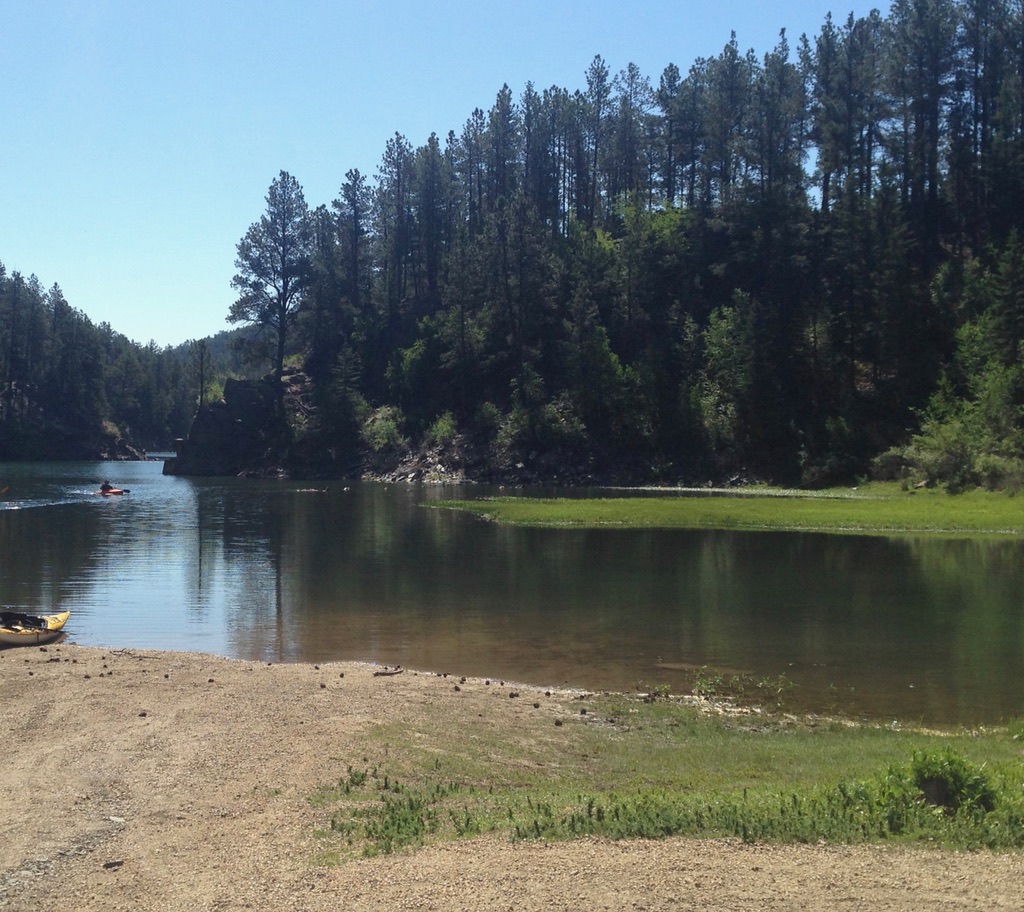
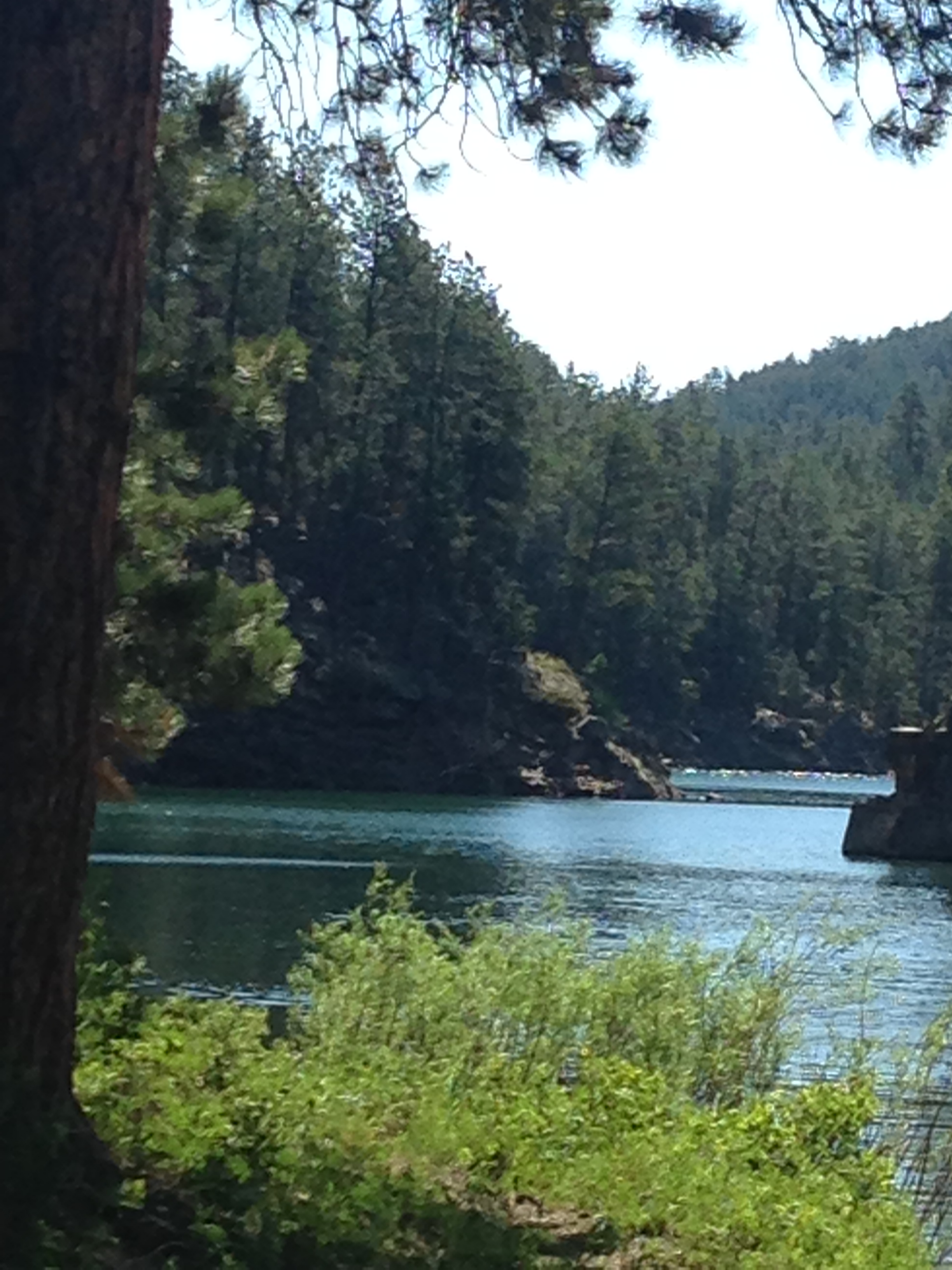
In this post, I review the drive on Jenny Gulch Road, in the central Black Hills.


In a  previous post, I gave a brief mention to Jenny Gulch Road.  It is found off Silver City Road, on the way to the Jenney Gulch boat ramp of Pactola Lake and the tiny community of Silver City. 

This gets a little confusing.  There are several roads in the Rapid City and the central Black Hills area that go by this name so Google Maps (and possibly other mapping programs) may send you to the wrong place.  To be clear, for this post I am referencing the Jenny Gulch Road that follows along Forest Road 261 and runs through a central portion of the Black Hills National Forest, outside of town.  It meets up with Broad Gulch Road and runs as far as Rochford Road, both of which eventually lead you to Highway 385, one of the main routes through the Hills. 

In the earlier post, I mentioned a large section of the road heads off to the north (and consequently not near Jenney Gulch at all) but we’d never taken that route.  I am happy to report we have rectified that issue and I can now give you details of that road, as well! 

Jenny Gulch Road offers a nice drive through national forestland.  It doesn’t really provide any exciting activity options, but several dead-end forest roads branch off from it which present prime “set-up-your-hammock-and-enjoy-the-quiet of-the forest” opportunities.  These would also be some good spots for dispersed camping. 

We did learn these are off-limits to vehicle travel and are barred by gates in the off-season (though they’re still available for foot travel). 

The road is recommended for high clearance vehicles only and near the northern terminus, I was glad we had the 4×4 with the higher ground clearance.  A regular AWD vehicle could probably make it but some of the ruts could cause the situation to become a little dodgy.

This back road is something to think about if you’re looking for a secluded place in the forest to collect your thoughts, and another item checked off of our Black Hills Bucket List!

Like what you read here today?  Please feel free to leave a comment, like or share this post!  Add your email at the bottom of the page, or the sidebar to the right, to be notified when a new post is published.  By signing up for the email list, you will also receive a free copy of the Tranquil Trekker’s Top 10 Tips of Trekking Do’s and Don’ts!

You can also follow the blog on social media by clicking the links below!

Facebook

Twitter

Instagram

Pinterest

Winter Fun at Eagle Cliff Ski Area

In this post, I discuss winter activities available at the Eagle Cliff recreation area, near Lead, South Dakota.


The Eagle Cliff ski area is located on national forestland just outside of Lead, South Dakota.  Much like Big Hill, it is a great place for winter recreation (though it provides outdoor leisure opportunities year-round.) 

Where is Eagle Cliff?

The Eagle Cliff ski area is located around 10 miles west of Lead, South Dakota on Highway 85, just west of Cheyenne Crossing and the southern mouth of Spearfish Canyon. 

Snow-covered hill covered in both pine and leafless trees on a cloudy day
The Winter Wonderland at Eagle Cliff

What are the Eagle Cliff trails like?

Eagle Cliff is comprised of a series of 21 trails with multiple trailheads and over 27 miles of possible trail combinations.  While this area is open year-round it is primarily used for winter recreation. 

Eagle Cliff is available for mountain biking and hiking in the summer but is not maintained at all and tends to become extremely overgrown.  When we’ve biked there in the past the grass has reached my knees or higher (while on the bike) in some locations. 

You can make a multitude of loops connecting various trails in this area.  Watch for the signs the many forest inhabitants that live here leave behind in the snow, including mountain lion tracks/scat.  Once we were able to surmise where a big cat had traveled through the fringes of the trees to stalk a herd of deer in the meadow below.

Mountain lion tracks in the snow
“Here kitty kitty”!

The Eagle Cliff trailheads are Dead Ox, Raddick, Bratwurst, Lily Park, and Sunny Meadow.  My personal favorites are Raddick and Sunny Meadow.  I especially like a loop made by taking the Raddick Gulch Trail to the Roller Coaster Trail loop.  This route is less than four miles in total length and it incorporates undulating hills and a beautiful landscape. 

This area is fully forested and doesn’t offer much by way of views, but as it’s protected from the wind, it is usually warmer here and the snow blankets the trees providing an iconic, winter landscape. 

View down a hill over a snow-covered open area surrounded by tall pine trees
This is near Raddick Gulch looking down into the valley where we saw evidence of a mountain lion stalking a herd of deer

Sunny Meadow is–as its name suggests–an open meadow, perfect for skiing or snowshoeing in the winter and biking in the summer (just watch out for the cows and their “leavings” in the warmer months 🤥).  This is an absolutely beautiful area with open, rolling hills surrounded by national forestland.  Because it is so open, this expanse can be rather windy and chilly in the winter, and due to lack of shade the sun beats down unmercifully here in the summer, so plan accordingly.  The only complaint I have regarding this beautiful space is that it is near snowmobile trails (though fortunately they aren’t allowed in the ski/snowshoe area) because their noise tends to shatter the serenity of this snowy landscape.

These are, literally, my favorite places in the Hills for winter sports.  Unfortunately, a few years ago, they closed these areas for snowshoeing (my favorite winter sport).  They are now only open for cross-country skiing and Raddick Gulch is a bit too steep for my menial XX-skiing skills.  This was because there were issues with snowshoers messing up the ski trails.  This is why we can’t have nice things! 😒 (FYI snowshoeing is only allowed off of the main, Eagle Cliff trailhead.  There is a large parking lot and a sign for it. 😀)

What activities can you enjoy at Eagle Cliff?

Although both snowshoeing and cross-country skiing are available in this area in the winter, there is only one groomed ski trail.  Similar to the Big Hill trails near Spearfish, this portion of the Black Hills usually receives some of the largest amounts of snow each winter.  This means that even if the ground is bare in Spearfish, Rapid City, or other lower elevations, it’s a good bet that there will be snow at these higher altitudes (oftentimes, A LOT of it)–It’s not unusual to step over the top of gates in the winter that you walk through in the summer or to see the trail signs that are at eye level in summer at boot level in winter. 😮

Ski tracks down a snow-covered forest road. Pine trees line both sides
One of the old forest roads available for snowshoeing or cross-country skiing

So, if you’re looking for a great place to enjoy winter sports that is both beautiful and quiet, check out the Eagle Cliff ski area! 

Have you enjoyed winter Sports at Eagle Cliff?  Tell me about your experience in the comments!


Did you enjoy reading this post?  Pin it!

Ski tracks down a snow-covered forest road. Pine trees line both sides. Pin reads, "Eagle Cliff Winter fun in the Black Hills!"

Like what you read here today?  Please feel free to leave a comment, like or share this post!  Add your email at the bottom of the page, or the sidebar to the right, to be notified when a new post is published.  By signing up for the email list, you will also receive a free copy of the Tranquil Trekker’s Top 10 Tips of Trekking Do’s and Don’ts!

You can also follow the blog on social media by clicking the links below!

Facebook

Twitter

Instagram

Pinterest

Winter Activities at Big Hill, Spearfish, South Dakota

In this post, I discuss winter activities available at the Big Hill recreation area, in the northern Black Hills.


Big Hill is a recreation area located in the Black Hills National Forest that offers outdoor, leisure opportunities year-round.  The prime activities enjoyed here are cross-country skiing, snowshoeing, and fat-biking in the winter, though people regularly hike and mountain bike here during the summer months, as well. 

Where is Big Hill?

The Big Hill recreation area is located southwest of Spearfish, in the northern Black Hills.  The easiest way to reach the main trailhead is to take Exit 8, off of I-90, for McGuigan Road.  Take this south until you reach the T-intersection with Tinton Road.  Turn right at the intersection to drive up the hill. 

After about 8 miles, watch for a VERY tiny brown sign on the right-hand side of the road showing a hiker.  Shortly after this sign, at the top of the hill, you’ll see a large parking area on your right. (The trailhead is directly across the road from the parking area).  It is difficult to miss as there are usually numerous other cars there (especially in the winter). 

There are other routes you can take to reach this trailhead–coming from downtown Spearfish–as well as a scenic route coming up the other direction on Tinton Road from the south (from Roughlock Falls Road).  While this is a beautiful, scenic drive that I highly recommend in the summer, it should be approached with extreme caution in the winter.  This portion of the road is barely maintained for winter driving and is usually at least somewhat snow-covered.  We have successfully taken this route in the 4×4 truck in the winter, but it’s not for the faint of heart (though it is necessary if you want to reach the Old Baldy trailhead to enjoy winter activities in that area). 

The route from McGuigan Road to the trailhead is usually maintained quite well and can often be reached using a typical, 2-wheel drive vehicle (we made our first trip there in an old Civic).  It should also be noted that whether Summer or Winter, all of these dirt/gravel forest roads are dependent on the current weather and their condition can vary greatly (and QUICKLY) as the weather changes.

What is the Big Hill Recreation Area like?

Big Hill offers over 15 miles of trails formed by several different loops/routes (many follow old forest roads) that can be combined in a variety of ways.  Trail maps are usually available at the trailhead.

The trails at Big Hill are very well-signed but it’s still best to have a map to help determine the best route for you (the map also indicates the difficulty levels of the various trails).  The managers of this recreation area also do a marvelous job of keeping the ski trails and the snowshoe/fat bike/dog-friendly trails separate while ensuring everyone can still enjoy this beautiful area! 

Big Hill tends to be one of the snowier places in the Black Hills so you can potentially participate in winter activities here anywhere from October – May (dependent on current snow conditions, of course).  We’ve enjoyed snowshoeing here, as well, though there are times the snow isn’t quite deep enough so we tend to favor the Eagle Cliff area for our snowshoeing adventures. 

Today, I am focusing on the winter sports available here.  I will say though, this area is a must-see in the fall when the yellow Aspens are in full color.

Brown meadowgrass in the foreground with a hillside of yellow aspen trees (intermixed with evergreens) in the background, all under a blue sky.

**I mentioned the Eagle Cliff area above.  It only has one groomed trail, the rest are just trails cut by outdoor enthusiasts.  Big Hill offers machine-groomed ski trails that are better for practicing the fundamental drills of skiing as they are smoother. 

Machine-groomed trails require FAR less effort, but I find I enjoy them less.  They are more crowded and while faster, I find it’s harder to control my skis.  The person-groomed trails require more effort and you’ll move less quickly, but I find the resistance the snow provides aides in control of the skis and balance.  So, while the groomed trails are usually recommended for beginners, I’d say you have to decide what is most important to you; ease of effort or less fear of hurtling down a hill uncontrollably…possibly towards a tree. 😳

Warmer the higher up you go?

This area is another example of the complicated, frequently-contrasting weather you can have in the Black Hills.  On several occasions we’ve experienced temps in the single digits to low teens in the lower elevations–but it can feel almost balmy with temps in the mid-twenties at Big Hill (that equates to perfectly comfortable conditions when skiing, in the sun, with little wind.)  This contrasting weather is due to a temperature inversion.  Put in simple terms this basically means warmer air is lighter and floats over cooler air.  This makes it warmer the higher you go in elevation. (If you want a more scientific explanation you’ll have to track down Mr. Trekker. 😃)

Snowshoeing vs. Cross-Country Skiing

Snowshoeing is great fun, but it’s HARD work depending on snow conditions (this activity and mountain biking are literally the hardest workouts I’ve ever done). 

Cross-country skiing, in contrast, requires far less exertion (and I’ve found that working out with an elliptical during the week is perfect training for this sport as the body motions required for both are very similar). 

Anyone who can walk can snowshoe.  It takes a little skill to keep from stepping on your own shoes, but once you master that, you’re golden.  Cross-country skiing, on the other hand, is FAR more difficult.  It requires balance, finesse, and the ability to relax and just “go with the flow”–all characteristics I SORELY lack (“sore” being the keyword as that’s often the result of my endeavors 😝). 

I would also argue skiing is more dangerous as you’re moving faster and are more likely to slip/twist something when you fall (and you WILL fall).  If you fall while snowshoeing, you pretty much just end up on your rump or fall to the side into a cushioning snowbank.  It may be cold, but not really injury-inducing (although your snowshoe could become stuck under a buried log, as I found out at Big Hill one early, spring day…😮 )  

We’ve gotten pretty good at most outdoor sports we enjoy, but with skiing, we’re still very much beginners.  Standing on a thin object that’s meant to glide quickly and effortlessly does not lend itself to keeping one’s balance.  Neither do skis that are as long as I am tall and stick out several feet both in front of and behind you.  Not only do you have to learn how to move around without stepping on yourself (similar to snowshoes) but you have to do it while each leg is trying to slide in an opposite direction. 😝

So, if you’re enjoying a snowy weekend at Big Hill, and you see a bumbling idiot barely able to stay upright on their skis..it just might be me! 😇

The best trails at Big Hill

Dirt trail crossing a brown-grass meadow with yellow apens and evergreens in the background, all under a blue sky.For beginners, I strongly recommend starting with the initial Loop A.  It’s a short, groomed trail that just goes in a small circle around a meadow/forested area near the front of the Big Hill trail network.  It’s fairly flat with only a few short rises and dips and doesn’t offer much opportunity for falls (though, full disclosure, I have fallen here 😝). 

There is another Loop A that goes farther out.  This option is also usually groomed. It’s also good for beginners once you get a little more confidence as it’s solely a “green” route–meaning it’s considered “easy”.  There are a few steeper slopes, one especially on the right-hand (western) side of the loop as you’re heading out.  I’ve had my worst spills in this area and though they were frightening, I’ve left without injury–so far–and haven’t even felt very sore the next day. (A surprise as I was sure my ankles were being ripped from my body when I fell. 😮 )

What will you see at Big Hill?

Big Hill is absolutely BEAUTIFUL no matter the time of year.  It offers a mixture of forested and meadowy areas that contain leafless deciduous and evergreen trees, all covered in a soft blanket of snow during the winter.  On sunny days you’ll frequently hear birds chirping in the trees, and the ever-present, South Dakota breeze rustling through the pines provides a respite from the deafening, snowy silence.  In the fall, this area offers a warm glow with the bronze meadowgrass, and glowing, yellow aspens all standing in contrast to the evergreen trees.

Brown meadowgrass in the foreground with a hillside of yellow aspen trees (intermixed with evergreens) in the background.

This recreation area is far enough from civilization that it offers an incredibly peaceful environment.  It is sullied in the winter only by the occasional roar of snowmobiles that also enjoy nearby trails–though not these exact trails. (Fortunately, they focus on the region on the other side of the road so they are usually only really heard when you are near the parking lot.)

If you’re looking for a great place to enjoy some snow sports that is both beautiful, easy to reach, and that offers fun options for everyone, check out Big Hill!

Have you tried the Big Hill Recreation Area?  Tell me about your experience in the comments! 


Did you enjoy reading this post?  Pin it!

Snow-covered meadow in the foreground; green, pine trees in the background. Pin reads, "Winter Activities at Big Hill in South Dakota."


Like what you read here today?  Please feel free to leave a comment, like or share this post!  Add your email at the bottom of the page, or the sidebar to the right, to be notified when a new post is published.  By signing up for the email list, you will also receive a free copy of the Tranquil Trekker’s Top 10 Tips of Trekking Do’s and Don’ts!

You can also follow the blog on social media by clicking the links below!

Facebook

Twitter

Instagram

Pinterest

Lookout Point Trail at Wind Cave National Park

In this post, I discuss activities available above-ground at Wind Cave National Park.


**Author’s note: Just a word of warning, as this is a National Park, no dogs are allowed on any trails (exceptions for Service Animals). They are only permitted in the campgrounds and parking lots.**

Wind Cave National Park, located near Hot Springs, South Dakota, is best known for the sites it offers below-ground.  However, it also provides plenty of opportunities for hiking above-ground, as well!

Hiking trails at Wind Cave National Park

There are several trails found throughout Wind Cave National Park and countless route combinations and loops can be made depending on how long of a hike you are interested in.  These include the Rankin Ridge Trail, and one of our favorites, a loop formed by the Lookout Point Trail. 

It includes a short skirt where the Sanctuary/Centennial Trails run together and then continues on to the final portion of the hike which is solely comprised of the Centennial Trail.  This is all located in the southern portion of the park. 

Where is the trailhead for the Lookout Point Trail?

The trailhead we use for this hike (the Norbeck Trailhead) also marks the southern terminus of the 111-mile Centennial Trail.  This route traverses the spine of the Black Hills.

The Lookout Point trailhead can be found off Route 87 in Wind Cave National Park.  There are numerous ways to reach it but we usually take SD 79 south out of Rapid City, to US 18 west heading to Hot Springs.  We then take US 385 north out of Hot Springs until it connects with Route 87 north. 

To return to Rapid City you can retrace your steps, or if you’re interested in a longer, more scenic route, you can choose from a variety of options north through Wind Cave, Custer State Park, and the Black Hills.  Have I mentioned a map is helpful when adventuring in the Hills? 😉

What You Will See on the Lookout Point Trail

The Lookout Point loop can be completed in either direction though we prefer starting on the Lookout Point Trail (the climbs going this direction are less steep).  The hike starts off along a small creek and then almost immediately takes you up a steep hill (fortunately the climb is of relatively short duration and once you reach the ridge above, the terrain is fairly flat for some time).  

The correct route through this area isn’t always clear due to  NUMEROUS game trails left by the many four-legged critters traveling to the creek for water, so be very watchful so as not to lose the path.  The signage on the trail is decent but (even with previous experience) we’ve ended up following well-worn buffalo paths instead of the actual trail.  Luckily, we were able to recognize our error early on and quickly correct it.

Once you jump on the Sanctuary Trail portion of the loop (about halfway through), the ecosystem makes a clear change as you descend from the open grassland of the prairie into a forested canyon.  The descent is rather steep so take care not to slip on loose scree (or if ice is present). 

See if you can spot an unusual item in the Black Hills, cedar trees!  They appear to favor this protected, damper area. 

This portion of the trail is also characterized by the rock cliffs towering far overhead. 
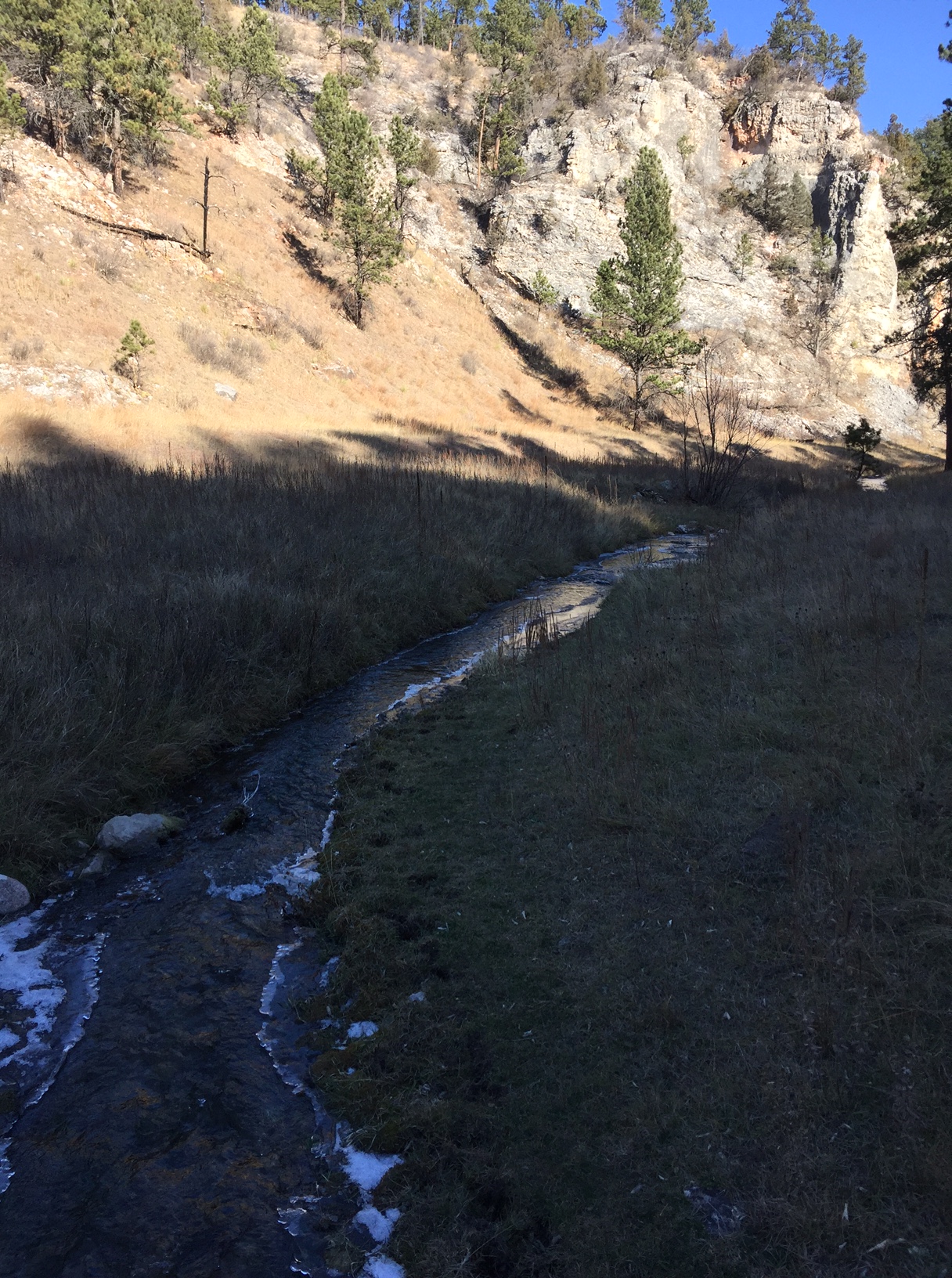
An icy creek traverses the bottom of a canyon. Dry, brown grass and green, pine trees speckle the rocky, canyon wall.
The creek through the canyon

The bottom of the canyon consists of a long, narrow meadow.  When you reach the floor of the canyon, be sure to turn left onto the Centennial Trail to keep to the loop (a right turn will put you on the Highland Creek Trail). 

There are several prime lunch spots along the creek and watch for remnants of the ungulates (deer and elk) whose bones are scattered throughout this area (whether they met their demise by flood or they were drug here by fanged animals, we will never know). 

Follow the canyon and its babbling creek for about two miles until you emerge dramatically into an open meadow.  A portion of the Centennial Trail will soon break off on an uphill branch to the right, while you will continue straight along the creek and eventually the trail will curve to the left.  It then ascends one final rise which brings you back to the trailhead.
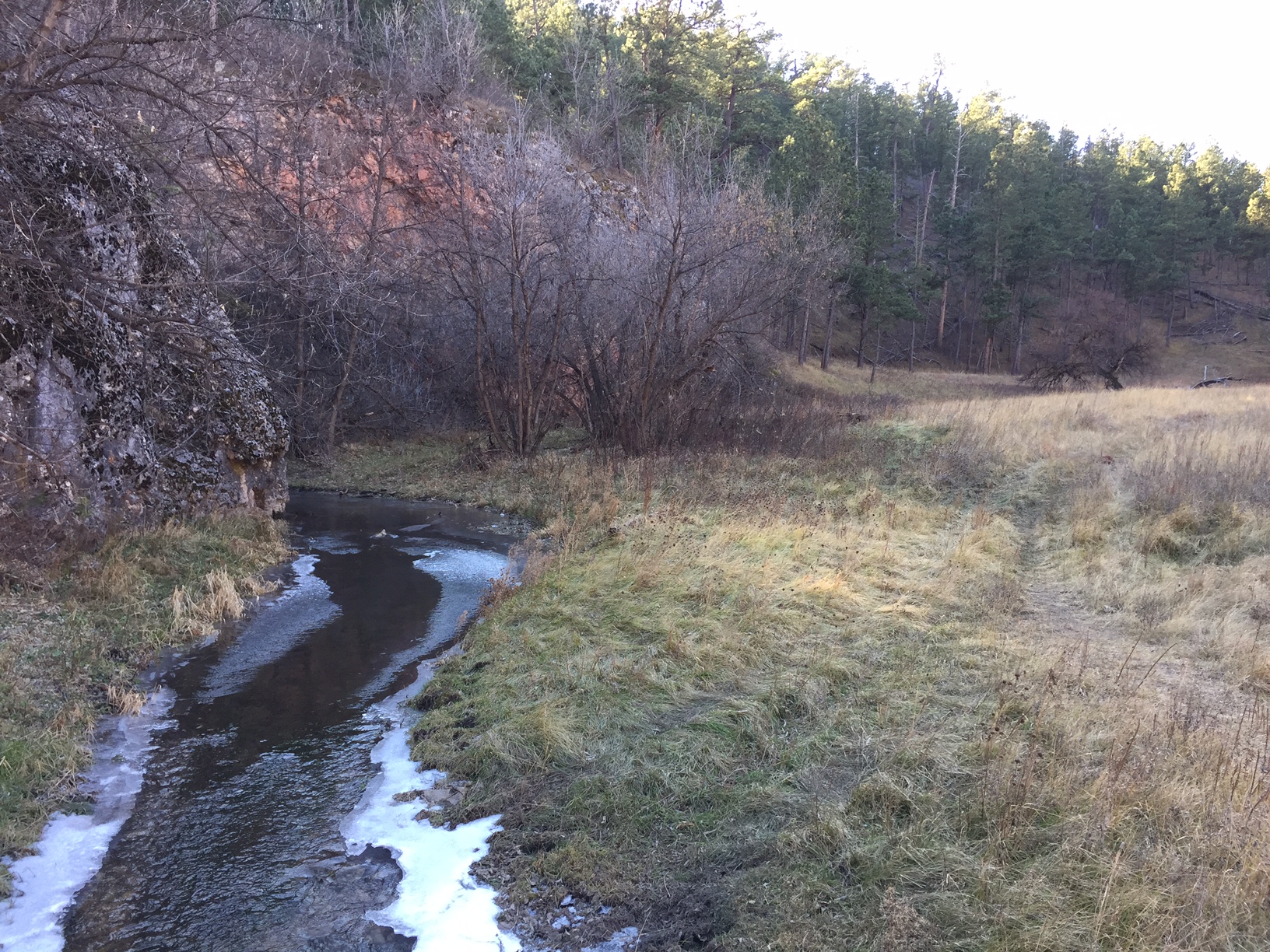
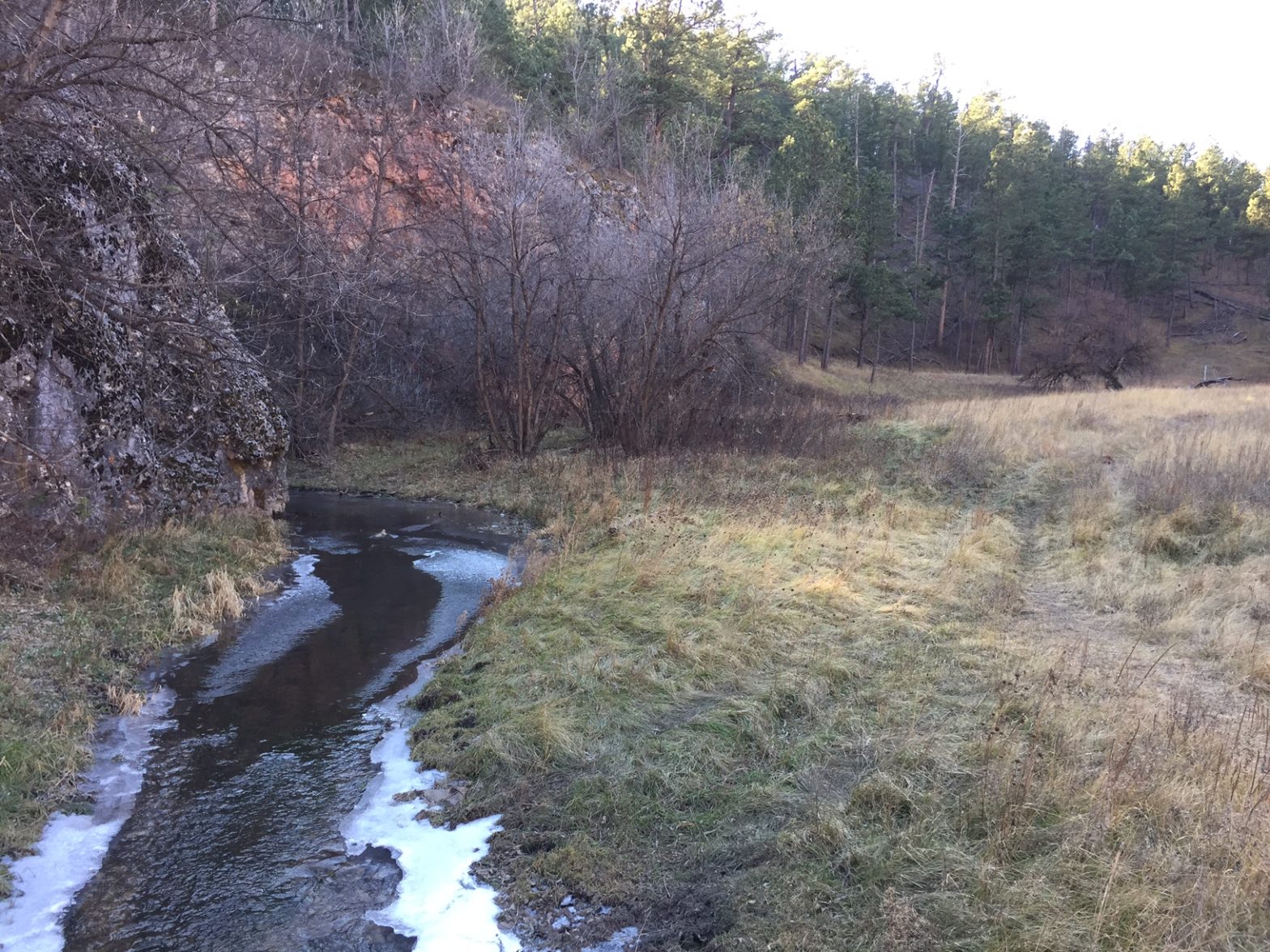
A winter scene. A small, icy creak meanders through a brown-grass meadow with bare trees on its banks and green pine trees in the background.
The creek through the meadow (notice how it is just beginning to freeze)

Wildlife on the Lookout Point Trail

Be sure to keep VERY ALERT for buffalo in this area.  They are numerous and we see them every time we hike in this park.  It is rare that we don’t have to alter our route to skirt a buffalo (or 30).  They seem to favor the same trails the humans use so be prepared to go off-trail and give them a wide berth. 

Fortunately, this area is highly visible, open prairie so even if you have to go well off-trail you’re usually able to keep at least one trail marker in sight.  It’s always advisable to bring a topographical trail map and compass when hiking these areas (or anywhere, really) to assist you in maintaining your direction if you need to go off-trail. 

Always remember, if the animal is reacting to you (acting agitated in any way, huffing, stomping its feet, etc.) you are TOO CLOSE and should move away (calmly and slowly) as soon as possible.  As long as the animal’s space is respected there are rarely any altercations but it should always be remembered that these are wild (not to mention LARGE) animals and they may react aggressively if they feel threatened (this is especially true in the spring when calves are present). 
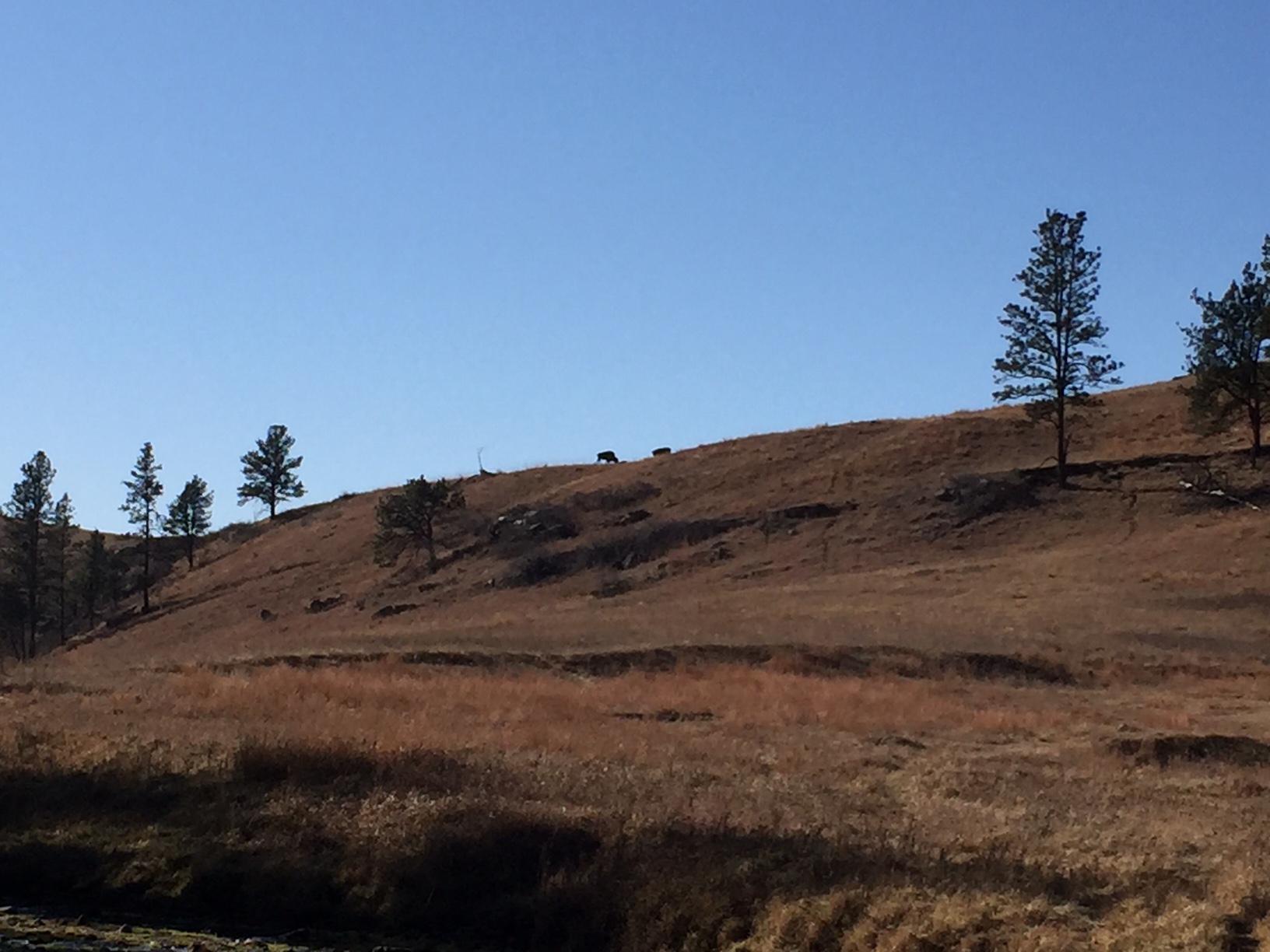
A brown-grassy hill dotted with pine trees, with two dark specks resembling buffalo at the top, all under a clear, blue sky.
Buffalo on the ridge, near the end of the hike

On this day’s hike the buffalo we saw didn’t even bother to get up and stop chewing their cud as they watched us wander by.  We have had buffalo turn to follow our every step until we’re out of sight when calves were present (and we were intentionally skirting them at the time).  We’re also often scolded by prairie dogs for “invading” their area when altering our course away from the buffalo. 

This brings up another safety point, give the prairie dogs space too.  According to the Forest Service, their fleas carry plague (yes, as in the Black Plague) which can be passed to you if you get too close and are bitten by said flea.  Also, the animals may bite if they feel threatened, though they aren’t usually aggressive.  In addition, rattlesnakes and black widow spiders favor abandoned prairie dog holes (not to mention these holes offer a prime opportunity to twist an ankle if you aren’t careful) so it’s best to treat these “prairie dog towns” with respect, as well. 

Be sure to keep a sharp eye out for coyote, elk, and deer in this area as this is prime viewing territory for that type of wildlife.  Be careful to also watch trail signs at junctions in these locales as there are several intersections and it is easy to get on the wrong trail.  

To Conclude

 This entire loop can be completed in about three hours (dependent on your skill level, speed, and how many sightseeing breaks you choose to take).  The trail is relatively easy with only short, moderate-difficulty climbs and is around five miles in distance for the entire loop.  This area is also lower in altitude than many areas in the Hills and may be easier for the “Lowlanders” to handle. 😉  In the summer, be prepared for unrelenting heat and little shade on the prairie section (though the ever-present prairie wind will offer some respite).

So, when visiting Wind Cave, don’t let the amazing sights below ground deter you from enjoying the numerous opportunities available above ground as well!

Have you hiked in Wind Cave? Tell me about your experience in the comments! 


Did you enjoy this post?  Pin it!
A winter scene. A small, icy creak meanders through a brown-grass meadow with bare trees on its banks and green pine trees in the background. Pin reads, "Lookout Point Trail at Wind Cave National Park"


Like what you read here today?  Please feel free to leave a comment, like or share this post!  Add your email at the bottom of the page, or the sidebar to the right, to be notified when a new post is published.  By signing up for the email list, you will also receive a free copy of the Tranquil Trekker’s Top 10 Tips of Trekking Do’s and Don’ts!

You can also follow the blog on social media by clicking the links below!
Facebook

Twitter

Instagram

Pinterest

Save

Save

Great Hikes in the Black Elk Wilderness

In this post, I review some hiking trails found in the Black Elk Wilderness, in the Black Hills of South Dakota.


The Black Elk Wilderness covers a portion of the central Black Hills, in the Mount Rushmore/Horsethief Lake portion of the Harney range (now the Black Elk range) of South Dakota.  There are some great hiking trails that traverse this area!

Hike the Horsethief Lake Trail to Grizzly Bear Creek Trail in the Black Hills

One great option is to begin at the Horsethief Lake Trail.  The trailhead can be found at the Horsethief Lake Fishing/Rec area which is located off of Hwy 244, west of Mt. Rushmore.

Note: this is one turnoff east of the drive for the Horsethief Lake Campground. 

There is a larger parking area right at the lake. The trailhead is located at a small parking area just to the east of here–there is a sign. 

We took the Horsethief Lake Trail (Trail #14) to the Grizzly Bear Creek Trail (Trail #7) which traverses a lovely canyon area and parallels Grizzly Bear Creek for a time. 

This portion of the Black Hills is particularly vulnerable to storm damage as it was decimated by the Pine Beetle plague in recent years.  Due to this, there are several hazards to watch out for in this area, including blow-down sections of trees and falling limbs/trees if windy conditions are occurring. 

What you’ll see hiking through the Black Elk Wilderness

The hike was lovely.  Much of it traverses canyons, surrounded on all sides by towers of granite.  There are several beautiful, lookout points with views of the surrounding Hills and the prairie stretching far to the east.  The trail is in a largely wooded area so it would be fairly shaded in the warmer months, and as you climb there is usually at least a moderate, cooling breeze (that can be downright chilling in the cooler months). 

Portions of this trail are open to horses as well so be watchful for the equines (and be careful not to step in what they leave behind). 

The portion of the trail we completed was of moderate difficulty, was well-developed, and was fairly wide.  There weren’t many rocks/large steps to negotiate and while there were few trail markers, they weren’t needed as the path was evident. 

It should be noted that the lower part of the Horsethief Trail is frequently wet and muddy so waterproof shoes/boots are suggested.   In the winter/early spring, thanks to snow-melt and the nearby creek it is often extremely icy and slick.  This portion of the trail is located in a canyon under a canopy of trees so it doesn’t get much sunlight to melt the ice.   We have seen several inches of thick, hazardous ice on this trail in the early spring that required our Yaktrax to navigate safely.

Other trail loops in the Black Elk Wilderness

If you’re up to the challenge, a loop can be made of this trail using the Horsethief Lake Trail to the Grizzly Bear Creek Trail to the Centennial Trail (Trail # 89). This will then eventually take you back to the Horsethief Lake trail almost at the Trailhead (the loop can be completed in either direction).  This entire loop would be around 10 – 12 miles.  While this is within our ability level, we weren’t sure about the steepness/difficulty of the remainder of the trail, and daylight was growing short so we chose to stop at about the halfway point, have some lunch along the creekside, and return the way we had come. 

Numerous trails connect throughout the Harney (Black Elk) range. Depending on your skill level and how long you are willing to commit to being out in the wild you can hike any combination of these, ranging from a simple hike of a few hours to a backpacking trek of several days.

For those non-locals who may be wondering why I keep referring to this area as the Harney (Black Elk) range, I’ll explain.  Harney Peak is the highest mountain in the Black Hills (and the tallest east of the Rockies).  It stands out among the surrounding peaks of the Harney Range.  The Black Elk Wilderness area comprises much of this range. 

Black Elk was a Lakota, Holy Man who lived around the turn of the century, the Wilderness area is named after him.*  A few years ago, it was decided that Harney Peak would be renamed Black Elk Peak in honor of this great man and as a tribute to the local, Lakota culture.  As it has been such a short duration of time since the change, many of the books/maps regarding this local area (and the signs currently posted) will still carry the former name of the mountain/range.

*If you’re a history buff or just interested in American Indian culture, I highly recommend the book Black Elk Speaks by John Neihardt.  It’s a biography of the Holy Man’s life based on interviews Neihardt completed with him in his final years. It is a very interesting, fairly objective account of a man growing up in a changing world.  It discusses Black Elk’s nomadic life before General Custer and his soldiers arrived and the way this life changed after gold–or as Black Elk called it, “the yellow metal that makes white men crazy”–was found in the Black Hills.

Below are two pics that Mr. Trekker took of our hike:

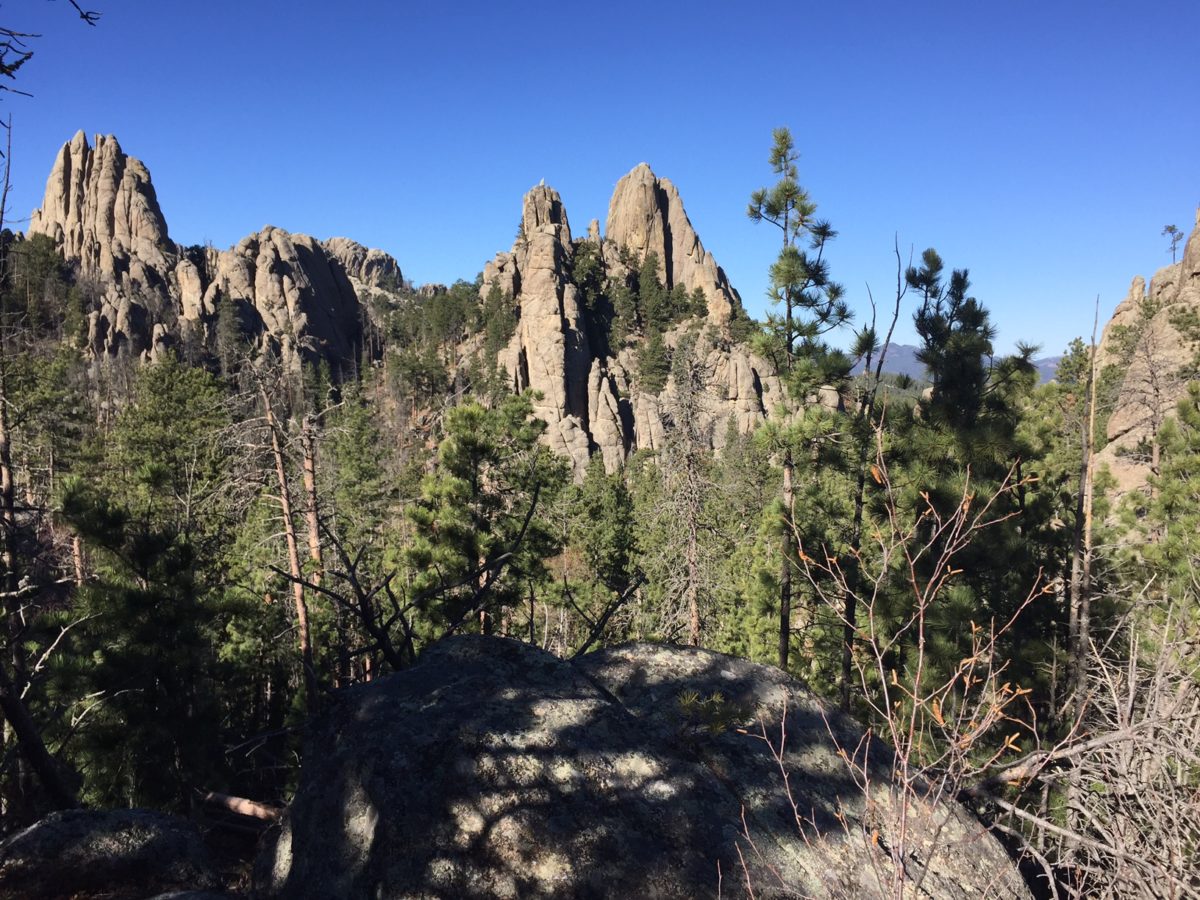
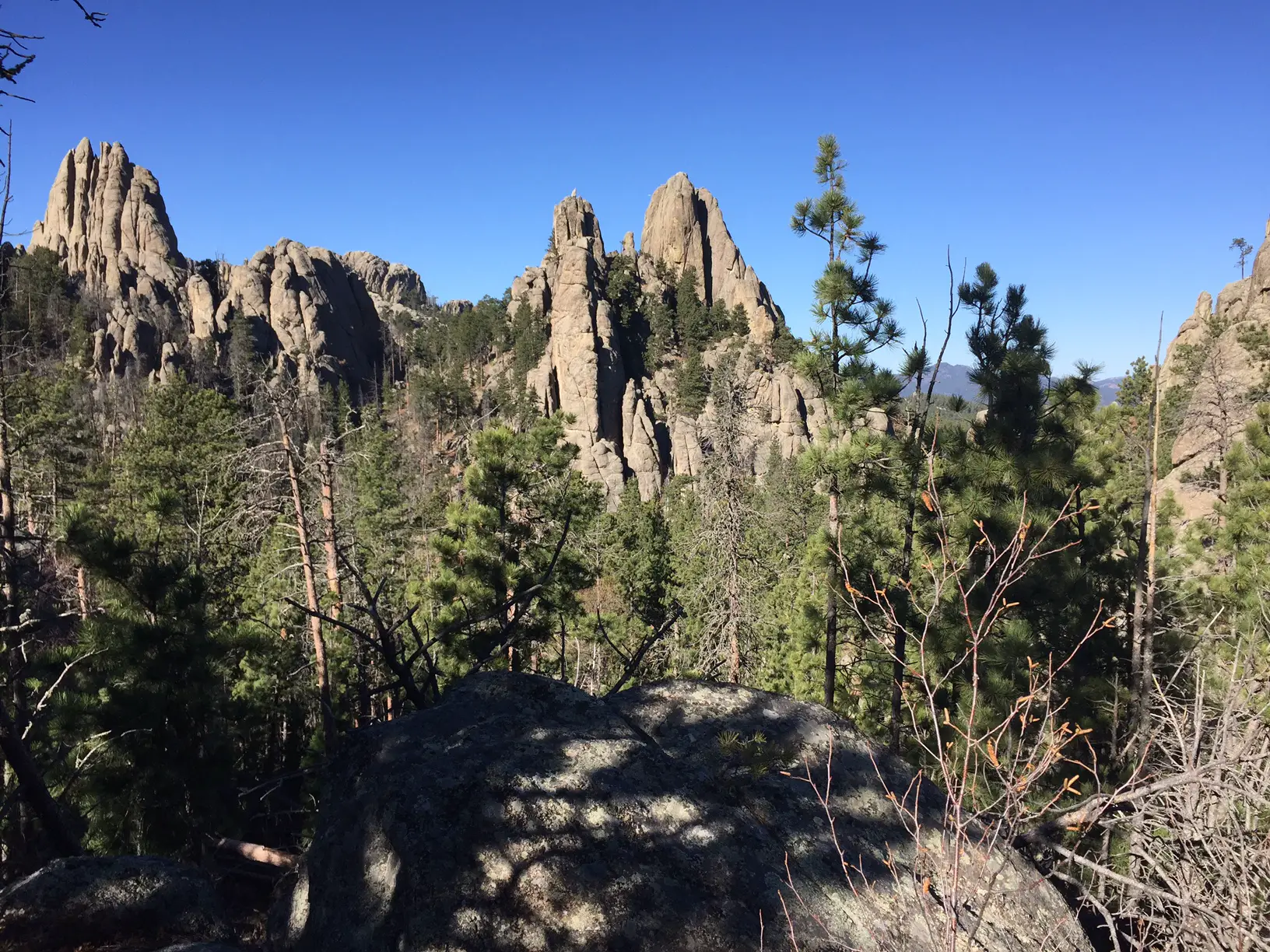
Rock spires rise above the green, pine forest, all under a clear, blue sky
The granite spires surrounding the canyon we were hiking in
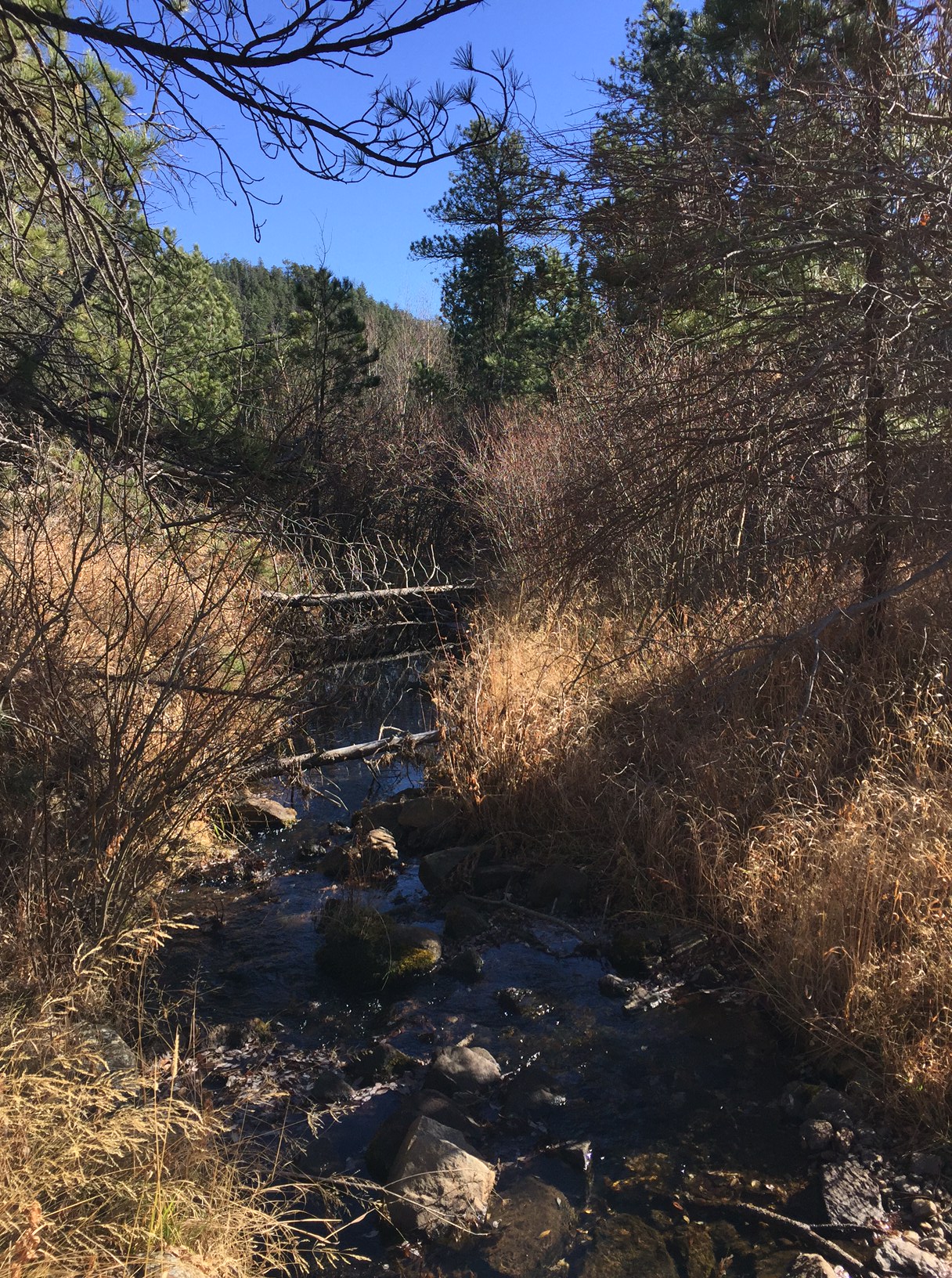
A fall scene. A small creek running through dry grass and bare trees, with green pine trees in the background, all under a clear, blue sky.
Grizzly Creek

Save/span</

For more information on other trails available in the Black Elk Wilderness, click here.

Have you hiked this portion of the Black Elk Wilderness? Tell me what you thought of the beauty here in the comments! 


Did you enjoy this post?  Pin it!

A fall scene. A small creek running through dry grass and bare trees, with green pine trees in the background, all under a clear, blue sky. 

Pin reads, "Great Hikes in the Black Elk Wilderness. Several hikes not to miss on your next trip to the Black Hills of South Dakota."


Like what you read here today? Please feel free to leave a comment, like or share this post! Add your email at the bottom of the page, or the sidebar to the right, to be notified when a new post is published. By signing up for the email list, you will also receive a free copy of the Tranquil Trekker’s Top 10 Tips of Trekking Do’s and Don’ts!

You can also follow the blog on social media by clicking the links below!
Facebook

Twitter

Instagram

Pinterest

Swiftcurrent Trail at Glacier National Park and 5 Other “Don’t Miss” Sites!

In this post, I review the early portion of the Swiftcurrent Trail (before the Pass) at Glacier National Park.


Author’s Note: Since we visited Glacier in 2016, the Park Service has implemented a complex, ticket system for visiting the park in the summer. To be honest, I can’t make much sense of it as it involves multiple tickets being required to enjoy various activities around the park. For more information on this system, visit the park website and/or contact the park office. 

Also, just a word of warning, as this is a National Park, no dogs are allowed on any trails within the park (exceptions for Service Animals). They are only permitted in the campgrounds and parking lots.**

Our trip to Glacier National Park was an incredible experience and we barely scratched the surface of the adventures available.  We’re already making a list of the new things we want to try on our next visit (that’s the problem when we go on vacation, we don’t cross places off our list, we just find more stuff we want to do!)  I’d encourage everyone to make it a priority to visit the park if you’ve never been there.  Its beauty is awe-inspiring, and no one knows how greatly it may be changed in the next few decades.

The last few days of our trip we hiked the early portion of the Swiftcurrent Trail (before the Pass) and then headed home via the Beartooth and Chief Joseph Highways.  It’s always fun to include a little adventure on your way home.  It helps to make the return trip something to look forward to, as well!

Swiftcurrent Trail at Glacier National Park

The Swiftcurrent Trailhead is found off the parking lot for the Swiftcurrent Lodge near Many Glacier, on the east side of the park, north of St. Mary’s.

It’s an interesting trail and it varies in difficulty depending on how you choose to navigate it.  It traverses as far as the Granite Park Chalet, which is a seven-mile hike to the top of Swiftcurrent Pass.  There it meets up with the Highline Trail coming from Logan Pass to the south, and The Loop trail coming from Going to the Sun Road to the east.

Related posts:  Going to the Sun Road at Glacier National Park; 5 Things you Don’t Want to Miss at Glacier National Park; Gunsight Pass Trail, Glacier National ParkGlacier National Park: Hiking the Apgar Lookout Trail

This is a beautiful trail that starts as a relatively flat, easy path. It then progresses into a strenuous hike on a narrow trail with sweeping dropoffs, if you choose to go that far.  I wasn’t feeling well that day so we chose not to attempt the entire route this time, choosing only to go as far as Red Rock Falls.

The section of the trail we hiked was well-maintained, smooth, and not too overgrown; it’s also shaded in many parts, depending on the time of day.  This was actually my favorite trail of all the ones we did throughout the week, even though it was the least challenging.  Similar to other trails at this park, always be watchful for bears (can you guess if we saw any?)

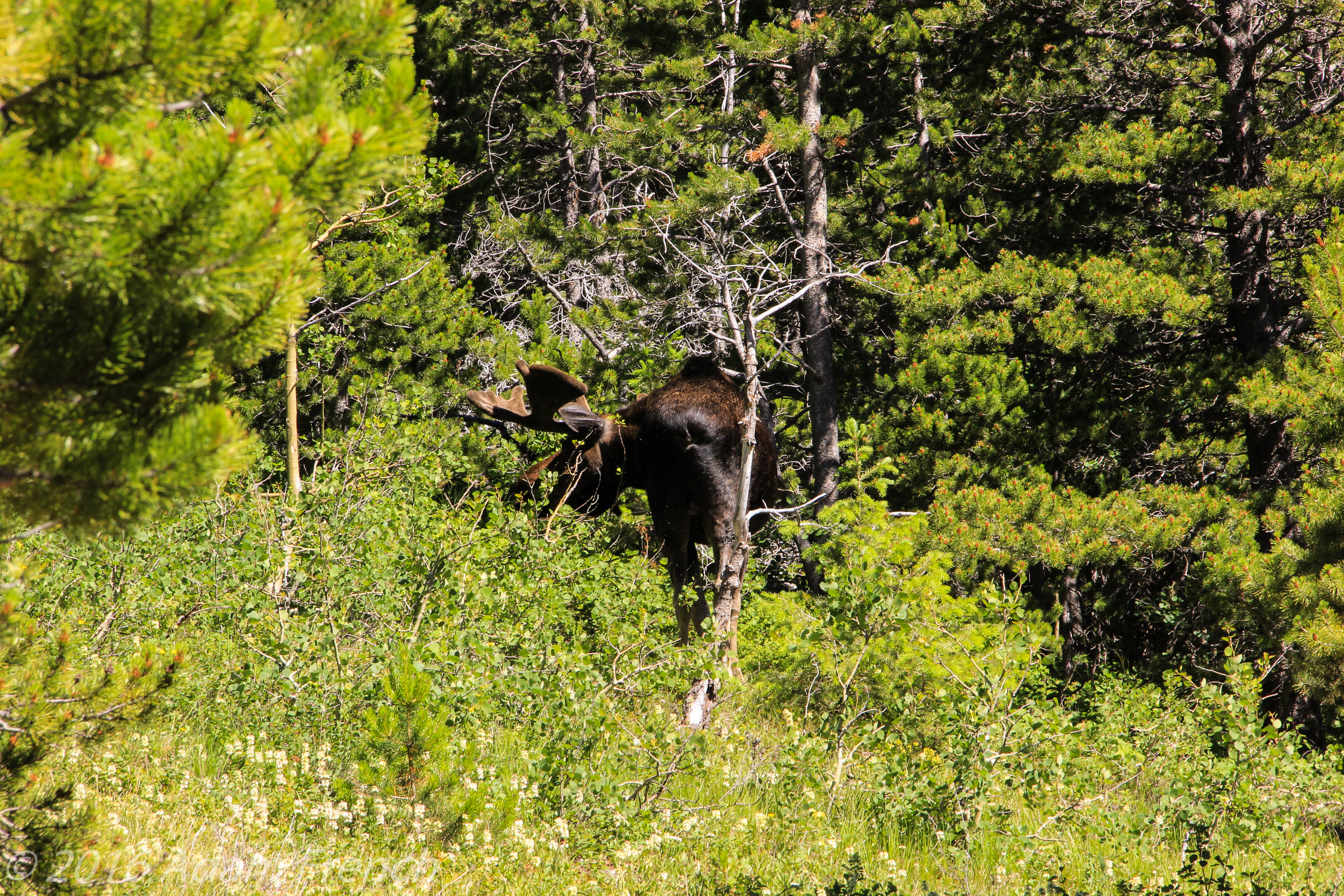
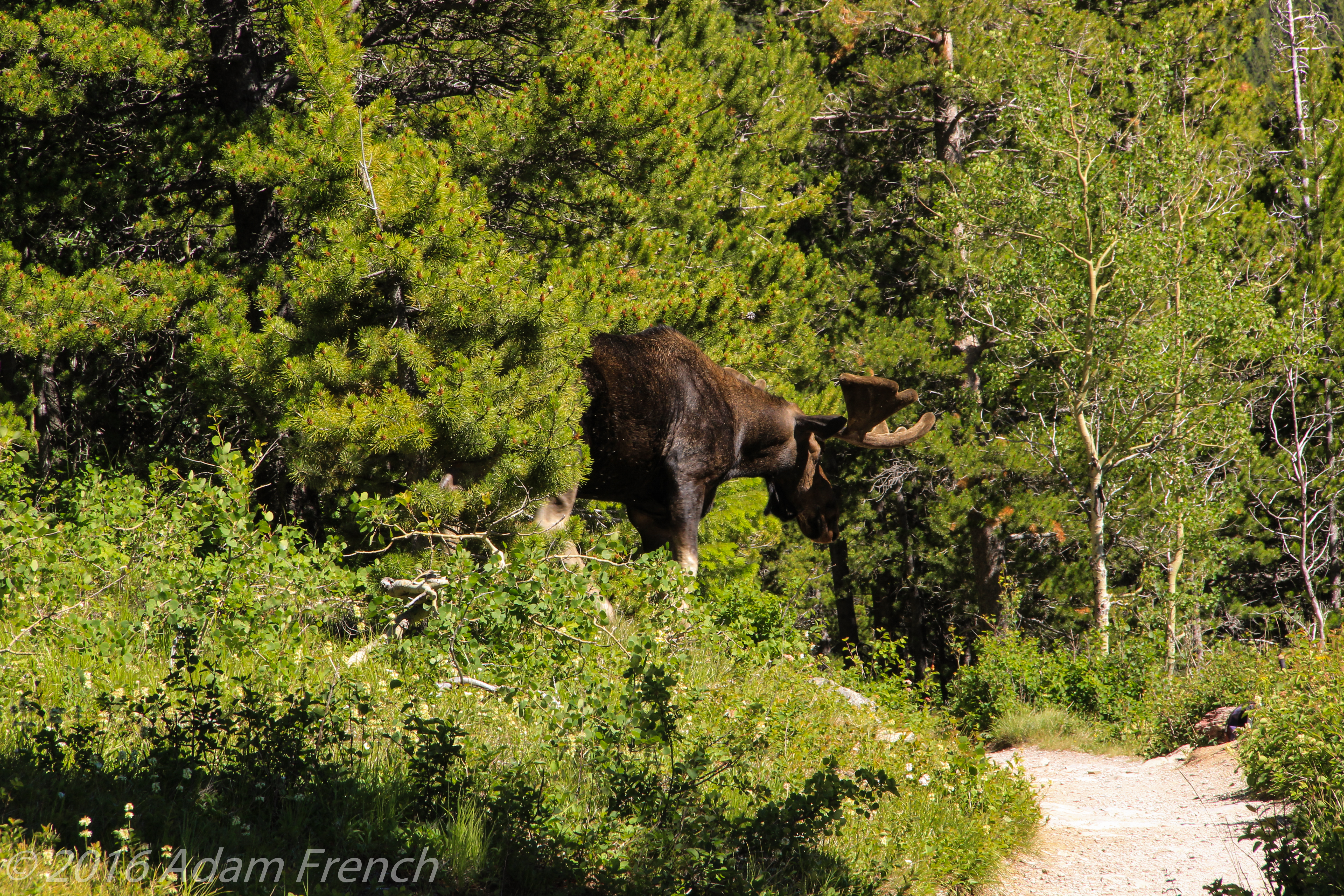
We did have a close encounter with a bull moose!  They are frequent visitors to this area as there are several lakes and numerous streams and they like the willows growing nearby.  We were made aware of the moose further up the trail by other hikers so we had fair warning–a fellow hiker almost had a head-on collision with the ungulate though as neither he nor the moose was paying close attention!

As we came over a rise we saw a small cluster of people and then spotted the full-grown bull moose just a few steps off the trail.  He appeared completely oblivious to the commotion he was causing as he calmly munched on nearby scrub.  When he grew tired of the attention he sauntered down the trail and off into the woods.

Fortunately, he was mild-mannered as several hikers inadvertently had closer encounters than would be recommended.   Moose are not predators but they are very large and can be very dangerous if they feel threatened (especially during the fall rut or if they’re protecting young).  As with any wild animals always admire them from afar and remember the general rule of thumb, if the animal is reacting to you, you’re too close.

A bull moose amongst trees
Our friend, the moose
A bull moose stands right next to a hiking trail in the woods
He was CLOSE to the trail

Don’t Miss Red Rock Lake and Red Rock Falls!

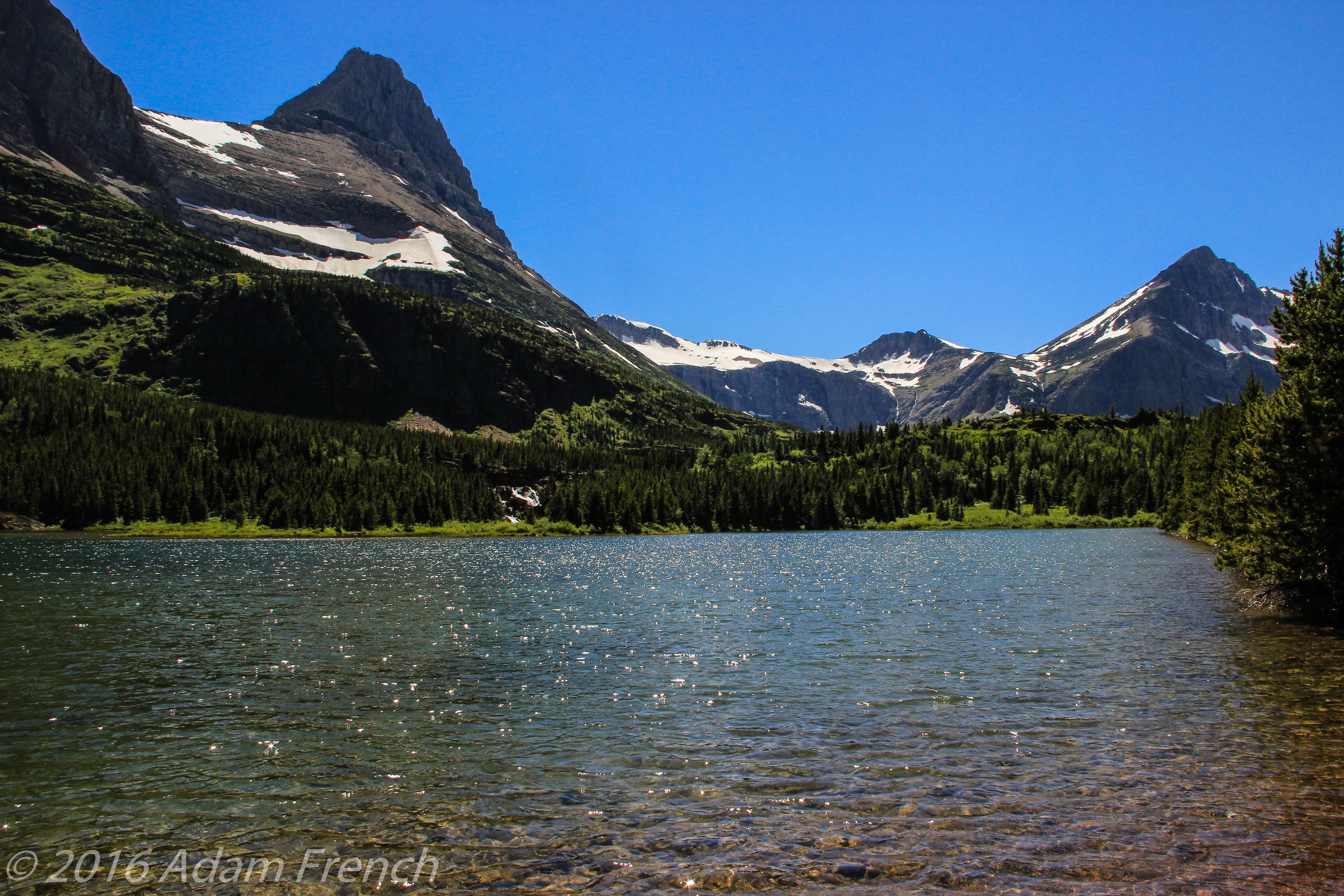
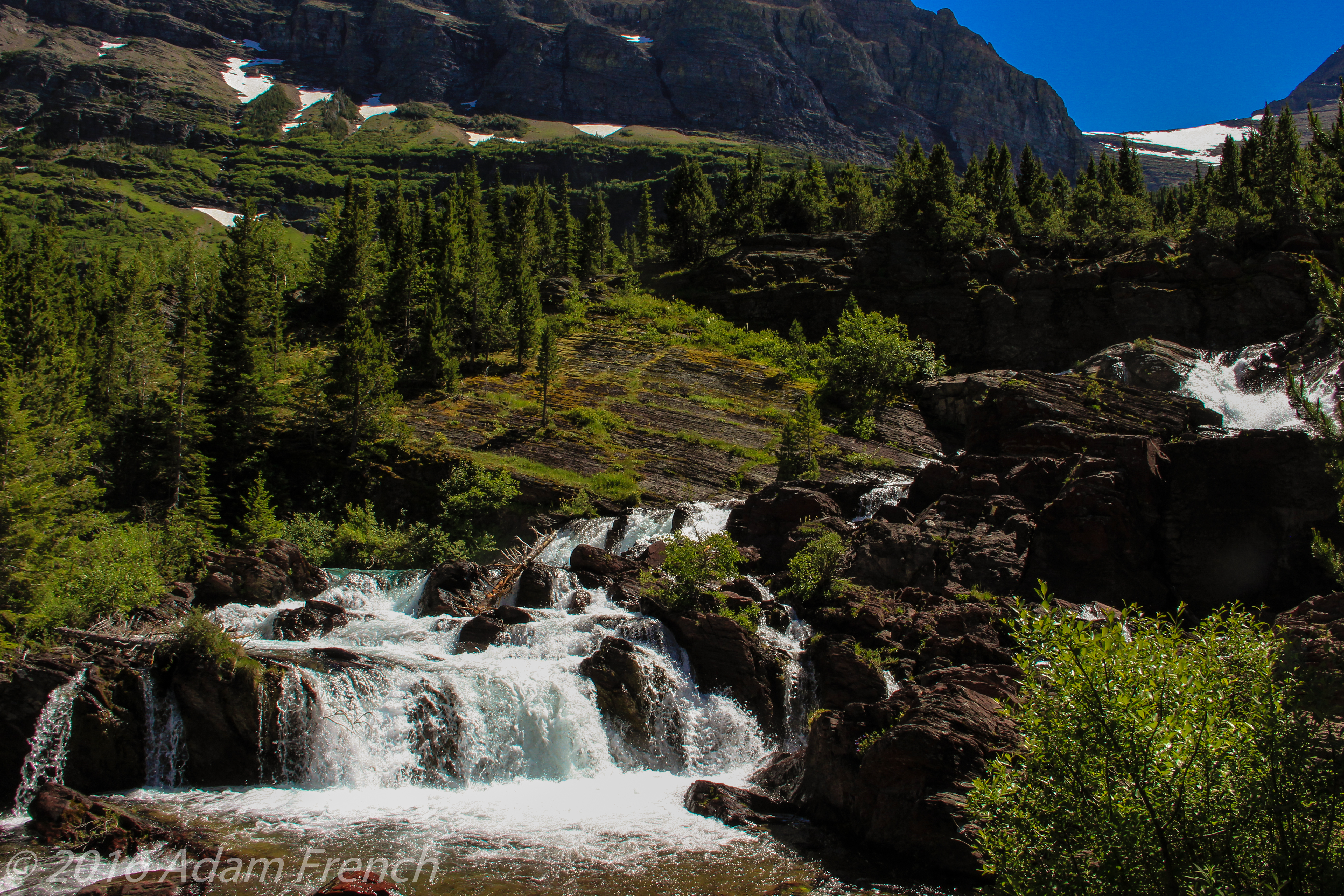
Both Red Rock Lake and Red Rock Falls are stunning.  After about 1 1/2 miles down the trail you reach your first view of the lake.  It expands outward toward the west with Mt. Grinnell and its surrounding range as a backdrop.  Then you skirt the lake for about another half a mile and will reach an unmarked side trail breaking off to the left towards the lake/waterfall.  You can’t really see the waterfall at this point but you will hear it.  Follow the unmarked trail a short distance and you’ll arrive at the base of the falls!

Lakewater ripples surrounded by rocky, towering mountains spotted with snow, all under a clear, blue sky
Red Rock Lake
A short waterfall surrounded by pine tree-covered mountainsides
Red Rock Falls

If you’re looking for some more challenging hikes in the St. Mary’s area, check out these:  Siyeh Pass Trail; Iceberg Lake Trail

Montana’s Scenic Roads

On our return trip from Glacier, we spent several days driving across the Montana plains on two-lane, state roads.  I’ve talked before about my love of back roads, and I strongly encourage people to get off the interstate and check out these state highways.

It can sometimes be a shortcut and it’s almost always a welcome change from the drudgery of the highway.  Search for alternate routes to mix the journey up a bit so you aren’t crossing the same areas on the return trip as you traversed on your outbound route.  Enjoy the drive that gets you to that vacation spot as part of your vacation.

This eases boredom but it also helps you to better appreciate the local culture and people in the areas you visit.  You may be surprised at what you might learn–just pay attention to your fuel gauge and the availability of gas when venturing onto backroads.  Also, be aware, that cell signal may be weak-to-nonexistent in many of these areas so be prepared to go old-school when searching for travel info.  You may need to resurrect long-forgotten methods of acquiring information: travel books, hard copies of maps, and even phone books can be good resources in these areas. 

We saw several missile sites leftover from the Cold War and learned about a sapphire mine from a Local (apparently these types of sapphires are only found in this area).  I also had no idea Central and Eastern Montana had so many mountains!  This was a pleasant surprise as I thought it was all rolling prairie.

Beartooth Pass and the Chief Joseph Highway

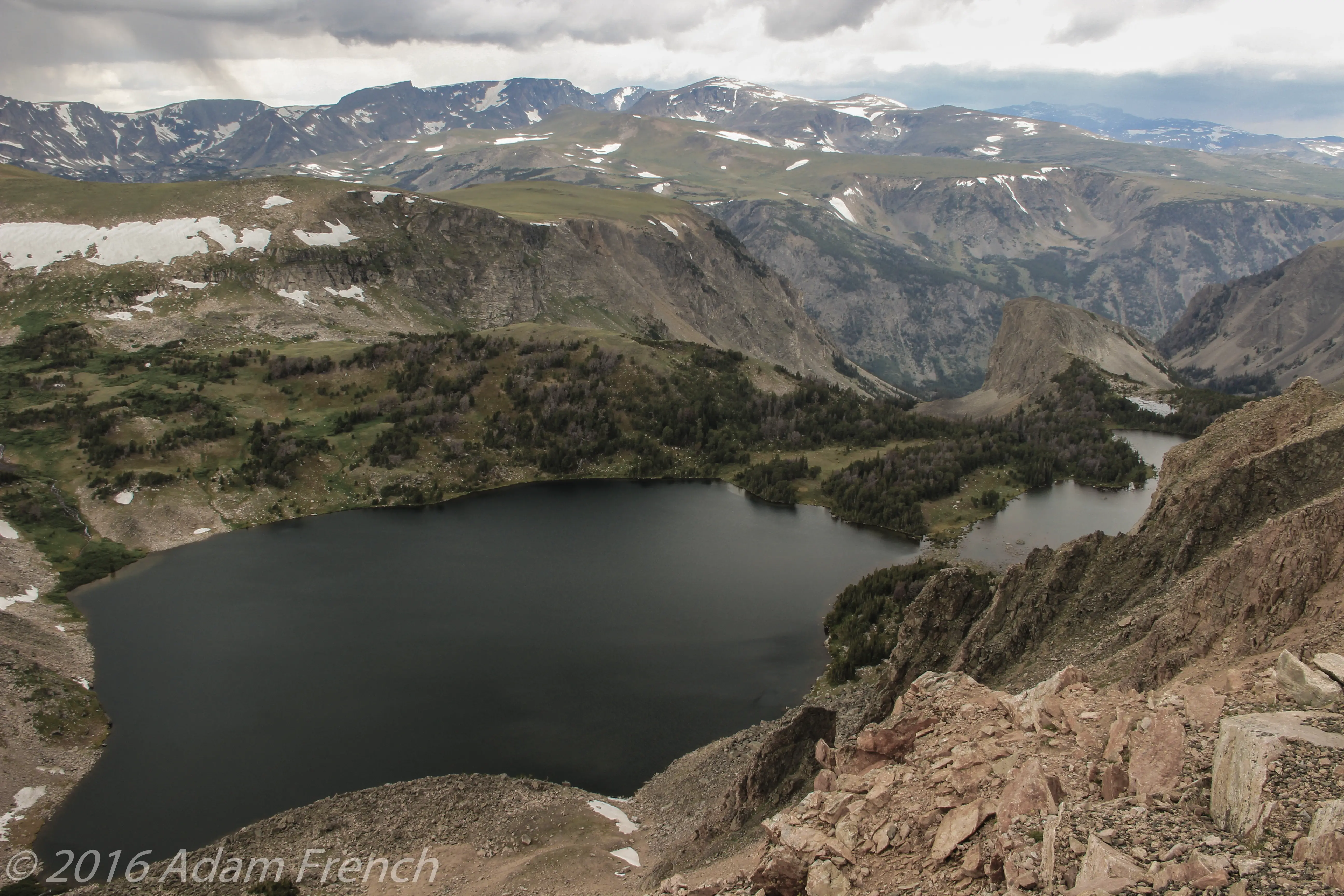
On our scenic trip home we knocked other points off our Vacation Bucket List by enjoying Beartooth Pass and the Chief Joseph Highway; two connecting Scenic Byways in southern Montana and northern Wyoming.  Be warned, much of this area is tundra with few trees.  This means there is little shelter to be found, so if a thunderstorm blows up (which one did while we were there–complete with small hail!) exercise extreme caution as lightning strikes are an especially dangerous risk in these highly exposed areas.  This is also a very, high-altitude region. The Beartooth Highway usually does not open until Memorial Day Weekend (at the earliest).

Click here for a post I wrote on our attempt to navigate the route that time of year.  

Red Lodge, Montana

I also highly recommend a visit to the town of Red Lodge, Montana.  It was absolutely adorable with its friendly, small-town charm.  It caters to summer and winter outdoor sports and is located off of US 212, about an hour south of Billings, at the base of the Rockies.  The area is perfectly situated to be used as a “base camp” for whatever adventures you are seeking.

A dark, mountain lake surrounded by rocky and snow-speckled mountains
Beartooth Pass

View down a mountain valley with towering, rocky mountains on both sides

Save

Have you hiked Swiftcurrent Trail, or driven the Beartooth or Chief Joseph Highways?  Tell me about it in the comments!


Did you enjoy this post?  Pin it!

A large, rocky mountain towers into the sky. Pin reads, "Swiftcurrent Trail at Glacier National Park"


Like what you read here today?  Please feel free to leave a comment, like or share this post!  Add your email at the bottom of the page, or the sidebar to the right, to be notified when a new post is published.  By signing up for the email list, you will also receive a free copy of the Tranquil Trekker’s Top 10 Tips of Trekking Do’s and Don’ts!

You can also follow the blog on social media by clicking the links below!
Facebook

Twitter

Instagram

Pinterest

Gunsight Pass Trail, Glacier National Park

In this post, I review a portion of the Gunsight Pass Trail (starting from the Jackson Glacier Overlook) at Glacier National Park.


Author’s Note: Since we visited Glacier in 2016, the Park Service has implemented a complex, ticket system for visiting the park in the summer. To be honest, I can’t make much sense of it as it involves multiple tickets being required to enjoy various activities around the park. For more information on this system, visit the park website and/or contact the park office. 

Also, just a word of warning, as this is a National Park, no dogs are allowed on any trails within the park (exceptions for Service Animals). They are only permitted in the campgrounds and parking lots.**

The Gunsight Pass Trail at Glacier National Park is a great hike that offers scenic views.

Similar to the Swiftcurrent Trail, this is a fairly long route that connects with several others throughout the park. It runs for almost 20 miles, from the Lake McDonald Lodge, past the Sperry Chalet, Gunsight Lake, and Lake Ellen Wilson, to the Jackson Glacier Overlook.  The trail offers prime views of several waterfalls along its length. (Both trailheads can be reached from the Going to the Sun Road.)  Because of its length, most thru-hikers do it in two days with an overnight stop at one of several backcountry campgrounds or the Sperry Chalet.

The Trekkers aren’t much for overnight camping in the backcountry, so we chose to only attempt the portion that runs from the Jackson Glacier Overlook, on the Going to the Sun Road, to Florence Falls.  Both of us entered this hike with a bit of trepidation as it was our first real foray into Grizzly Country.  Our goal was to make it to the Florence Falls trail junction (four miles in, making it a total hike of eight miles, round trip).

We had hopes of reaching the falls but wanted to wait to see how we were feeling when we got there.  We knew going in that the final mile of the return trip would be a strenuous uphill climb, so we planned to reserve some energy for that (and it was good we did).

Related posts: 5 Things you Don’t Want to Miss at Glacier National ParkGlacier National Park: Hiking the Apgar Lookout Trail

Hiking on the Gunsight Pass Trail

This is a beautiful trail!  As it runs largely through the forest, in a lower-lying area, along the St. Mary River, it was a cooler option on that 85-degree day.  It is fairly evenly-graded with some beautiful views and was the least crowded trail we experienced in late June (we saw several groups of hikers though none of the “lines” we encountered on a few other trails).  The section we chose was the least strenuous portion of the route–it runs along the valley floor as opposed to climbing the peaks as it does in other segments. 

Despite being in the forest, portions of this trail do allow for breaks in the foliage that overlook a marshy area (look for moose!) with incredible views of the soaring mountain peaks and Jackson Glacier as a backdrop.  Upon completing the initial steep descent the trail levels off at the picturesque Deadwood Falls. 

On your return trip, this is a good place for a break before attempting the final climb to the top.  There’s plenty of space to sit on the rocks in the sun or shade (depending on your preference and the time of day) and let the mist from the falling water cool you.  The creek below the falls is also an opportunity to dip your feet in the chilly water; just use caution, the current is strong and the rocks may be slippery. 

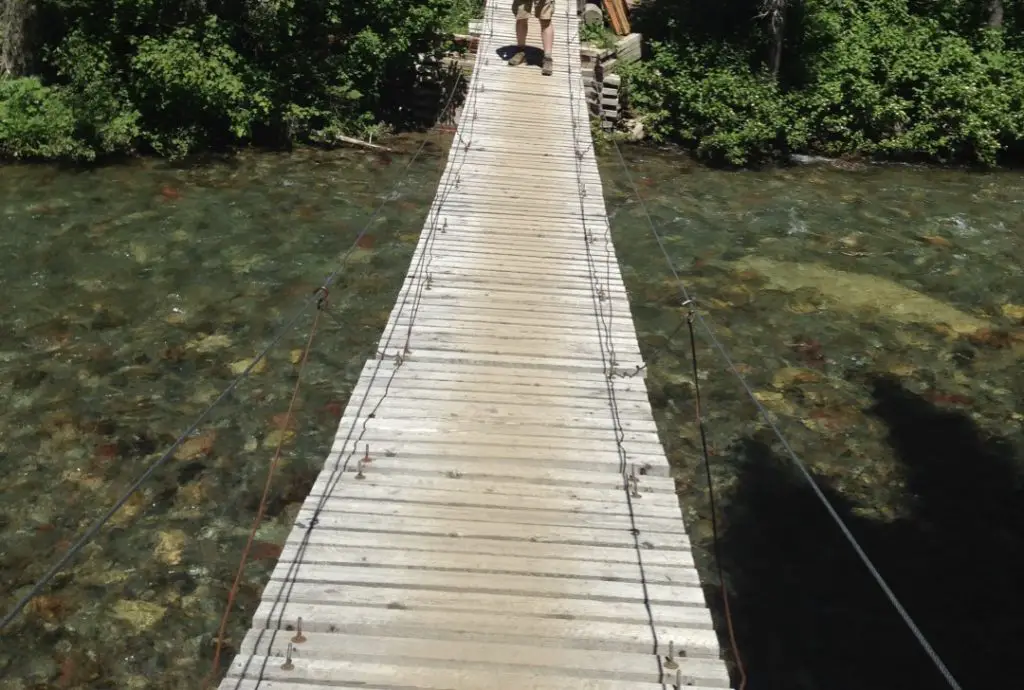
The coursing creek continues to accompany you along the trail.  Shortly after passing the falls and the first back-country campsites, you’ll encounter an interesting suspension bridge that crosses the creek.

A wooden bridge with wires on the sides hangs over a river
The suspension bridge over the creek
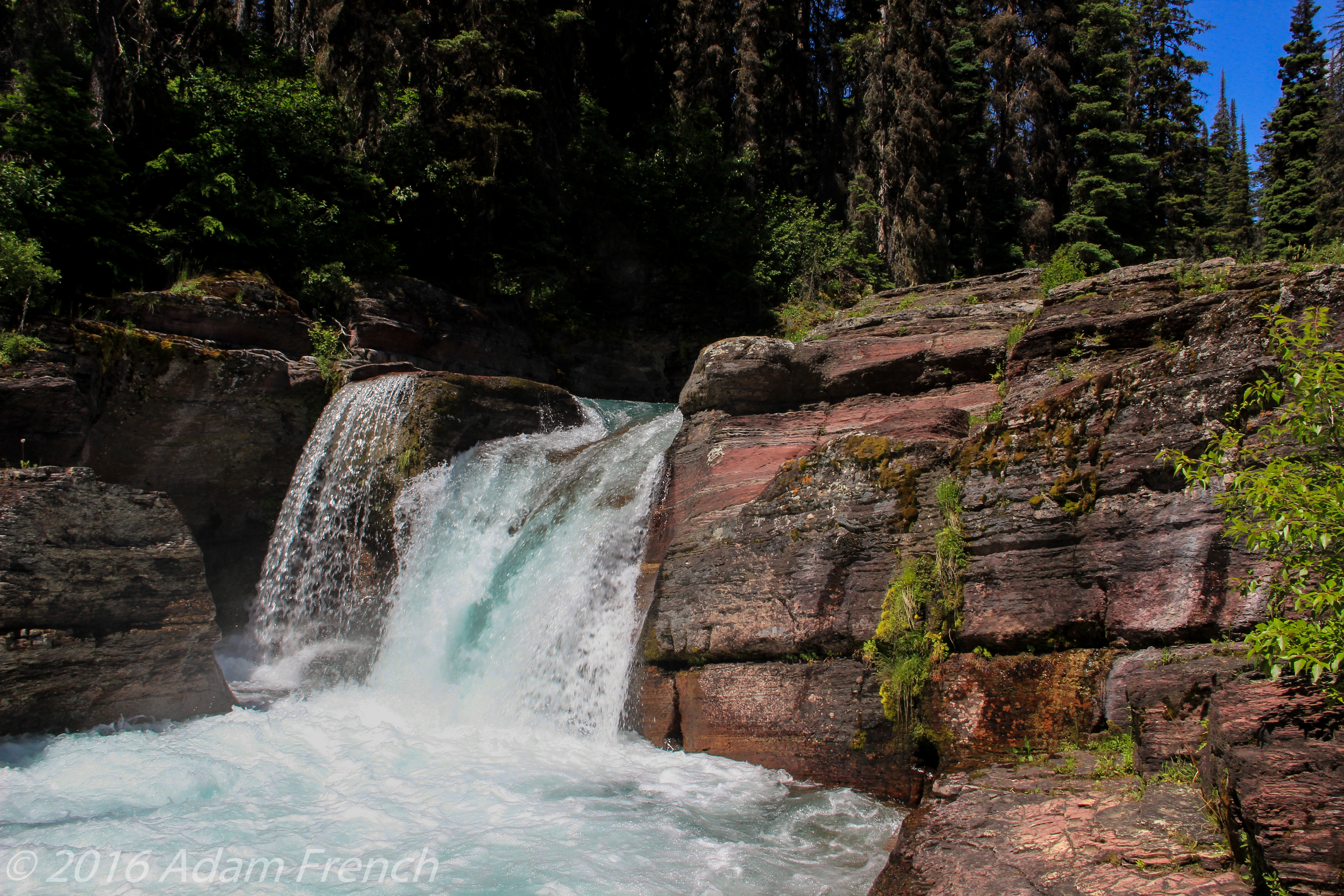
A short, turquoise waterfall flows over red rocks
The beautiful Deadwood Falls

Grizzly Bears at Glacier National Park

The only unpleasant factor on this trail was the huckleberry bushes; they were many and accompanied us for a large portion of the four-mile journey.  That time of year they were calf to knee height, though later in the summer they can reach chest to head height.

This causes an especially sensitive situation as the berries are a favorite for grizzly bears in late summer.  There are several places where the trail encounters blind corners and hills so be sure to follow standard safety guidelines when hiking in bear country:  never hike alone, don’t hike around dusk or dawn, carry bear spray, and make plenty of noise (one of our favorite methods is singing and hand-clapping–this also helps to alleviate trail fatigue). 

Also, be aware, that the water rushing in the nearby creek may mask your sounds and could increase the likelihood of surprising one of the large Ursines.  We did not see a bear on our hike (have you noticed a trend in our hikes in Bear Country?) though we saw evidence of a very recent pass-through. 

Another hazard of the thick bushes was they almost completely obscured the trail in some cases making it somewhat hard to follow.  They also hid a less menacing annoyance, bees–as I, unfortunately, found out when one flew inside my hiking boot and stung me for my intrusion.

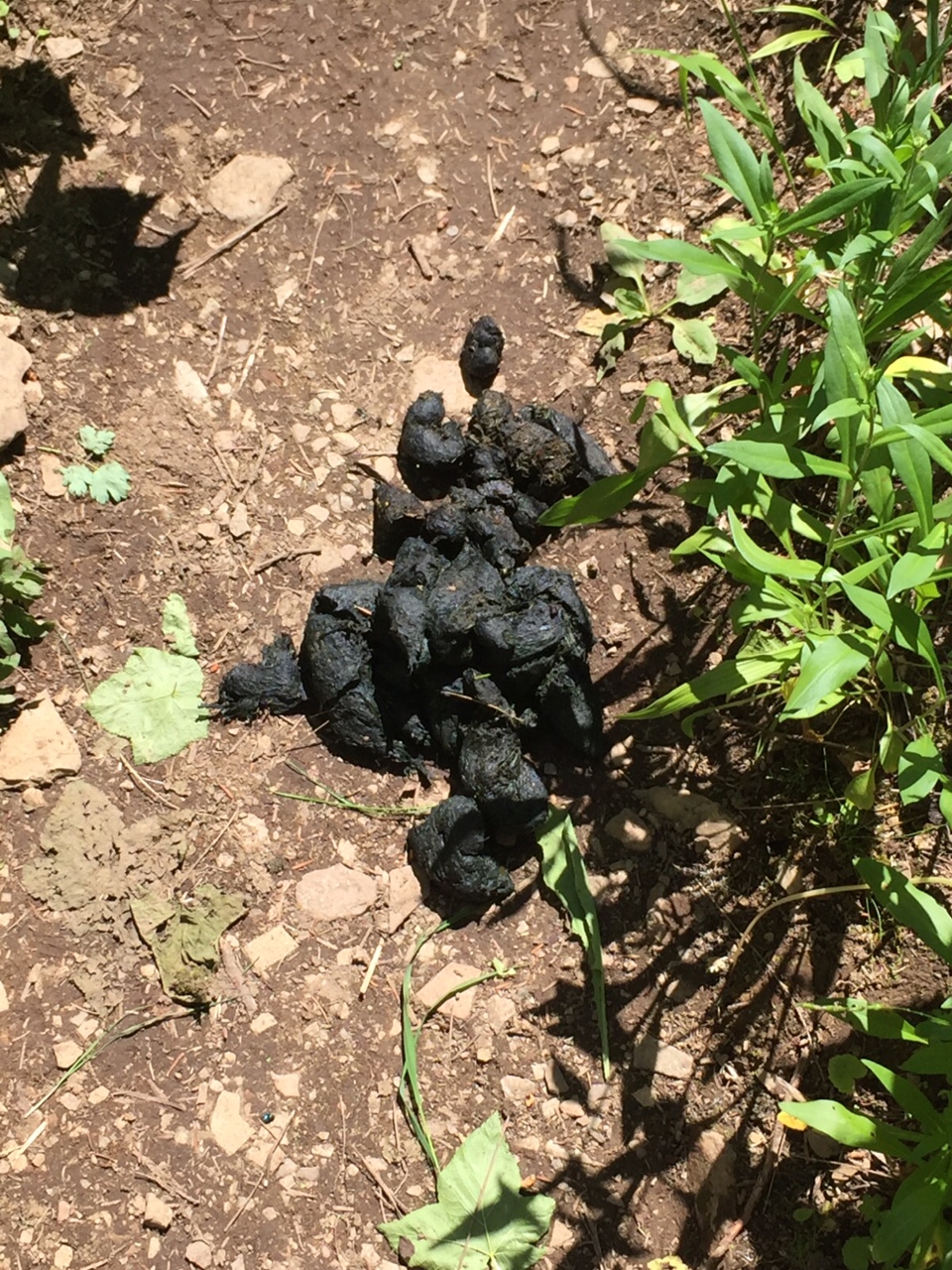
A large pile of animal poop on a dirt path
This is gross but it’s shown to make a point. This is the closest we got (and that I ever want to get) to a grizzly.  I kid you not, it looked like something that came from an animal the size of a horse!

Wolverines on the Gunsight Pass Trail

We encountered another first on this trail…a wolverine! (It looked nothing like Hugh Jackman! 😝)  They are commonly known in this part of the park.

We were traversing one of the clearer portions of the trail, I was in the lead.  As I looked down the trail a wolverine came trotting towards us around a bend about 25 feet down the trail.  We all stopped…he looked at us…we looked at him…he looked especially cranky as he panted in the heat…then he kept coming!

We’ve never encountered a wolverine in the wild before but I’ve heard stories of their nastiness (apparently they’ve been known to kill moose that have gotten mired in snowdrifts, as well as a polar bear on at least one occasion–seriously!)  At this point, I was scanning the huckleberry-covered hillside for an escape route as I did NOT want to have to deal with this critter that is 1/10th my size but can kill creatures many times larger than me!  Fortunately, at about that moment, he decided it was too hot for a confrontation and sprinted off into the bushes.

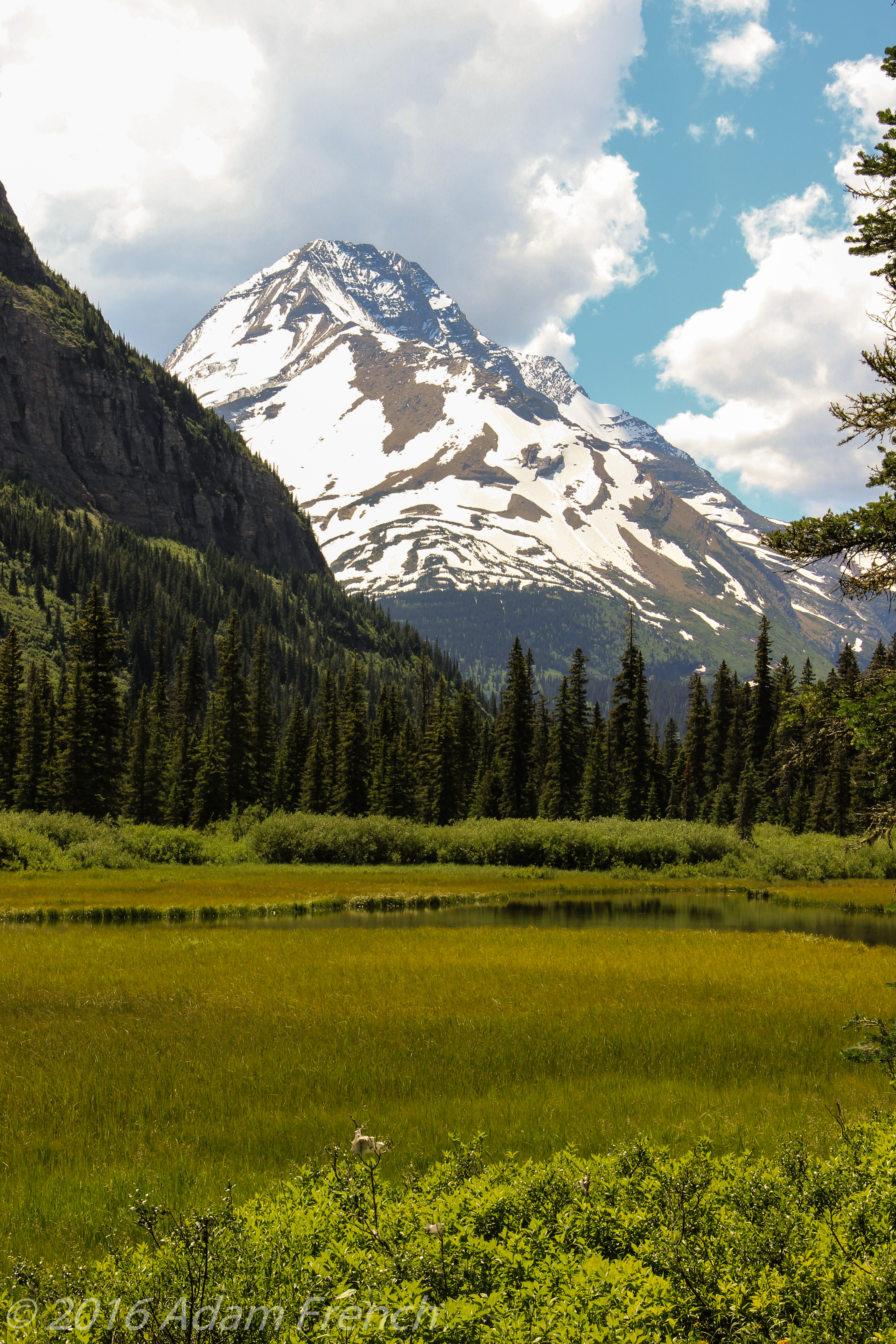
The view overlooks a green, marshy area with a large, snow-covered mountain in the distance.
This is the view from one of the lookout points on the trail.  Moose are frequently seen in this area (none were there the day we hiked).  Jackson Glacier is just out of sight on the other side of this mountain.
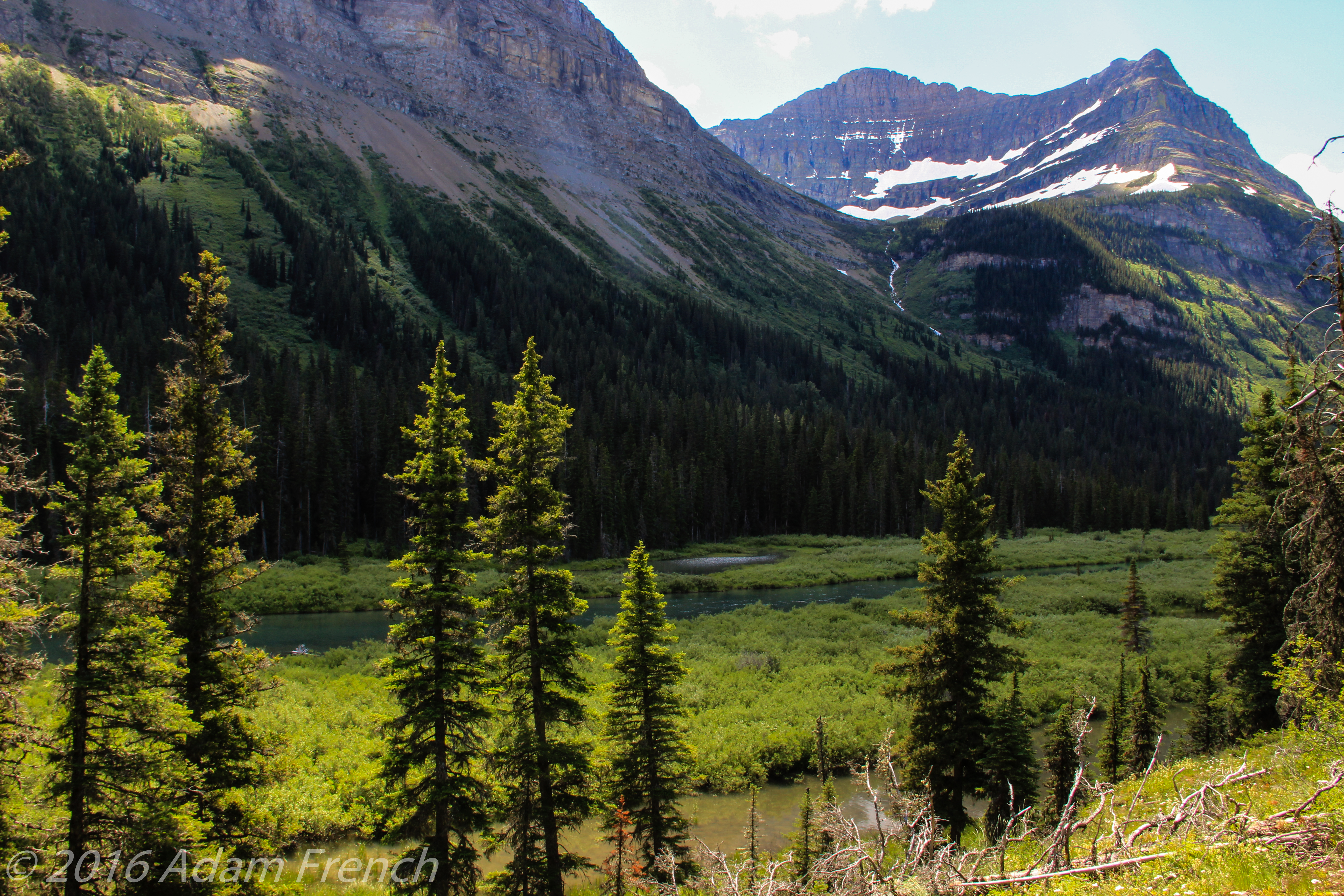
The view overlooks a green, marshy area with large, snow-covered mountains in the distance.
Another view from the trail lookout

We did reach our four-mile goal but did not make it to Florence Falls.  We had the energy to continue on but knew it would have added over a mile to our trek and we still had a hefty climb ahead of us on the return trip.  We were also running low on water so we again made the safe choice to turn back–this turned out to be wise as our water barely held out the remainder of the hike.  Having faced our fears and successfully trekked eight full miles in the middle of Grizzly Country, we counted this hike as a success!

Have you hiked the Gunsight Pass Trail?  What was your experience?  Tell me in the comments!


Did you enjoy this post?  Pin it!

The view overlooks a green, marshy area with a large, snow-covered mountain in the distance. Pin reads, "Gunsight Pass Trail, Glacier National Park"

Save


Like what you read here today?  Please feel free to leave a comment, like or share this post!  Add your email at the bottom of the page, or the sidebar to the right, to be notified when a new post is published.  By signing up for the email list, you will also receive a free copy of the Tranquil Trekker’s Top 10 Tips of Trekking Do’s and Don’ts!

You can also follow the blog on social media by clicking the links below!
Facebook

Twitter

Instagram

Pinterest

Glacier National Park: Hiking the Apgar Lookout Trail

In this post, I review the Apgar Lookout Trail at Glacier National Park, and discuss our failure to reach the summit.


Author’s Note: Since we visited Glacier in 2016, the Park Service has implemented a complex, ticket system for visiting the park in the summer. To be honest, I can’t make much sense of it as it involves multiple tickets being required to enjoy various activities around the park. For more information on this system, visit the park website and/or contact the park office. 

Also, Just a word of warning, as this is a National Park, no dogs are allowed on any trails within the park (exceptions for Service Animals). They are only permitted in the campgrounds and parking lots.**

Otherwise known as the “Soul-Crushing Switchbacks Trail” 😮–thank you Mr. Trekker, for that!–the Apgar Lookout Trail traverses Apgar Mountain to the fire tower near the peak, and offers views of Lake McDonald, in Glacier National Park.  

Where is the Apgar Lookout Trail?

The easiest way to reach the trailhead is from the West Glacier entrance on the west side of the park.  Shortly after passing through the West Glacier entrance gate a road branches off to the left with signs for the Glacier Institute, a horse corral, and the Apgar Lookout Trail.  At the next intersection, you’ll turn right towards the horse corral, then continue following the signs to the left which take you to an unpaved dirt road and the trailhead.

Hiking on the Apgar Lookout Trail

This trek was rough!  The trail is interesting because it isn’t that long (only about seven miles round trip); it’s also fairly wide (enough so that two people can walk side-by-side in some cases), and it’s smooth (there aren’t many roots/rocks to trip you up).  The first 3/4 of a mile is fairly flat but then the elevation gain begins.  You gain almost 2000 feet of elevation in about three miles over a series of three, LONG switchbacks. 

Related posts:  Going to the Sun Road at Glacier National Park; Swiftcurrent Trail at Glacier National Park and 5 Other “Don’t Miss” Sites!5 Things you Don’t Want to Miss at Glacier National ParkGunsight Pass Trail, Glacier National Park

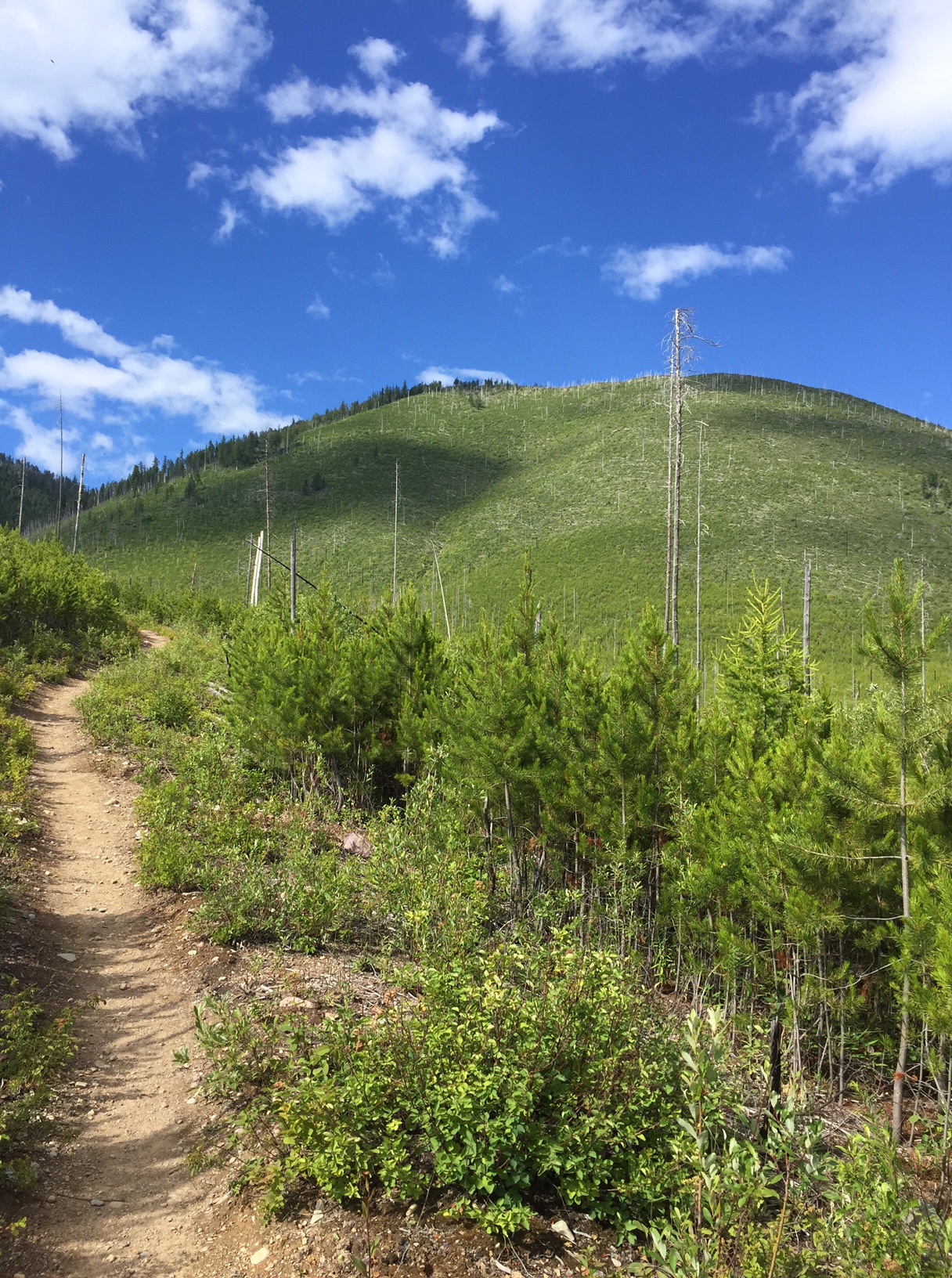
We didn’t fully appreciate just how steep it was on the way up, it was the difficulty in keeping our balance on the way down that clued us in.   Part of what makes it so difficult is that almost the entire trail runs through a burn scar left by a forest fire from several years ago; so it is completely exposed to the sun. 

We got a late start (about 2 pm as we made the attempt shortly after arriving at the park) and it was hot and fairly humid that day (about 85 degrees).  I should also note my body does not tolerate heat well.  There’s a reason why I rejoiced in our move to the cool Northern Plains after living in the steamy South!

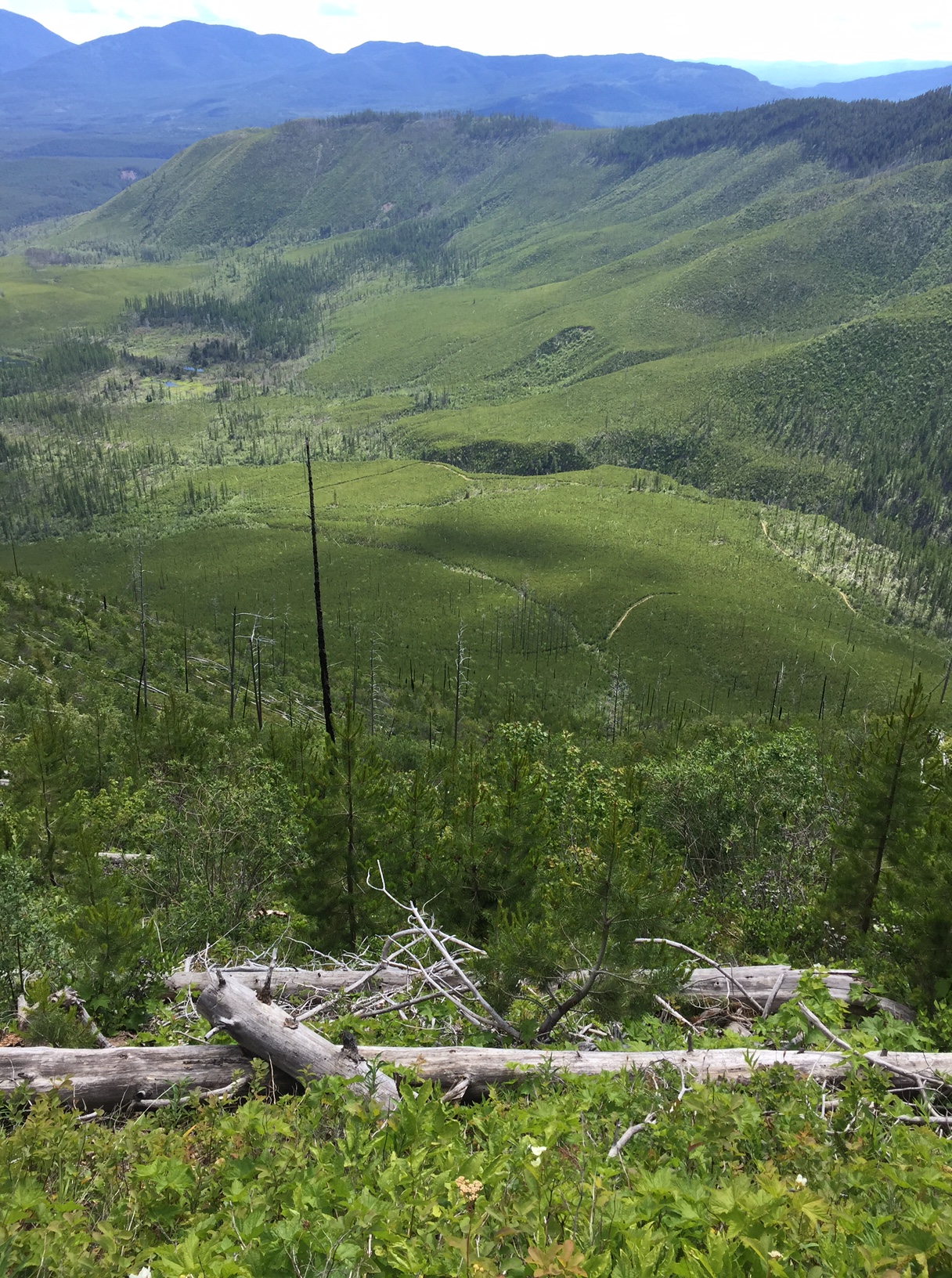
The lack of shade-producing foliage does offer one advantage…this trail allows for incredible views of the surrounding Flathead River Valley! 

If you make it to the top, we were told the views of Lake McDonald bordered by the park’s mountains to the north are beautiful. (click here for the webcam view from the summit of Apgar Mountain.) 

In my semi-delirious state, I half-heartedly named this “the Butterfly Trail” for the numerous (and lovely) flying insects we stirred up on our trek. 

As I’ve mentioned in other posts for this park, beware of bears on this trail.  We did not see any but some hikers that were exiting the trail as we were starting out did.  Also, three days later, a mountain biker (and park ranger) was tragically killed when he surprised a grizzly on a bike path about six miles from this very trail (outside the boundaries of the park).

A dirt path through knee-high, pine trees with green hills in the background.
The trail–the view is looking upward near the beginning of the LONG climb, this is essentially what the entire trail looks like.

Know How Hard to Push Yourself When Hiking

I’m going to get on my soapbox a bit regarding an important safety tip:  KNOW YOUR LIMITS in the outdoors!  There is a fine line between pushing yourself to extend your stamina and increase your strength…and putting yourself into a dangerous/potentially deadly situation. 

There are some well-known symptoms of exhaustion, dehydration, and heat stress but it also helps to know your body.  This takes time and experience to learn what signals your body gives when it’s being stressed and what those signals mean.

As much as it pains my pride to admit it…we didn’t make it to the top of this trail.  We decided to turn around about a quarter of the way through the 3rd switchback when the “bent-double” stomach cramps and nausea hit me.  I’ve learned from past experience that this is a major sign of dehydration for myself and I didn’t want to push things too far.

Always remember, just because you get to the top, that’s only halfway, you still have to get back down and sometimes going downhill can be more difficult.  Exhaustion combined with the pull of gravity on the return trip can prove disastrous–I’ve worn scrapes and bruises resulting from stumbles caused by this dastardly combination on more than one occasion.

So don’t spend all your energy on only half the trail or you may find you’re unable to complete the most important half…getting home!

It’s also important to note, for the benefit of your wallet, that some parks/states require you to pay for at least a portion of the cost involved in a Search and Rescue operation if one is deemed necessary.  They’ll come to get you, but the financial toll may remain long after the physical injuries have long since healed.  If concern for your own body isn’t enough to convince you to turn back, perhaps concern for your wallet will be.

View down a mountain from above. Green grass and tree-covered mountains in the distance.
The view–the Flathead River Valley from near the middle of one of the switchbacks, you can see how far we’d come from the trail below us

Don’t be Afraid to Turn Back when Hiking

It’s difficult to admit we failed on this attempt, but I firmly believe we made the right decision in turning back.  It’s easy to get “Summit Fever”, especially when you go into a situation expecting to succeed.  The length of this trail was well within our average hiking range and it was fairly easy, technically speaking, so turning back definitely caused some wounded pride.

Don’t be afraid to admit you’ve bitten off more than you can chew though.  A report from the years 2003 – 2006 found that 23% of Search and Rescue incidents included people in their 20’s and 66.3% of the victims were male.  So the takeaway lesson is, that young males–the ones usually thought of as being the most healthy, strong, and capable–are also the ones most likely to run into trouble.  If they struggle, the rest of us shouldn’t feel bad admitting we struggle too!

So guys, take note…find a hiking partner who wimps out before you do so you can turn back and still save face. 😉  I should note, that the cramps relented within minutes once I stopped climbing, found some shade, got some sustenance in me (food and drink), and cooled down.

If you’re looking for a challenging hike on your next trip to Glacier National Park, check out the Apgar Lookout Trail!

Have you attempted these infamous switchbacks?  What was your experience like? Let me know in the comments!


Did you enjoy this post? Pin it!

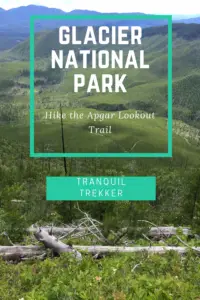
View down a mountain from above. Green grass and tree-covered mountains in the distance. Pin reads, "Glacier National Park, Hike the Apgar Lookout Trail"

Like what you read here today?  Please feel free to leave a comment, like or share this post!  Add your email at the bottom of the page, or the sidebar to the right, to be notified when a new post is published.  By signing up for the email list, you will also receive a free copy of the Tranquil Trekker’s Top 10 Tips of Trekking Do’s and Don’ts!

You can also follow the blog on social media by clicking the links below!
Facebook

Twitter

Instagram

Pinterest


Save