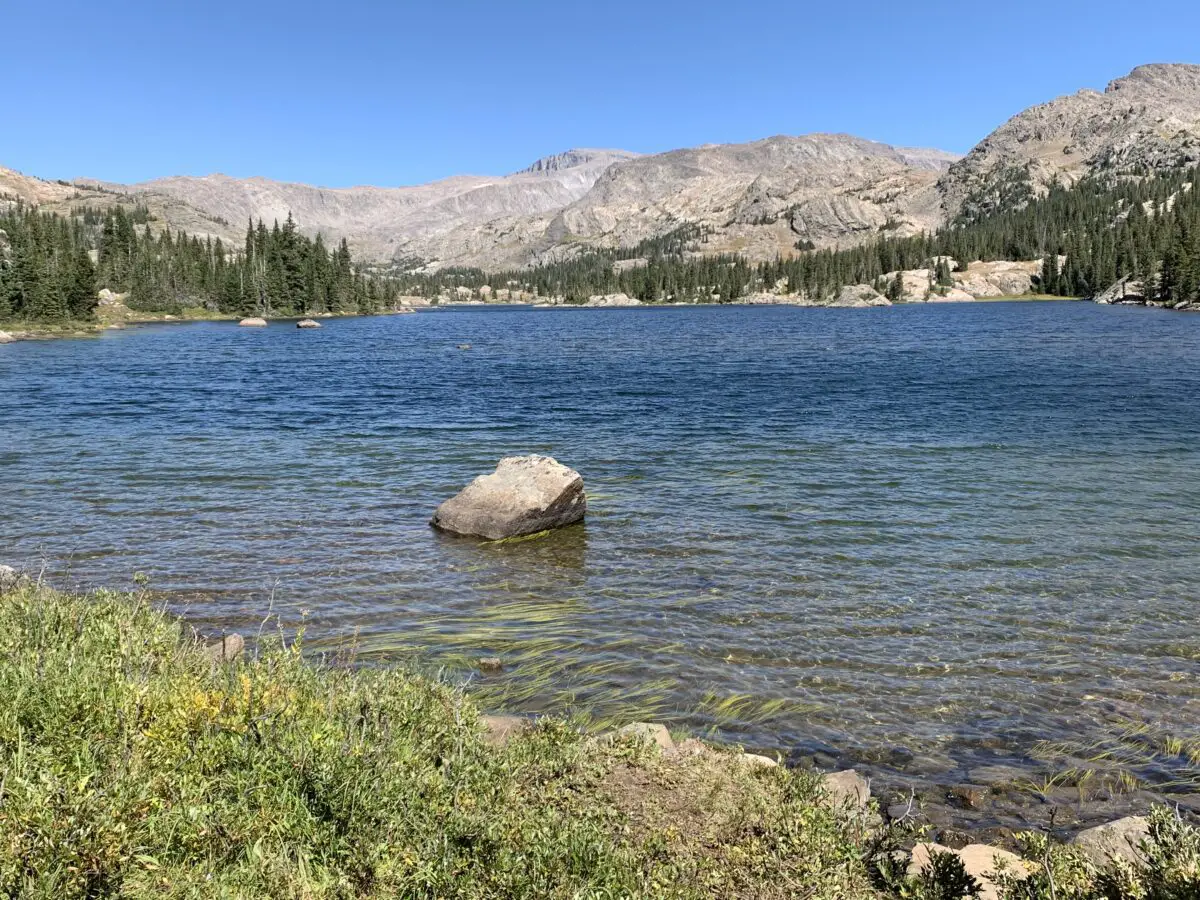
Lake Helen, Bighorn Mountains, Wyoming

In this post, I review the Misty Moon trail starting at the trailhead at West Ten Sleep Lake and continuing to Lake Helen.


Are you looking for a moderate hiking trail that really lets you enjoy the wilderness of the Bighorn Mountains in Wyoming? Check out the Misty Moon trail from West Ten Sleep Lake to Lake Helen in the Cloud Peak Wilderness!

Where is the Misty Moon trail?

Trail #63, the Misty Moon trail, is one of the most accessible, main trails to access Cloud Peak and Bomber Mountain.  It starts at the trailhead behind West Ten Sleep Lake (this is also where the trail for Mirror Lake/Lost Twin Lakes begins.

To reach the trailhead take Forest Route 27 to where it terminates.  FR 27 is located off of US 16 in the southern Bighorn mountains.  You will turn at the sign for (and location of) the Deerhaven Lodge.  Boulder Campground, Island Park Campground, and West Ten Sleep Campground are also all located off of this road.
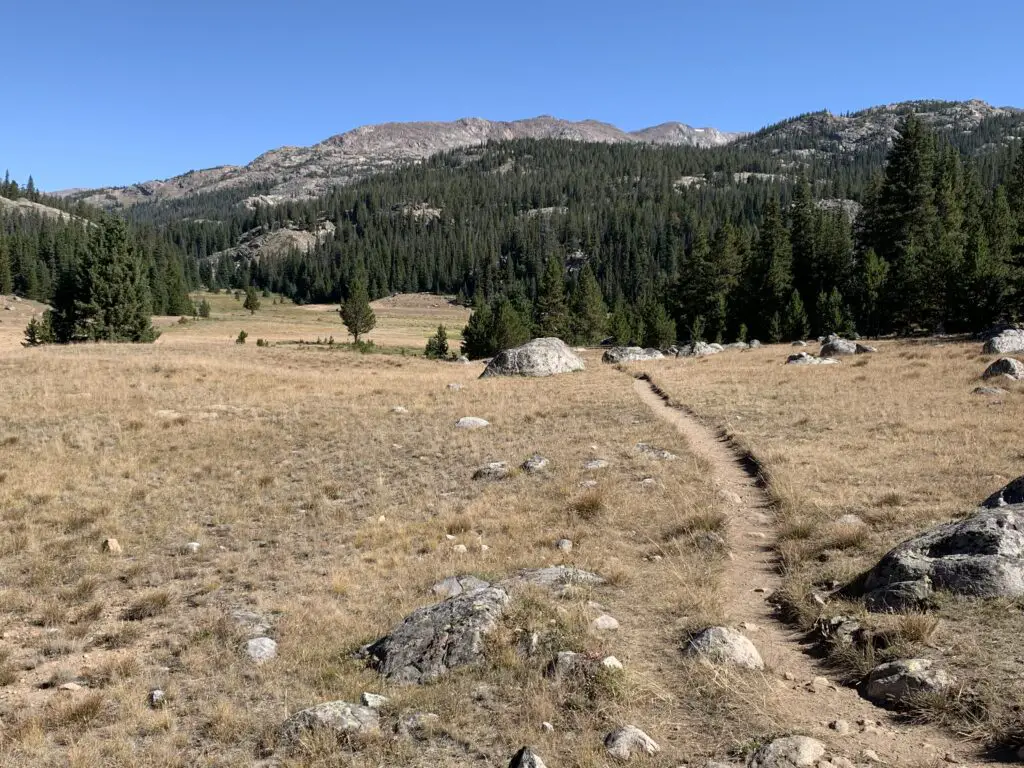
Hiking trail crossing a grassy meadow leads to trees with a rocky mountain behind

What is the trail to Lake Helen like?

The first few miles of the trail are LOVELY. You start by meandering on a flat trail through the woods around West Ten Sleep Lake.

We saw a momma moose and baby bedded down in the tall grass near the lake!  Be sure to give these animals PLENTY of space, especially with dogs. Most momma animals can be INCREDIBLY aggressive when they’re protecting babies, and moose have been known to kill dogs–we kept Puppers on a leash and she was too distracted by smells to be aware of our new friends. 
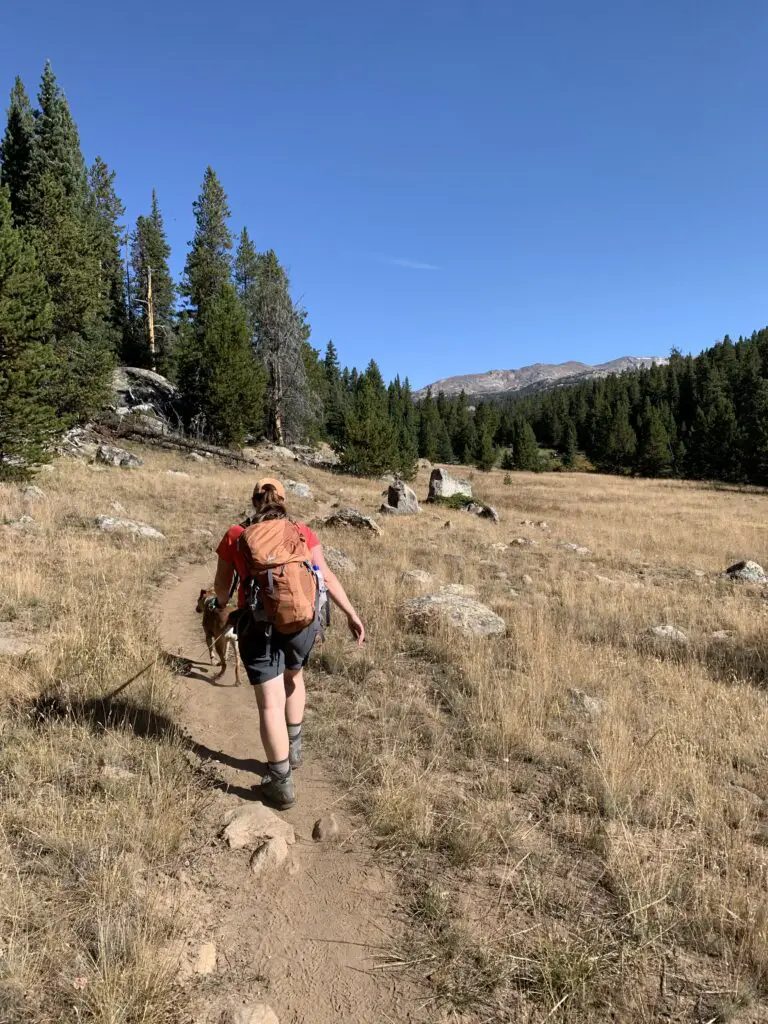
(As viewed from the back.) A woman and dog ascend a hiking trail through a grassy field. Trees and a rocky mountain can be seen in the background
Puppers and I on the Misty Moon Trail

Once past the lake, you start a gradual climb through several grassy meadows and forested areas, with great views of the mountains beckoning you along the way.

The trail undulates the whole way so while there are a few short, steep spots, there are no lengthy, spirit-crushing climbs–I think this contributed to the trail feeling easier than it actually was.
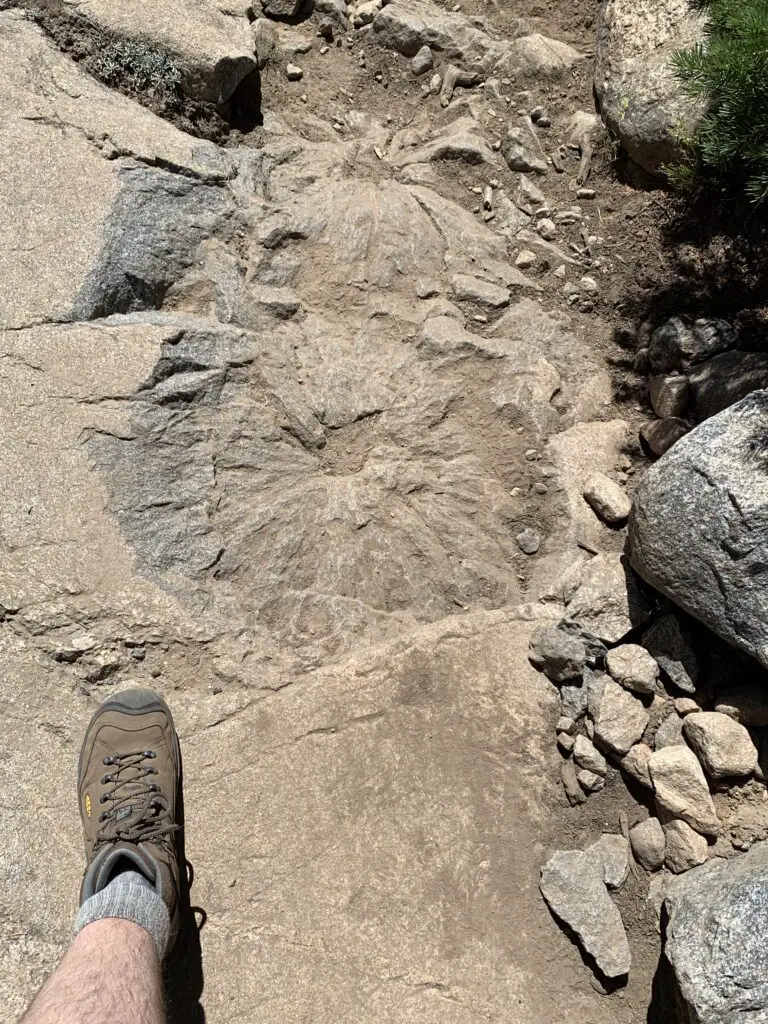
Circular, rough indentation in the rock
We saw a bunch of these indentations on the rocks, not sure if it’s some kind of fossil? Looks like a plant left them…🤔

About halfway to Lake Helen, the trail becomes steeper.  This is where you hit the rocky sections.  There are no large boulder fields to cross and no scree slopes to navigate (on this portion of the trail) but the rocks are big enough that they cause a lot of uneven terrain that you’ll need to manage.  Hiking boots are definitely recommended for this trek!

I think older kids could do this trail. It’s a longer one and they may need some help in the rocky areas, but overall I would say it is moderately difficult.

The hike didn’t actually seem that bad while we were doing it. Both Mr. Trekker and I were pleased at how good we felt throughout.  Especially considering we carried heavier packs than usual (we brought A LOT of water) and we hadn’t hiked much this summer as it’s been so warm.  Also, the trail STARTS at around 9000 feet (you gain around 1000 feet in elevation over its five-mile length.  Lake Helen sits at almost exactly 10,000 feet.)

Mr. Trekker and I were both pleased that we didn’t feel the altitude too much (it probably helped that we camped at 9000 feet the night before).  If you aren’t used to these altitudes though, you’ll definitely want to take it easy.

The Trekkers seem to be doing better with altitude in recent years. It used to be that just driving to Estes Park in Colorado (which sits at around 8000 feet) was enough to make me feel funny.  Now we’ve camped and hiked higher than that on multiple excursions in Colorado, Wyoming, and Montana and done quite well.  They claim your body “learns” how to adjust to the altitude better the more you experience it and I think that may be true. (Living at 3000+ feet for the last decade probably hasn’t hurt either. 😉)

Related posts:  A drive through Ten Sleep Canyon!Bighorn Medicine Wheel in Wyoming; 4 Don’t Miss Sites in the Bighorn Mountains of Wyoming; Camping in the Bighorns

We considered going all the way to Misty Moon Lake but that would have added several miles to our already 10-mile hike.  All three of us were feeling good when we arrived at Lake Helen so we figured we’d just spend a relaxing lunch at the lake and head back.

As it turned out it was good we did decide to turn back.  Even though she was raring to keep going when we reached the lake, by the time we got back to camp Puppers was hurting.  This was the first time she’s ever really had issues on the trail.  This is one of the longer trails we’ve ever done with her (though she’s done 10 miles with us before).  This trail is REALLY rocky, in parts, which means it’s probably also one of the toughest trails we’ve ever done with her.  We did LOTS of rock hopping on the way down and she was obviously aching by the time we got back.  She seemed to make a full recovery within a few days though! (In her defense, my hips were sore for several days afterward, as well.) 
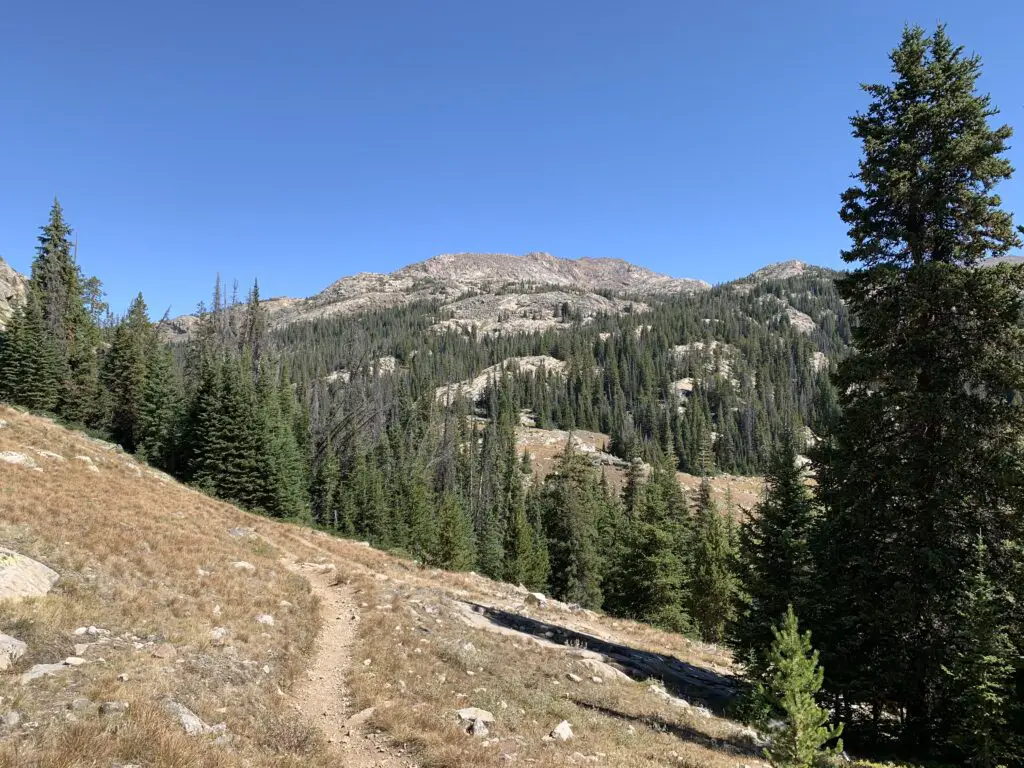
Hiking trail crossing a grassy meadow leads to trees with a rocky mountain behind

Obviously, I can’t speak to the trail past Lake Helen (since we didn’t do it. 😉 I do know that Misty Moon Lake is only about 300 feet higher than Lake Helen but it takes two more miles of hiking (each way) to get there.

Also, my understanding is once you get past Misty Moon Lake the trail gets much tougher.  There are some scree slopes and boulder fields (namely on the way to the wreckage site at Bomber Mountain and to reach the actual Cloud Peak).  Also, once you get past Lake Helen you are basically above treeline the entire way.  This means there is NO SHADE at all so make sure you bring sun hats, LOTS of water, and sunscreen if you’re planning to go this route.  There is also NO PROTECTION if you’re caught out in a storm.

I cannot stress this enough:  if storms appear imminent PLEASE get below treeline as safely and quickly as possible.  It is INCREDIBLY dangerous to be above treeline during a lightning storm.  Safety should ALWAYS be your first priority!  
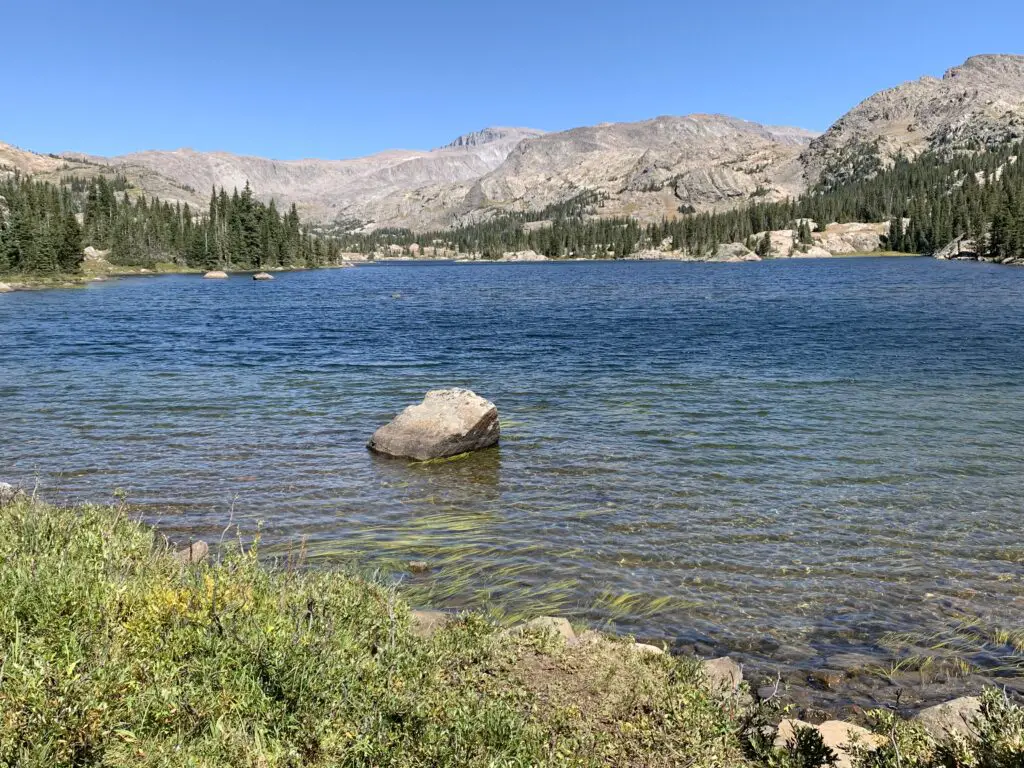
Small lake with a large rock in the middle, ringed by trees. Rocky mountains rise in the background.
Lake Helen! (Bomber Mountain is near the tall peak straight up from the rock in the water. Florence Pass is through the saddle even further to the right.)

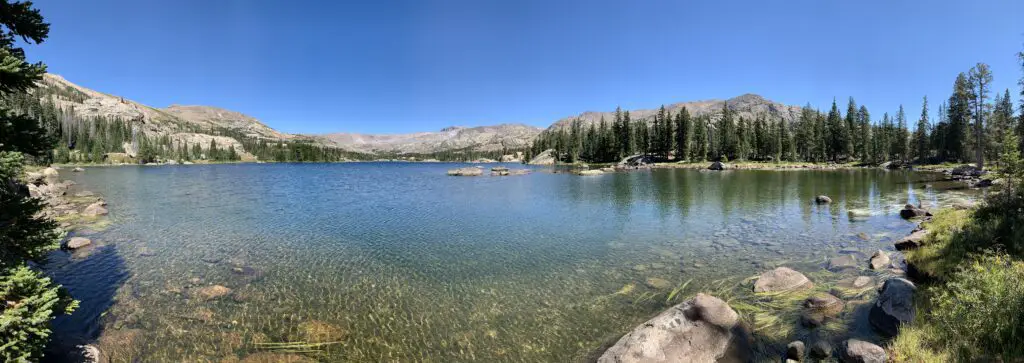
Panoramic view of a blue, peaceful lake with rocky mountains and trees in the background

From Lake Helen you can see Bomber Mountain and the high-altitude, Florence Pass to the right.  What you cannot see is Cloud Peak (as often as we have visited the Bighorns we have yet to see that site. It’s VERY isolated. 😝)  From what I have heard from other hikers though, you CAN get views of Cloud Peak from Misty Moon Lake.

Let’s talk about Bomber Mountain and Cloud Peak

Cloud Peak and Bomber Mountain reach altitudes higher than 12,000 feet so altitude sickness starts to be a concern when you spend lengthy amounts of time at these altitudes.  Potential hikers should also be aware the snow can be quite deep on these trails through July!  Also, mosquitoes are said to be HORRIBLE in the summer (we had no problems at all on Labor Day weekend and we didn’t use any bug spray. 😁)

Bomber Mountain:  This used to be an unnamed mountain in the Bighorns.  That is until a World War II-era bomber crashed here while on a training mission in the early 1940s.  If you know where to look you can still view the wreckage. (Don’t ask me how to get there, I don’t know. 😉. For more info on this hike you can click here)

You can check with local forest offices for information on how to get to the site.  From what I’ve heard there are also rock cairns that help direct the way but you need an idea of where to look. 

Please be respectful if you visit this site as several soldiers did lose their lives in the crash.
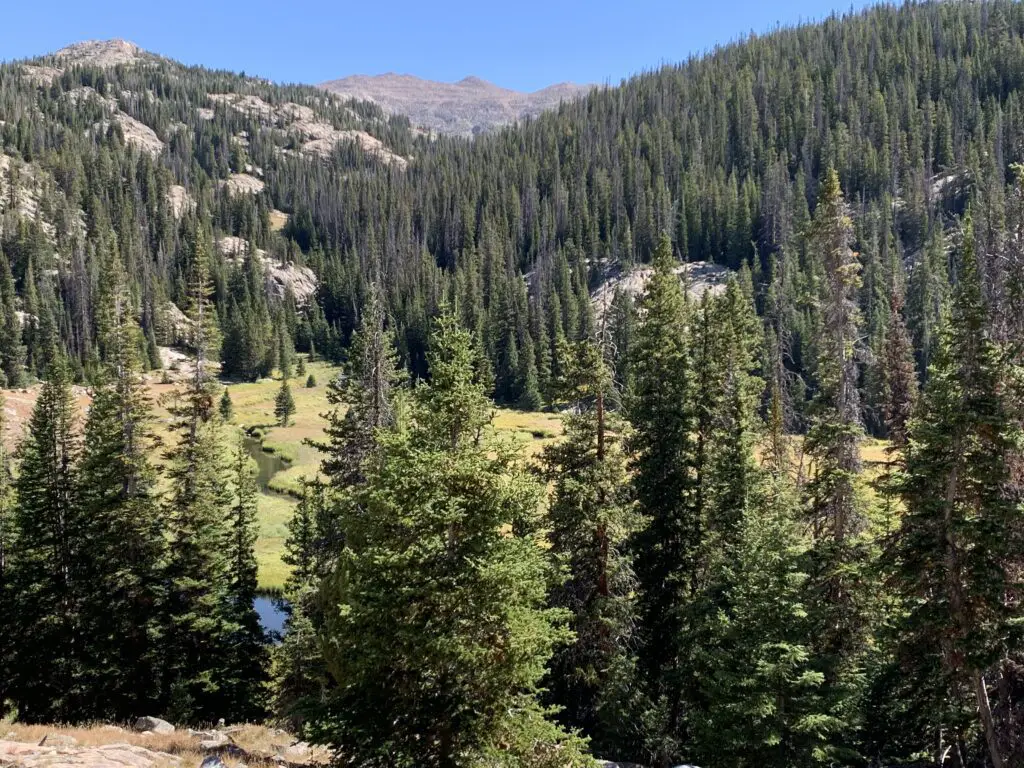
Pine trees in a grassy valley with a spring running through it and mountains on all sides

There are no actual trails that go to Bomber Mountain or Cloud Peak. (This seems a little odd to me as Cloud Peak is the highest point in the Bighorns and is what the wilderness area is named for, but I digress. 😝)  There are some rock cairns to guide your way to Cloud Peak.  My understanding is for Bomber Mountain, you pretty much just have to know where you are going.

This being said, PLEASE be sure you have a good, topographical map and a compass with you if you are attempting these hikes.  Also, be aware there will likely be some bushwacking involved and you could easily become lost. These routes should only be attempted by EXPERIENCED, backcountry hikers! (Cell phone service is spotty at best in this area. DO NOT rely on it!)

Cloud Peak: “can” be done in one day but it would be a VERY long and VERY hard day (it’s around 24 miles total).  People have done it but most suggest doing a 2 – 3 day backpacking trip. (Lake Helen and Misty Moon Lake are popular places to camp for these.)  The last three miles to the summit are said to be a boulder field with “house-sized” boulders (per the reviews).  The “trail” isn’t super clear either.  Some people suggested this is actually a more difficult hike than the notorious Longs Peak in Rocky Mountain National Park 😮 so PLEASE think hard and use incredible caution if you’re considering this trek.

West Ten Sleep Lake Campground

On other trips, we’ve stayed at the Island Park campground but since we were leaving from the trailhead at the lake we stayed at the West Ten Sleep campground on this trip.
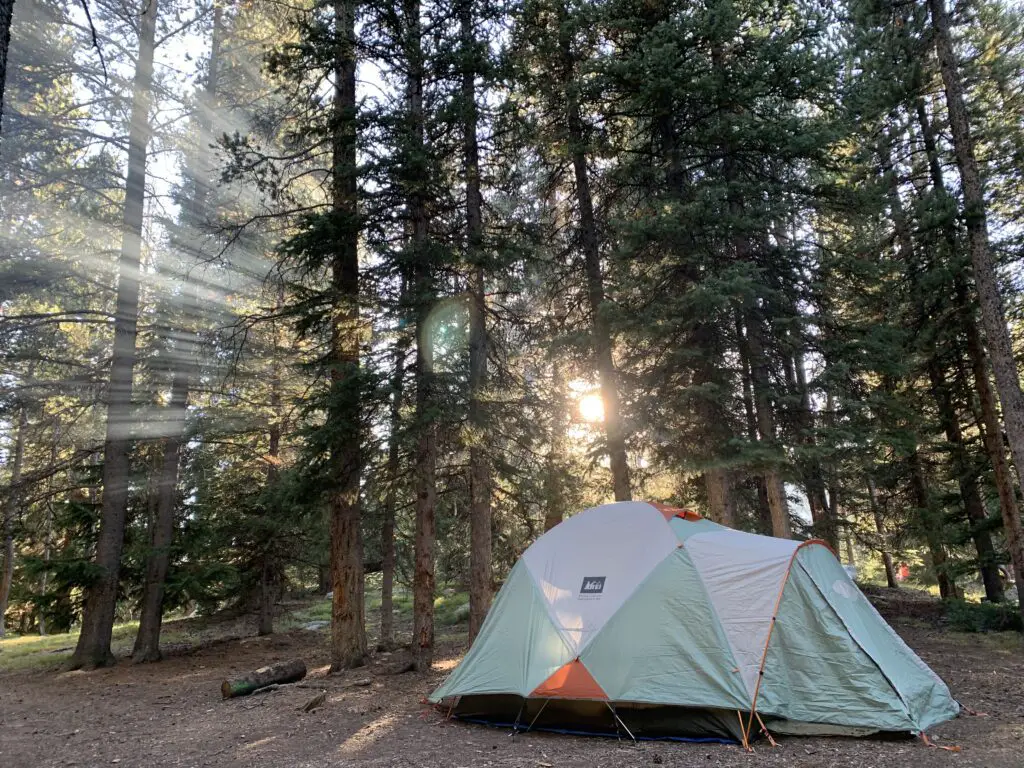
A tent sits in the forest, sunlight streams through the trees and creates beams in the smoky air

It was LOVELY! Some sites had views of the lake, ours had forest views. But the sites were nicely shaded with lots of soft, pine fluff.  The campground was also relatively quiet and quite pretty.  It was also only a couple of hundred yards to the beauty of West Ten Sleep Lake!
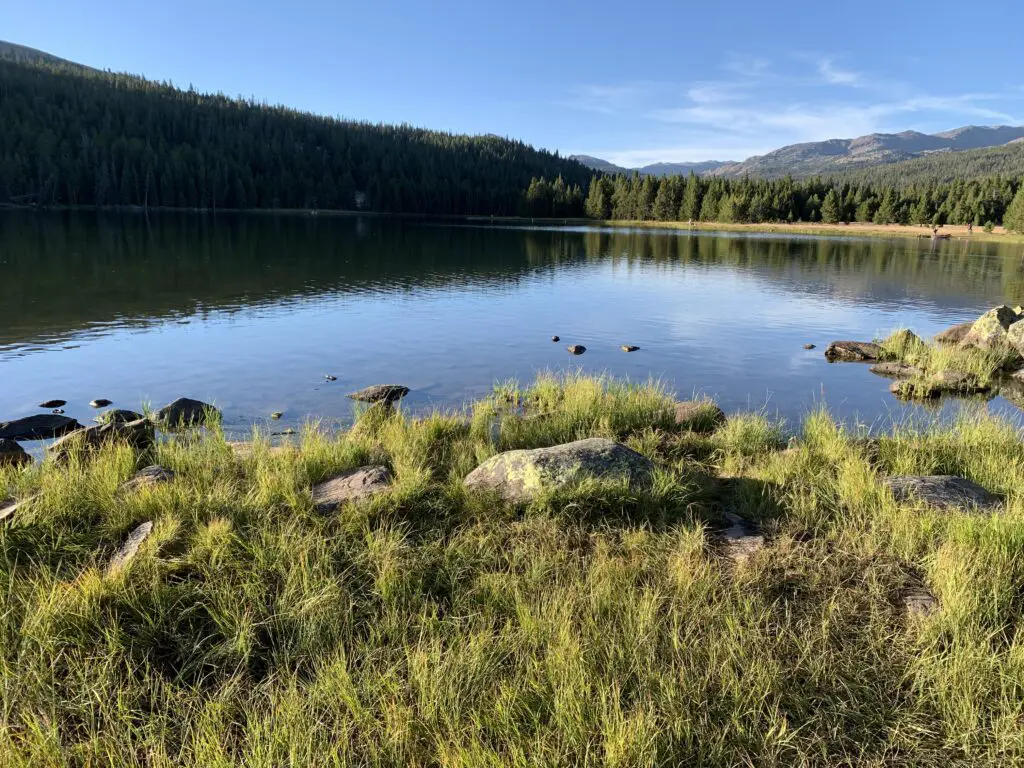
Serene lake reflecting the trees and mountains that surround it
West Ten Sleep Lake!

James T. Saban Fire Lookout

The Trekkers have passed this lookout on every trip we’ve made to the Bighorns and we always say, “we should check that out!”…so, we did!

The trailhead for the James T. Saban Fire lookout is found off Route 16 in the Bighorn Mountains, around five miles east of Meadowlark Lake.  The turnoff is on the south side of the road.  I can’t remember if there are signs telling you to turn but you can see the lookout at the top of the hill from the road.  This is also the turnoff for the St. Christopher’s Chapel and there are signs for that site.
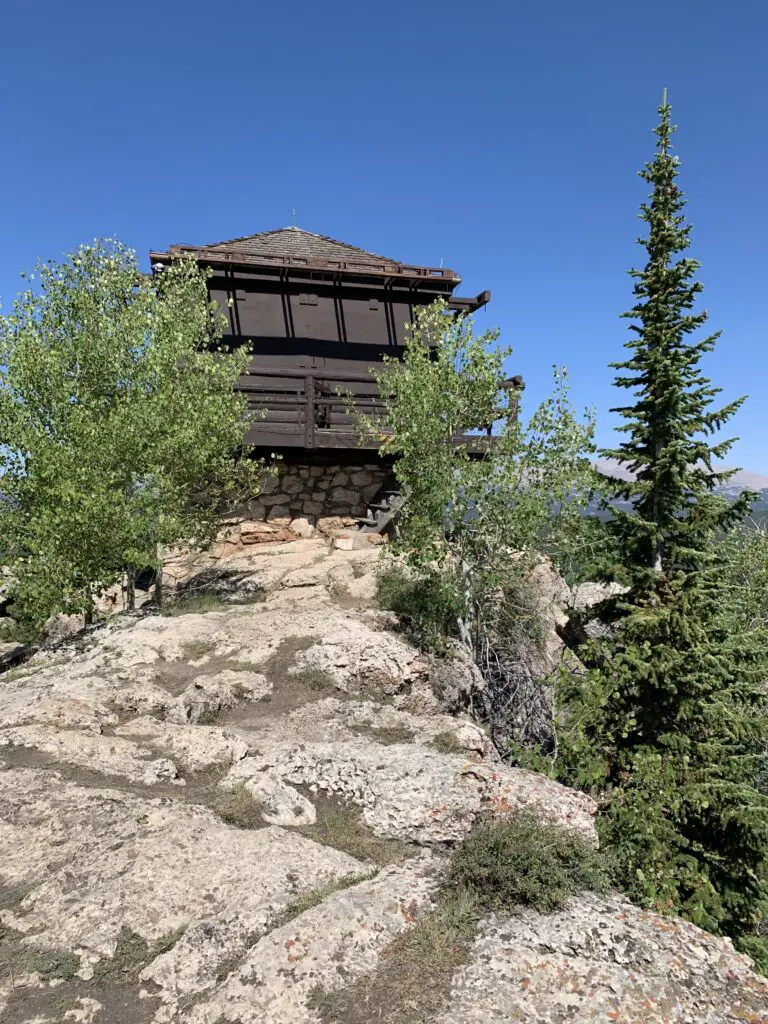
A wooden and shuttered fire tower sits on top of rocks. Trees grow out of the rocks.
The James T. Saban Fire Lookout!
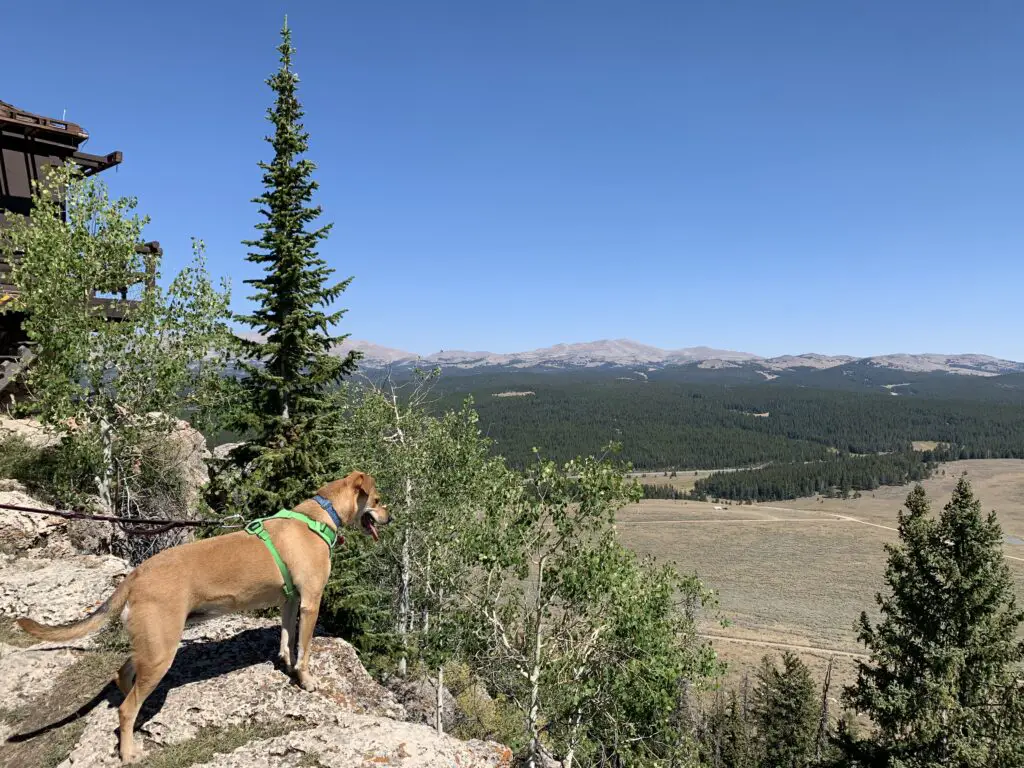
Dog stands on a rocky ledge overlooking trees and a dropoff. A grassy field and mountains are in the background.
Puppers enjoying the view from the fire lookout!

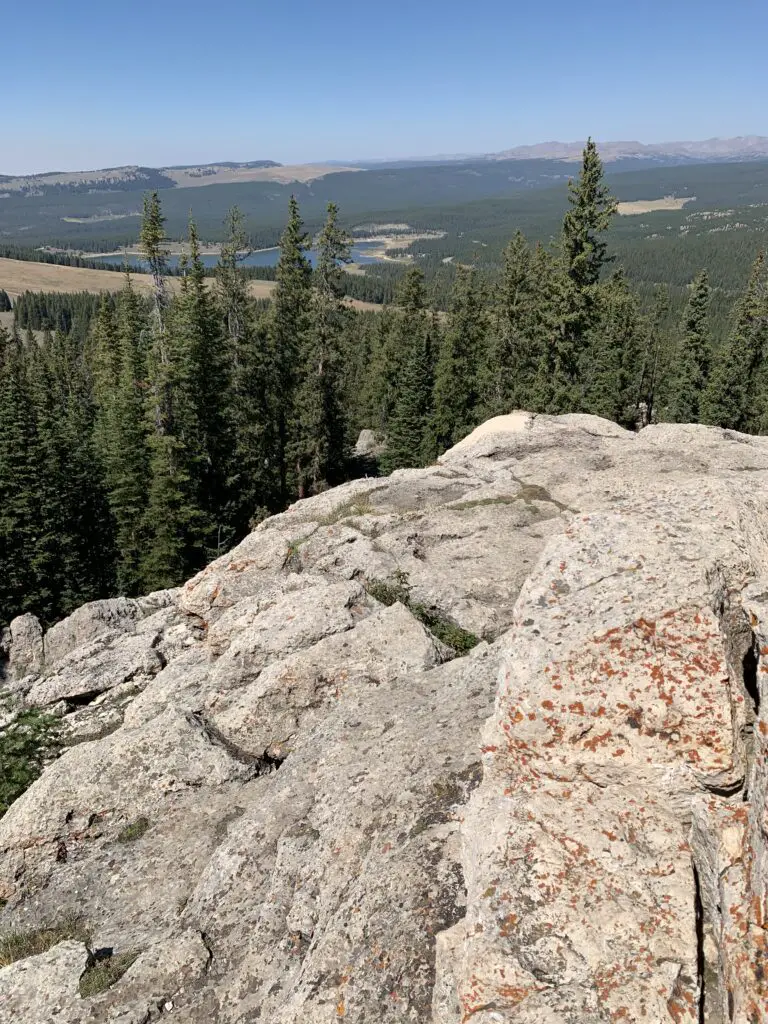
This fire lookout is easy to reach and offers some amazing views of the surrounding area.  It requires a short drive on a narrow, dirt road to reach the trailhead.  You’ll want to take it slow and watch where you are driving. In good conditions, I would be comfortable taking almost any higher clearance car, SUV, or truck there.  In poor conditions (mud or snow) the road may be impassable.

Once you reach the trailhead, it is about a 15-minute walk (in each direction) to the tower at the top of the hill.  It isn’t a bad hike. It gets a little steep in spots but the trek is short enough almost anyone in good health should be able to handle it. (Note: you are at an altitude of around 8000 – 9000 feet in this area so take your time as you may feel short of breath.)
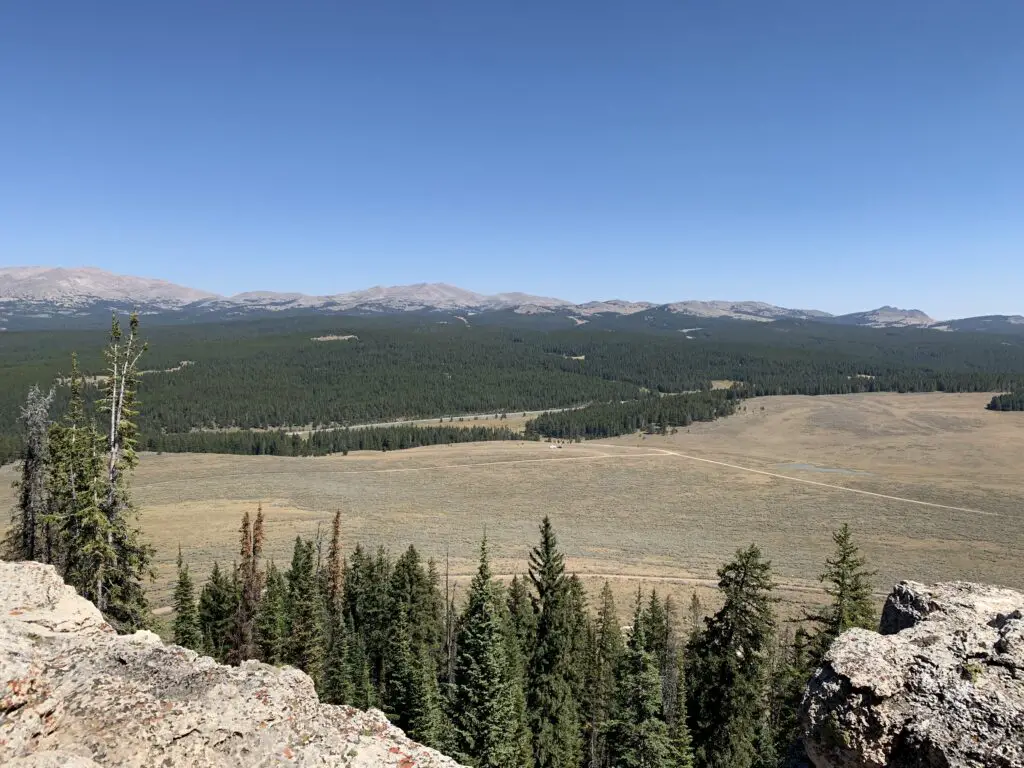
Mountain overlook, trees in the foreground, then a grassy field with mountains in the background

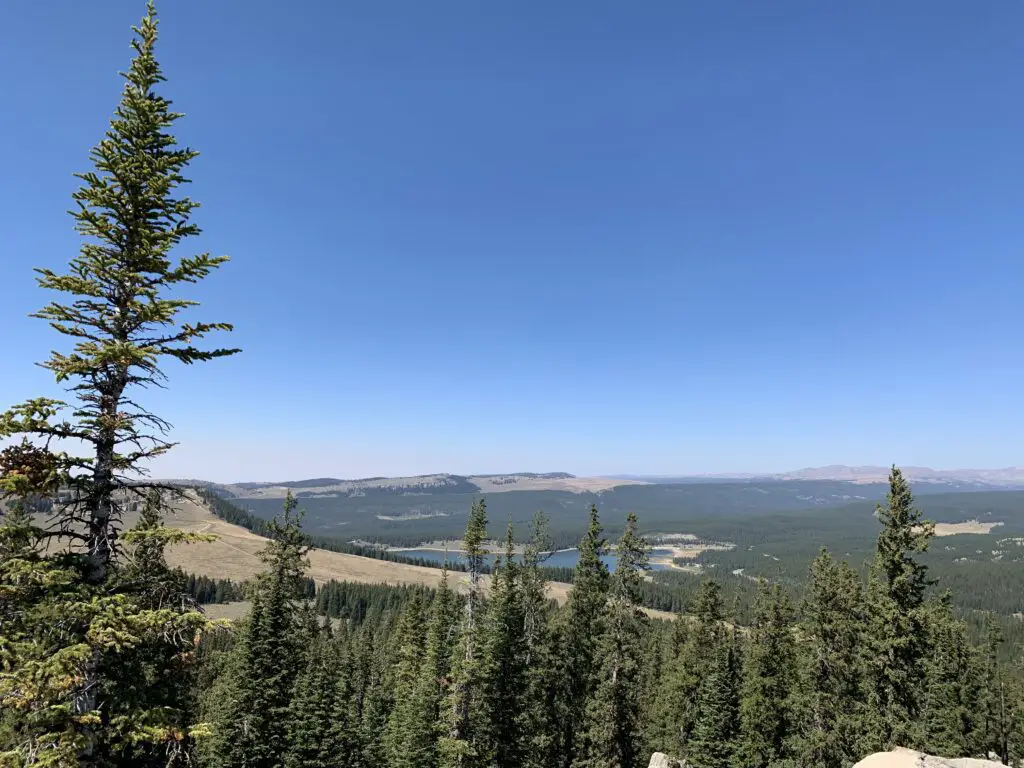
Mountain overlook, rock and trees in the foreground, then a lake and mountains in the background
That is Meadowlark Lake in the background

Mountain overlook, trees in the foreground, then a grassy field with a lake and mountains in the background

Though it is a bit long and strenuous, the Misty Moon Trail to Lake Helen is a great hike if you want to really get a taste of the Cloud Peak Wilderness area in the Bighorn Mountains!

Have you hiked to Lake Helen, Bomber Mountain, Cloud Peak, the James T. Saban Lookout Tower, or Misty Moon Lake? If so, tell me about your adventures in the comments!


Did you enjoy this post? Pin it!
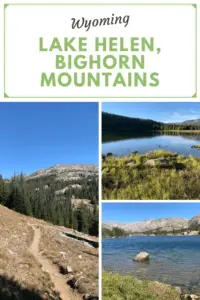
3 pictures show a trail with mountains behind it, a lake with forest surrounding it and a lake with rocky mountains in the background. Pin reads, "Wyoming, Lake Helen, Bighorn Mountains"


Like what you read here today?  Please feel free to leave a comment, like or share this post!  You can also follow the blog on social media by clicking the links below!

Facebook

Twitter

Instagram

Pinterest

4 Tips for Digital Mindfulness at Work

In this post, I outline some steps we can all take to be more mindful regarding the use of work laptops, phones, and messaging programs when we’re supposed to be enjoying some “downtime”.


I started a new (more normal) job a few years ago after COVID pretty much killed my freelance career. 😝  I still work from home a lot but I also visit with clients out in the community.  Because of this, I now have two laptops and two phones (one each for work and personal use).  As you may imagine, this does not lend itself to tranquility, peace, or a dearth of technology in my life. 

I’ve felt like the old grandma at work, trying to figure out her grandkids new-fangled technology. 😝  I actually did this same job 10 years ago but back then all I had was a Word document, a flip phone, and a laptop. (It took real effort to locate a WiFi signal anywhere away from the office back then, and there were no hotspots on my flip phones!)  Today, almost everything is web-based.  While this makes things far more convenient (and saves trees, a definite plus!) it also means there are countless more assessments and paperwork items that are screaming for my attention at all times.

All of this runs completely counter to the mindfulness principles so many of us work so hard to maintain in our lives.  We want to be Present in the current moment…we strive to focus our mental energy on one task at a time…and then we’re slammed by multiple devices pinging and dinging with alerts like “you’ve got mail!”, “someone’s calling!”, or “your next meeting starts in 15 minutes!”  It’s EXHAUSTING!

So, how do we use these devices as tools to help make our work-life run efficiently, so we can focus our mental and physical energy on what is most important, thereby leaving LOTS of time to live life?  Read on for the Tranquil Trekker’s tips for digital mindfulness at work! 

Author’s Note:  My intent with this post is NOT to complain about my new job.  Having a work phone and laptop actually makes a lot of sense with the work I do.  My home IS my office.  Also, since my job is fairly mobile, it only makes sense that my work is mobile too.  I also VERY MUCH appreciate that my company has provided me with work devices as I DON’T want to have to use my own. 😝  

And bottom line, SO MANY people are in this same boat.  Having multiple devices is really just becoming the new normal (especially with the popularity of flexible work options and the rise in work-from-home due to COVID.)  My goal with this post is to encourage people to view these devices as necessary evils and to help them figure out how to use them as beneficial tools without allowing them to take over our lives.

Compartmentalize your Work Devices

Compartmentalize with your work laptop, phone, and any messaging apps if at all possible.  You can accomplish this by only having these work-related programs on your work devices.  Also, be sure to turn these off at the end of every day and on your days off if possible (I realize this isn’t always an option if you are on-call).

If you feel this isn’t an option in your case, my question would be, are you actually on-call?  If not, is there truly an expectation that you respond to calls, emails, or messages during off-hours?  To put it bluntly, are you actually jeopardizing your job (or future promotional opportunities) if you don’t respond promptly?  Or, is this a self-imposed prison?  Is it not actually necessary for you to be available at all times but do you feel like you should be?

Many people have their work email come to their personal phone (even though oftentimes this is voluntary, and is NOT required by their job).  I think they’re nuts, personally 😉, but I also can’t help but feel a bit sad for them.  They need (and deserve) a break and I just don’t see how this practice achieves that for them.

So my advice is to talk to your boss.  Get a clear understanding of what the expectations really are.  If the presumption is that you be readily available during off-hours, then you’ll have to decide for yourself if that’s the work environment you want.  Just know that studies show you’ll be a better employee if you have true downtime. (Don’t take my word for it, you can read about some of them below! 😉)  And if you’re the boss, check out the links and please, don’t be an a-hole! 😇)

Harvard Business Review–The Upside of Downtime  
Forbes–Downtime is Important!

Multitasking Makes you Less Productive

In addition to compartmentalizing your work devices, the studies linked below also show that contrary to popular office belief, multitasking DOES NOT work, and it actually DAMAGES your productivity! 😮

Forbes: Multitasking is Bad for You!
Cleveland Clinic:  Multitasking Doesn’t Work
Forbes:  Multitasking Hurts Productivity

Multitasking is almost NEVER a mindful practice, as mindfulness requires you to put your full mental energy and focus into ONE task at a time.  As an example, think about taking a work call while driving (we’re going to assume you’re using hand’s-free devices.)  If you’re paying attention to driving (which you should be) you CAN’T be putting all your mental energy and concentration toward the phone call you’re having.  And if you’re aren’t focusing on the phone call whatever/whomever you’re trying to serve with that call won’t be getting your best effort.  Also, you can’t take notes while driving, or look things up on your computer or phone as you may need to. (I would also ask, how do you pay close attention to driving if you’re distracted by a call?)  So all this multitasking scenario succeeds in is making you less of a safe driver while also providing lousier service to your job task at hand.  It’s a lose-lose situation!

Prioritize Downtime

Now that I’m back to working more like a normal person, there is nothing better than 5:00 on a Friday, when I log out of my work email, turn my work phone off, close my work laptop, and put all of them (screen down) in the office, not to be looked at for the next several days.  I think it’s important that we have that break whenever/wherever we can take it.

That break is important for our mental health and it makes us better workers.  It gives us a chance to recharge mentally and physically so we have more mental energy to face the challenges of the job when the next work week comes.  I worry this appreciation for the benefits of downtime is something that’s gotten lost in recent years, in our always-on society.

Find Unique Places to Work

This one may be difficult for some people.  Depending on the type of work you do you may need to be in front of a video monitor often.  Or you may do highly technical work that requires you to be tied down to some sort of office environment.  But for many of us, one of the joys of flexible work situations is that you can pick where you want to actually work.  So don’t limit yourself to being locked in your home office, the basement, the second bedroom, or wherever you usually work from.  If it’s a nice day and you have the internet access you need, work from the front porch or the back deck.  Go sit at a local park, beach, or other green/blue spaces.  If the Great Outdoors isn’t really your thing, go to a local coffee shop.

Obviously, make certain you are still ensuring all necessary confidentiality your job may require.  Use screen protectors so others can’t read your screen, talk quietly if you’re on the phone or seek out private places to talk, or use headphones if you’re in a meeting or a training session (anyone sitting within earshot will appreciate this anyway!)

To Conclude:

This is somewhat of a complex subject as our jobs all vary so greatly in terms of the circumstances that surround them, what our supervisors may require, the security necessary to protect the information we work with, and the practicality of how our jobs function.  I just want us all to “think outside the box” when it comes to flexible work options. 

One of the best things about these work options is they allow us to get out of the office and better fit our work into the lives we live.  So take advantage of this!  Set boundaries for when and how you use your work devices.  Recognize that while multitasking may make you FEEL more productive, in all likelihood it’s probably, actually hurting your productivity.  This isn’t good for your company or the clients you serve.

Also, remember to prioritize your self-care.  If you aren’t in a good place it will be almost impossible for you to put your best foot forward in terms of the work you do.  Part of this self-care means making your work environment the most pleasurable it can be (while staying within the confines of what is required for your job, of course). 

So, the next time you go to grab your work laptop or phone on your “off” hours ask yourself, “Is this really what’s best for me, my client, or my company?” If the answer is likely “no” go do something enjoyable instead!

Do you have any tips for keeping a healthy balance between work and home when your digital, work devices follow you home?  Tell me about them in the comments!


Did you enjoy this post?  Pin it!

Two laptops and two cell phones, all sitting on a desk. Pin reads, "Tips for Digital Mindfulness at Work"


Like what you read here today?  Please feel free to leave a comment, like or share this post!  Add your email at the bottom of the page, or the sidebar to the right, to be notified when a new post is published.  By signing up for the email list, you will also receive a free copy of the Tranquil Trekker’s Top 10 Tips of Trekking Do’s and Don’ts!

You can also follow the blog on social media by clicking the links below!

Facebook

Twitter

Instagram

Pinterest

Little Devils Tower, Cathedral Spires and Needles Highway Loop

In this post, I review a loop hike made from two popular trails and a scenic road, all amidst the beauty of Custer State Park!


While there are many great hikes in Custer State Park, one of my favorites is an awesome loop trail that connects the Cathedral Spires to the Little Devils Tower Trails and incorporates a portion of the Needles Highway.

You can do this loop any time of the year, but I suggest extreme caution if you try it in the summer.  It includes either a lengthy overlanding stretch which requires scrambling over steep, unmarked terrain, or it means you have to walk along the narrow, CROWDED Needles Highway.

Where are the Little Devils Tower and Cathedral Spires trailheads?

You can reach both of these trails from the Sylvan Lake area, which is found off Route 87 in Custer State Park.  Both are accessible throughout the year (weather permitting) though you can’t drive directly to the trailheads during the winter months. (You can access them via a spur trail from Sylvan Lake or other connector trails in the local area.)  See below for directions to both trailheads:

Little Devils Tower Trailhead

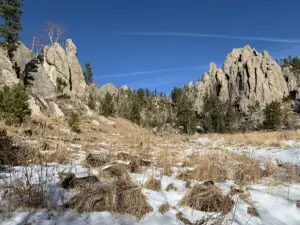
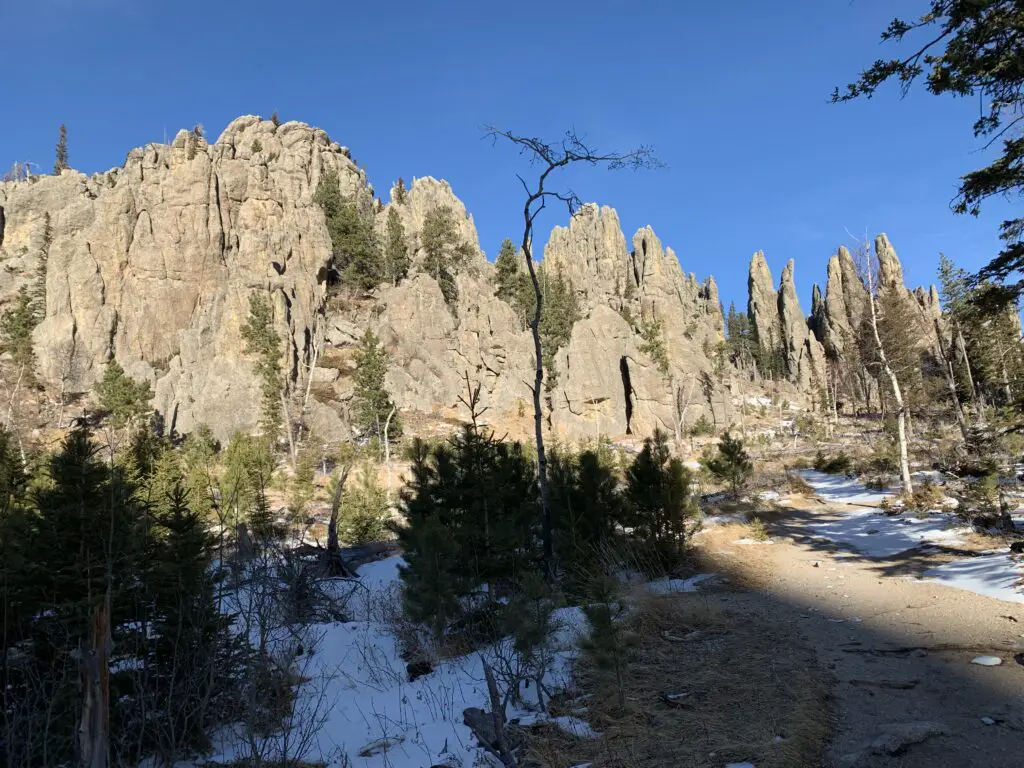
Brown grass with some snow in the foreground. Gray, pointy rock structures in the background, dotted with green, pine trees, all under a clear, blue sky.This is found just past the turnoff for Sylvan Lake. (Continue on Route 87 a little less than a mile south of the turnoff for the lake.  You will see a sign for the trailhead on your left and will make a left-hand turn into the parking lot.)

You can’t reach this trailhead by car in the winter months as the road is closed in that area.  In this case, you can access the Little Devils Tower trail via an easy spur trail that is located on the western corner of the main Sylvan Lake parking area.   

Cathedral Spires Trailhead

This trailhead can be found less than one mile south of the Needle Overlook on the Needles Highway (Route 87). (Note, this is south of the turnoff for Sylvan Lake.)

Extreme caution should be practiced in this area.  The parking lot is small and is located at a bend in an extremely curvy and narrow portion of the Needles Highway.  It is necessary to cross the road to reach the trailhead and in the summer this area is frequently crowded with traffic.  The curves and rock walls can greatly reduce a driver’s visibility and cars are sometimes parked incorrectly, as well, further exacerbating the problem.

As the Needles Highway is closed in the winter, that time of year you can only access this trail by car if you do it via a connector trail (such as the Little Devils Tower trail).

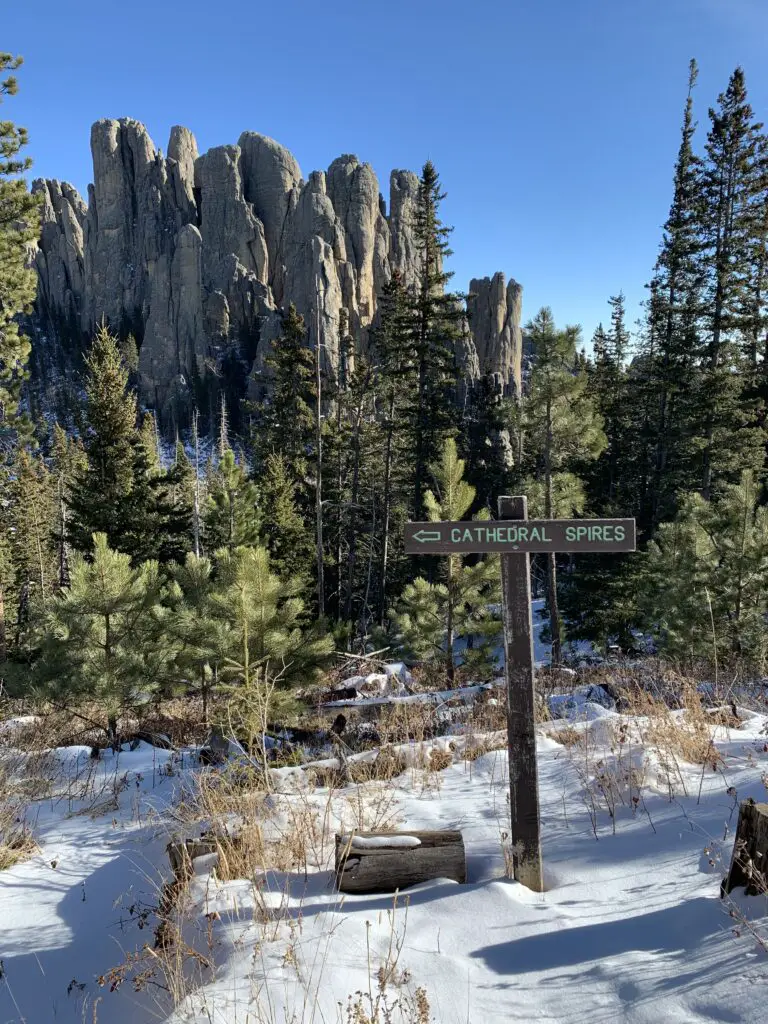
Snow in the foreground, then green, pine trees and gray, rock spires in the background. A brown sign reads, "Cathedral Spires".
This is the junction where the Little Devils Tower trail meets the Cathedral Spires trail

What will you see on the Cathedral Spires/Little Devils Tower/Needles Highway loop?

The loop can be completed in any direction, or you can hike each section individually.  The Trekkers find it easier to start at either Sylvan Lake and take the spur to the Little Devils Tower Trail or to just drive to that trailhead directly.

This route is especially enjoyable during the winter months (roughly November through April depending on the weather) because the Needles Highway is closed to all vehicles during that time.  You can still hike/bike/snowshoe/ski it though!  It’s so cool to be able to slowly and calmly enjoy this route, and all the beautiful views it offers, in peace.

No offense tourists, we love you guys!  It’s just that during the busy, warm months, all the bustling of cars, busses, and motorcycles makes us miss our quiet, peaceful Hills. 😇   

See below for a description of each trail:

Little Devils Tower Trail

This trail is around two miles long, in each direction.  It is fairly wide and smooth and isn’t overly difficult (it does ascend the entire way out but the grade is low).

If you know where to look, the fabled Poet’s Table can also be found in this area.  If you want a few hints on how to find it, click here.  

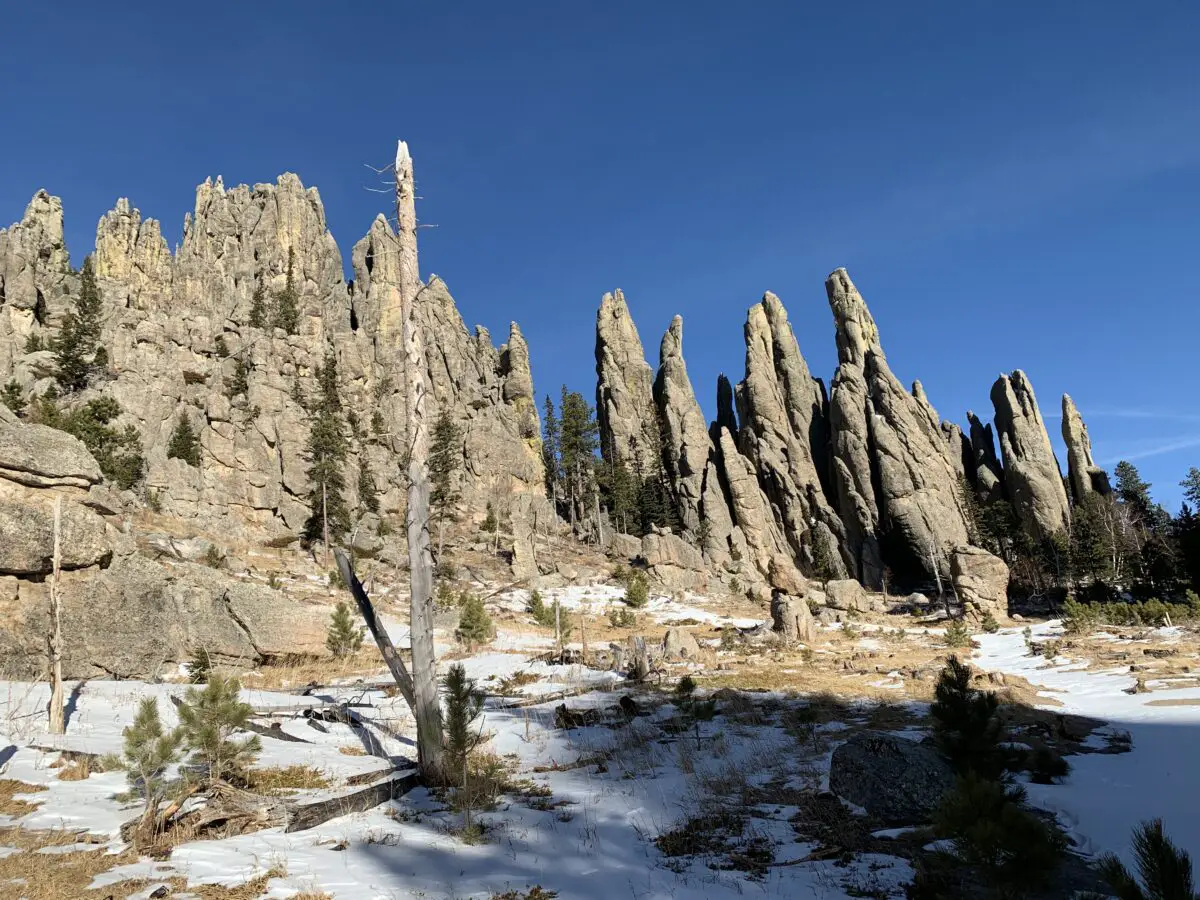
Near the summit, the last several hundred feet does require scrambling over large, steep boulders.  There are some absolutely gorgeous vistas on this trail, and from the summit, you can get great views of the Cathedral Spires…

Brown grass with some snow in the foreground, dotted with green, pine trees. Gray, pointy rock structures in the background, , all under a clear, blue sky.

Cathedral Spires Trail

You can reach this trail directly from the Little Devils Tower Trail or from the Cathedral Spires Trailhead on Needles Highway (if it’s open).  The actual Cathedral Spires trail is about one-and-a-half miles in each direction. Be aware that it IS steep though. A little clambering/bouldering is even required if coming directly from the trailhead. Returning to the trailhead from the Spires is easier though some hopping down rocks is still required. (So while accessing the Spires from Sylvan Lake takes longer, it’s also easier!

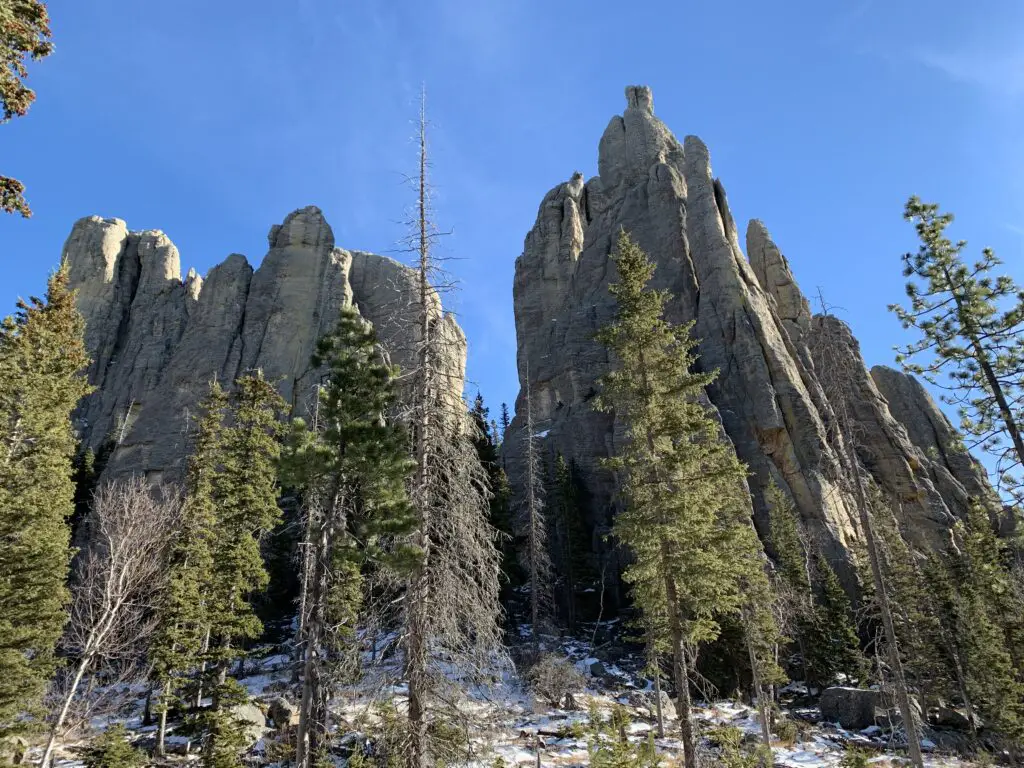
At the terminus of the trail, you will find yourself in an amphitheater.  It is surrounded on three sides by rock spires that reach to the heavens as they tower overhead.  Sounds reverberate off the rock causing a cacophony of noise.  This is a prime area to stop for a quick lunch break and it is especially haunting in the fog when it creates a spooky, almost fairy-tale-like scene.

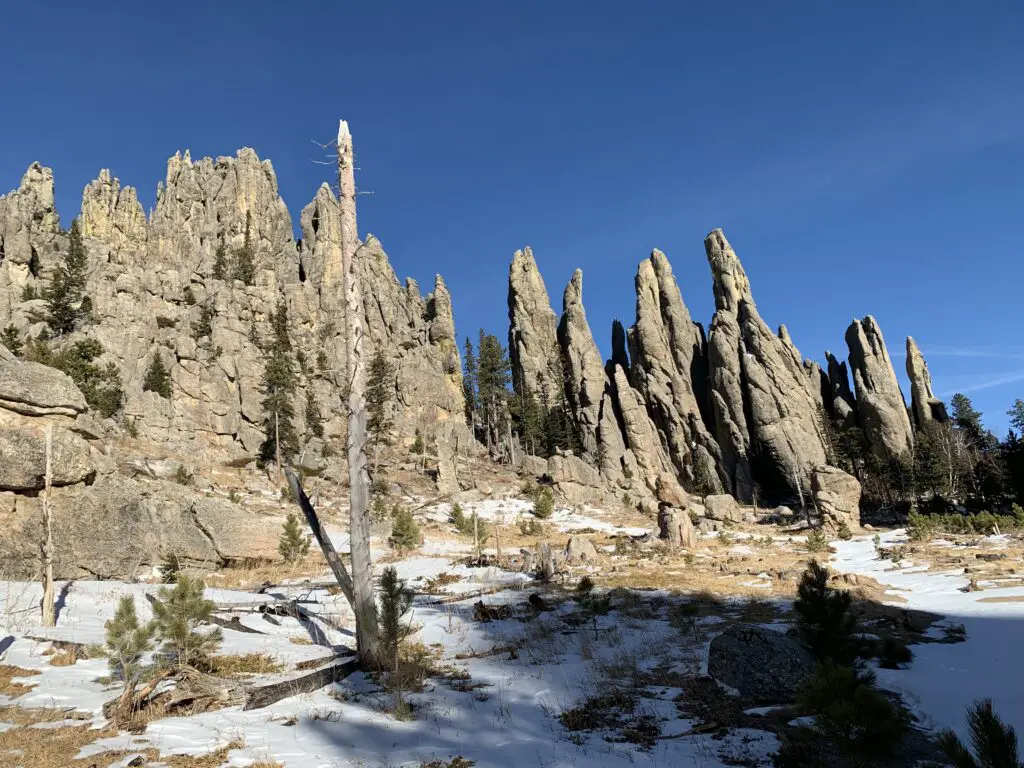
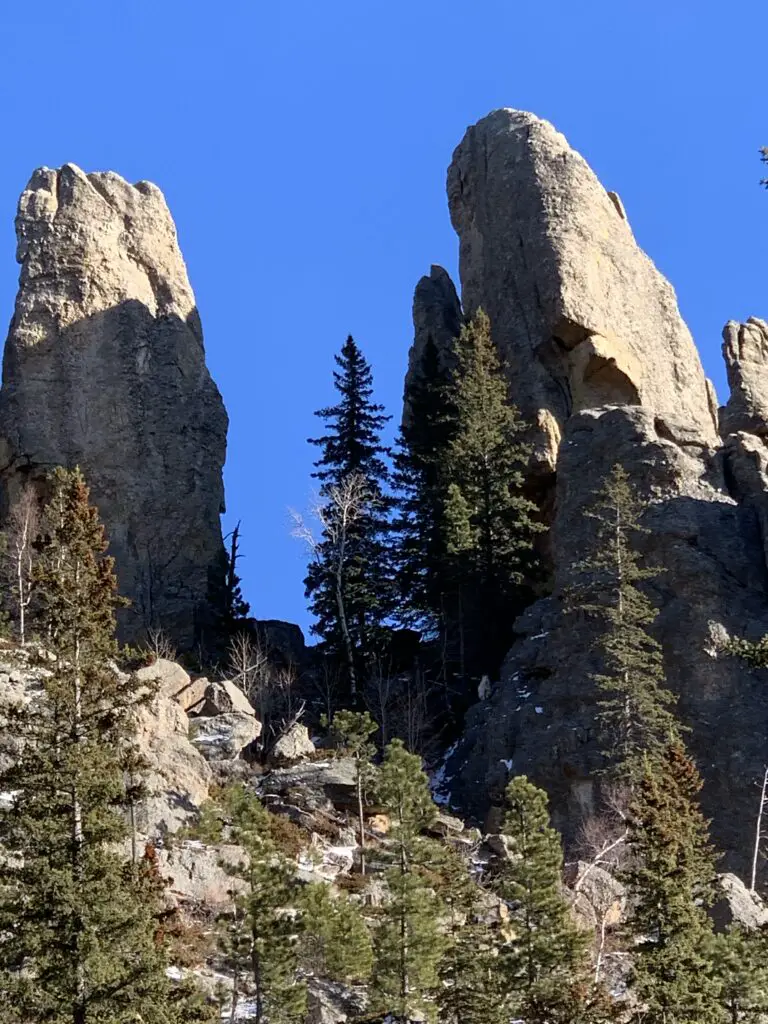
Green, pine trees in the snow in the foreground. In the background, gray, rocky spires reach to the clear, blue sky.
The Cathedral Spires!

Small, green, pine trees in the snow in the foreground, along with a dirt path. In the background, gray, rocky spires reach to the clear, blue sky. Needles Highway

This connector section of the trail offers incredible views of Custer State Park and the town of Custer that sits directly to the south of the park.  On clear days you can also see the plains that stretch to the east and south.  It is truly a beautiful area!  Watch for mountain goats here too as they favor the rocky, granite crags that this part of the state is known for.

Green, pine trees in the snow in the foreground. In the background, large, gray, pointy boulders under a clear, blue sky.
Can you spot the mountain goat?
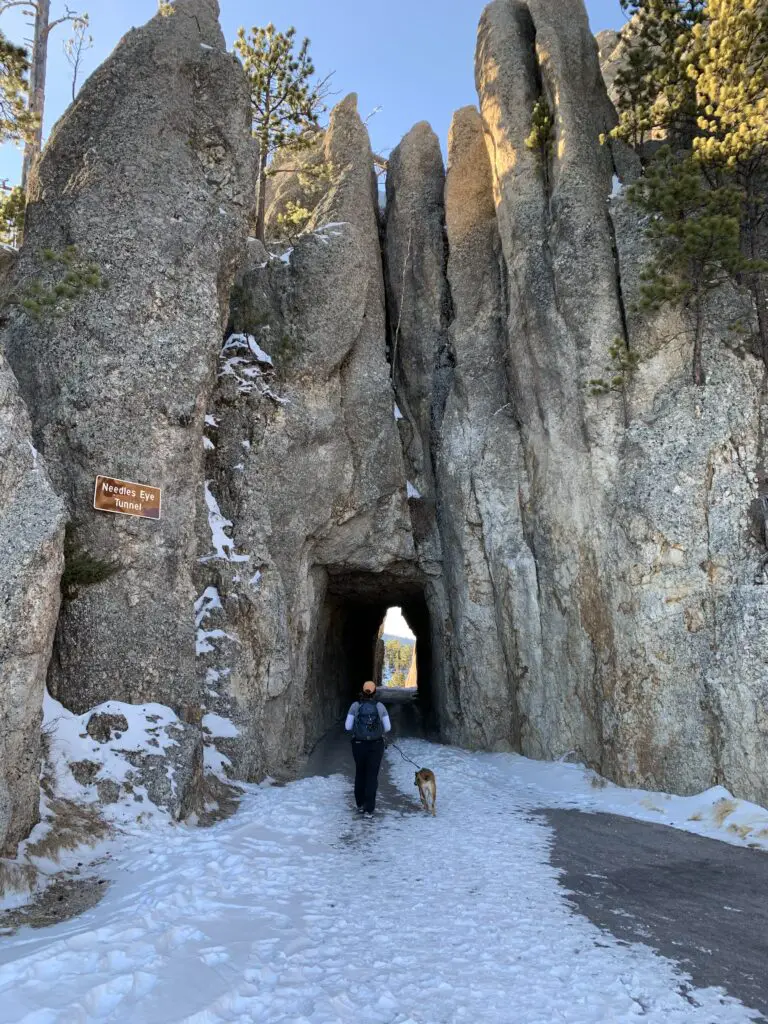
Rear view of a woman and dog walking on a snow-covered path through a tunnel of pointy rocks. A sign on the rocks reads, "Needles Eye Tunnel".
Puppers and I entering the Needles Eye Tunnel! Can you believe full-sized buses fit through here?! True story!
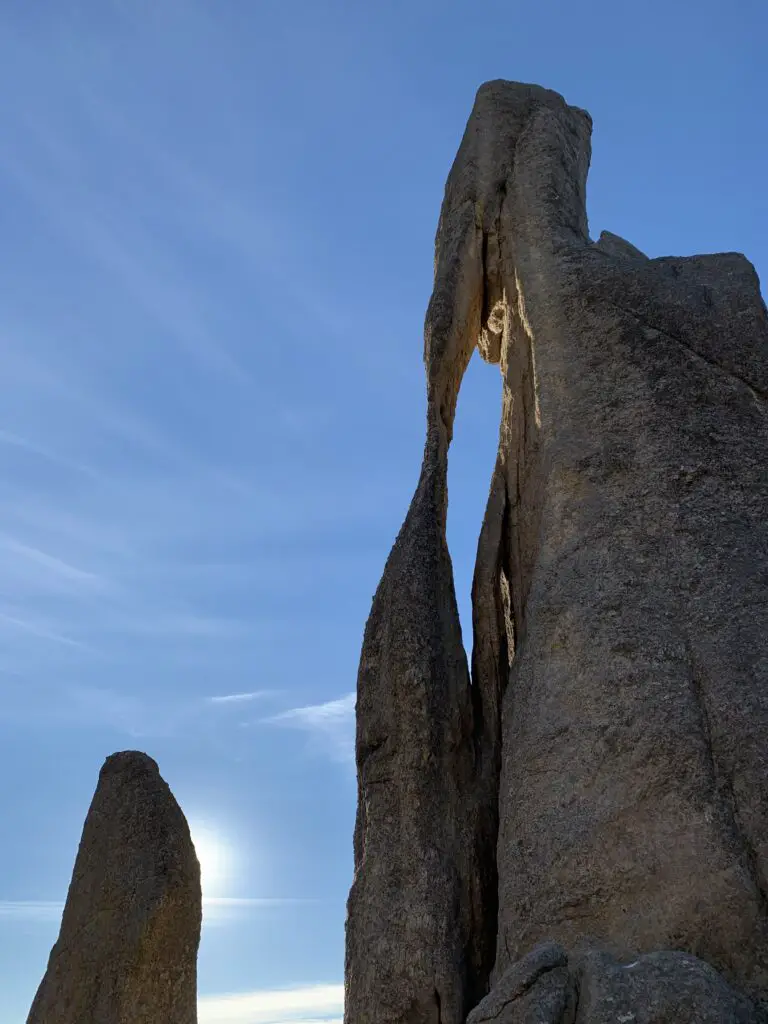
Two large, rock structures, one with a long, narrow hole, all under a blue sky.
The Needles Eye!

The entire loop is around 9ish miles in total length so it’s a little long.  However, there isn’t a lot of elevation gain as you’re already at one of the highest points in the Hills and the routes themselves aren’t too difficult.  I would rate this as a moderate hike.

So, if you’re looking for a fun and scenic way to see well-known parts of Custer State Park, check out this loop trail made from the Little Devils Tower and Cathedral Spires trails, and the Needles Highway!

Have you hiked these trails? Tell me about your experience in the comments!


Did you enjoy this post?  Pin it!

Two large, rock structures, one with a long, narrow hole, all under a blue sky. Pin reads, "Hike this loop, off-season in Custer State Park. A loop trail of the Little/Cathedral Spires Trails and the Needles Highway"


Like what you read here today?  Please feel free to leave a comment, like or share this post!  Add your email at the bottom of the page, or the sidebar to the right, to be notified when a new post is published.  By signing up for the email list, you will also receive a free copy of the Tranquil Trekker’s Top 10 Tips of Trekking Do’s and Don’ts!

You can also follow the blog on social media by clicking the links below!

Facebook

Twitter

Instagram

Pinterest


Centennial Trail Between Bear Butte and Alkali Creek Trailheads

In this post, I review the northern portion of the Centennial Trail that runs between Bear Butte State Park and the Alkali Creek trailheads (this also includes Fort Meade) in the northern Black Hills.


Mild, winter days make great weather for hiking the northern portions of the Black Hills Centennial Trail.  Today’s post is going to focus specifically on the sections that run between the Alkali Creek trailhead and Bear Butte State Park (Fort Meade is included in this).

Where can you find the Alkali Creek, Fort Meade, and Bear Butte trailheads of the Centennial Trail?

When hiking the Centennial Trail from these trailheads you can choose to start from whichever one you’d like and can travel northbound or southbound from any of them.  All of these are pretty easy to find as they are all close to populated areas (namely I-90 and Sturgis, South Dakota).  See below for specific directions to each:

    • Alkali Creek trailhead:  located adjacent to I-90 across the highway from the Black Hills National Cemetery at Exit 34.
    • Bear Butte trailhead:  found at Bear Butte State Park which is northeast of Sturgis, SD on Route 79.
    • Fort Meade trailhead:  located on the eastern edge of the Fort Meade historical site off of Route 34, just east of Sturgis.

What will you see on the Black Hills Centennial Trail in the Northern Hills?

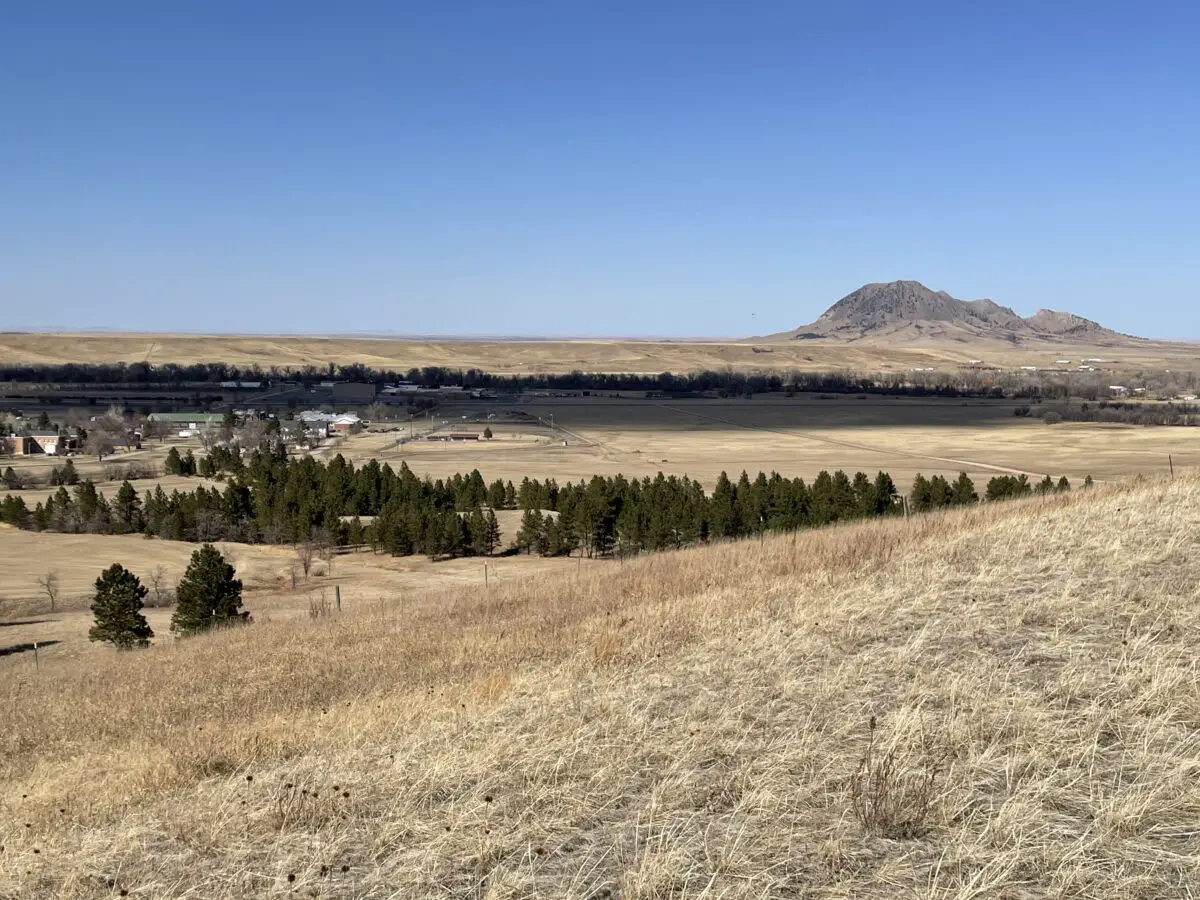
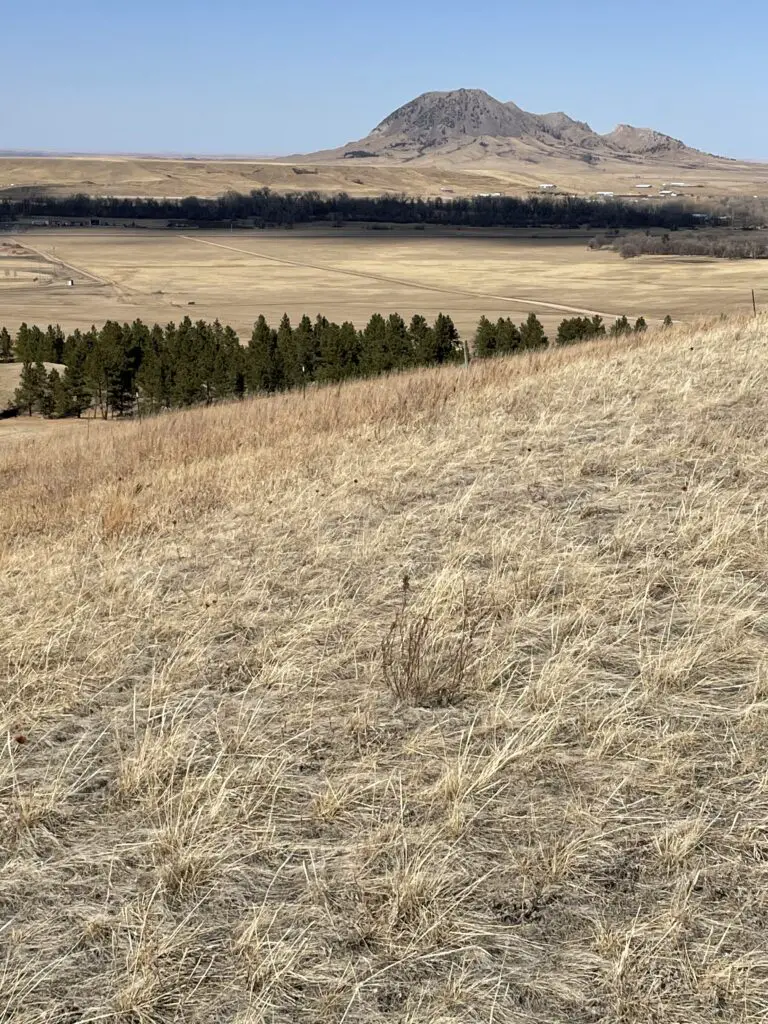
This whole area sits in the shadow of Bear Butte, meaning it offers spectacular views of that unique formation.

Bear Butte is a “sister” volcanic plug to Devils Tower that is located in eastern Wyoming.  The American Indians who named this geological formation gave it this name as they thought it resembled a sleeping bear. (I think it more resembles a sleeping stegosaurus or dragon, but the tribal people probably wouldn’t have been familiar with these critters, so I’ll give it to them. 😀)

The idea of the bear plays into the American Indian legend of the giant bear who scored the sides of the Tower with his claws, leaving the large columns of igneous rock behind.

The Centennial Trail between Alkali Creek and Fort Meade trailheads

My favorite of these sections is the portion between Alkali Creek and the Fort Meade historical site in Sturgis.  As its name would imply, Fort Meade was originally built as a fort in the late 1800s.  It now features a museum, multiple historical buildings, and a VA hospital.

As you venture near the fort you start to see many historical buildings popping up along the hiking route.  One was just an old ( but beautiful) stone fireplace and chimney.  Another looked to be old, stone barracks.

Brown-grass plain in the foreground leads to tree covered hills in the background
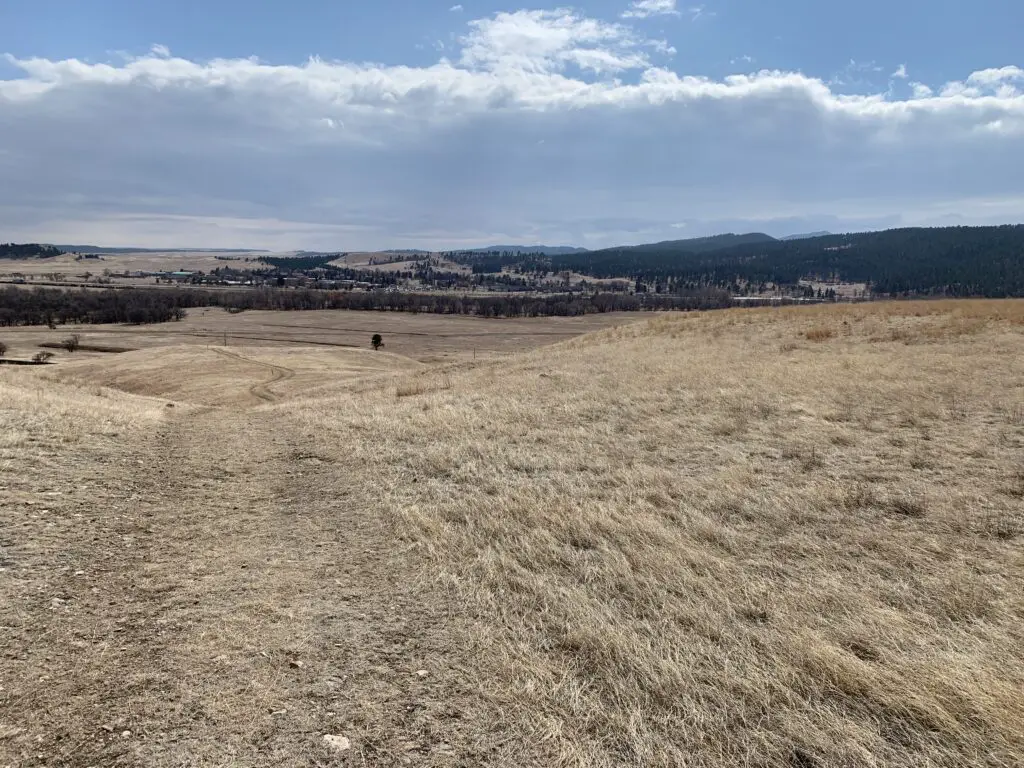
On the Centennial Trail, looking towards Fort Meade from the north

On the Alkali Creek portion, we made a loop of the Centennial Trail and through the Fort Meade Recreation Area.  This place is awesome!  I had heard about it before but had never been there.  We’d definitely like to go back and do more of the trails.  They would be perfect for mountain biking or horseback riding, in addition to hiking.

We brought roads 11 and 12 back to the Alkali Creek trailhead to complete our loop.  They were much easier and quicker than the way out as they were mostly on old forest roads.  Be aware though, that this section has no shade as it traverses the grassland portion of this trail.

Brown-grass plain, green pines and leafless trees in the foreground, a small grouping of houses and other buildings in the background surrounded by trees
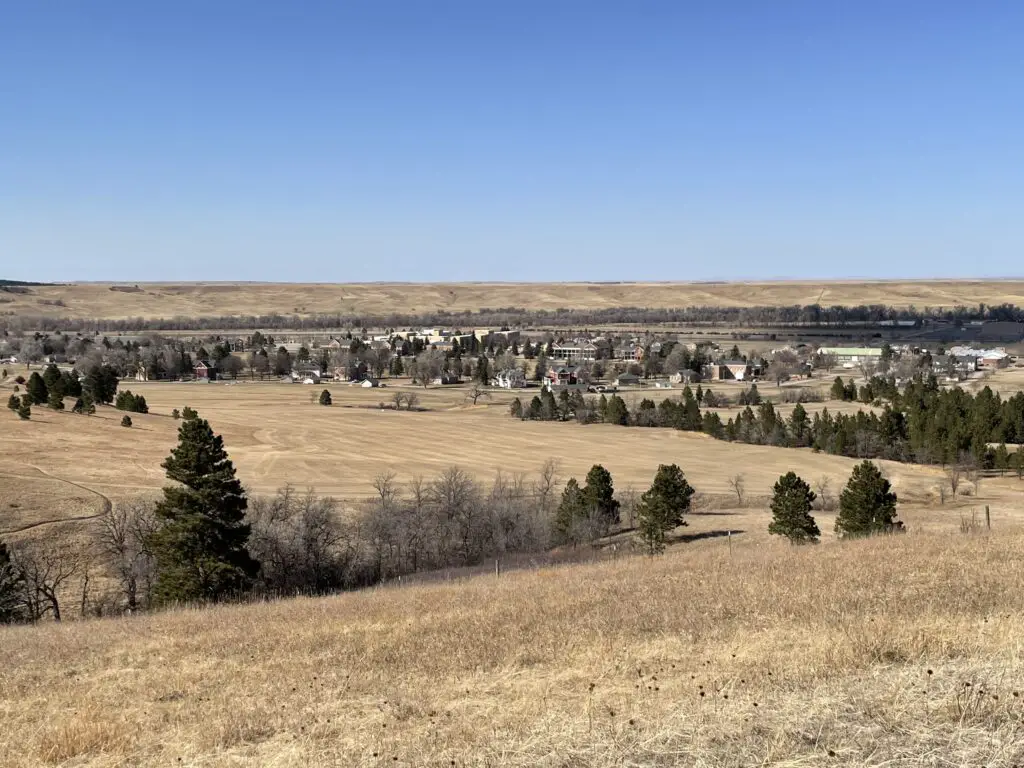
The Fort Meade historical site

This section of the Centennial Trail is VERY pretty.  It is comprised of forested hills (much like the rest of the Black Hills) and prairie sections.  There are lots of different ecosystems and flora represented here, ranging from pine forests to prairie grassland.  It made me wonder if this is what Bear Butte looked like, before the fire in 1996?

Brown-grass plain and green pine trees to the horizon where a mountain stands that looks like an animal laying down, all under a clear, blue sky
Bear Butte, the sleeping bear (or sleeping stegosaurus, if you prefer. 😉 )

This portion of the trail is comprised of a bunch of up-and-down sections, but nothing too terribly steep or long.  It reminded us of some of the Devils Tower hikes in Wyoming where you are hiking through the trees but can still look out over the plains.

While one portion of this hike is VERY close to I-90 (the highway is maybe half a mile away?) it isn’t very noisy because you’re in the forest on the “other” side of the hill!  Yay, science!

The Black Hills Centennial Trail between Fort Meade and Bear Butte trailheads

The rest of this section of trails is comprised mostly of just prairie and prairie dogs. 😊  We did spot a grass fire to the north as we were hiking along.  That was a little disconcerting as were surrounded by highly flammable material. 😮

We weren’t too worried as it was quite a ways off, we could see the authorities were already on the scene, and the wind was blowing the fire away from us.  It did get us thinking about what we would do if a fire was to come racing across the grassland while we were hiking through it. 😝  There was a farmhouse nearby we could have run to or there were some small cow ponds scattered nearby.  These may not have been very clean or nice but they would have sufficed in a pinch! 😂

Take note that these portions of trails could be VERY warm in the summer (which is partially why we enjoyed them in the winter).  Much of the Centennial Trail in this region traverses grassland with no shade to speak of ANYWHERE.  While the brisk, South Dakota breeze usually accompanies you, you won’t be able to escape the unrelenting sun.

Between the hot sun and that breeze–plus the fact that the air is usually quite dry here–you can dehydrate quickly and easily.  Not only do they dry you out, but the constant breeze and dryness can make it so that you don’t even realize how much you are sweating.

That being said, this portion of the Centennial Trail is a great hike!  It offers some amazing views and it is easier than many portions of the trail that are further south.  This is because the altitude is lower here and the elevation changes are far more minimal.  So if you’re looking for something fun to do, check out the Centennial Trail in the Northern Black Hills!

Have you tried out any of these routes?  What did you think?  Tell me about your hike in the comments!


Did you enjoy this post?  Pin it!

Brown-grass plain and green pine trees to the horizon where a mountain stands that looks like an animal laying down, all under a clear, blue sky. Pin reads, "Black Hills Centennial Trail between Alkali Creek and Bear Butte"


Like what you read here today?  Please feel free to leave a comment, like or share this post!  Add your email at the bottom of the page, or the sidebar to the right, to be notified when a new post is published.  By signing up for the email list, you will also receive a free copy of the Tranquil Trekker’s Top 10 Tips of Trekking Do’s and Don’ts!

You can also follow the blog on social media by clicking the links below!

Facebook

Twitter

Instagram

Pinterest

Willow Creek Trail Black Hills

In this post, I review the Willow Creek loop trail!


One shorter trail the Trekkers really enjoy in the Black Hills is the Willow Creek Trail (trail #8)!  I like this route so much because it isn’t super difficult.  Anyone can reach the trailhead with any vehicle (in good conditions).  It’s also fairly short with no lengthy or super-difficult climbs, so anyone in decent condition should be able to manage it.  This trail is appropriate for all ages, children, adults, and four-legged friends! 

Related posts:  Hiking the Boulder Hill Trail; “Secret” Hiking Trails off Sheridan Lake Road; Coon Hollow Trail; Little Elk Creek Trail; Flume Loop TrailStratobowl near Rapid City

The Willow Creek trail also sticks to the lower altitudes in the Black Hills and doesn’t offer any major elevation changes, which makes it easier.  This route allows you to get out into the Hills, to experience their beauty, to view some of the more rugged parts of the Hills, and to really experience getting out into the wilderness, on an easily accessible and hike-able trail.  It’s almost perfect!

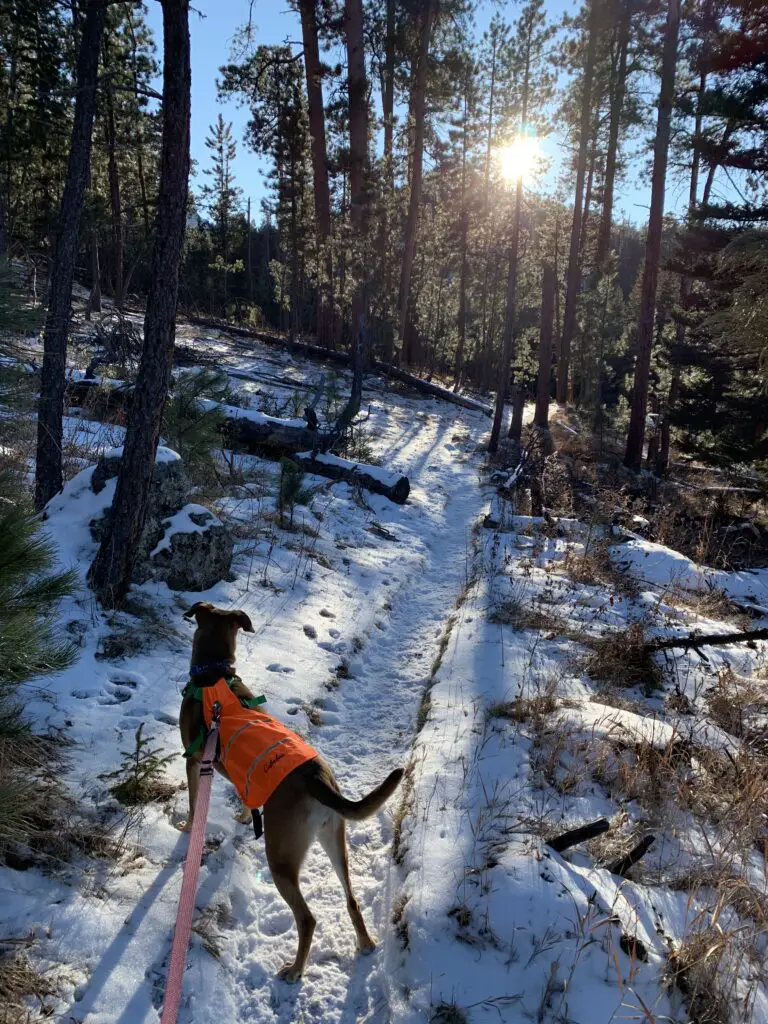
Rear view of a dog standing on a snowy, hiking trail in a forest. A low sun shines through the trees.
This trail is Puppers approved!
Where in the Black Hills is the Willow Creek Trailhead?

You will find the trailhead at the Willow Creek Horse Camp which is off of Route 244, almost directly across from the Mt. Rushmore KOA Resort at Palmer Gulch.  It sits about 6 miles to the west of Mount Rushmore and around 3.5 miles east of the junction of US 385 and Route 244.  There is a short lane to reach the trailhead that is dirt, but it is well-graded and appropriate for any type of vehicle (in good conditions.  It may be impassable in deep snow.)  There is also a large parking area with plenty of room for numerous vehicles.

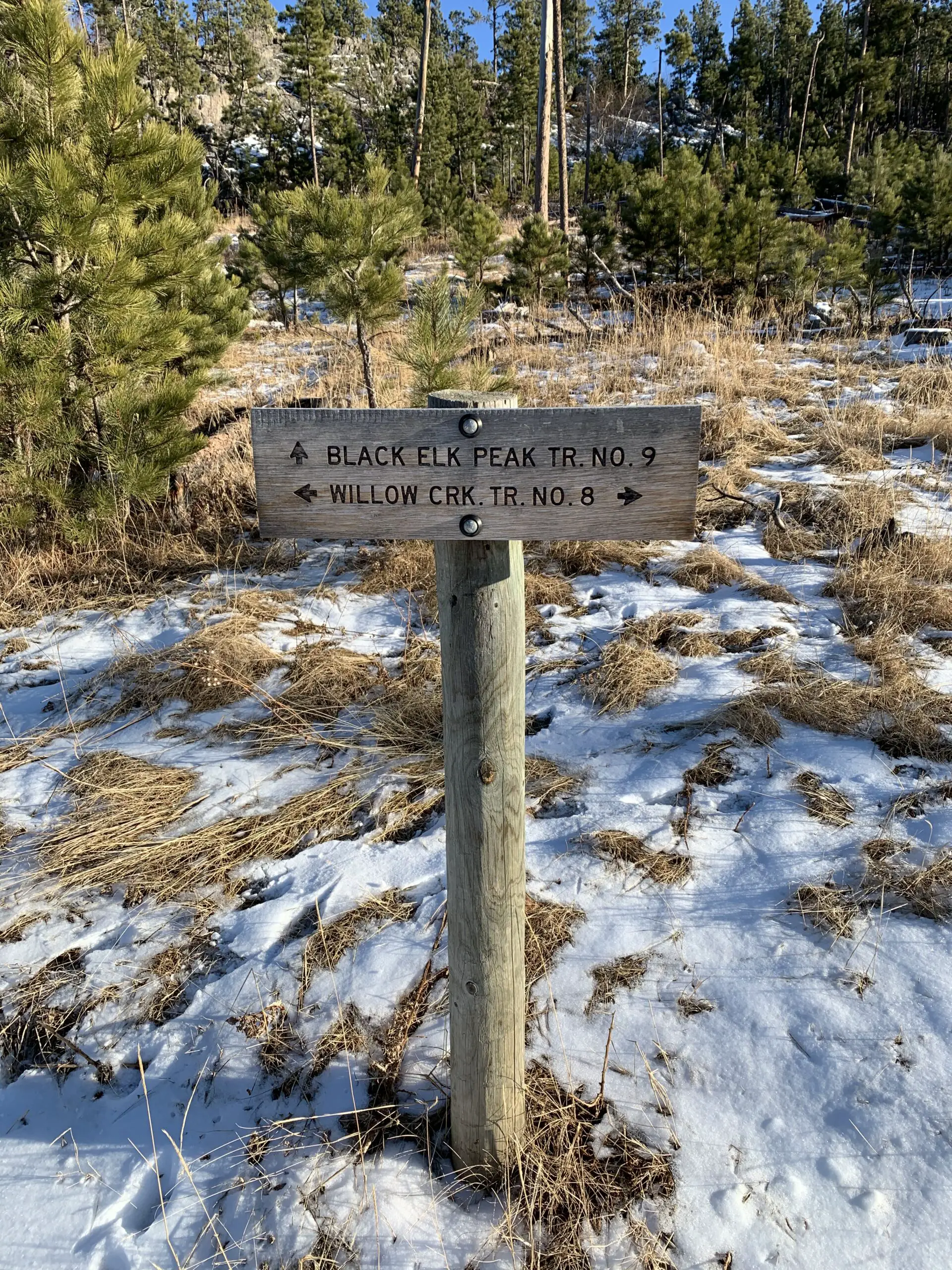
In the foreground, a trail sign that reads, "Black Elk Peak Trail #9" (arrow straight ahead), "Willow Creek Trail # 8" (arrow left and right). Hillside with sparse snow and pine trees in the background.

This trail doesn’t “go anywhere” per se. It does connect to the Black Elk Peak trail (trail #9–the hard way!) which is the northern route up the tallest mountain in the Black Hills.  It also connects to the Lost Cabin Trail which is another fun hike in this local part of the Harney Range.

How long is the Willow Creek Trail?

This trail is a 2.5-mile loop, that you can take in either direction.   I recommend trekking it counterclockwise.  This means you will face the two steepest, uphill climbs earlier on in the hike when you are most fresh.  Also, if conditions are iffy at all–wet, snowy, or icy–it is usually easier to handle these while climbing rather than on the downhill. (It is better to work against gravity in these situations.)  This left (or east branch) of the trail does have a lesser amount of shade.  When the weather is cool this means it’s more likely to be warmer, though in the hotter months, the sun can beat down on you in this section.  

What you will see on the Willow Creek Trail

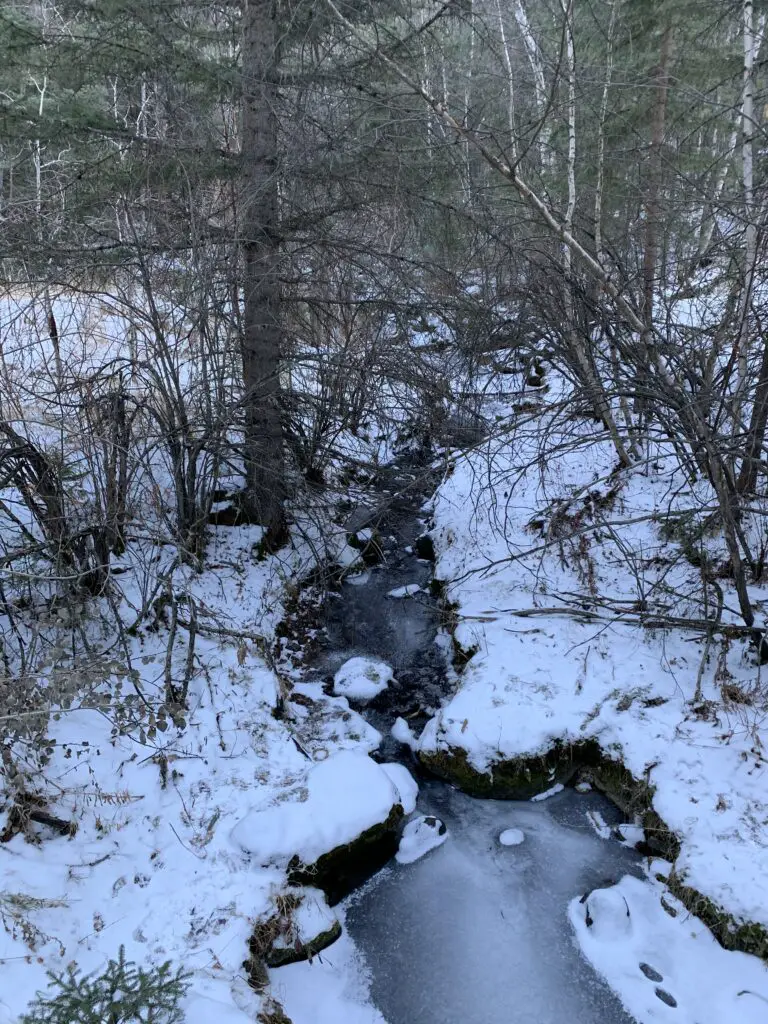
While the entire trail is fun, the prettiest portion of it is on the right (or western) arm of the loop.  This area is one of the lowest and flattest parts of the trail.  It comprises mostly a riparian habitat (or one that is near a creek).  It’s lush, vibrant, fairly cool, and shaded during the summer months.

A narrow, icy creek flows through a snowy forest.
Willow Creek!

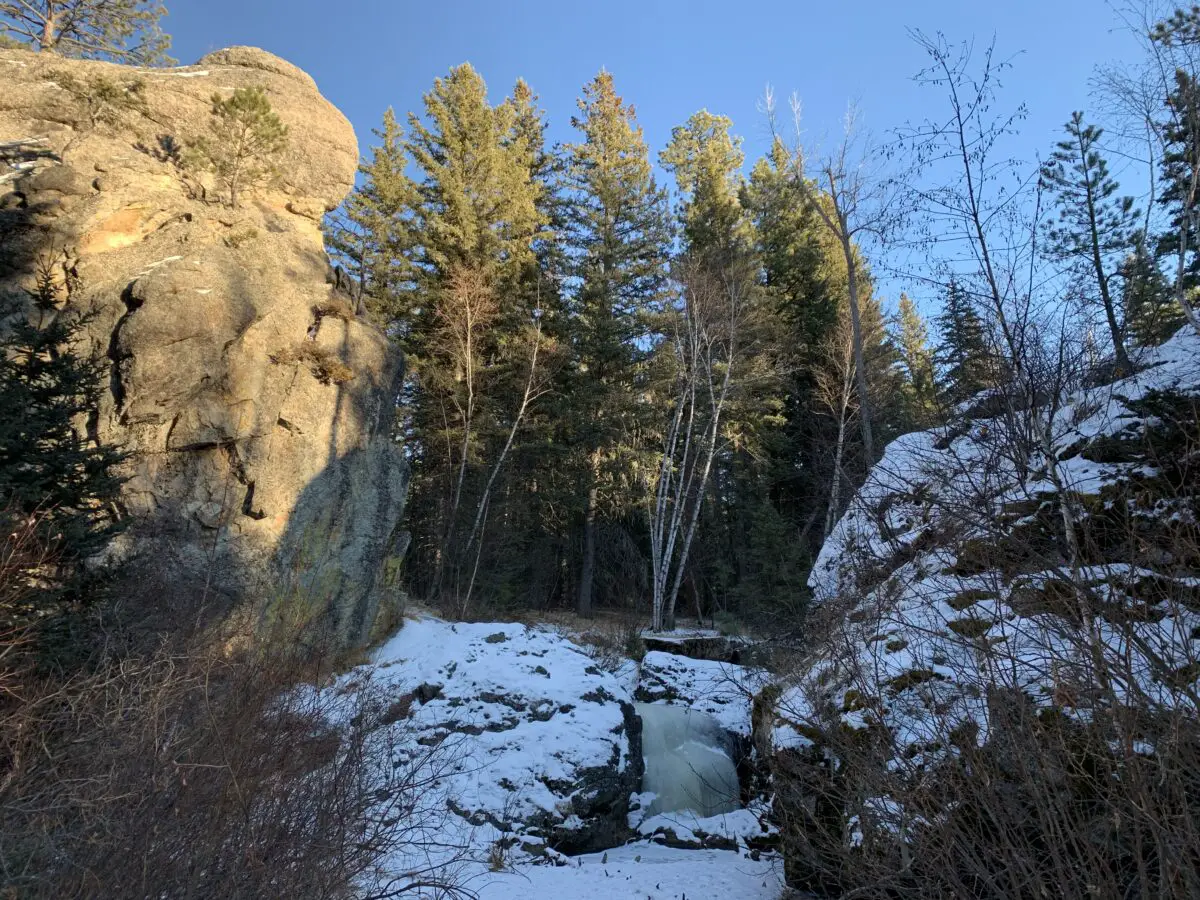
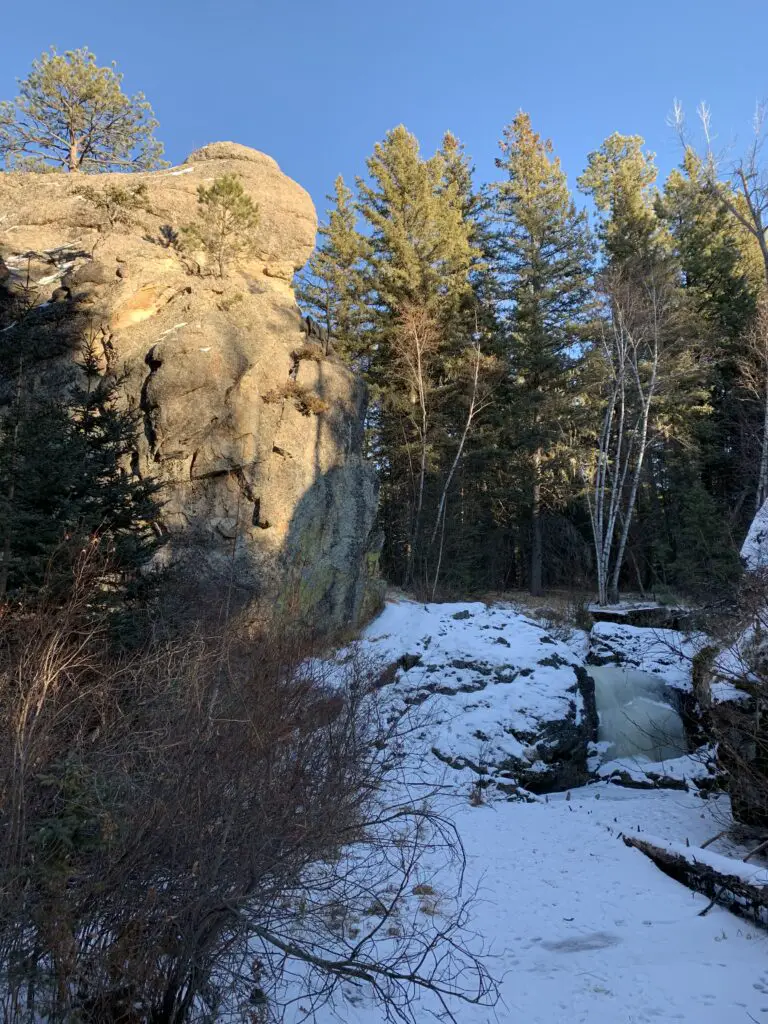
One of the prettiest parts of this section of the trail is a small waterfall that is formed by the creek.  A short side path will lead you to it.  It is especially pretty when it is frozen in the winter, though use care when walking on and around the ice.

A snowy slope with a large boulder towering on one side in a forest. A tiny, iced-over waterfall sits in the snow.

Below is a video Mr. Trekker took of the frozen waterfall:


If you’re looking for a fun trail to hike in the Black Hills that is easy to reach and appropriate for almost anyone, check out the Willow Creek Trail!

Have you hiked the Willow Creek Trail? Did you enjoy it? Tell me about your experience in the comments! 


Did you enjoy reading this post?  Pin it!

Three pictures: 1) A trail sign that reads, "Black Elk Peak Trail #9" (arrow straight ahead), "Willow Creek Trail # 8" (arrow left and right) on a snow-spotted hill; 2) A snowy slope with a large boulder towering on one side in a forest. A tiny, iced-over waterfall sits in the snow; 3) a dirt, hiking trail through a snow-spotted forest. Pin reads, "Black Hills Willow Creek Trail


Like what you read here today?  Please feel free to leave a comment, like or share this post!  Add your email at the bottom of the page, or the sidebar to the right, to be notified when a new post is published.  By signing up for the email list, you will also receive a free copy of the Tranquil Trekker’s Top 10 Tips of Trekking Do’s and Don’ts!

You can also follow the blog on social media by clicking the links below!

Facebook

Twitter

Instagram

Pinterest

Give Wildlife Room to Roam

In this post, I discuss the need to respect wildlife and give them their space.


Public Service Announcement!  I apologize in advance, this post is going to be a bit of a rant. 😇 

Every year tourists come to our beautiful corner of South Dakota.  They visit some of our amazing locations like Wind Cave National Park and Custer State Park.  Many of these visitors aren’t used to some of the exotic wildlife we have here.

Many of them have only seen domesticated animals in their pens, or have only seen wild animals if it’s been behind the safety of cages or other dividers in places like zoos.  Out West, we have national and state parks where there’s nothing between you and the MASSIVE, POWERFUL, and VERY WILD animals except a little bit of oxygen.  So let’s talk about giving wildlife room to roam!

Every year you hear of people getting attacked by deer, elk, or bear (especially in places like Yellowstone National Park.)  Oftentimes they’ll get charged or gored by buffalo which especially, seem to be problematic and tempting for visitors.  They look like domesticated cows…note to self, THEY AREN’T!  They are strong, they have INCREDIBLY HARD AND POWERFUL heads, and oh yeah, they have SHARP HORNS!…even the females.

It’s pretty well known that Mommas of any species can get quite aggressive when defending their babies. (I’m not a human Momma but Puppers is my baby and I will go into full Momma Grizzly mode if someone or something tries to hurt her. 😝 )  Oftentimes, mother animals are the ones that can pose the greatest risk to us, or our dogs.  Even neighborhood deer have been known to act aggressively when they think their young are in danger. 

We all need to remember that when we go out in the wild, we are invading the animals’ homes.  Let’s be courteous guests and treat this natural beauty with the respect it deserves!  If an animal reacts to you in any way, YOU ARE TOO CLOSE!  It doesn’t matter if you think you’re giving them plenty of space or if you “aren’t even doing anything”.  If the animal reacts to you that’s his way of telling you that you need to back off, and that should be the end of the story.

So the next time you’re visiting one of these amazing locations or interacting with wild animals in any setting, take it from a local (and heed the advice of the MANY signs that are posted ALL OVER these types of parks)…#dontpetthefluffycows! 🙄  We are supposed to be the superior species in regards to mental prowess, after all, so let’s act like it, please! 😝

Do you have any suggestions for enjoying the beauty of wild animals while also giving them space?  Let me know what they are in the comments!


Did you enjoy reading this post?  Pin it!

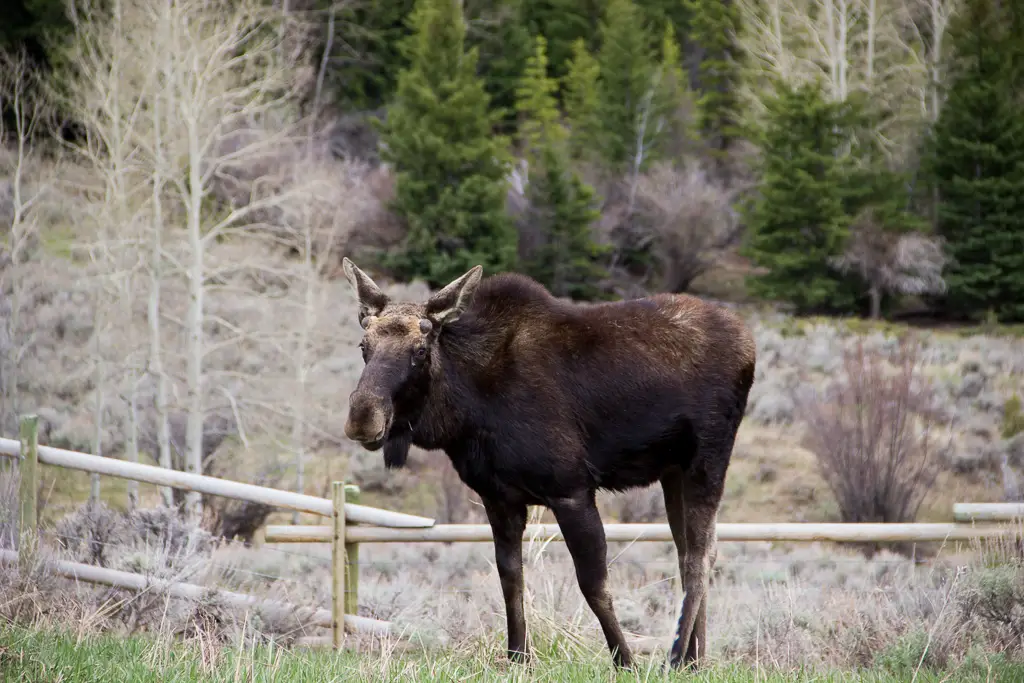
3 pictures: 1) A cow elk walks through a meadow with trees behind her; 2) A cow moose stands in front of a fence. A rocky mountain and pine trees are behind her; 3) In the background, several moose stand in a meadow with pine trees behind them. A creek is in the foreground. Pin reads, "Please! Give Wildlife Their Space!"


Like what you read here today?  Please feel free to leave a comment, like or share this post!  Add your email at the bottom of the page, or the sidebar to the right, to be notified when a new post is published.  By signing up for the email list, you will also receive a free copy of the Tranquil Trekker’s Top 10 Tips of Trekking Do’s and Don’ts!

You can also follow the blog on social media by clicking the links below!

Facebook

Twitter

Instagram

Pinterest

Microadventures: Fun Close to Home!

In this post, I review a recent adventure the Trekkers pursued, “chasing” the Neowise comet!


I’m going on a Microadventure!

What is a Microadventure?

“Microadventure” is a term that’s come about in recent years.  It basically means you’re going on an adventure that’s close to home, easily accessible, and can be completed in as little as a few hours.  It can range from anything from a Saturday picnic in the woods to a several-day long camping trip.  It can be enjoyed at any time, though it became increasingly popular during Covid when many people were choosing to save some money, and to not venture too far from home.

Microadventures are a great way to find the hidden gems to enjoy in your local community and region.  They’re especially helpful as an escape from everyday stress and burnout when you may not have the time, funds or vacation days for a lengthy trip.

The Trekkers live for microadventures, be those outdoor activities in the Black Hills, or storm chases in the nearby plains!

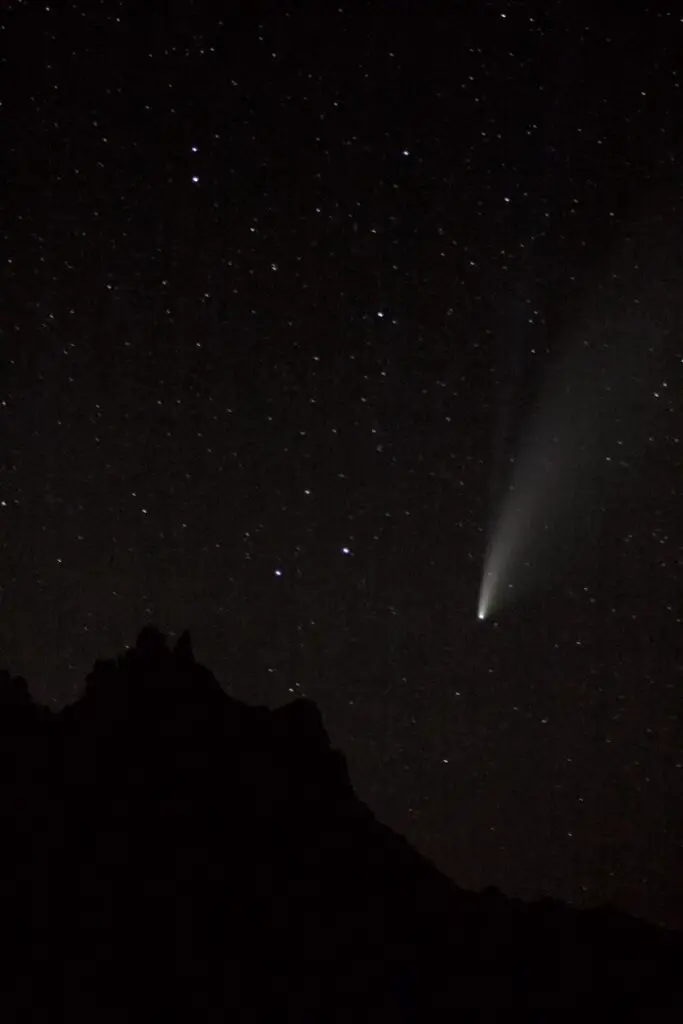
One of our favorites was several years ago when we “chased” Neowise, the comet that made a surprise appearance in the skies above us!

This wasn’t the first comet I’ve seen in my life.  I’m old enough to remember standing outside my childhood home, in the 1990s, with my mom one night, checking out the Hale-Bopp comet through the binoculars.

How do I find a microadventure near me?

It helps that we live in a beautiful place that makes these opportunities many and easy to find, though you can enjoy these types of activities in most places if you know where to look.  Go to your local community park or just take a drive in the country outside the city lights.  So many places have walking paths and greenways now, even in more urban areas.  There are also museums, historical and natural sites, and additional recreational activities, such as ropes courses to explore.

We actually started our chasing adventure on Skyline Drive, which traverses the ridgeback that splits the town of Rapid City in two.  Unfortunately, the light pollution from town made it difficult to see the comet.  A few evenings later we visited Badlands National Park, with MommaTrekker and Puppers in tow.

Badlands National Park, by-the-way, is one of the best places to view the night sky that I’ve ever seen.  As the park’s location is the epitome of the “middle-of-nowhere” and being that this area is more arid, where clear skies are a common occurrence, this is a place with very little light pollution where you can view the night sky in all its grandeur.  It helped that the night we went, the moon wasn’t up yet.

My mom agreed that she had never seen so many stars, and she’d spent the last 40 years living on a farm in Indiana!  Several different constellations, planets, and the Milky Way were also easily visible to the naked eye.  I can also attest, from previous experience, that this is a GREAT place to view meteor showers! 😮 

Several days later, we finished our adventure with a short drive to Pactola Lake which is about a half-hour to the west of Rapid City.

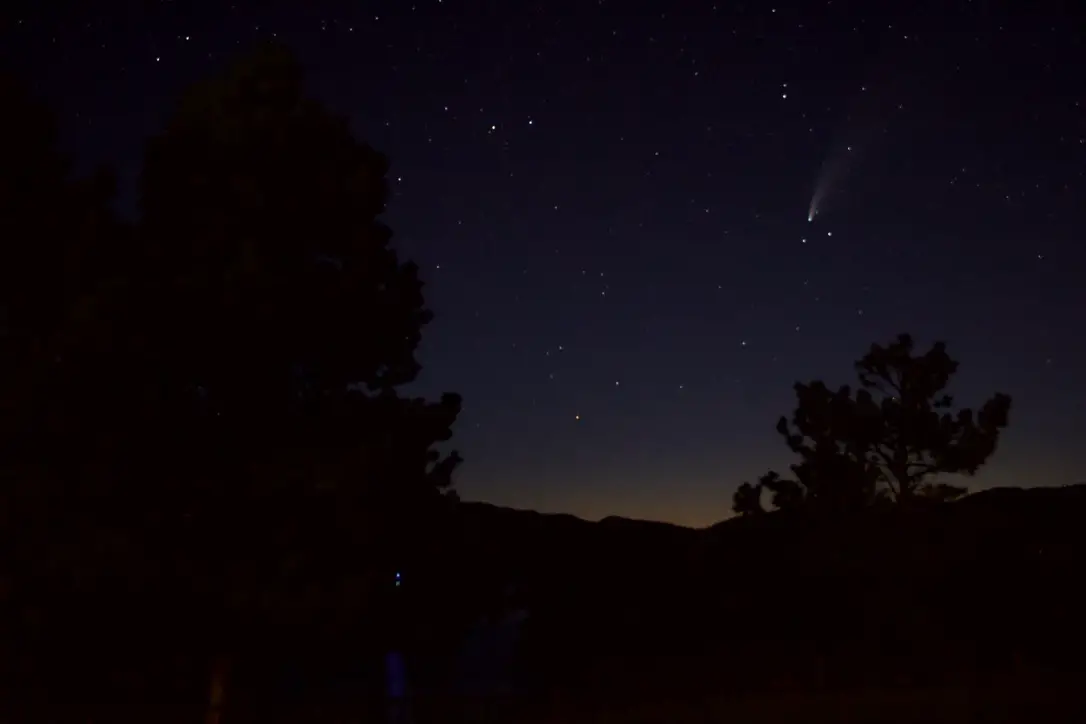
A small, white-colored comet streaks across the dark night sky
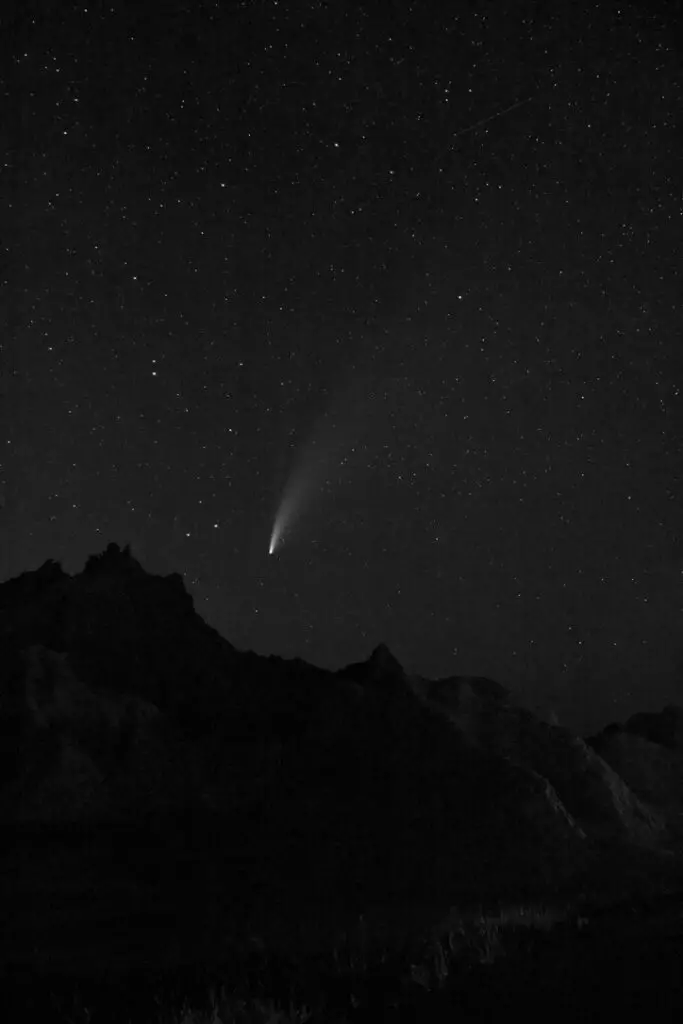
Neowise over the Badlands!

A small, white-colored comet streaks across a dark, night sky dotted with stars

Whether you don’t have much spare time, you prefer sticking closer to home, or if you’re trying to save a little on expenses, try out a microadventure.  See what you can discover near you!

What sorts of activities do you enjoy on your microadventures?  Tell me about them in the comments!


Did you enjoy reading this post?  Pin it!

A small, white-colored comet streaks across the dark night sky with a dark, mountain silhouette in the background. Pin reads, "The Tranquil Trekker presents Microadventures: fun close to home!"


Like what you read here today?  Please feel free to leave a comment, like or share this post!  Add your email at the bottom of the page, or the sidebar to the right, to be notified when a new post is published.  By signing up for the email list, you will also receive a free copy of the Tranquil Trekker’s Top 10 Tips of Trekking Do’s and Don’ts!

You can also follow the blog on social media by clicking the links below!

Facebook

Twitter

Instagram

Pinterest

Spring Forward: Daylight Saving Time

In this post, I discuss how my SAD symptoms decrease with the time change.


It’s that time of year again!  We push our clocks forward one hour this weekend (in the US at least)!  I know people hate the time change and I know many people have good reasons for feeling that way. (It has even been proven to mess up your sleep.)  I actually love time change day (in the spring)!  It is the day my SAD (Seasonal Affective Disorder) dies ya’ll!  

For those of us in the Northern Plains, the time change really does make the best use of our daylight hours that fluctuate wildly throughout the year.  If we stayed on Standard Time all year, it would start getting light at 3:30 am in the summer (no joke).  Whereas if we stayed on Daylight Time all year, it wouldn’t get light till after 8 am in the winter.  I’m not ok with either of these options.😝  So, I will firmly remain #teamtimechange.

Winter passed quickly

I am always amazed at how quickly the dark winter actually flies by.  It always goes more quickly than I think (worry) it will.  I’ve been VERY fortunate that my SAD has been super mild for the past few years.  I’ve hardly been noticing it at all!  It may be a fortunate side effect of my taking high doses of Vitamin D3 for the last several years. It helps that we’ve had fairly mild winters in recent years, too.

Other Vitamin D3 options:  Nature’s Bounty, Nature Made 2000 IU tablets, NOW softgels

SAD symptoms end with the time change

I am always amazed at how much better I feel once my SAD symptoms start to ebb.  It really gives you an appreciation for how strongly they affect your life.  You don’t always notice it while you’re experiencing them.  You know that everyone seems to be keen to IRRITATE THE HELL OUT OF YOU! (must they swallow so loudly?! 😂)  And you can’t help the tears that come when EVERYTHING YOU TRY TO DO FAILS MISERABLY!!! (Why am I the only one whose life is so difficult?! 🙄😉)

I hope it’s obvious that I’m being sarcastic with these statements.  In all seriousness though, I find it amazing how my SAD symptoms cast a shadow on every other aspect of my life.  Even though I personally experience it, it’s hard to believe it can cloud your judgment so much on whatever thing you’re dealing with at any given moment.   Every problem seems 10x worse when SAD is already weighing you down.  Any other stressor you feel is amplified. 

As someone who struggles with anxiety throughout the year, the SAD worsens those symptoms, as well.  I am a master champion at catastrophizing future events that I’m worried about on a good day.  When I’m dealing with SAD, as well, that ability becomes a superpower. 🙄😝

Every fall I swear, I’m not going to let SAD affect me as much this year.  I know what’s coming, I know how to deal with it, I know it WILL END, I just have to get through it…and then every spring I’m back to, “Wow!  Was all that extra angst I was feeling JUST from my SAD?”  Maybe someday I will learn. 😐

Related posts: Summer Solstice: The Longest Day; Therapy Lamp and Calm App Reviews; I HATE Seasonal Depression!Enjoying the Winter Solstice; Increasing Daylight as Winter Wains

Take back your power from SAD

Our brains are powerful tools, and they can allow our imaginations to run away with themselves if we permit them.  While its important to always be patient and understanding with ourselves, it’s also important to try to reign in the negative thoughts, especially when we can speak the name of the demon they come from (“SAD”).  By doing so we can help to lessen its control over us.  Fortunately, we CAN control that demon, and it’s time to take our power back!

Do you find the time change affects your mood?  Tell me about it in the comments!

Did you enjoy this post?  Pin it!

Orange sunrise over a meadow with a silouette of mountains in the background. Pin reads, "Daylight Saving Time Spring Forward Read on for how this change affects my SAD symptoms"


Like what you read here today?  Please feel free to leave a comment, like or share this post!  Add your email at the bottom of the page, or the sidebar to the right, to be notified when a new post is published.  By signing up for the email list, you will also receive a free copy of the Tranquil Trekker’s Top 10 Tips of Trekking Do’s and Don’ts!

You can also follow the blog on social media by clicking the links below!

Facebook

Twitter

Instagram

Pinterest

A Very Trekker Christmas

In this post, I discuss some of my happiest memories from Christmas, as well as some new traditions the Trekkers have started.


Happy Christmas everyone!

This has always been one of my favorite holidays, so on this Christmas Eve Day I thought I’d reflect on some holiday memories from my childhood, and some new traditions that Mr. Trekker and I have been implementing into our own, little family.

Trekker Family Traditions

Family Christmas traditions are funny, and growing up, my family was no exception.  Time for a bit of a confession…I never really believed in Santa (shocking, I know 😮).  Some people think that’s sad, but I was always richly blessed during this time of the year, so I never felt like I missed out on much.  Below are some of the reasons why I went without this holiday tradition:

1)  We didn’t have a fireplace growing up, so even as a child, my overly logical, skeptical mind was like, “ummm…how would that work?”

2)  My mom always put presents under the tree when she was done wrapping them.  I’m not sure how this got started, but to me, a tree looks naked if there are no presents under it (and yes, I still do this too.) 

Also, I always helped her shop for, and wrap, presents for my cousins, so I kinda figured that if she was “Santa” for them…it’s pretty obvious who Santa was for me! 😉 

Also, also, inevitably, I always ended up finding one of my presents before the big day and it was ALWAYS on accident (truly!)  One year, my mom sent me to her closet to get something for her, completely forgetting one of my unwrapped presents was hidden in there! 😂

3)  I grew up in a very religious family, especially on my dad’s side, so that aspect of the holiday was always stressed more than Santa or the gifts (Grandpa and Uncle were pastors after all 😉).  I think this was good though, as it always helped me to keep the commercialism of the holiday in perspective.

One tradition we had for a few years, when the kids were young, is to have a birthday cake for Baby Jesus on Christmas Eve.  We even got to sing “Happy Birthday” to Him (and there was cake so…😁!)  I think that is such a cool tradition.  It’s a fun way to help keep the true meaning of Christmas front-and-center for kids!

A box of Queen Anne cordial cherries sits on a table
Not everyone likes these sweet treats (I do!) but they represent a special memory for me. We would have them every year at my Grandma’s house at Christmas!

4)  Most of my Christmas memories from my childhood are from the BIG gatherings we used to have at my grandparents’ house on Christmas Eve.  The WHOLE family (we’re talking like 20 people) would gather there, with mounds of presents stacked everywhere.  After dinner, we always dressed in our best (I usually got a pretty, new dress each year, several times my mom even made them!) and we went to the Christmas Eve church service, which has always been my favorite of the whole year! 

The church would be decked out in beautiful lights and decorations, and it would always end with a moving version of “Silent Night”, lit only by candlelight.  Then, the lights would be brought back up, and while we basked in the acrid, sulphuric smoke that wafted from the tips of the blown-out candles (I LOVE that smell), we’d be sent off to a rousing rendition of “Joy to the World!”

Then we’d return to Grandma’s house for…PRESENTS! (This is probably another reason why I never believed in Santa. 😂)  

The story my grandfather told me for starting the tradition of opening gifts on Christmas Eve was that my mom and her three siblings used to wake my grandparents up REALLY early on Christmas morning to open presents (of course).  The “old folks” didn’t like it, so…they started opening presents Christmas Eve instead, so they could sleep in Christmas morning! 🤣 (To be fair, my mom disputes this story. 😂)  I always thought I was lucky, all the other kids had to wait a whole other sleep to get their presents, HA! 😉

Changing Holiday Traditions

As an adult, the holidays always seem a little weird, especially when you move far away and only return home occasionally.  They say you “can’t go back again” and in many ways this is true.  The experience is never quite the same as the rose-colored memories you have from childhood.

I have SO MANY amazing memories associated with this holiday.  I find these days though, my feelings are somewhat bittersweet.  I still LOVE all the shiny lights, carols, the beauty and peace of a candlelit church service, and time spent with family…but Christmas doesn’t quite feel the same as I remember as a kid.  For the last 20 years, things have been changing, as all of us “kids” have been moving out (and away) and getting busy with our own lives. 

You watch once-vibrant grandparents and parents age, slow, and eventually, one year, become only a memory…so all the memories made with them start to dim, as well. 

It just never quite feels the same as the days when Grandma would crawl around on the floor with us kids, with silly string in her hair.  One year the tree fell over on her as she rooted around for that last Christmas present (true story, there is video evidence of this somewhere! 😁)

A grandma lays on the floor laughing and playing with two grandchildren amongst wrapping paper
This is my favorite pic of that crazy lady, it shows her in her element…with her grandchildren.  This was Christmas, circa 1986, and yes, that brown mop of hair you see on the left would be me.

Relatives or childhood friends you were once almost inseparable from, you may now find you have little to talk about outside the updates you’re already aware of from social media.  While some family members are lost, new ones are added (both through marriage and birth).  While these are, certainly, blessings, the additional people–and their responsibilities to their own families–create complexities of their own.

Traditions change.  What used to be a gathering at Grandma’s house, of what seemed like 100 people (when you were 5), is now a smaller group sitting around another table, or even gathering at a restaurant where you can pay a stranger to cook for you and clean up afterwards! 😉 

It’s almost impossible to get everybody together at the same time anymore.  Everyone lives all over the country (sometimes all over the world!) and we’re all busy with our own families (and families-in-law).  Even on the rare occasions we DO all get together, there are so many other distractions (many of us have young kids of our own now). 

It just isn’t the same as when we used to stay up till 3 am on Christmas Eve, my cousins and I, playing with our new toys together, while the adults played cards in the other room…  

Your concept of family may change too.  It’s no longer just about blood relations (especially as various in-laws or step-family members are added).  Not everyone was blessed with a close-knit, loving family.  Others may have no close family left or those that remain may live too far away to visit with every holiday.  For many, friends make a wonderful, adoptive family.

There is always a sense of loss of family members, and “the old ways”.  One of the only real guarantees we have in life is that things WILL change.  This can be a good thing, though.  We can store up wonderful memories of bygone days, and continue some old traditions from times past while seeking to embrace new practices that will carry with them wonderful memories of their own.     

New Traditions

Mr. Trekker and I have started to develop our own traditions.  Christmas Eve, I make homemade lasagna, then we open presents with my parents (gotta keep that tradition alive!) and still enjoy a candlelit, church service.  We also like to watch a “big” Christmas movie that night, like “It’s a Wonderful Life”. 😁  Then, before bed, we read “The Night Before Christmas”. (When I was a kid we often read the Christmas story out of the Book of Luke, from the Bible, but now we kinda figure we’ve just heard it at church, so… 😉)  Then…for the big finale…we have a little slumber party in the living room with the dog, under the glowing lights of the Christmas tree!  Who needs kids to have fun?! 😂

When Christmas morning comes, we start it off with homemade treats for breakfast!  Then, there’s Facetime chats with Mr. Trekker’s side of the family (we  “Zoomed” Christmas morning with relatives who live in far-off places for years, long before COVID made it cool! 😝)  Then it’s time for the big, Christmas dinner!  Finally, we end the evening on the couch watching “A Christmas Story” (the one with Ralfie…”you’ll shoot your eye out!”)

To Conclude

Change is inevitable, and I will CHERISH those Christmas memories from when I was a kid for the rest of my life.  But I am also excited to make new memories, in the new situations we find ourselves, and with the new friends and family who may be joining us in the years to come.

I hope everyone has a wonderful holiday!  Enjoy your traditions with your own friends and families (be they blood-relation or otherwise and whether they are in-person or virtual) this holiday.  Merry Christmas to you all, and as Tiny Tim would say, “God Bless us, everyone!” 😉

Tell me about your family’s Christmas traditions in the comments!

Did you enjoy this post?  Pin it!

A grandma lays on the floor laughing and playing with two grandchildren amongst wrapping paper. Pin reads, "A Trekker Christmas"


Like what you read here today?  Please feel free to leave a comment, like or share this post!  Want to be notified when a new post is published?  Add your email and click the “Follow” button at the bottom of the page or the sidebar to the right.  By signing up for the email list, you will also receive a free copy of the Tranquil Trekker’s Top 10 Tips of Trekking Do’s and Don’ts!

You can also follow the blog on social media by clicking the links below!

Facebook

Twitter

Instagram

Pinterest

Dinosaur National Monument: the Colorado Side

In this post, I discuss the Colorado side of Dinosaur National Monument.


**Author’s note: Just a word of warning, as this is a federal, National Monument, no dogs are allowed on any trails (exceptions for Service Animals). They are only permitted in the campgrounds and parking lots.**

In this post, I reviewed the Trekkers’ visit to the Utah side of Dinosaur National Monument.  In this post, I’ll be discussing the Colorado side (as the park spans both states).

Scenic Drives on the Colorado Side of Dinosaur National Monument 

One of the main things we enjoyed on the Colorado side of the monument was the scenic drives.  There are several found throughout this portion of the park, though all but Harper’s Corner Road are suggested for high-clearance vehicles only.

As I mentioned in Part 1, under good conditions most of these roads are great to drive (honestly several of them were less bumpy than some of the paved, county roads we drove on).  I would have felt comfortable taking any vehicle with a higher wheelbase on these (such as an Outback), and we saw several SUVs.

I cannot stress enough though, that we were there in the most ideal weather possible.  According to the park, several of the roads are completely impassable when wet.  This seemed likely as we crossed many dry stream beds that could easily fill with stormwater runoff.  It also makes sense that the powdery dirt that covers the surface of many of these routes could quickly turn into slippery ooze when wet.  Many of the roads also only have one way in or out, so, if you reach the end, and then a rainstorm comes…you may not be able to get back out again.  Several also lead through low-lying canyons which are likely to flood quickly in a heavy rain event.  So please, be wary before attempting these roads if any bad weather conditions are present or expected.

Click here for the NPS website for the park which will have up-to-date info on current road conditions.

Harper’s Corner Road

This is the main road through the Colorado section of Dinosaur National Monument.  You access it near Dinosaur, Colorado.  This is also one of the only paved roads in the park.  At the end of it is the Harper’s Corner Trail which offers INCREDIBLE views.

Hiking on Harper’s Corner Trail

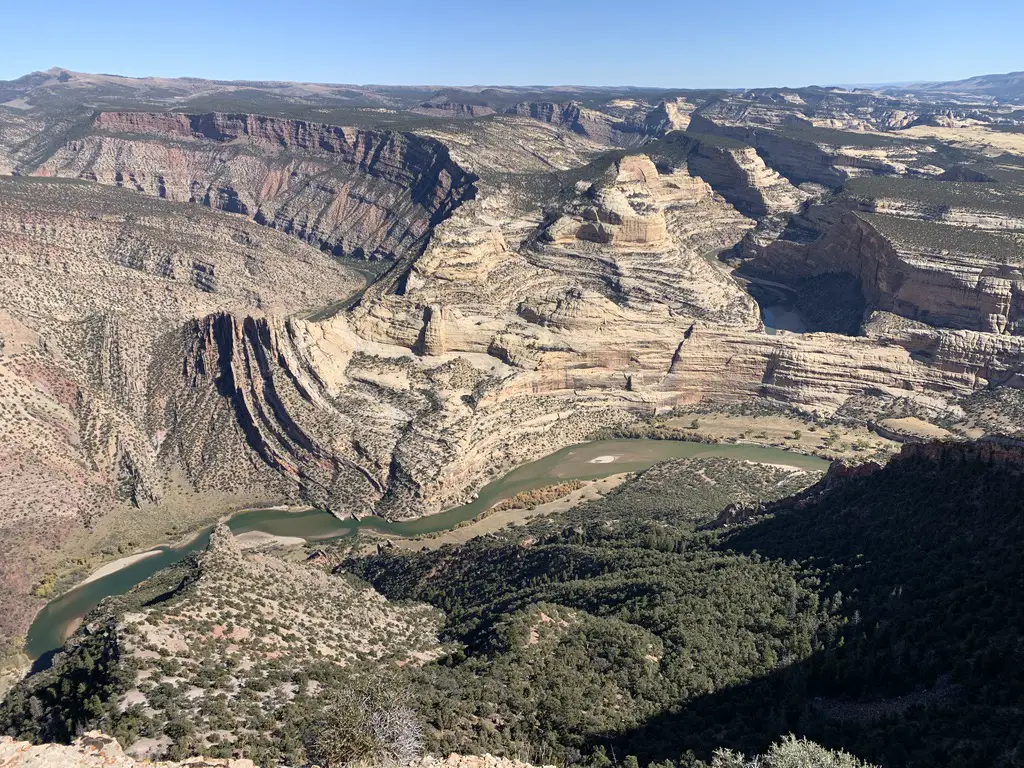
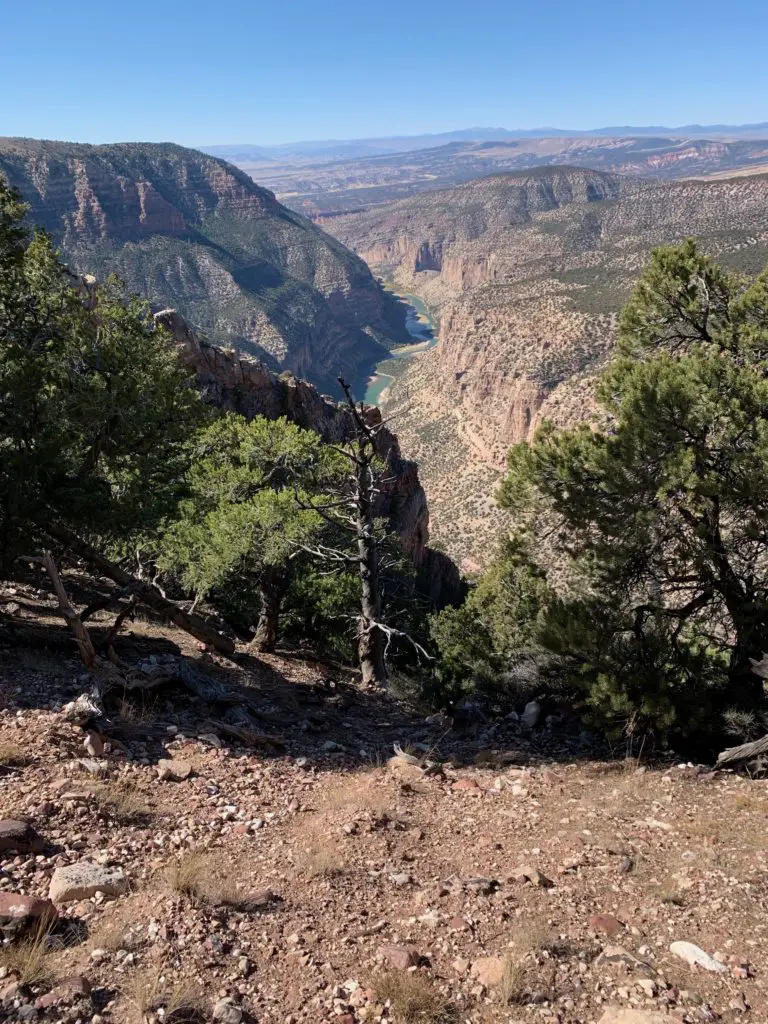
This trail is beautiful! At times you are hiking on an almost knife-edge of rock, with the Green River winding along beside you on one side, and the Yampa River on the other.  Did I mention you are up to 2500 feet ABOVE these waterways throughout the hike? 😮  It got my acrophobic-heart pumping a bit! (It really wasn’t too bad.  I only felt nervous in one spot where you get a healthy view of a chute, down a cliffside. 😋)

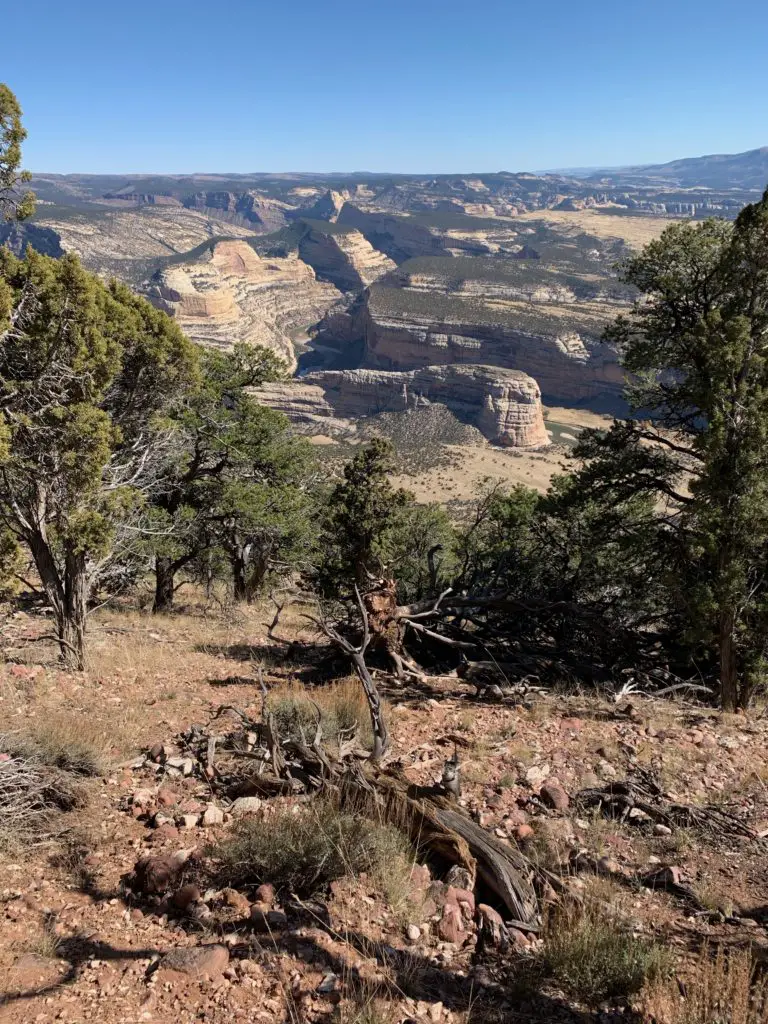
I would rate this trail as “easy”.  It’s about three miles in total length (out and back) and it doesn’t have much elevation gain.  Just about anyone wearing tennis shoes should be able to handle it (though I should note the park is at an altitude of over 5000 feet, so “flatlanders” may want to take it slow. 😉)  At the end of the trek you are treated to an AMAZING view down the canyon, and of Steamboat Rock from above, behind which the Yampa and Green Rivers meet.

A narrow river valley in a desert landscape as seen from above. Short trees are in the foreground while a thin, green river can be seen far below.
One of the incredible lookout points from the Harper’s Corner Trail. That’s the Green River far below, you can maybe see how it got its name.
Looking out over a desert, badlands landscape from above. Short trees are in the foreground with a large, rock formation in the background.
Steamboat Rock, from above…

Echo Park Road

This route takes you from Harper’s Corner Road, east, to Echo Park and its campground.  This area is called a “park”, like several other locations in Colorado.  It is really just a flat, meadow-like area.  It was cool!  (Hint, it’s called “Echo Park” for a reason, I encourage you to experiment with this 😁.)

This route traverses the lower “benches” of land that can be seen from above when traversing the Harper’s Corner trail.  They are called this as they are wide sections of terrain.  They literally look like benches, or steps, that rim the lower, river canyons. 

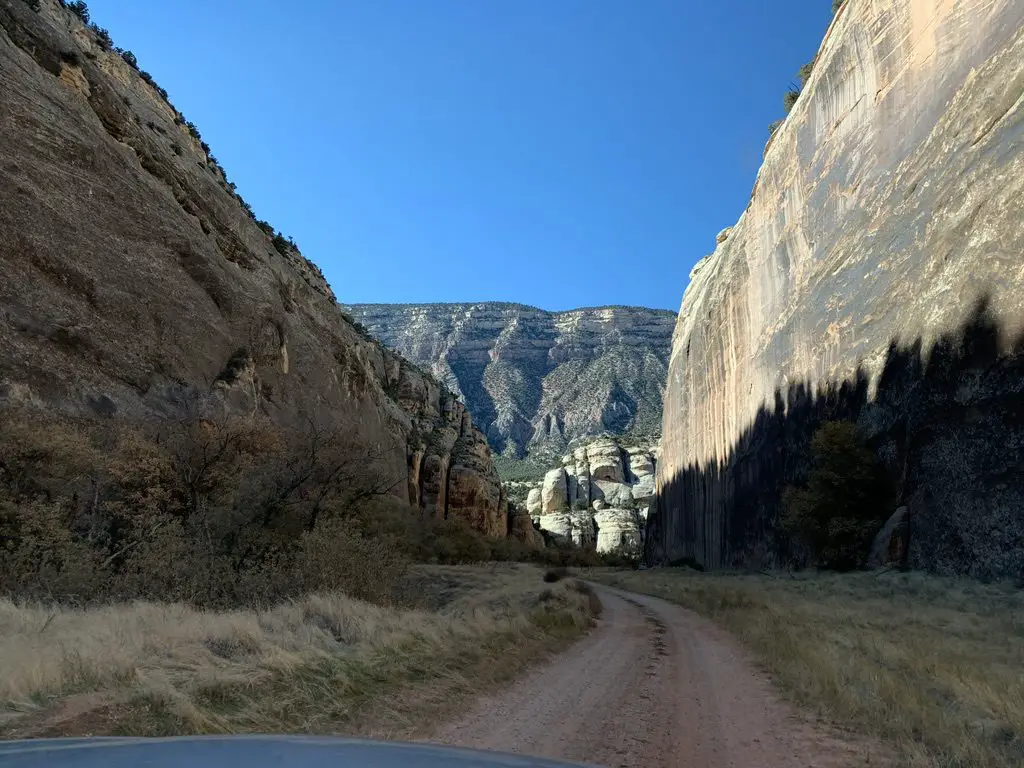
The road winds through an incredible canyon where sheer rock towers over you on both sides.  From here you can see Steamboat Rock from the bottom, where it’s much more impressive.

There is a short hike along the river’s edge that is around two miles long (out-and-back).  It takes you to the confluence of the Yampa and Green Rivers.  There is also a place on this road called Whispering Cave.  It appeared fairly unassuming, at first, as it’s just a vertical slit in the rock wall of the canyon, that you can stand in.  This was until we figured out its secret (and how it got its name).  If people stand at either end of this long slit and whisper REALLY quietly…you can hear each other VERY well (thanks to the unique acoustics of the rock structure).  And it’s far more effective than if you try the same thing outside (we checked! 😉)

Click here for a short video of the drive!

A dirt road snakes through a narrow canyon, rock towers on three sides.
The canyon on Echo Park Road.

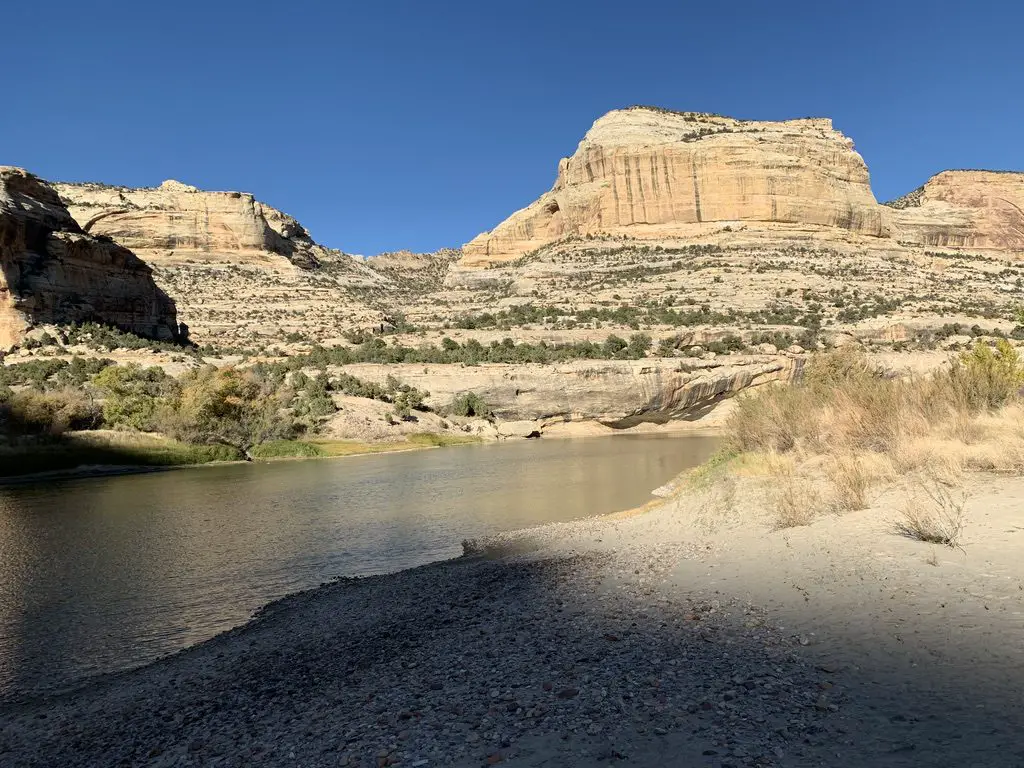
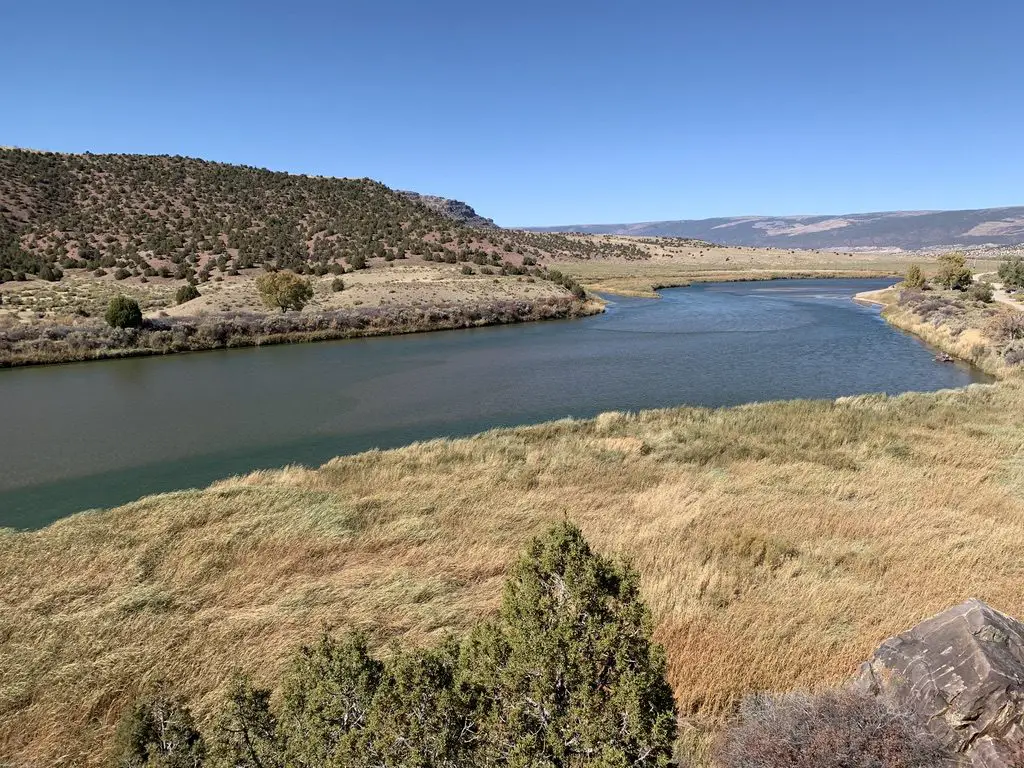
A river with a desert landscape and rock rising in the background

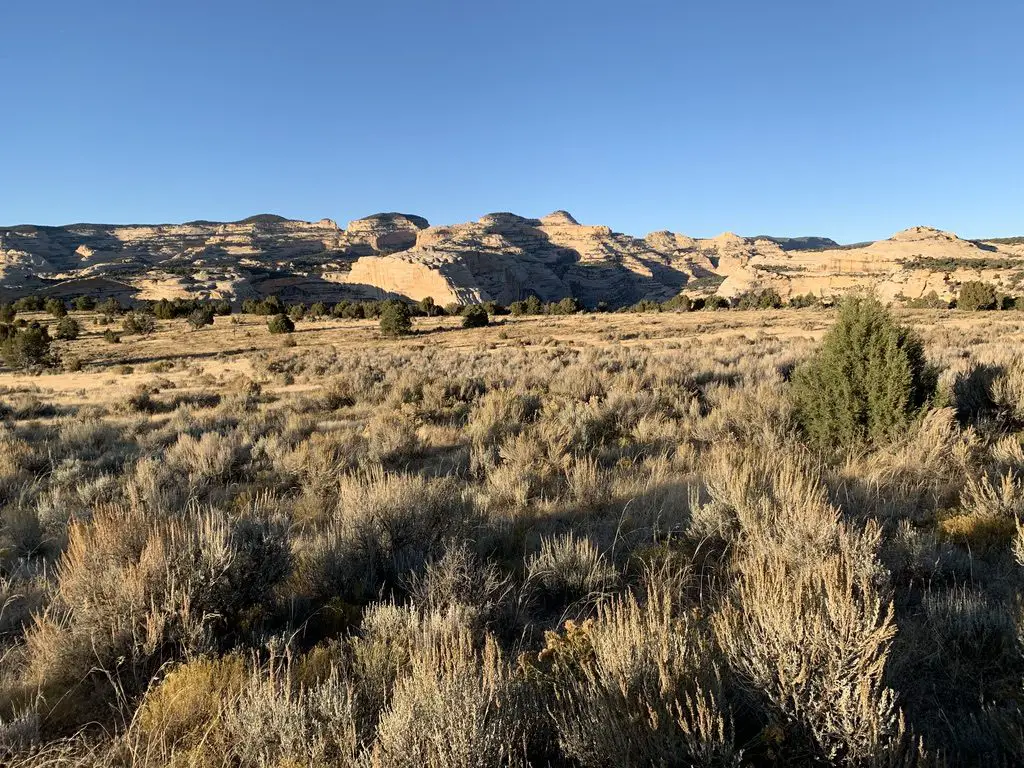
A dry, yellowed meadow in a desert landscape and rock rising in the background
Echo Park!
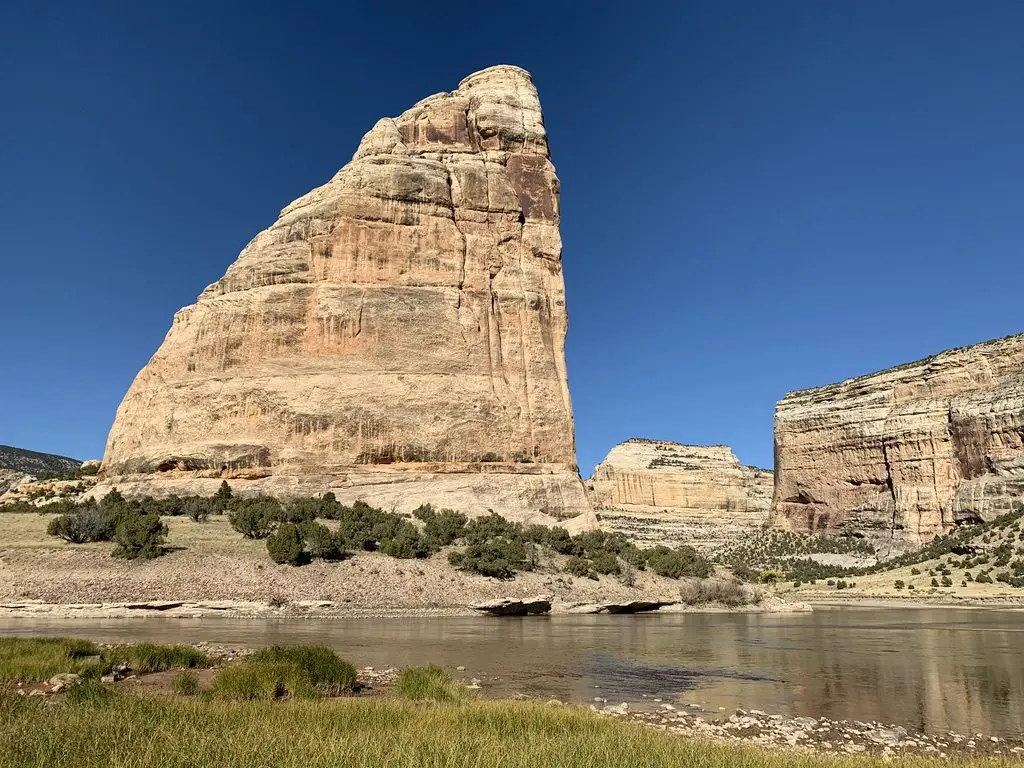
A river with a large rock that resembles a shark's fin rising behind it, all in a desert landscape.
Another view of Steamboat Rock!

Yampa Bench Road

This route takes you from Echo Park Road, east, all the way to US 40 in Elk Springs (though there are a few places you can bug out before you get that far, dependent on road conditions).  This was the most difficult route we encountered.  The drive was beautiful though, with yellow grassland and scrub brush spread before you, all the way to the rock walls that rise above you on two sides.

Even this road wasn’t bad at this time of year, though I could see it being difficult if it was wet.  It was the steepest drive we took and it had the sharpest turns.  This was also the longest route we attempted, by far.  It was fun, but we covered less than half of it (around 20 miles) and that took almost two hours.  This did appear to be the most difficult part of the trek.  According to the map, the rest of it looked flatter and easier (and some parts may have been roughly paved).  We did finally escape, through a blessed hole in the rock wall called Thanksgiving Gorge (I think I know why they give it that name!) just as daylight was waning.  We were rewarded with a herd of elk…and LOTS of cows! 😋

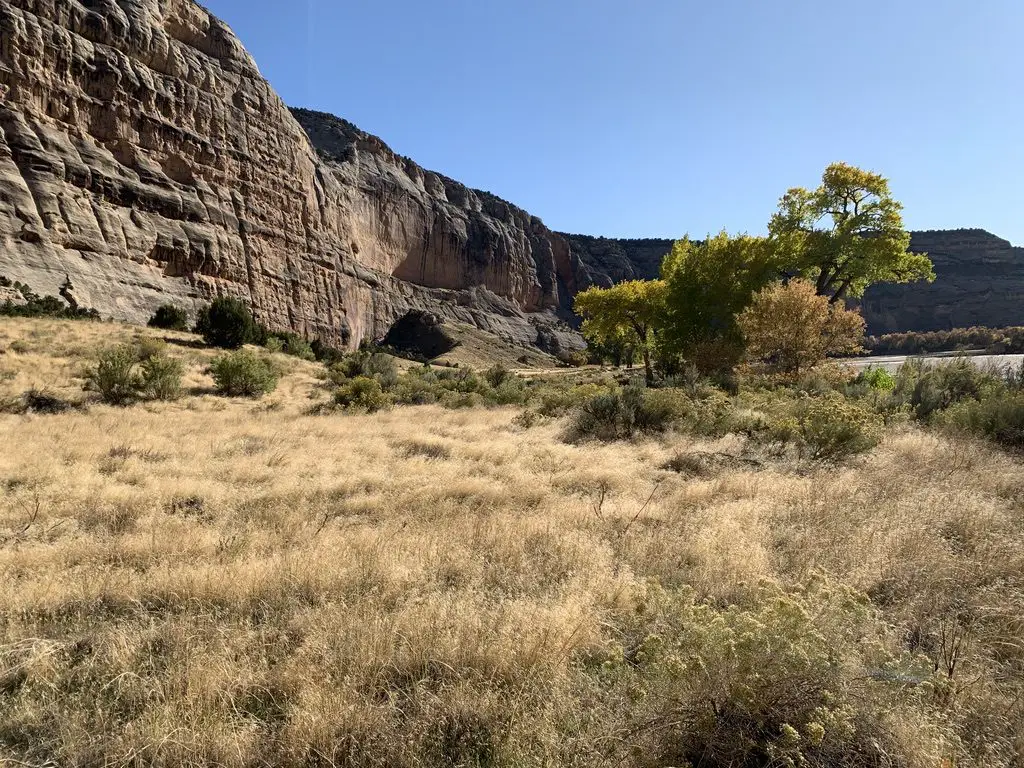
A dry, yellowed grass meadow with rock formations in the background. The sun angle is low and shadows are long.
Sunlight is waning on the Yampa Bench Road

Beautiful Canyons in the Colorado section of Dinosaur National Monument

Flaming Gorge Reservoir

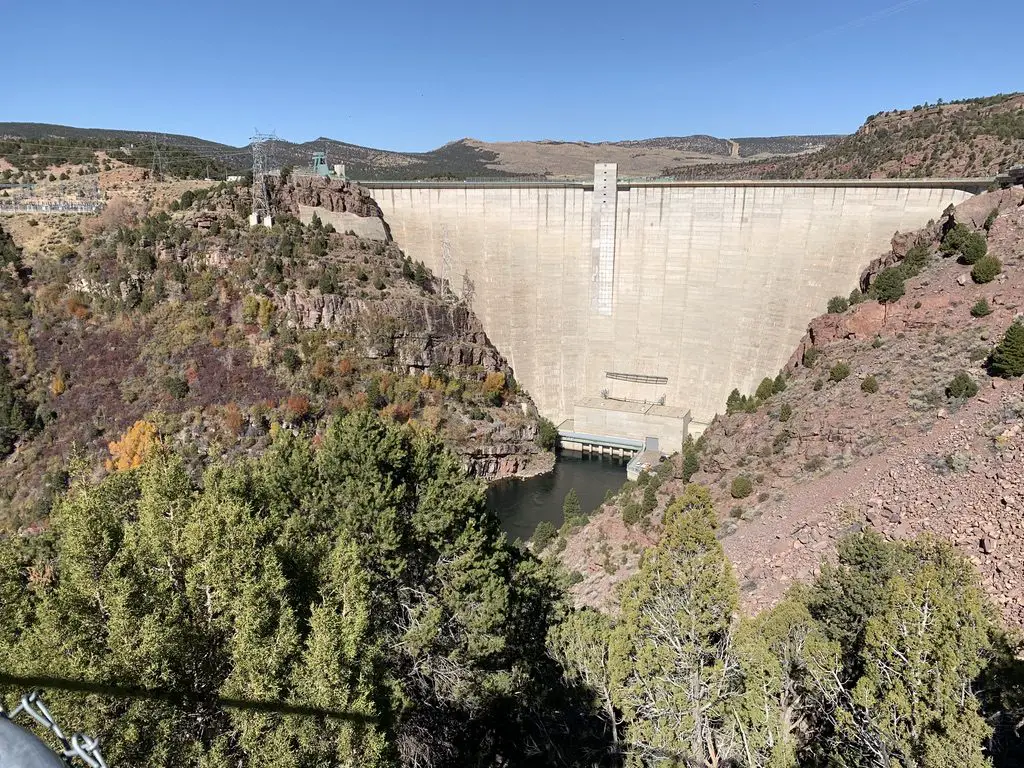
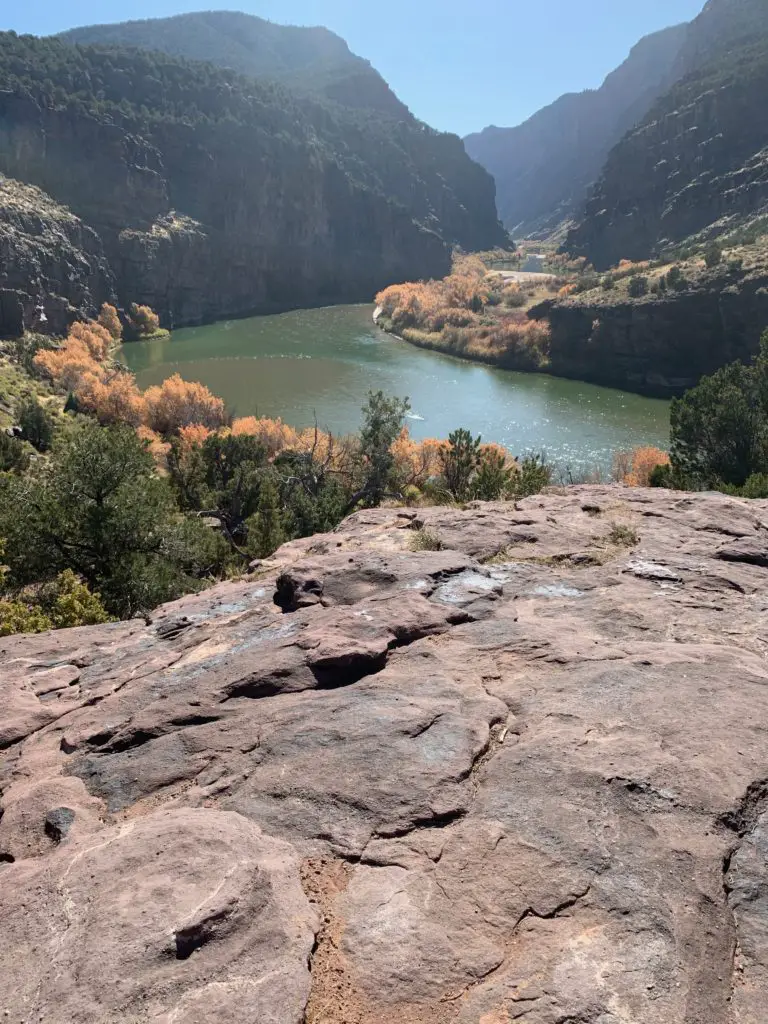
On Sunday we took US 191 north of Vernal, Utah, to the Flaming Gorge Reservoir.  It was named for its vibrant, red cliffs that were cut by the Green River.  The gorge spans both northeastern Utah, and southeastern Wyoming, just to the north.  It is absolutely beautiful, and the dam that created the reservoir is pretty stunning, as well.

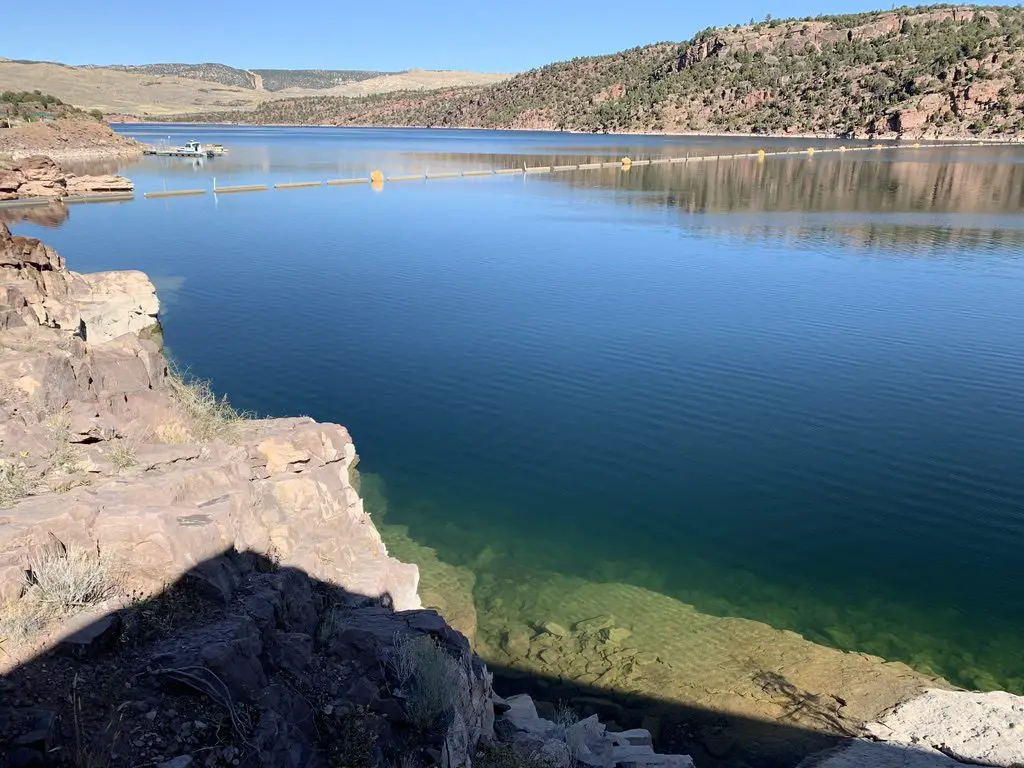
A lake sits between two rocky hillsides in a desert landscape
Flaming Gorge Reservoir
A large, concrete dam in a desert landscape
The Flaming Gorge Dam

Gates of Lodore

From the dam, we then continued north on Route 191, just across the Wyoming line, and picked up Brown’s Park Road.  This we took east, back into Colorado.  From here we followed signs to the Gates of Lodore, another INCREDIBLE canyon that was cut by the Green River.  It sits on the northern tip of the monument.  This route was a mixture of well-graded dirt and rough pavement, though any passenger car should be able to handle it, at least in good weather.

I was pronouncing this location like “Gates of Mordor”, from Lord of the Rings, but was quickly corrected by a local.  Apparently, it’s supposed to sound more like “Gates of la-DOOR”. 😂 

There’s an easy, and fairly short, hiking trail that leads to the mouth of the canyon, from the parking area.  Due to its sheer, rock walls, there is no access through this rocky cleft, except by watercraft on the river itself.

A river winds through a desert canyon. Tree-covered, steep, rocky walls line both sides of the canyon.
Gates of Ladore!

A river snakes through a desert landscape with yellow-grass meadows and scrub brush-covered hillsides

Crouse Canyon/Brown’s Park Scenic Backway

We returned back to Vernal by way of the Crouse Canyon/Brown’s Park Scenic Backway.  This is another route that cuts through a beautiful canyon, and then a meadowy area.

This road was one of the rougher routes we traveled on and was basically only one lane wide.  This was unexpected as it was listed as a scenic drive in one of the local tour brochures, and wasn’t suggested to be high-clearance.  Our truck handled it easily but had we known how rough it would be we would have aired the tires down, just for a smoother ride.  In good conditions, any SUV with a higher wheelbase should be able to handle it (we passed a CRV or two) but I wouldn’t suggest attempting it in a typical passenger car (just because there were some rocks and ruts that had to be navigated).  An Outback probably could have managed it, but we would have been extra cautious. 

The drive was BEAUTIFUL though, with the yellow and orange leaf colors set against the red rock of the canyon walls, which contrasted with the blue of the sky above.  Click here for a short video of it!

We returned home via US 40 east, through Craig, Steamboat Springs, and Rabbit Ears Pass.  This is the one portion of northern Colorado we hadn’t been to yet.

Colorado is one of my favorite places to visit. Click here for more posts on this awesome state!

From there we took Route 14 north to Walden, then headed north to Laramie, Wyoming, and back to the Black Hills.  FYI, this is a great way to avoid the traffic in the Denver area, and much of I-25, if you’re heading north from northern Colorado!  It offers some great views too!

You won’t find a better time to visit this park than Fall.  Tree colors are bright, crowds are light and temperatures are cool.  So the next time you’re looking for a good autumn vacation spot, think of the out-of-the-way Dinosaur National Monument!

Have you visited this incredible place?  Tell me about your favorite parts of it in the comments!


Did you enjoy this post? Pin it!

A narrow river valley in a desert landscape as seen from above. Short trees are in the foreground while a thin, green river can be seen far below. Pin reads, "Dinosaur National Monument: the Colorado Side"


Like what you read here today?  Please feel free to leave a comment, like or share this post!  You can also follow the blog on social media by clicking the links below!
Facebook

Twitter

Instagram

Pinterest